Get in Touch with IDA


Filling Machine Guide: How Every Filling Technology Works and How to Choose the Right One
PackagingLine team Each packaging line has one essential component—the filling machine. Regardless if you are operating a small craft sauce kitchen, or a pharmaceutical cleanroom, the bottle filling machine you select will directly influence your throughput, cleanliness, waste, and compliance. This article sμmmarizes all of the major filling methods, how they operate, and provides you with an easy method to select the optimμm solution for your product.
📐 Quick Specs: Filling Machine Industry at a Glance
| Market Size (2025) | $7.95 billion |
| Growth Rate | CAGR ~5% through 2031 |
| Key Technologies | Gravity, Overflow, Piston, Pump, Auger, Vacuum, Net Weight |
| Accuracy Range | ±0.2% to ±2% depending on technology |
| Automation Levels | Manual, Semi-Automatic, Fully Automatic |
What Is a Filling Machine and How Does It Work?
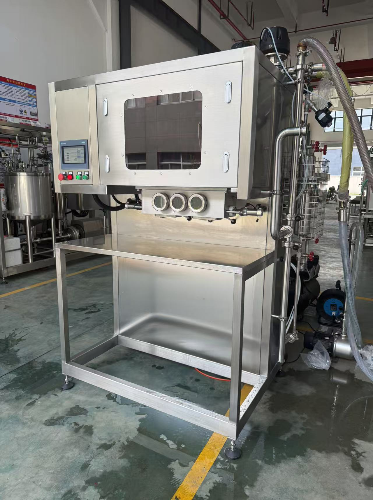
A filling machine is part of a range of industrial machinery used to portion a pre-set amount of a product (liquid, powder, paste or granulation) into an array of packaging or forming devices (bottles, jars, pouches, sachets, tubes etc). These range from the beginning to the end of most manufacturing processes in the pharmaceutical, food, cosmetic and chemical industries. Every bottle filling machine on a production line works alongside other packaging equipment — cappers, labelers, and case packers — to move product from bulk tank to sealed carton.
Revenue for this category of equipment worldwide was $7.95 B in 2025. We expect this to grow at around 5% CAGR through till 2031 on the back of growing demand for packaged foods and tightening fill-accuracy regulations across various industries.
The Core Fill Cycle: Measure → Dispense → Seal
No matter what type of technology we employ, each filling machine operates in a similar filling cycle as described below:
- Mass flow device – A container such as a hopper, tank or reservoir is used to feed the product to the metering device under gravity, pressure or vacuum.
- Metering – The machine dispenses a controlled quantity. The metering system can take several forms- a cylinder can dispense a preset volume, an auger can rotate a specific number of turns or a load cell can weigh the product as it is being fed.
- Dispensing- The measured amount of the product is placed into the container awaiting it. Feed nozzles can be of several types depending on the product being measured- bottom-up fill (for foam, light liquids), free-fall nozzle (granules), diving filling nozzles (viscous pastes).
- Indexing—a rotating or conveyer table advances the filled container and presents it, an empty one, to the conveyer. Automatic equipment is coordinated to do this in unison with downstream capping, labeling, and sealing operations.
The five standard parts of nearly every filling machine are a supply tank/hopper, a metering device (cylinder, auger, pump, or scale), filling nozzles, a conveyor or indexer, and a PLC/HMI control that controls timing, speed, and fill sets.
What Is a Filling Machine Used For?
A filler is a machine for automatically or semi-automatically delivering measured quantities of a product into a container or pack along a production line. In the food sector fillers work with water and juice, dairy and cooking sauces, syrups, creams and honey. Pharmaceutical lines will dose liquids, ointments and syrups to strict cGMP standards.
Cosmetic lines fill creams, lotions, serums, perfumes into bottles and pouches. Chemical lines will dose solvents, adhesives, paints and agrichemicals. Whatever the application there is a filler to do the job of hand-pouring measure and control of the process – that is repeatable, measurable, clean and fast.
Types of Filling Machines: A Complete Technology Breakdown
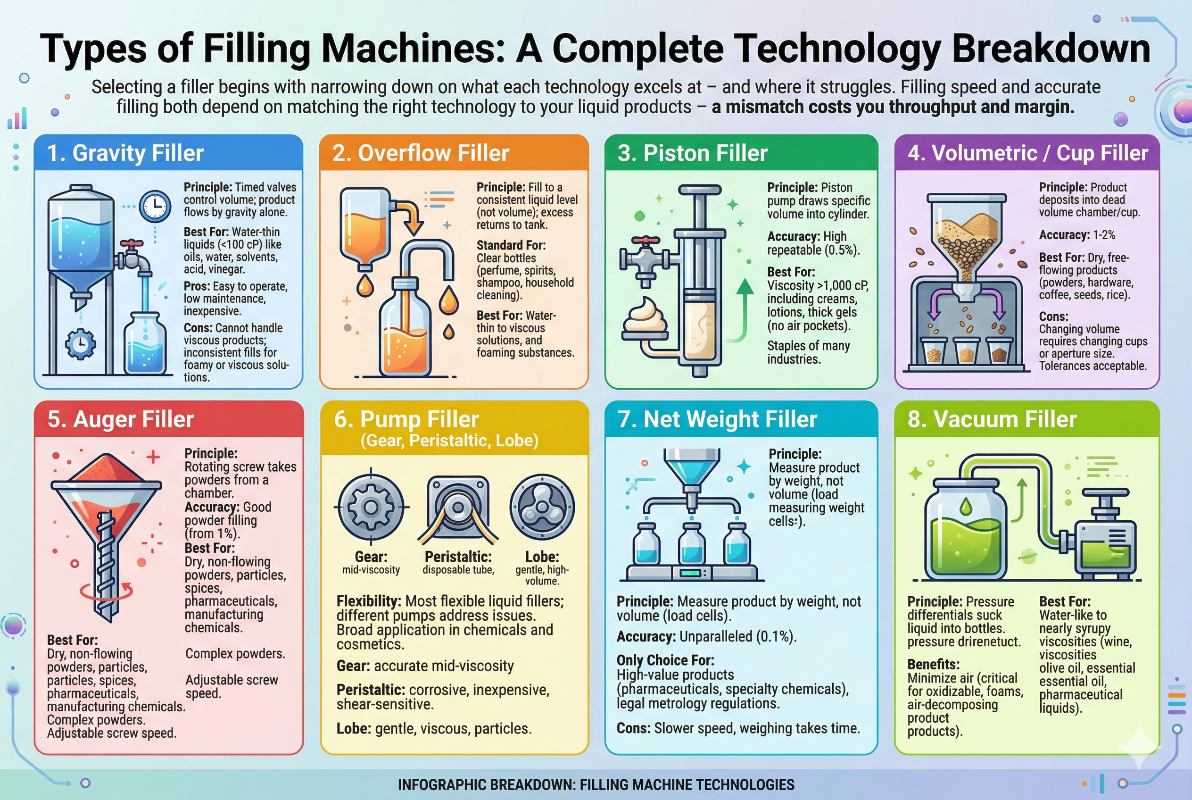
Selecting a filler begins with narrowing down on what each technology excels at – and where it struggles. Here are the eight main filling technologies implemented in today’s production lines, sorted according to their predominant metering technique. Filling speed and accurate filling both depend on matching the right technology to your liquid products — a mismatch costs you throughput and margin.
1. Gravity Fillers
Gravity fillers are the simplest machine type, with product flowing from an elevated tank into containers by gravity alone, with fill volumes determined by timed valve openings. Gravity fillers work best with water-thin, flowing liquids of less than 100 c P: oils, water, solvents, acid, vinegar. Since there are no packings, seals, moving parts or other maintenance issues, these units are easy to operate and inexpensive to maintain. The tradeoffs here are that gravity systems cannot dispense viscous products, and the foamy and more viscous solutions yield inconsistent fills.
2. Overflow Fillers
The overflow filler addresses an issue that gravity fillers cannot: providing a consistent fill level to the consumer. Instead of filling to a specific volume, overflow valves fill each individual container to the same level. Excess liquid is directed back into the supply tank through a return port located in the overflow nozzle. Overflow fillers are standard equipment for clear bottles of perfume, spirits, shampoo and household cleaning products. They can also dispense worth-thin, viscous solutions without difficulty, and foaming substances without much trouble.
3. Piston Fillers
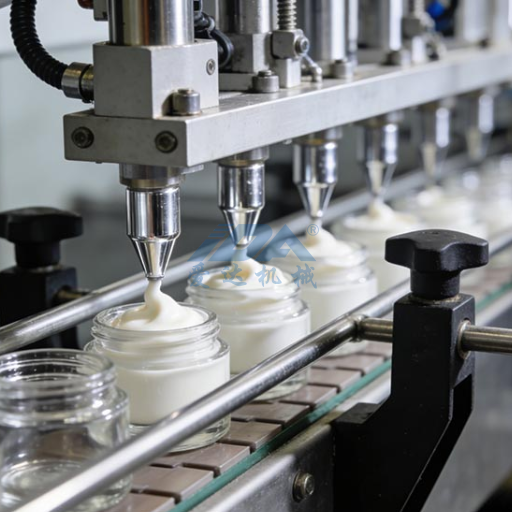
When product viscosity exceeds 1,000 c P, the piston filler provides highly repeatable, accurate filling. The piston pump is retracted, drawing a specific volume of product into a cylinder. The cylinder then pushes the material out the nozzle during the forwards stroke. With accuracy of about 0.5% across viscosity ranges from 1,000c P to much greater viscosity conditions, the piston filler is extremely popular, and a staple of many industries. A cream filling machine built on piston technology handles product filling for lotions, body butters, and thick gels without air pockets.
4. Volumetric / Cup Fillers
Volumetric cup fillers are designed for dry, free flowing products. The product is deposited into a chamber or cup of dead volume; the chamber then opens into the container and the product is released. Powder, small hardware, coffee, seeds, rice and other dry products do well in volumetric filling machines. Setting and changing fill volumes requires a change of the cup or alteration of the aperture size. Accuracy is usually in the range of 1-2%. This is acceptable for, for example, weight-based bags of product – tolerances are wider.
5. Auger Fillers
Auger fillers – with a rotating screw inside a funnel taking powders out of a chamber – provide good powder filling accuracy, from 1%, with very dry, non-flowing powders, particulates, spices, pharmaceuticals, manufacturing chemicals that would jam in a cup filler. The auger or screw speed is adjustable to deliver many different accurate fill weights. This system is ideally suited to complex powders.
6. Pump Fillers (Gear, Peristaltic, Lobe)
Pump fillers are the most flexible of the liquid filler machines. There are several types and variants of pumps, each of which treat particular fill challenges and product issues: gear pumps provide a dependable method for filling medium-viscosity liquids with accuracy; peristaltic pumps accomplish the same with corrosive or inexpensive, shear-sensitive liquids through the use of a disposable tubing; lobe pumps are gentle, high-volume fillers for viscous products, or those with particulates. The pump system has broad applications in chemicals and cosmetics where the product is the limiting factor.
7. Net Weight Fillers
Net weight fillers measure the amount of product by weight, not volume. Accurately measure by weighing each fill (using load cells or strain gauges below each filling head)—an unparalleled accuracy of 0.1 %. That makes them the only choice for high-value products (pharmaceuticals, specialty chemicals) or situations where legal metrology regulations drive machine design for weight-based fills. Drawback? Slower speed: now that every fill must be weighed instead of displaced, and that fill takes longer, nozzles are usually slower than displacement or pump-based systems.
8. Vacuum Fillers
Vacuum filling machines operate by creating pressure differentials to suck a liquid into bottles. First, a vacuum is created within a sealed filling chamber or the bottle itself. Then, atmospheric pressure drives the product into the vessel from the filler supply tank. This technology minimizes the inclusion of air, critical for oxidizable products, foams, or any product that breaks down in contact with air. Vacuum fillers accommodate viscosities from water-like to nearly syrupy. Typical applications include wine, olive oil, essential oil, and pharmaceutical liquids.
What Is a Vacuum Filling Machine and How Does It Work?
A vacuum filling system creates a subatmospheric environment either inside the bottle or in a vented chamber. When the vacuum is activated, the atmospheric pressure differential relative to the atmosphere outside the system pulls the product into the vessel. Once the desired weight or level has been achieved the vacuum is released and the bottle moves onto the next phase of filling. This technology is useful in cosmetics and food industries for sensitive products where the presence of air can cause the product to degrade or lose its intended properties. Some operators classify a vacuum filler as a dispensing machine because the bottle — not a pump — drives the fill action.
Viscosity-Technology Matrix: Master Comparison Table
| Technology | Viscosity Range | Accuracy | Speed (BPH/head) | Best Products | Cost Tier |
|---|---|---|---|---|---|
| Gravity | 1–100 cP | ±1–2% | 600–1,500 | Water, solvents, light oils | $ |
| Overflow | 1–500 cP | ±0.5–1% | 800–2,000 | Perfume, spirits, shampoo | $$ |
| Piston | 1,000–100,000+ cP | ±0.5% | 300–1,200 | Creams, sauces, gels, pastes | $$ |
| Volumetric/Cup | Dry solids | ±1–2% | 400–1,000 | Granules, seeds, rice | $ |
| Auger | Fine powders | ±1% | 200–800 | Flour, spices, pharma powder | $$ |
| Pump | 100–50,000 cP | ±0.5–1% | 400–1,500 | Chemicals, cosmetics, food | $$–$$$ |
| Net Weight | Any (weighs mass) | ±0.1–0.2% | 200–600 | Pharma, high-value chemicals | $$$ |
| Vacuum | 1–10,000 cP | ±0.5–1% | 500–1,200 | Wine, oils, oxidation-sensitive | $$–$$$ |
“The single biggest mistake an operator can make when selecting a filling method is to focus exclusively on speed. viscosity, foaming characteristics, and FDA/USDA/ other regulatory requirements should all be evaluated for the final decision – speed is a result of selecting the proper method.”- Names of industry packaging engineers
Filling Machine Applications Across Industries
Filling machines are used in pharmaceutical cleanrooms, cosmetic research laboratories, food manufacturing plants, and chemical processing facitoies – but each environment places its own demands on the material tolerance, accuracy criteria, recordkeeping systems, and operator safety standards. Here are a few of the different uses of filling equipment in four separate locations.
Food & Beverage
Food meet strict requirements defined by 21 Part CFR 113 of the Food and Drug Administration for thermal processed foods and hazards analysis and the USDA’s sanitary design code for equipment. Strata of different products are filled on counterpressure, overflow and gravity filling systems. Isobaric fillers are used to fill carbonated beverages and selected soft drinks to prevent excessive foaming. Hot fill designs allow entry of liquids at 85-95C but require unique heat resistant seals and care fully designed nozzles, Prior to filling, products are usually delivered in highly dispersed mixes or planetary mixers.
Pharmaceutical & Nutraceutical
Pharmaceuticals are filled according to cGMP (FDA 21 CFR 211-Subpart D – Equipment). Equipment must be “of appropriate design, adequate size, and suitably located to facilitate operations for its intended use and for its cleaning and maintenance”. In sterile liquid filling, equipment is referenced to Class 100 (ISO 5) cleanrooms for accuracy to 0.3% or better. All equipment must be IQ/OQ/PQ validated ahead of use in production. Material requirements are demanding: all wetted parts in 316L stainless steel, PTFE or FKM seals, enclosed drain systems, and Ra 0.8 m interior finishes to inhibit harboring microbes. An overwhelming proportion of liquid filling in the pharma sector is net weight fillers due to their documented traceable accuracy.
Cosmetics & Personal Care
The cosmetics space divides wide viscosity segments: 5 c P perfumes to 50,000 c P viscous liquid body butters. Displacement Fillers are used on the heavier (creams, masks, serums, hair treatments), while peristaltic fillers are utilized on shear-sensitive liquids like suspensive actives incorporated into serum formulations. Cosmetic fillers need to reliably work with a number of container types: palates, tubes, airless pump bottles, droppers, etc. different nozzles are used between each type. Color/ fragrance changes are common and therefore, CIP capability is important. Upstream preparation is usually related to three roll milling to disperse raw pigments.
Chemical & Industrial
The chemical space has a different set of concerns that make it completely unique compared to foods or cosmetics: acid, solvent, and base ingredients are corrosive; flammables pose explosion risks; intermediates exhibit toxic qualities. Corrosives are often handled in peristaltic fillers where product contact never touches pump mechanics (replace disposable tubing between each fill). FTFE and FKM sills allow no contact to be present in the pump system. Explosive atmospheres (ATEX 2014/34/EU approved equipment) mandate explosion-proof motors, intrinsically safe sensors, anti-static grounded hoses, components, and cabins. Fill sizes range from 50mL blood tubes for laboratories to 200L drums and IBCs on which accuracy should be attained through weight-based filling to fulfill regulatory and safety concerns.
| Industry | Primary Standard | Typical Technology | Accuracy Req. | Special Considerations |
|---|---|---|---|---|
| Food & Beverage | FDA 21 CFR 113 | Gravity, Overflow, Piston | ±1% | Hot fill, CIP, allergen control |
| Pharmaceutical | FDA 21 CFR 211 | Net Weight, Piston, Peristaltic | ±0.3% | Cleanroom, IQ/OQ/PQ, 316L SS |
| Cosmetics | ISO 22716 (GMP) | Piston, Peristaltic, Overflow | ±0.5–1% | Wide viscosity range, frequent changeover |
| Chemical | ATEX 2014/34/EU | Pump, Net Weight | ±0.5% | Explosion-proof, corrosion-resistant |
How to Choose the Right Filling Machine: Selection Framework & Performance Benchmarks
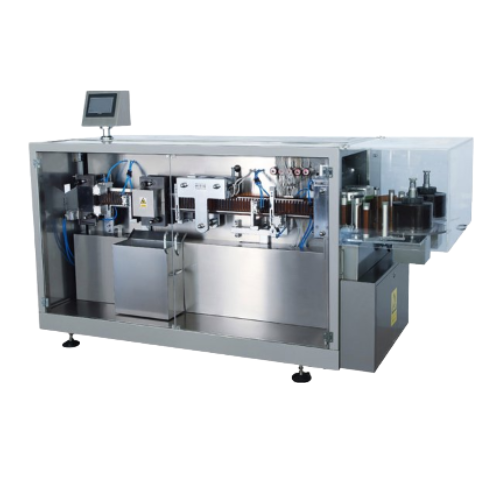
Selecting a filler becomes complicated with eight filling types and dozens of configurations within each. The following five-factor methodology balances out the most popular pitfalls of product vs. technology cross-over.
The 5-Factor Filling Machine Selection Method
Factor 1: Define Your Product Characteristics
First, start with your product, not the filling technology. Prior to approaching a supplier document five characteristics of the material: viscosity (Centipoise, measured at the typical filling temperature), particulate profile (size and solidity percentage), propensity to generate foam, typical filling temperature, and formula reactivity (corrosivity pH). A lotion with 25,000 c P at room temperature may mix down to 8,000 c P and require a different filling technology when heated to 45. C
Common Mistake: Over-looking the value of product testing, prior to purchase, cannot be overstated. For instance, a product checked at lower temperatures and placed in production at elevated temperatures will show significantly different technical behavior. It doesn’t matter how you like your product, always test under the thermal conditions it will be filled.
Factor 2: Match Technology to Product
Match your product details to the Viscosity-Technology matrix located above. If you are working with a low viscosity, non-foaming, non-particulated product below 100 c P, gravity or overflow fillers can be used for all formats. If, on the other hand, your product is swelled to more than 1,000 c P or contains particulates, a displacement filling system should provide your baseline.
Tip: Start with gravity or overflow fillers for thin liquids in small-volume packages. Upgrade to displacement or pump technology as product and package size grows. This staged approach allows you to confirm you have a proven process before investing in expensive filling machinery.
Factor 3: Determine Automation Level
Automate based on your volume. The table below correlates ranges of production volume (number of bottles in a day) with levels of automation:
| Feature | Manual | Semi-Automatic | Automatic | High-Speed |
|---|---|---|---|---|
| Bottles/Hour | 50–200 | 200–1,000 | 1,000–6,000 | 6,000–20,000+ |
| Operators | 1–2 | 1 | 0–1 | 0–1 |
| Investment | $1K–$5K | $3K–$15K | $15K–$80K | $80K+ |
| ROI Timeline | Immediate | 6–12 months | 12–24 months | 18–36 months |
Factor 4: Calculate Required Throughput
Take a simple calculation: target daily volume operating hours per shift number of shifts = bottles per hour (BPH) requirement. From here, calculate how many nozzles are necessary: BPH requirement single-nozzle rate of capacity of your technical solution = the minimum amount of nozzles. Factor in a 15-20 % margin for changeovers, product restarts, and cleaning.
Factor 5: Budget Framework and ROI
The purchase price of a filling machine is often only 40-60% of the overall ownership expenses. Make provisions for installation, validation (very important in the pharmaceutical industry), spare parts, annual maintenance, and consumables (seals, tubing, spare nozzles). For a medium level solution expect 20-30% additional investment beyond the purchase price during first year and use a filling machine ROI calculator to estimate your own figures.
Performance Benchmarks
Once a filling system is operating, please use the following benchmarks to establish whether your filling system’s filling speed meets expectations. Accurate filling at high speed requires weekly nozzle checks, stable supply pressure, and consistent product temperature across the batch.
- OEE 65% is the accepted rate for a newly-created production line. 85% would be regarded as a global benchmark. Lower than 60% would imply that no improvements can be obtained from analyzing the efficiency of production.
- Changeover time: fast changeover from one product to another is a key advantage of modern plugging and filling machines (for example tool-less interface with recipe-driven PLC regimes – move from one product to the next in less than 15min).
- Fill accuracy by technology: Gravity 1-2%, overflow 0.5-1%, piston 0.5%, net weight 0.1-0.2%. If your filling accuracy is well above these figures it is time to replace wear seals, fix air leaks, and check the product temperature if necessary.
Engineering note: To check filling accuracy, review OIML R87 (Quantity of Prepackages). This standard details the procedures for sampling filled packages and acceptable errors – valuable for export compliance and audits.
What Is the Difference Between Semi-Automatic and Automatic Filling Machines?
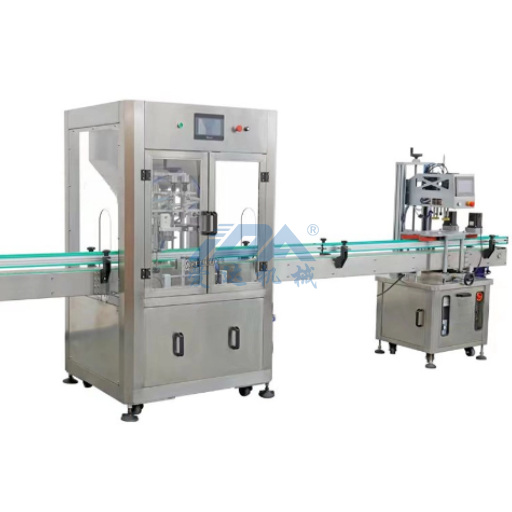
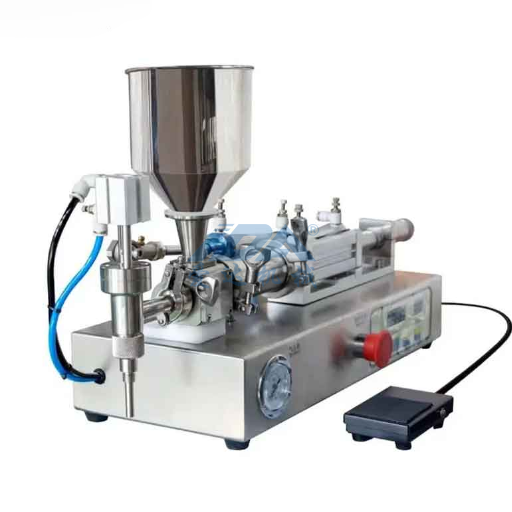
Semi-automatic filling machines involve an operator who presents the containers to the nozzles and activates the next filling cycle (via a pedal switch or button on the control panel). The machine fills accordingly. An automatic filler for production employs a conveyor, sensors, and programmable logic controllers (PLC) to feed, discharge, and fill containers automatically. Foot-pedal activation fillers are suitable for lower to medium throughput (200-1,000 BPH) where there is frequent product changeover. Fully-automated manufacture requires significant constant volume throughput where speed translates to cost savings.
✔ Real-World Scenario: Scaling from Manual to Automated
$2,500,, a craft sauce manufacturer, first used a manual 1-head bottle filler running 80 bottles per hour with 2 staff members. When business increased after one year their next investment was a 4-nozzle semi-automatic filler capable of 600 bottles per hour operated by just 1 staff member. The changeover time moved from 45 to 12 minutes. The economics of this investment yielded a return on investment in just over half a year and saved the 2 workers.
Regulatory Compliance and Industry Standards for Filling Machines
Filling machinery and packaging machinery must be compatible with applicable regulations too. In terms of design, materials, and documentation even the most ‘general’ guide lines are as follows:
FDA 21 CFR 211 — Pharmaceutical GMP
Equipment 21 CFR 211 Subpart D sets out requirements for pharma manufacturing equipment in the US. For general pieces of pharma processing equipment 211.63 states “…that is of appropriate design, adequate size and suitably located to facilitate operations for its intended use and for its cleaning and maintenance.” Filling machines are classified as general production equipment hence meeting this requirement is the following documented qualifications prior to a batch production: DQ, IQ, OQ, PQ. All surfaces contacting product must be either 316L stainless with an electropolished finish (Ra 0.8 m).
EU GMP Annex 1 (2023 Revision)
Updates to Annex 1 2023 have clarified many of the previous guidance points in the manufacture of sterile medicinal products. Amongst the many updates to Annex 1, there are some specific changes to environmental monitoring program, barrier technology expectancies for isolator and RABS products and contamination control strategy (CCS) records for sterile filling lines. Existing EU filling equipment for sterile products must be evaluated to meet current Annex 1 guidance.
CE Marking and the Directive 2006/42/EC
All filling equipment used within the EU zone must be CE marked to comply with the directive. This has its own documented risk assessment, must conform to essential health and safety requirements and requires a technical file maintained by the vendor. Larger automated production lines will also have the scope of integration safety covered by the directive, documented between suppliers of each component package (conveyor, robot system, filling equipment), such that “safe deliverability” is demonstrated.
ATEX 2014/34/EU — Explosive Atmospheres
Equipment handling flammable liquids, combustible powders or chemicals with dangerous emissions in potentially explosive atmospheres meet ATEX specificasion. This includes explosion-proof motor enclosures, exotic safety sensors, anti-static belt materials and earthing/bonding for all mu-metal components. Classification of the zone (Zone 1, Zone 2, Zone 21, Zone 22) determines the required equipment protection level.
OIML R87 — Quantity of Prepackages
Where companies need to sell enclosed products by declared net quantity, OIML R87 defines maximum permitted errors based on units and tables for the several levels of sampling by authorities in market surveillance checks. It also establishes the conditions of maximum error acceptance and the maximum allowed errors. Such verification could lead to the product holds at customs, retail recalls and penalties to the mandator. For filling machines with built-in check-weighers the avoidance of one-off errors according to OIML R87 shows the best results to measure maximum error.
| Standard | Scope | Key Requirements | Industries |
|---|---|---|---|
| FDA 21 CFR 211 | Pharma GMP (US) | IQ/OQ/PQ, 316L SS, Ra ≤0.8 μm | Pharmaceutical, Nutraceutical |
| EU GMP Annex 1 | Sterile manufacturing (EU) | RABS/isolator, CCS documentation | Pharmaceutical (sterile) |
| CE 2006/42/EC | Machinery safety (EEA) | Risk assessment, technical file | All (if sold in EU) |
| ATEX 2014/34/EU | Explosive atmospheres | Ex-proof motors, IS sensors, earthing | Chemical, Solvent-based |
| OIML R87 | Net content metrology | Sampling plans, MPE limits | All (packaged goods) |
“Equipment shall be of appropriate design, adequate size and suitably located to facilitate operations for its intended use and for its cleaning and maintenance.”- adapted from 21 CFR 211.63.
Filling Machine FAQ
Is it “filler machine” or “filling machine”?
View Answer
“Filling machine” is the typical technical specs and industry publication terminology. “Filler” is an effective short name (as “gravity filler”).
How much does a filling machine cost?
View Answer
Manual entry level fillers include the $1,000-$5,000. Modular two, three or four-nozzle cost the range from $3,000-$15,000. Fully automatic inline equipment varies from $15,000 to $80,000 according to the number of nozzles and nozzle technology. Large scaleproduction high speed rotary units may costs of the range of $80,000. Medical grade equipment costing significant premiums over equivalent food grade equipment for validation paperwork.
Can one filling machine handle multiple container sizes?
View Answer
Yes. The majority of current bottle filling equipment accept vial and bottle diameters and heights travelling over variable guide rails, changeable nozzle heights and storing more than one filling recipe in the PLC. Quick-change tooling for container change over 10-15 minutes (no mechanical adjustment needed) is available in the higher range of models.
Can a volumetric filling machine work with both liquids and pastes?
View Answer
To introduce liquids and pastes (high viscosity) requires a piston-type filler that has adjustable stroke length, and optionally, doeszing nozzle diameters. A cup filling system is confined to dry products (granules and powders). For versatility between liquids and pastes, use cylinder-and-stroke or a positive displacement pump.
What is the typical ROI timeline for filling machine automation?
View Answer
For pedal-activated improvements versus manual filling, top efficiency operators realize break-even in 6-12 months on average, through labor efficiencies plus less product waste. Fully automatic lines 12-24 months, and high-speeds for high-volume production 18-36 months. Use a filling machine ROI calculator to input your own rates to model production specs.
How often should filling machines be calibrated?
View Answer
The frequency of calibration depends on your industry and regional requirements. For pharmaceutical lines, it needs to be verified on a batch-by-batch basis in accordance with cGMP which is normally practice every day or shift-to-shift. Whereas for food and cosmetic systems should be checked at least quarterly through weekly spot-checks using calibrated test weights or graduated cylinders.
Always check your calibrated metering system following any repairs or parts replacement (seal, nozzle, or pump rebuild) prior to restarting production. Maintain written calibration records for audit purposes as auditors will seek to find documented evidence of control.
Find the Right Filling Machine for Your Production Line
Our production lines consist of IDA Equipment’s displacement, pump and automatic filling machines serving the food, cosmetic, pharmaceutical and chemical sectors. We produce the right set-up for your product, type and throughput. Please give details of your product and desired throughput.
About This Technology Guide
Provides information on different filling machine technologies, viscosity testing and selection methods, as well as the regulatory frameworks for determination of production line fills. Technical information based on published industry standards (FDA, EU GMP, OIML, ATEX) and manufacturers specifications. Reviewed by IDA Equipment engineering team.
References & Sources
- Mordor Intelligence — Filling Machines Market Report
- Fortune Business Insights — Liquid Filling Machines Market
- Grand View Research — Packaging Machinery Market
- FDA 21 CFR Part 211 — Current Good Manufacturing Practice
- EU GMP Annex 1 (2023) — Manufacture of Sterile Medicinal Products
- OIML R87 — Quantity of Prepackages
- EU Machinery Directive 2006/42/EC
- ATEX Directive 2014/34/EU