Get in Touch with IDA
Silicone Sealant Production Line: A Process-to-RFQ Guide

Contents
show
A silicone sealant production line isn’t a mixer followed by a filling machine. It’s a controlled chain that turns a precise formulation and its approved formula ingredients into completed, released, sealed packs, and its effective production capacity is determined by the slowest verified function in that chain.
This guide shows equipment buyers how to define the process boundary, identify what the process requires for equipment cleaning, choose an architecture, size the line, prove it with representative trials, and write acceptance terms that suppliers can actually test.
The manufacturing production process may include automatic handling, but automation only adds value when the manufacturer has already defined the underlying duty and acceptance evidence.
Define the Line Boundary Before You Compare Machines
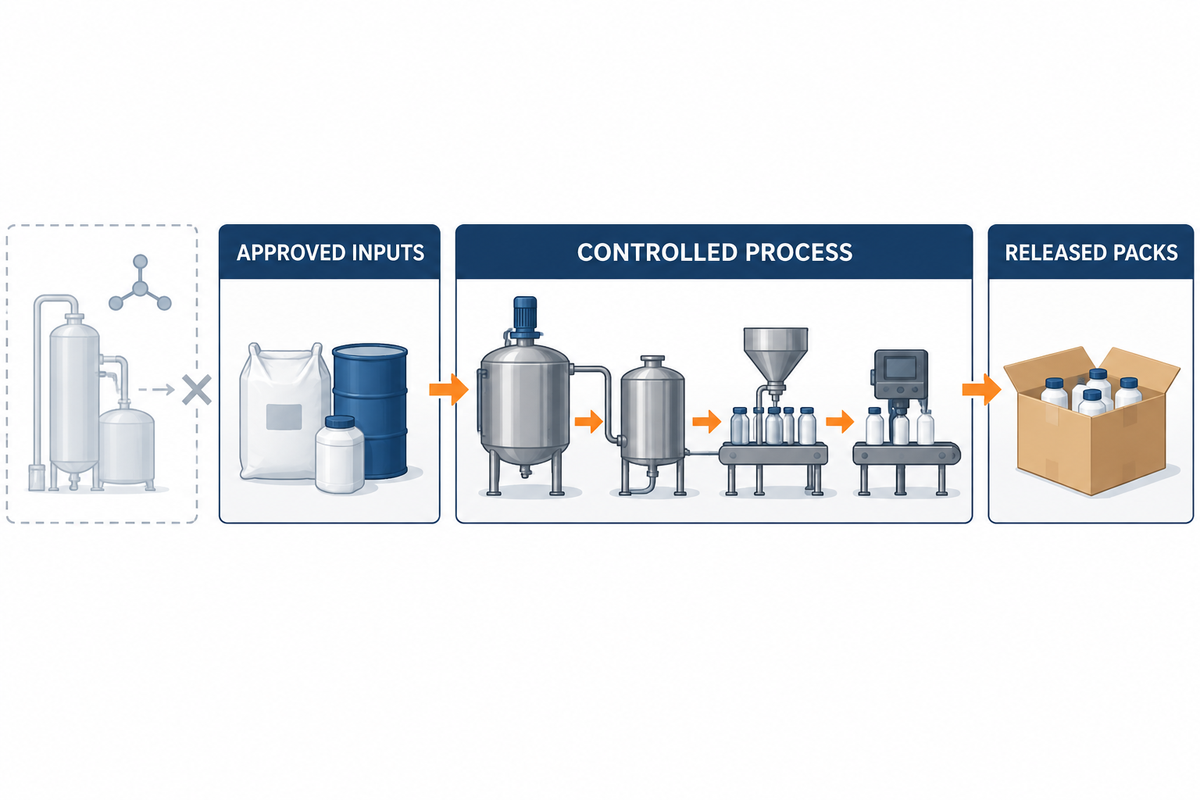
A typical purchased line begins with received, specification-approved polymers, fillers, plasticizers, crosslinkers and other crosslinking ingredients, catalysts, pigments, and other additives. It ends with qualified and released materials in sealed, coded cartridges, sausages, pails or drums.
Manufacture of silicon metal, chlorosilanes, siloxanes, base polymers, and silica falls within a separate chemical-production scope from the silicone sealant production process unless backward integration for production line turnkey projects beyond the silicone sealant production line equipment is explicitly stated. Merging these scopes in a single request for quotation makes equipment comparisons meaningless.
Where should a silicone sealant line begin and end?
| Boundary item | Typical owner | Required interface | Proof to request |
|---|---|---|---|
| Approved raw materials | Formulator and quality team | Identity, storage, and release status | Material specification and lot record |
| Charging and dosing | Line supplier | Ingredient range and addition method | Recorded trial additions |
| Mixing and dispersion | Line supplier with formulator | Rheology and endpoint | Representative-material test |
| Atmosphere and vacuum | Shared | Product envelope and equipment capability | Leak, hold, and batch records |
| Discharge and transfer | Line supplier | Pressure, closure, and residual heel | Mass balance and discharge time |
| Filling and sealing | Packaging supplier | Pack mix and material condition | Reject and seal-integrity record |
| Product release | Buyer quality team | Sampling and test method | Signed release result |
| Upstream polymer synthesis | Excluded unless contracted | Separate reaction-plant basis | Explicit scope exclusion |
Key takeaway: Freeze the start, finish, owners, interfaces, and exclusions, before considering machine models. NIST’s production-systems requirements framework likewise starts by defining manufacturing-system context, scope, and information requirements.
Choose the Architecture by Product Family
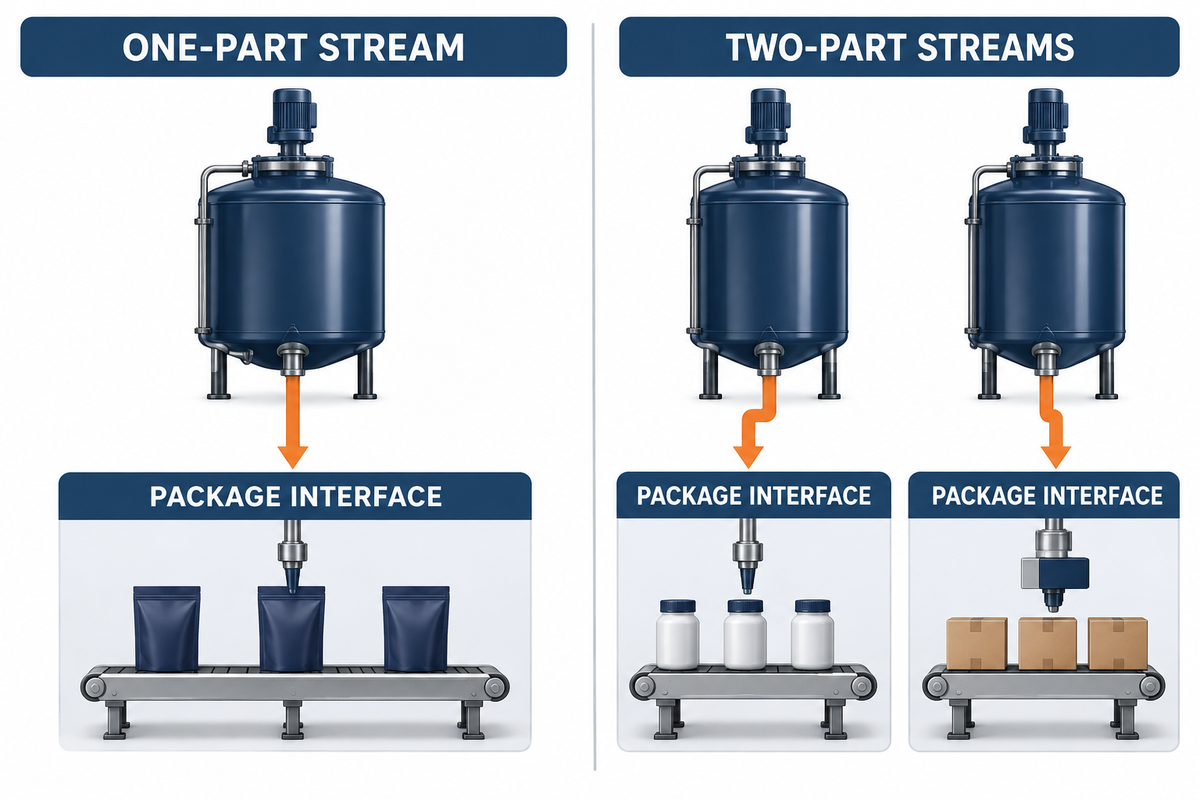
Product family changes the process duty. A one-part moisture-curing product is made and packed as one protected stream, while a two-part system keeps components separate until use and may need separate trains, release records, and ratio-control or paired-packaging provisions.
How do one-part and two-part systems change line architecture?
| Decision | One-part line | Two-part line | Buyer must confirm |
|---|---|---|---|
| Material streams | One finished stream | Separate component streams | Formulation ownership |
| Contamination control | Protect cure-sensitive material | Prevent cross-contact between components | Cleaning and segregation method |
| Release records | Finished batch record | Component and pairing records | Traceability depth |
| Packaging | Moisture-tight single pack | Separate or paired packs | Actual commercial formats |
| Ratio control | Normally outside end-use mixing | May be critical at dispensing | Where ratio control belongs |
| Trial plan | Worst-condition finished product | Each component and paired use | Acceptance tests |
Neutral, acetoxy, structural, general-purpose, and single-component labels do not by themselves determine materials of construction, temperature, vacuum level, nitrogen use, or safety classification; vacuum mixing and high-temperature service are separate process conditions. Actual formulation and safety data sheets are required for those determinations.
Key takeaway: split the concept by materially different product families before combining into a shared line.
Map Each Process Duty to the Right Equipment
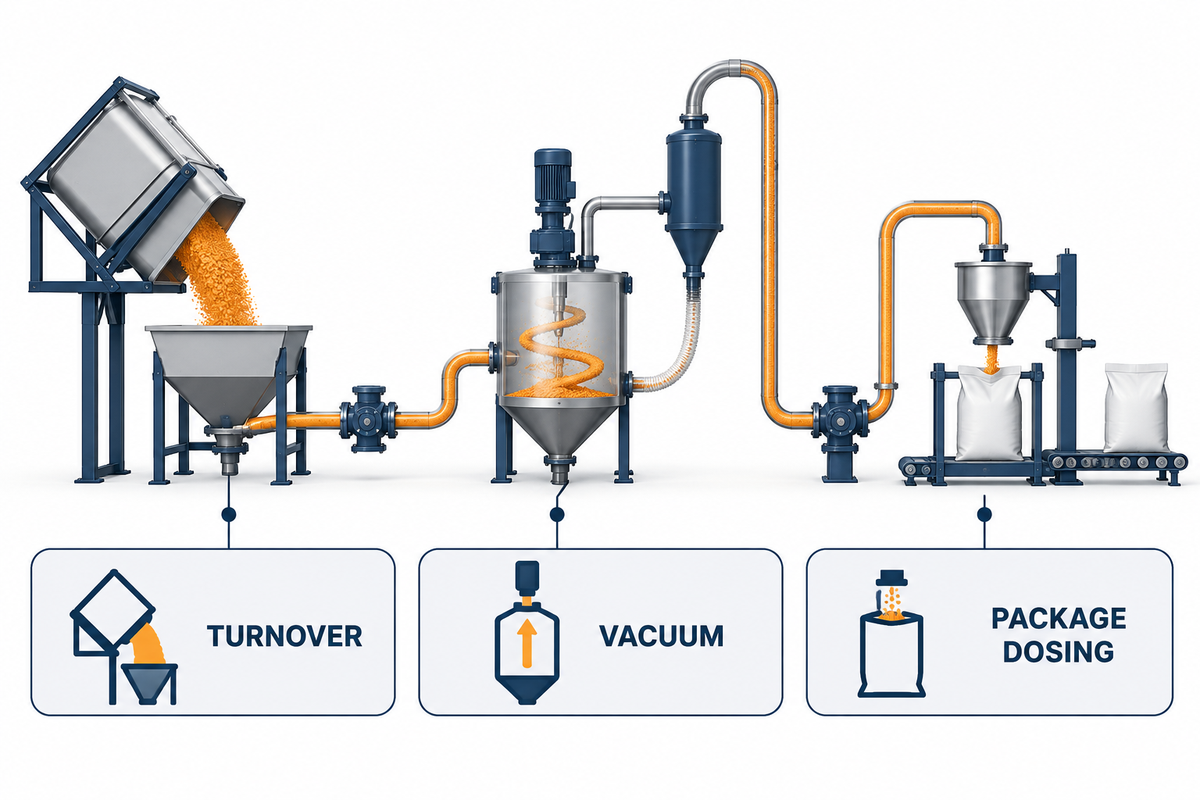
Start with duties, not equipment names: receive, dose, wet out, turn over the full vessel, disperse, manage heat and atmosphere, discharge, transfer, fill, seal, code, and release; then compare the required turnover with a double planetary mixer and other suitable architectures. High-viscosity silicone mixing can add heat and incorporate air, so the selected architecture must be tested as a complete operating method; the high-viscosity mixer selection guide explains the adjacent equipment-selection questions.
Which duties belong to planetary, multi-shaft, kneader, milling, vacuum, and hydraulic-discharge equipment?
| Duty | Candidate equipment | Evidence that decides |
|---|---|---|
| Powder incorporation | Planetary, multi-shaft, or kneader | Dust control, wet-out time, unmixed zones |
| Whole-vessel turnover | Planetary or kneader arrangement | Representative batch uniformity |
| High-shear dispersion | Disperser or other defined high-shear stage | Product endpoint and heat history |
| Fine milling | Conditional three-roll mill | Endpoint missed by upstream mixing |
| Air removal | Vacuum-capable vessel and system | Leak, hold, density, and appearance results |
| Non-flowing discharge | Hydraulic platen or suitable pump | Discharge time, heel, pressure, temperature |
| Protected transfer | Closed piping and controlled connections | Exposure and contamination record |
| Package dosing | Format-specific filler | Weight, seal, reject, and changeover results |
A three-roll mill isn’t automatically required. Equipment designed for high-viscosity service must also demonstrate how air bubbles are controlled or removed under representative material conditions. Define the dispersion or quality endpoint first, then prove whether the selected mixer meets it without adding a transfer, guarding, cleaning, and contamination burden.
Key takeaway: every proposed machine needs a defined duty, measured input, and measured output, and an acceptance record.
Control Moisture, Air, Heat, and Contamination
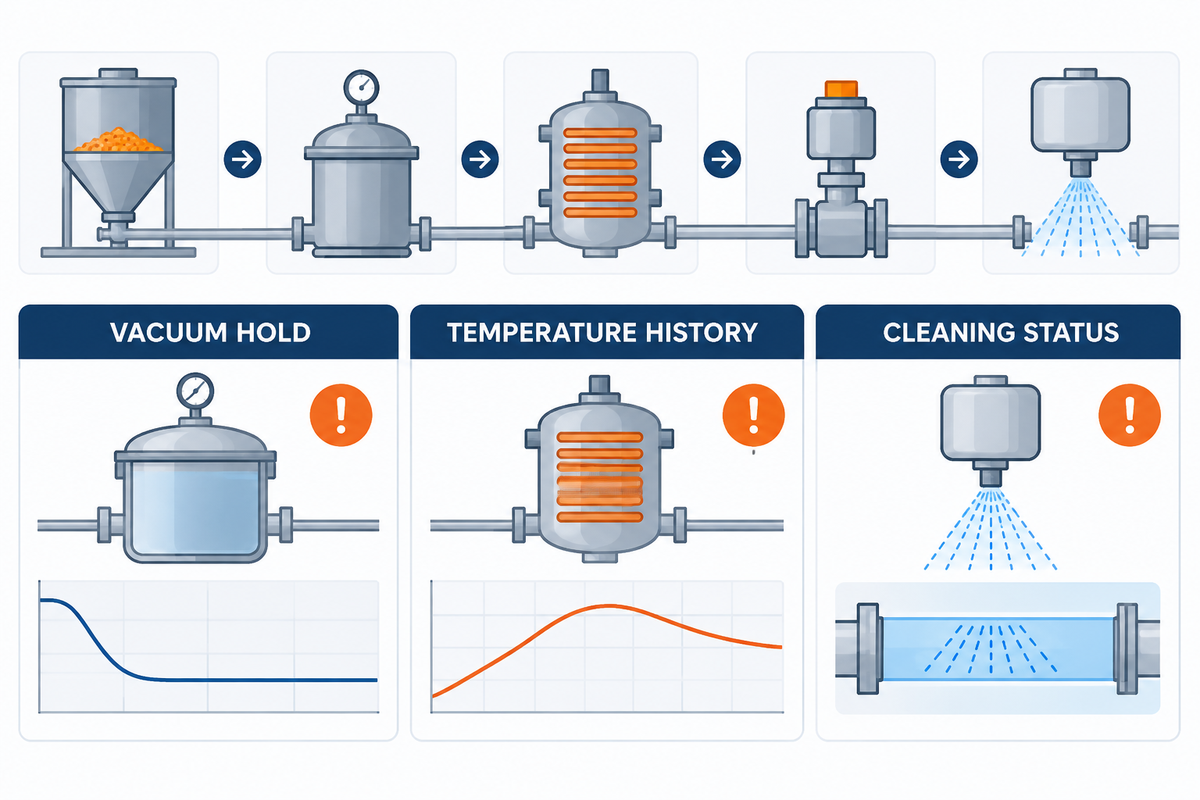
The formulation owner defines the process envelope. The equipment supplier needs to show how the line measures and controls it, including the vacuum and multi-shaft duties described in IDA’s vacuum triple-shaft mixer guide where those duties apply. Avoid universal vacuum, temperature, mixing time or atmosphere set points, as public sources can’t demonstrate them for the buyer’s recipe.
| Control point | Failure signal | Evidence | Response |
|---|---|---|---|
| Raw-material condition | Out-of-spec identity or exposure | Lot and release record | Hold before charging |
| Addition sequence | Temperature or torque deviation | Time-stamped batch trend | Stop and assess the batch |
| Vacuum system | Slow pull-down or failed hold | Leak and hold result | Check seals, piping, pump, and loading |
| Temperature history | Unplanned peak or slow recovery | Product and jacket trends | Review shear and heat-transfer duty |
| Transfer closure | Exposure, bubble, or contamination event | Connection and transfer record | Quarantine affected material |
| Cleaning status | Residue or wrong-product risk | Inspection and release signoff | Repeat validated cleaning |
Key takeaway: specify sensors, sampling points, records, alarms, and deviation actions—not just machine features. For the machinery-safety boundary, OSHA 29 CFR 1910.212 identifies points of operation, nip points, and rotating parts as guarding hazards in U.S. workplaces.
Let Package Format Set the Downstream Pace
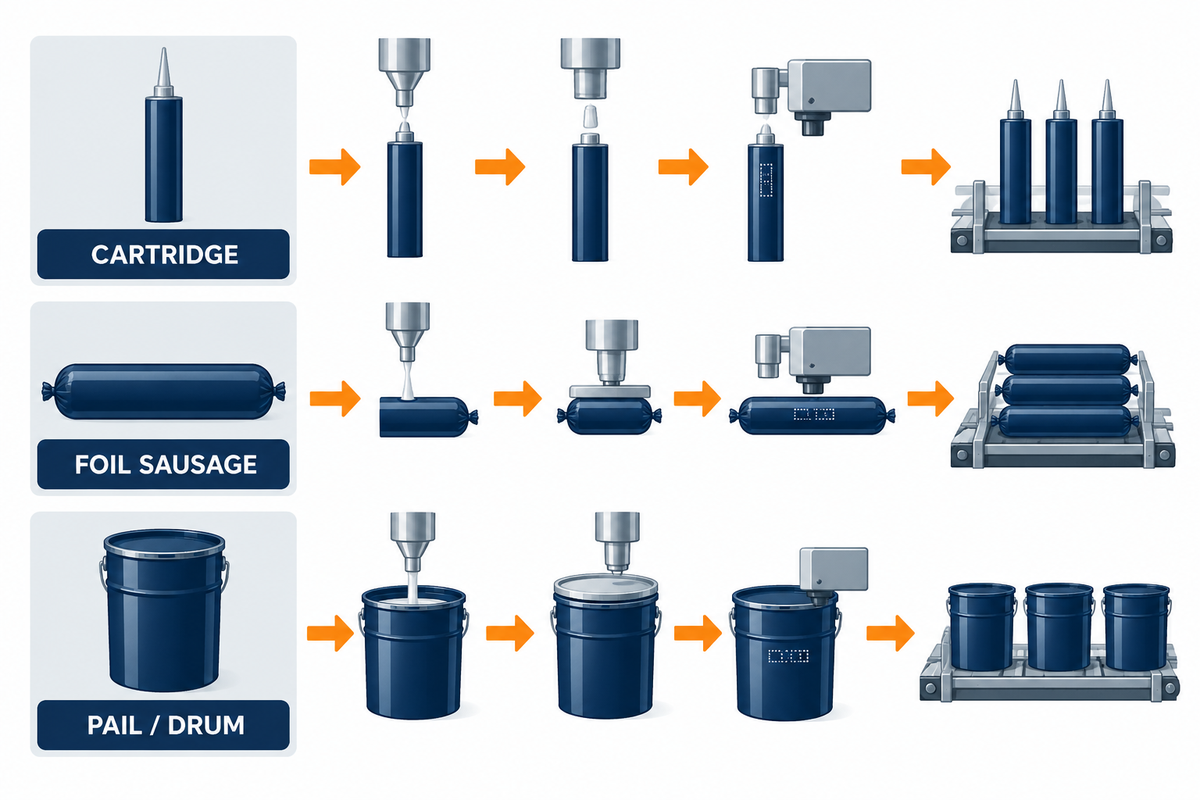
Rigid cartridges, foil sausages, pails, and drums impose different dosing, sealing, coding, changeover, labor, and reject-handling duties; IDA’s filling-machine guide provides a broader format comparison. Filling suppliers themselves configure systems around viscosity, container format, dosing method, and production requirements. A high-speed filler is relevant only when representative product and package trials prove that the full downstream path can sustain its rate.
How Do Cartridges, Sausages, Pails, and Drums Change Line Design?
| Package path | Critical interface | Trial evidence | Hidden constraint |
|---|---|---|---|
| Rigid cartridge | Container feed, fill, plunger, seal, code | Weight and closure integrity | Container handling and changeover |
| Foil sausage | Film, clipping, cut, code | Seal and clip integrity | Film handling and waste |
| Pail | Bulk dose, lid, identification | Mass and closure check | Handling and pallet flow |
| Drum | High-mass transfer and closure | Mass balance and contamination control | Discharge and material movement |
Takeaway: use the pack mix, and the worst handling product in the package path when determining the size of the production system.
Size the Line Around the Bottleneck, Not the Vessel
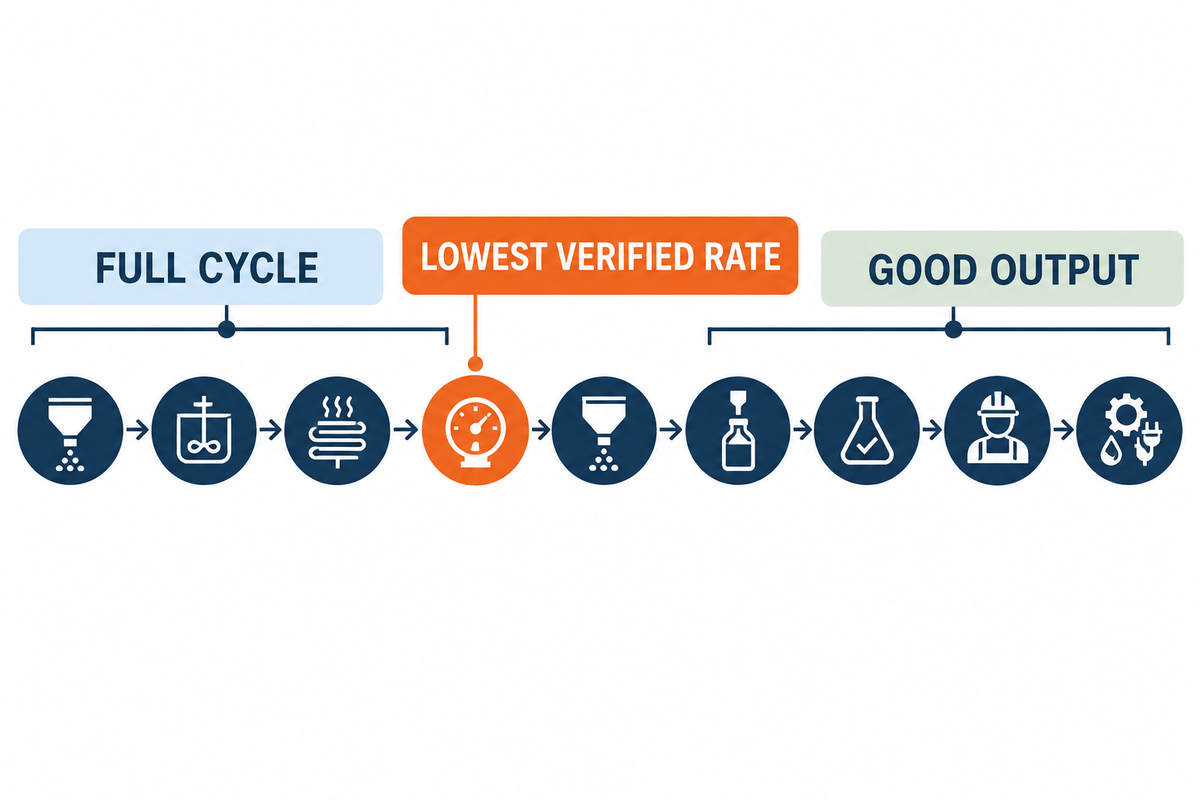
What inputs size a silicone sealant line credibly?
Nominal vessel volume isn’t saleable output. We start with usable released batch mass divided by full cycle time. Then, we apply scheduled hours, availability, and good batch yield.
Annual good output = (usable released batch mass ÷ full cycle time) × scheduled production hours × availability × good batch yield.
The full cycle comprises charging, mixing, heating or cooling, vacuum treatment, discharge, quality release, cleaning, and changeover. Every value must be from buyer records or a representative trial. The equation is a worksheet, not an IDA performance claim.
Batch-to-Pack Bottleneck Constraint Map
| Stage | Measured input | Rate or time | Owner | Contract proof |
|---|---|---|---|---|
| Raw-material feeding | Worst powder and liquid sequence | Charge time per batch | Plant | Observed trial log |
| Mixing and turnover | Representative formulation | Time to agreed endpoint | Supplier + quality | Batch trend and test |
| Thermal recovery | Actual heat load | Heat/cool time | Supplier | Temperature trend |
| Vacuum treatment | Actual fill level | Pull-down and hold time | Supplier | Vacuum record |
| Discharge | Worst-flow product | Released mass per hour | Supplier | Mass balance |
| Filling and sealing | Actual pack mix | Accepted packs per hour | Packaging supplier | Good-pack count |
| Labor | Staffed shift plan | Attended hours and interventions | Plant | Operator log |
| Quality release | Required tests and sampling | Release lead time | Quality | Laboratory record |
| Utilities | Simultaneous peak demand | Available capacity | Engineering | Measured utility test |
In a representative trial, the lowest verified rate controls the line. The finance team should do a payback model on packaged good output, and the plant manager and quality team should provide evidence on cycle time and yield.
Key takeaway: Contract the bottleneck and its test method, not headline capacity detached from the whole cycle. A NIST manufacturing-systems analysis similarly describes a throughput bottleneck as the machine that most impedes production-line throughput.
Validate the Process With Representative Material Trials
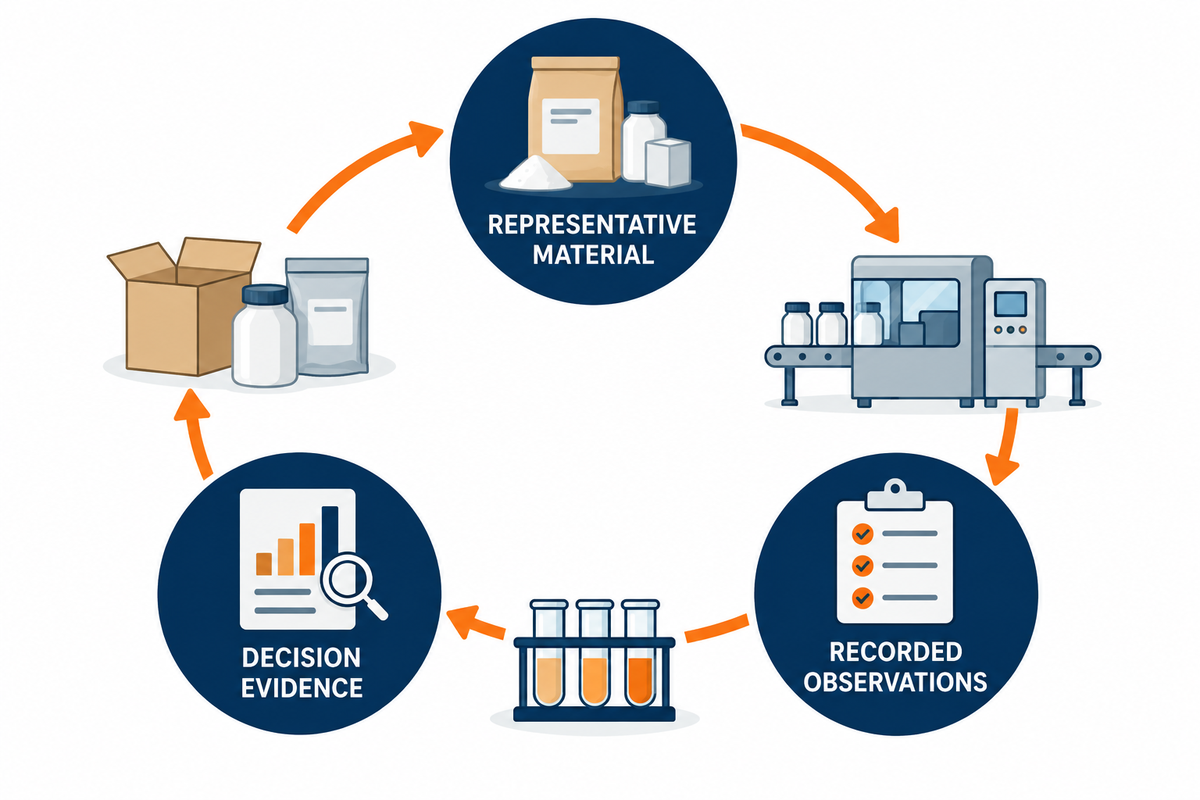
Trials should use the buyer’s actual polymer or base, fillers, additives, and selected packs at relevant viscosity and filler loading. High-performance grades still require the same representative-material evidence rather than a label-based assumption. An easier substitute may prove motion, but not the performance of the product.
- Identify every material lot, recipe revision, and package revision.
- Document the addition sequence, time, temperature, torque/load signal, vacuum behavior, and any interventions by the operator.
- Measure the agreed product endpoints, usable mass, residual heel, discharge time, package rejects, and how repeatable the process is.
- State scale-up assumptions and identify which ones remain unverified.
- Ownership of trial material, waste, samples, deviations, and retesting must be established.
Supplier-authored technical guidance from Christine Banaszek of Charles Ross & Son recommends comparing candidate mixer types using the actual process and considering cycle time, cleaning, discharge completeness, heating, and energy.
Key takeaway: The evidence pack is the link between a concept that’s plausible and a production line that’s contractible.
Turn Supplier Promises Into Acceptance Evidence
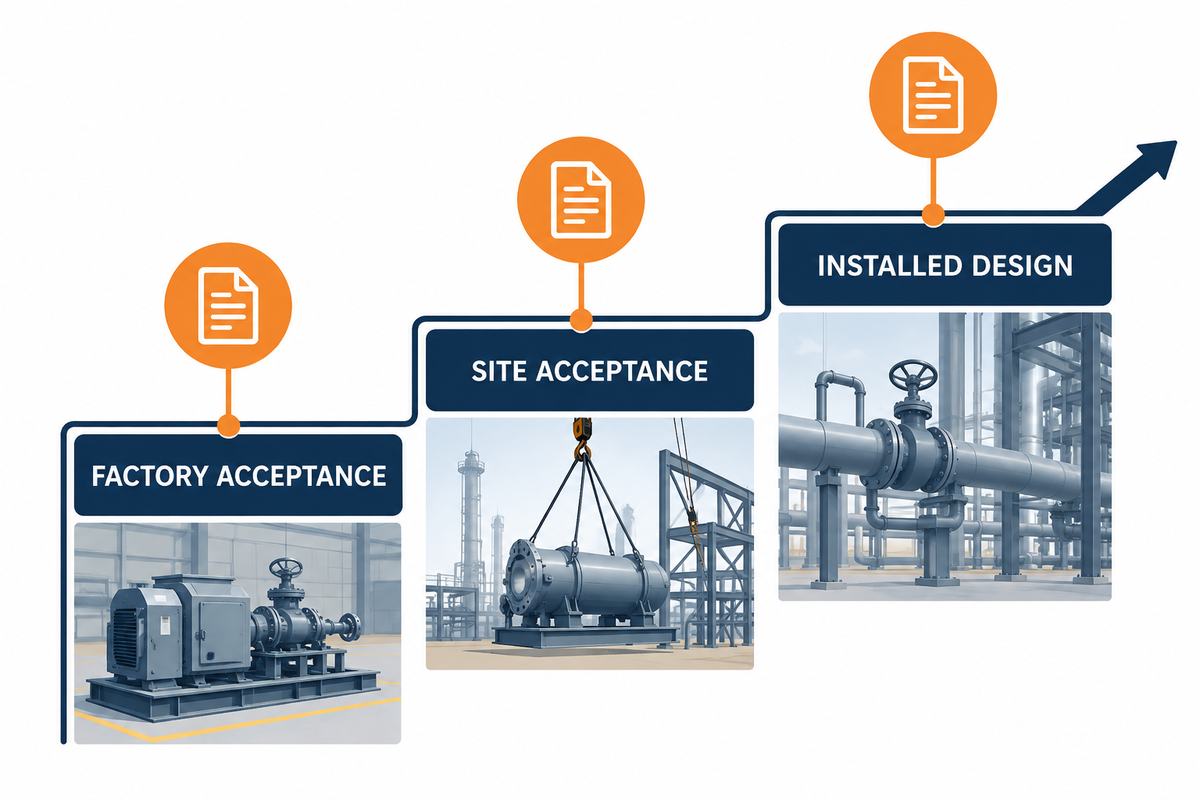
Factory acceptance and site acceptance answer different questions: one checks the built system before shipment, while the other checks the installed system with the buyer’s site conditions. Both need predefined requirements and documented results.
What Evidence Belongs in Trials, Factory Acceptance, Site Acceptance, and Process Qualification?
| Gate | Question | Required record | Acceptance owner | Commercial action |
|---|---|---|---|---|
| Design review | Are duties and interfaces complete? | Approved scope and drawings | Engineering + procurement | Release detailed design |
| Dry control test | Do sequences, alarms, and interlocks work? | Signed function log | Engineering + safety | Release wet trial |
| Wet factory test | Can agreed material meet defined endpoints? | Batch, test, and deviation pack | Quality + plant | Approve shipment milestone |
| Packaging test | Are accepted packs produced at the tested condition? | Good-pack, reject, and seal record | Quality + operations | Accept package subsystem |
| Site acceptance | Does the installed line work with site utilities? | Installed performance report | Plant + engineering | Approve installation milestone |
| Process qualification | Is performance repeatable? | Agreed repeat-run evidence | Quality | Release commercial use |
| Documentation | Can the plant operate and maintain the line? | Manuals, drawings, spares, training | Maintenance + operations | Close documentation holdback |
| Deviation closure | Were failures corrected and retested? | Approved deviation and retest | Named contract authority | Release retained payment |
Relevant points of operation, nip points, and rotating parts must be addressed by machine guarding under the applicable jurisdiction. A certificate or sales statement doesn’t replace inspection of the installed design.
Key takeaway: Link all important promises to a test, observed value, record, owner, deviation route, and payment milestone.
Build a Quote-Ready Silicone Sealant Line RFQ
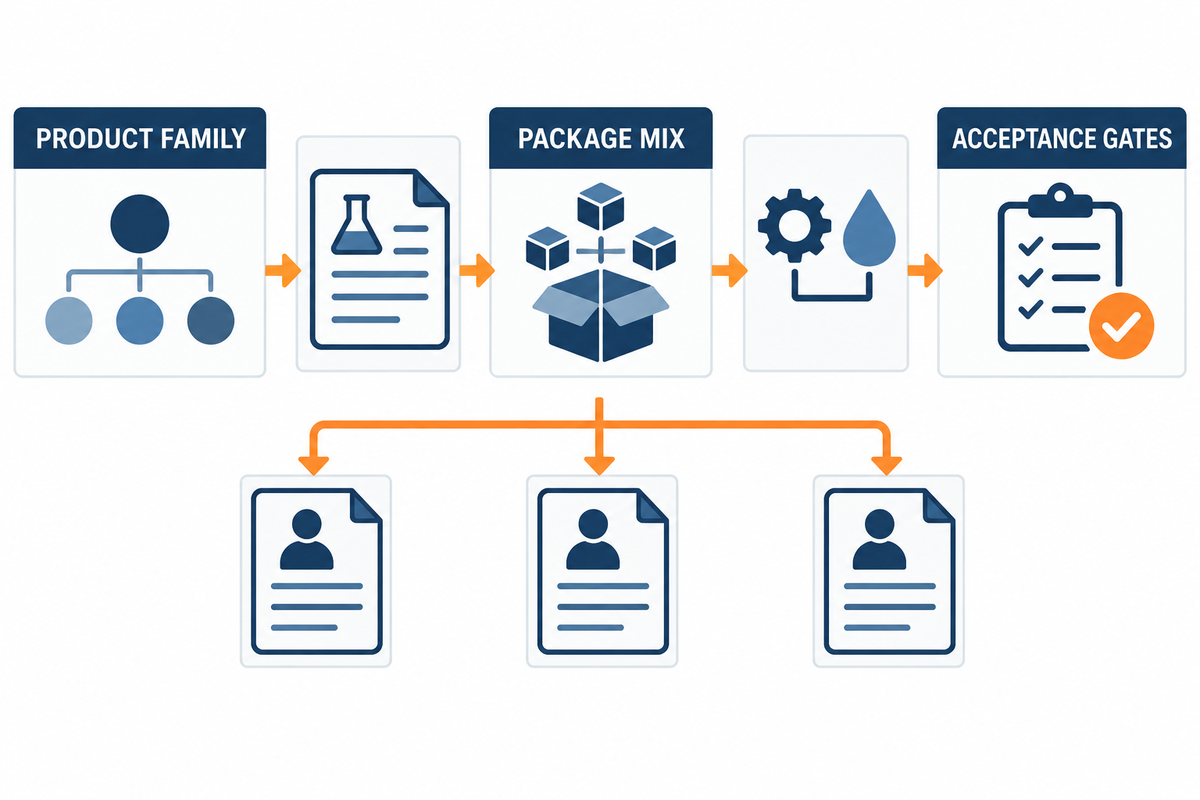
A comparable request for quotation should state the product-family split, target good output, recipe envelope, rheology method, filler properties, addition sequence, package mix, site utilities, controls, safety basis, trial plan, acceptance gates, documentation, spare parts, and service expectations.
- Define the purchased process boundary and explicit exclusions.
- List representative and worst-condition products and packages.
- Indicate measurable process inputs without sharing more recipe detail than is necessary.
- Require suppliers to specify assumptions and exclusions, potential interfaces, and predicted throughput bottleneck.
- Attach the trial evidence pack and evidence-to-payment matrix.
- Ask for utility loads, footprint, cleaning method, changeover basis, and staffing assumptions.
- Require deviations to be visible so proposals can be normalized.
When decision basis is available, review IDA Equipment’s adhesive production line for configuration and quotation discussions. This article remains the preparation guide; the linked page is the commercial handoff.
Key takeaway: Requests for quotation should be written in a way to encourage suppliers to price the same boundary and to prove the same outputs.
Decision Path: Scope, Prove, Size, and Specify
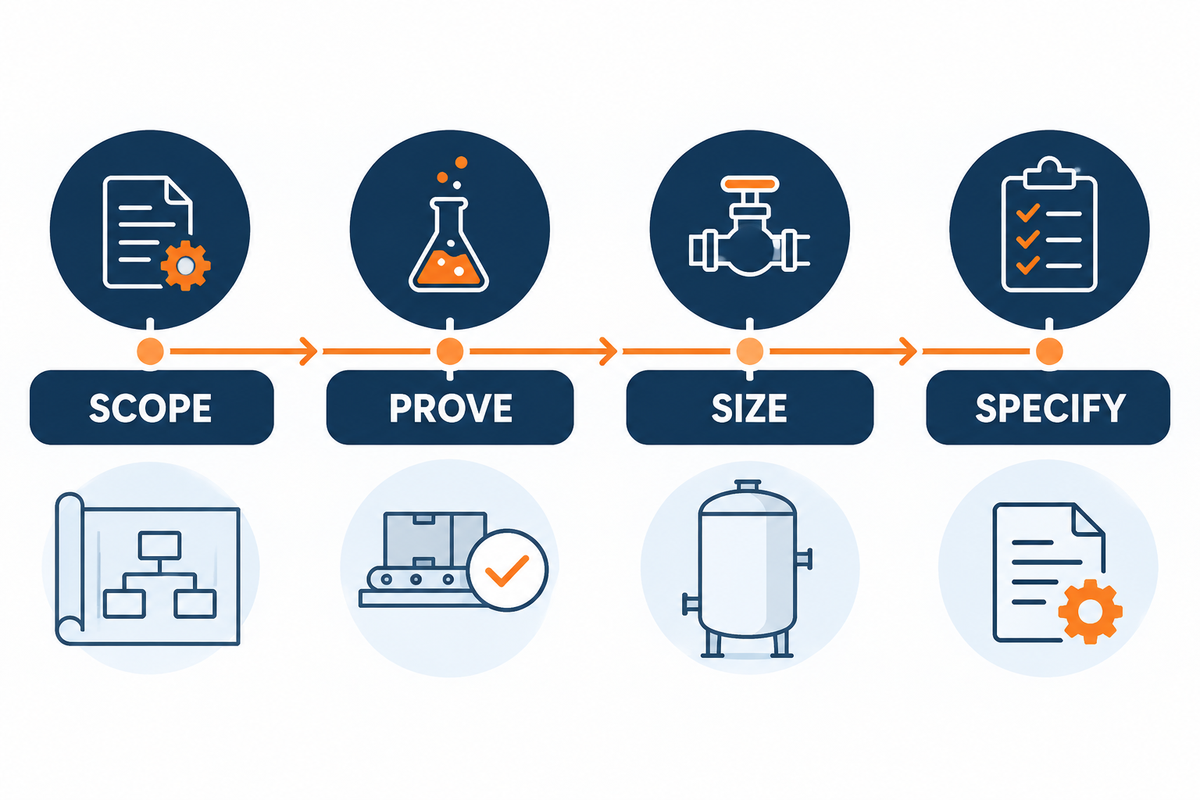
- Freeze the line boundary and exclusions.
- Separate materially different product families.
- Assign every process duty to an equipment function.
- Define the real downstream format mix.
- Trial representative materials and packs.
- Calculate output based on the full cycle time and the lowest verified rate.
- Bind tests and records to commercial milestones.
- Issue a comparable, quote-ready request.
If evidence doesn’t support assumptions, revise the concept or retest it. NIST’s verification and validation guidance defines acceptance testing as testing a system to ensure contractual requirements are satisfied. Don’t let schedule pressure turn an unverified assumption into a guaranteed line rate.
Frequently Asked Questions
What equipment is required for a silicone sealant production line?
There’s no global list. A complete concept assigns equipment to all the following in some combination: Receiving and dosing, high-viscosity turnover and dispersion, atmosphere control, conditional milling, discharge, transfer, filling, coding and quality release. The final set is determined by the recipe envelope, product family, batch size, pack mix and trial evidence.
Is a three-roll mill always required for silicone sealant production?
No. Milling is a conditional dispersion step. First, set the product quality end point and evaluate with representative trials if the specified mixer achieves it without a separate mill. Also, consider the mill’s heat, guarding, transfer, cleaning, and contamination duties.
How do you calculate silicone sealant line capacity?
This starts with the released usable mass per batch and the complete cycle time. Apply scheduled hours, availability, and good-batch yield, then compare the result with feeding, mixing, thermal recovery, vacuum, discharge, filling, laboratory, labor, and utility limits. The lowest verified rate controls the line.
What raw materials enter a silicone sealant factory line?
The purchased production scope normally receives specification-approved base polymer or silicone fluid, fillers, plasticizers, crosslinkers, catalysts, pigments, adhesion promoters, and other formulation additives. The exact ingredients and addition sequence belong to the formulator; elemental silicon and upstream polymer synthesis are usually outside this equipment project.
What should be tested before ordering a turnkey line?
Run representative ingredients and packs through the proposed process. Verify turnover, dispersion endpoint, temperature history, atmosphere performance, discharge, filling, rejects, cleaning, traceability, alarms, safety functions, and final product tests, then convert agreed results into contractual acceptance criteria.
References & Sources
- OSHA 29 CFR 1910.212, General requirements for all machines
- Dow Silicone sealants, foams and industrial assembly guide
- Adhesives & Sealants Industry – Mixing and Dispersing Silicones
- Christine Banaszek, Charles Ross & Son – Planetary mixers for adhesives and sealants
- PQE Group, Factory and site acceptance testing
Final setpoints, materials, safety classifications, output guarantees, price, lead time, and recipe ownership must be confirmed for the actual project. Supplier performance ranges are trial hypotheses, not reusable design limits.