Get in Touch with IDA
Mixer Material Compatibility: A System-by-System Selection Guide

Contents
show
Mixer material compatibility takes into consideration all product contact components in conjunction with the full extent of the service condition it’s expected to encounter. It’s more than just reading the grade on the vessel and making a determination. A 316L tank doesn’t justify an unsuitable seal, scraper, liner, weld, fastener, or discharge valve. The approval unit is the complete wetted assembly under product, cleaning, startup, shutdown, and upset conditions.
This guide provides a repeatable approach to the screening of an assembly, and identifies the cause of an uncertain rating. It stays separate from mixer-technology and quotation intent. If your process also needs high shear dispersion with wall scraping for a batch with medium to high viscosity, IDA’s Butterfly Disperser Mixer is one example; information about the machine can be found on its product page.
Short answer: define the duty envelope, map every contact point, screen each material by failure mode, preserve unknowns, and escalate uncertain combinations from charts to supplier data, tests, and representative trials.
Mixer Material Compatibility Is a Chain, Not a Steel Grade
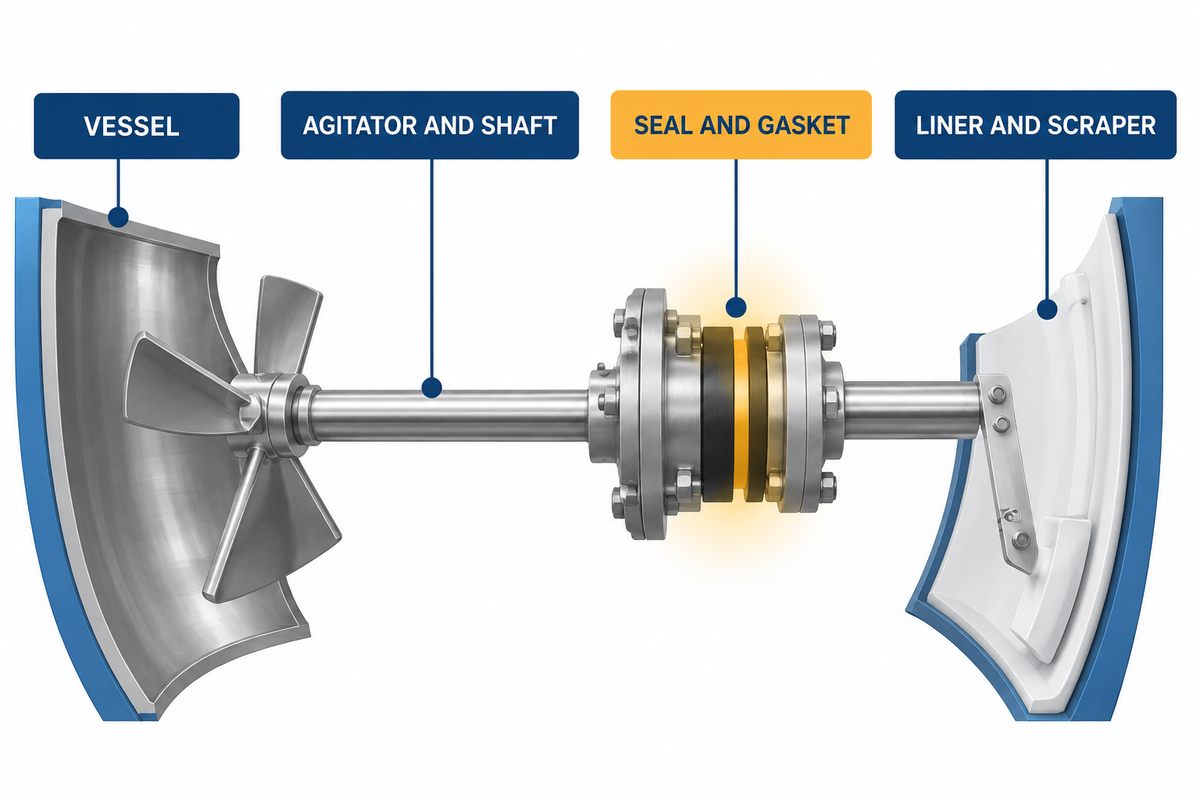
A compatibility decision fails at its weakest exposed link. Trelleborg’s technical paper on looking beyond compatibility charts supports screening exact polymer behavior and service conditions instead of trusting one broad material label. While the shell of the vessel may remain bright and reflective, an O-ring may swell, a PTFE scraper may creep, a coating may delaminate and lift at an edge, and around a fastener there may be a crevice that traps a corrosive liquid.
Behavior of component families isn’t the same. Metals can pit, crack, gall, or erode. Elastomers may swell, harden, soften, shrink, or lose compression. Linings can permeate, blister, delaminate, or wear through. Surface damage can create residue traps, even when wall thickness of the component is adequate. A single rating such as “good with acid” can’t mean all the above behaviors.
| Assembly element | Typical compatibility question | Evidence to request |
|---|---|---|
| Vessel, shaft, impeller, welds | Which corrosion or wear mechanism controls at actual chemistry and temperature? | Exact alloy grade, fabrication route, weld treatment, corrosion basis, and inspection plan |
| Seals and gaskets | Will the compound retain dimensions, hardness, strength, and compression? | Compound-specific fluid data, temperature limit, exposure duration, and seal design review |
| Liners and coatings | Can they resist permeation, adhesion loss, mechanical damage, and cleaning? | Resin/lining identity, thickness, cure, holiday test, repair method, and service limits |
| Scrapers and guides | Will chemistry, friction, load, and abrasion alter fit or shed material? | Polymer grade, wear allowance, contact pressure, inspection interval, and replacement criterion |
| Valves, nozzles, instruments | Are all hidden wetted trims and diaphragms covered? | Complete wetted-parts list rather than a housing-material description |
Key takeaway: Request a bill of wetted materials at compound and grade level. “Stainless steel construction” isn’t a compatibility specification.
Capture the 9-Field Duty Envelope Before Opening a Chart
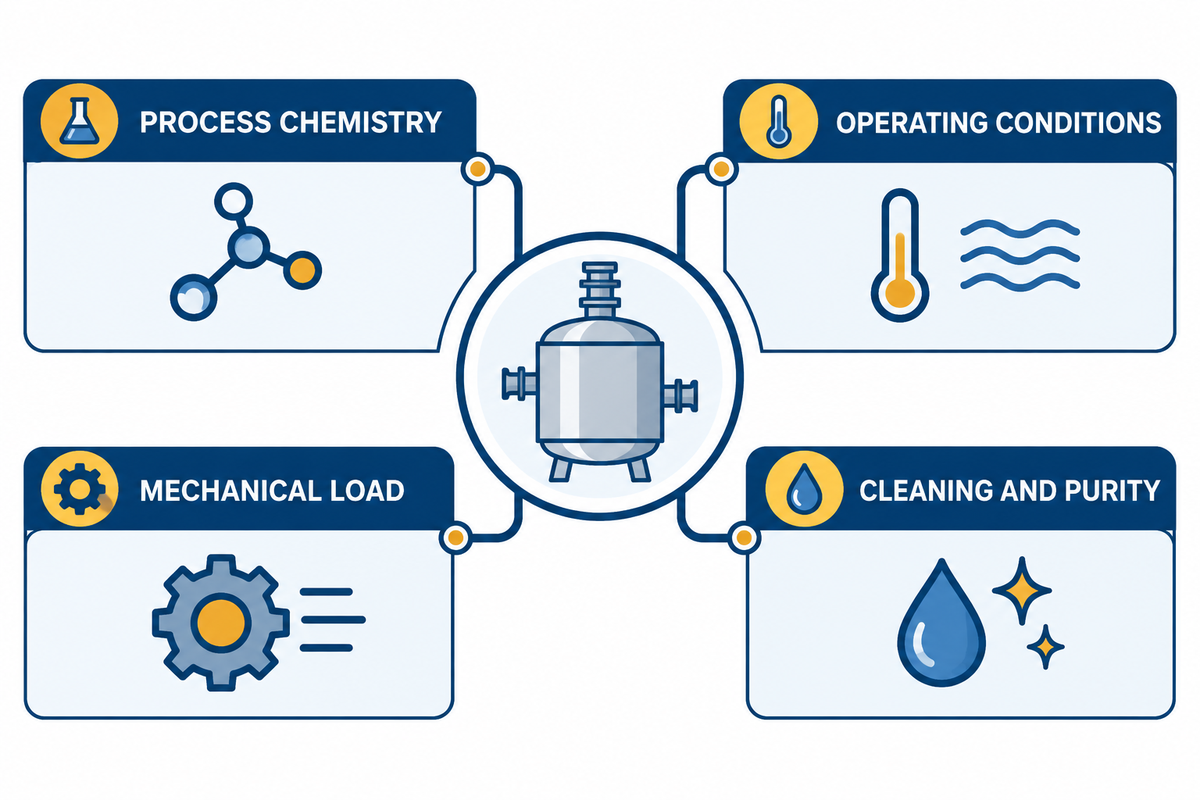
A compatibility chart is useful only when its test conditions match the proposed duty. The same Trelleborg technical guidance emphasizes that fluid chemistry, temperature, time, and material behavior must be considered together. Fill in the following fields, first. For any field that isn’t known, enter unknown. Don’t use an optimistic assumption.
- Chemical identity: all constituents (ingredients and carriers, solvents, catalysts, pigments, salts, expected impurities).
- Concentration and pH: minimum, normal, maximum, and actual during addition or drying.
- Temperature: of product, jacket, cleaning, sterilization, startup, shutdown, and upset temperatures.
- Exposure time: batch time, continuous/intermittent contact, standby, hold (overnight), wet storage.
- Solids and abrasion: loading, particle size, hardness, shape, settling, crystallization, agglomeration.
- Mechanical duty: speed, torque, vibration, shaft deflection, contact, pressure, and vacuum.
- Cleaning regime: every rinse and cleaner, concentration, temperature, contact time, frequency, and drying condition.
- Purity and compliance: acceptable metals, extractables, color pickup, product carryover, and required contact documentation.
- Upsets and special hazards: wrong addition order, cooling loss, stagnant zones, flammable atmospheres, static behavior, and abnormal oxygen or chloride exposure.
Temperature and concentration deserve separate entries. The effects of fail aren’t reliably linear. The most severe condition is more likely to occur during a caustic wash than during a normal batch. A dilute and a concentrated acid behave differently toward the same elastomers and alloys.
This method captures the true formulation and eliminates marketing names. “Water-based coating” doesn’t provide much detail about chloride, amine, surfactant, solvent, pigment, or cleaning exposure, for example. Sometimes formulations are confidential, and a supplier can review them under a nondisclosure agreement. However, the compatibility decision needs the hidden variables.
Classify Contact: Continuous, Splash, Vapor, Cleaning, or Maintenance
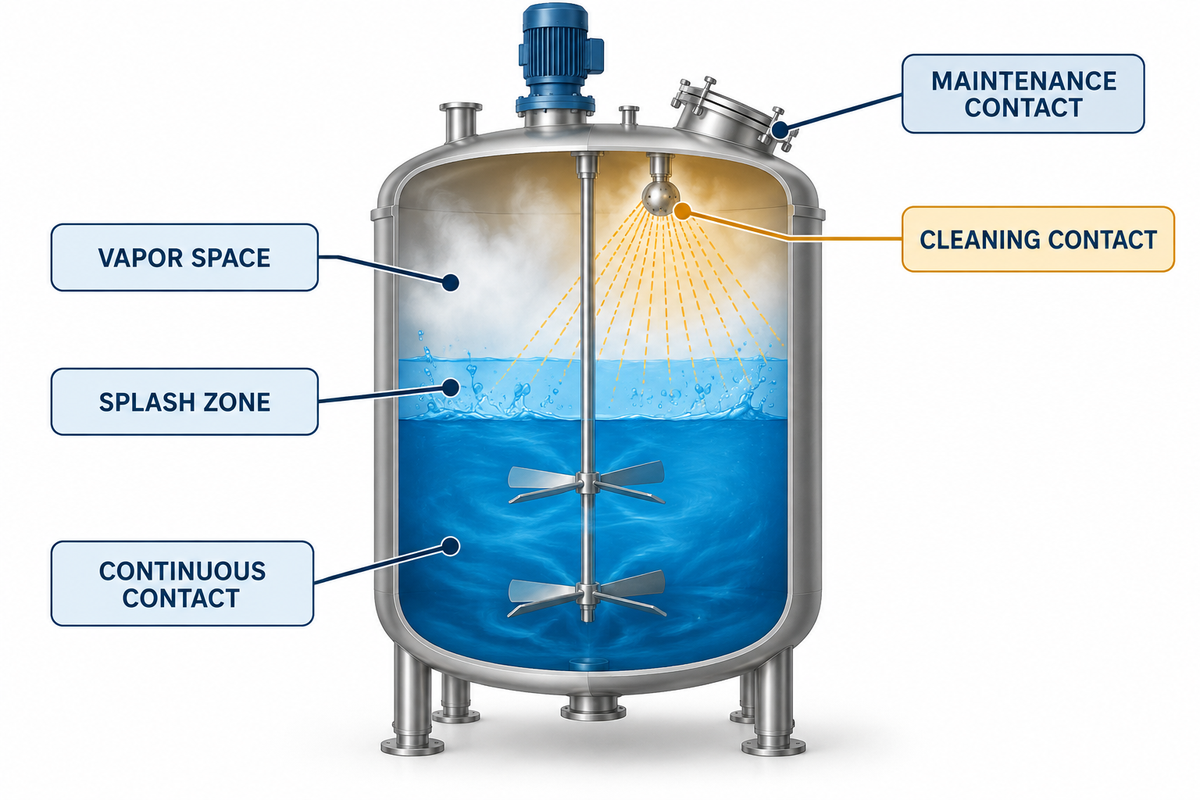
Not all components see the same service conditions. Alfa Laval’s hygienic-design guidance shows why surfaces, geometry, drainability, and cleaning exposure belong in the contact map. Build a contact map consisting of five classes: continuous immersion, intermittent splash, vapor or condensate exposure, cleaning exposure, and maintenance exposure. This prevents two common errors. It prevents over-specifying non-contact components without following the failure path and overlooking components above the normal liquid line.
- Continuous: vessel walls and internal components, impeller, lower shaft, bottom outlet, submerged probes.
- Splash: Vessel covers and baffles, charging ports, scraper support.
- Vapor/condensate: headspace hardware, vent path, vacuum connection, and upper mechanical seal surfaces.
- Cleaning-only: Components that are exposed to cleaning agents and sprays, including CIP, manual solvents, steam and sanitizer, even if the product never touches them.
- Maintenance: lubricants, anti-seize compounds, and removal of temporary cleaning tools. Replacement parts will be installed by maintenance.
Bulk liquid isn’t necessarily the most aggressive component of the system, especially if volatile components concentrate on a cool surface. Deposits may also create a crevice corrosion environment. The map should therefore describe what each location actually sees, not just its distance from the product level.
Which Failure Windows Matter When Comparing Metals?
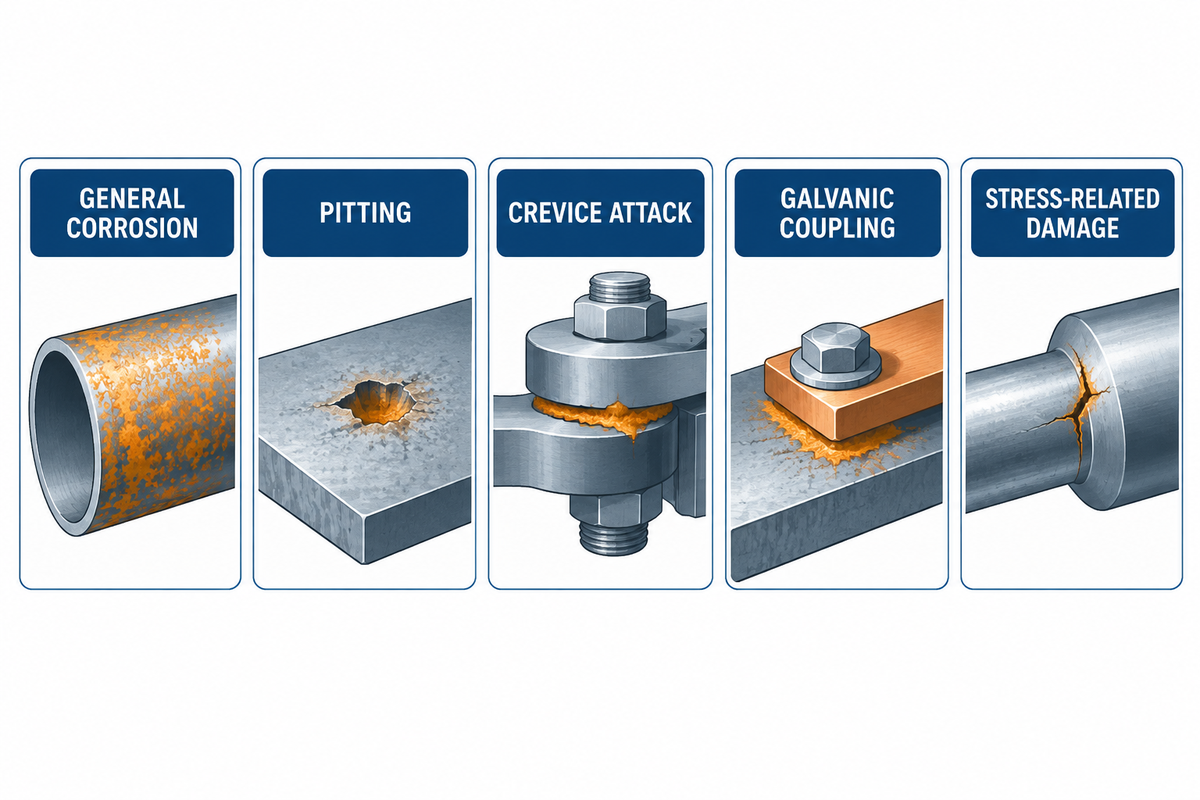
No metal grade is universally the best. Compare candidate families against the factors that could make them fail, and verify the exact grade and fabrication. The Outokumpu corrosion guide states that all stainless steels can still be vulnerable to localized attacks, and that for chloride-bearing media pitting and crevice corrosion and stress-corrosion cracking are of concern.
| Material class | Useful screening strengths | Failure windows to investigate |
|---|---|---|
| 304 stainless steel | General cleanliness, fabrication, and mild-duty corrosion resistance | Chlorides, certain acids, crevices, deposits, and cleaning chemistry |
| 316L stainless steel | Improved localized-corrosion resistance over 304 in many services; low carbon supports welded construction | It is still not immune to chloride pitting, crevice attack, stress-corrosion cracking, or aggressive acids |
| Carbon steel | Strength, stiffness, fabrication, and cost for suitable dry or noncorrosive service | Rust, product contamination, coating damage, water exposure, and cleaner attack |
| Nickel alloys such as C-276 | Candidate for severe chemical environments where stainless grades are inadequate | Exact alloy selection, fabrication quality, galvanic interfaces, availability, and high cost |
| Titanium | Candidate for selected chloride and oxidizing services | Reducing environments, galvanic coupling, rubbing/galling, fabrication, and chemistry-specific limits |
| Duplex stainless steel | Candidate where higher strength and localized-corrosion resistance are useful | Exact grade, fabrication heat input, phase balance, weld procedure, and service chemistry |
| Glass-lined steel | Barrier option for selected corrosive products where metallic contact is undesirable | Impact, thermal shock, chips, holidays, nozzle details, repair limits, and inspection access |
| Fluoropolymer-lined steel | Barrier option for selected aggressive chemicals at suitable temperature and load | Permeation, creep, vacuum resistance, liner support, abrasion, seams, and repair method |
| High-nickel alloy families | Candidate set for duties beyond standard stainless grades | Exact alloy chemistry, weld filler, galvanic interfaces, availability, and condition-specific corrosion data |
Specify the exact Hastelloy grade and the titanium grade, surface, fabrication route, and service conditions. Hastelloy is a family name. Within stainless families, welding, heat tint, surface condition, crevices, deposits, and residual stress can move the failure boundary.
Evaluate metals for flow, abrasion, crevices, weld stress, galvanic coupling, and localized-corrosion mechanisms alongside corrosion-rate or immersion data. ASTM G31 provides a recognized framework for laboratory immersion corrosion testing of metals; assess these operating-mixer conditions separately from controlled immersion results.
Why Do Liners, Scrapers, Gaskets, and Seals Need Separate Selection?
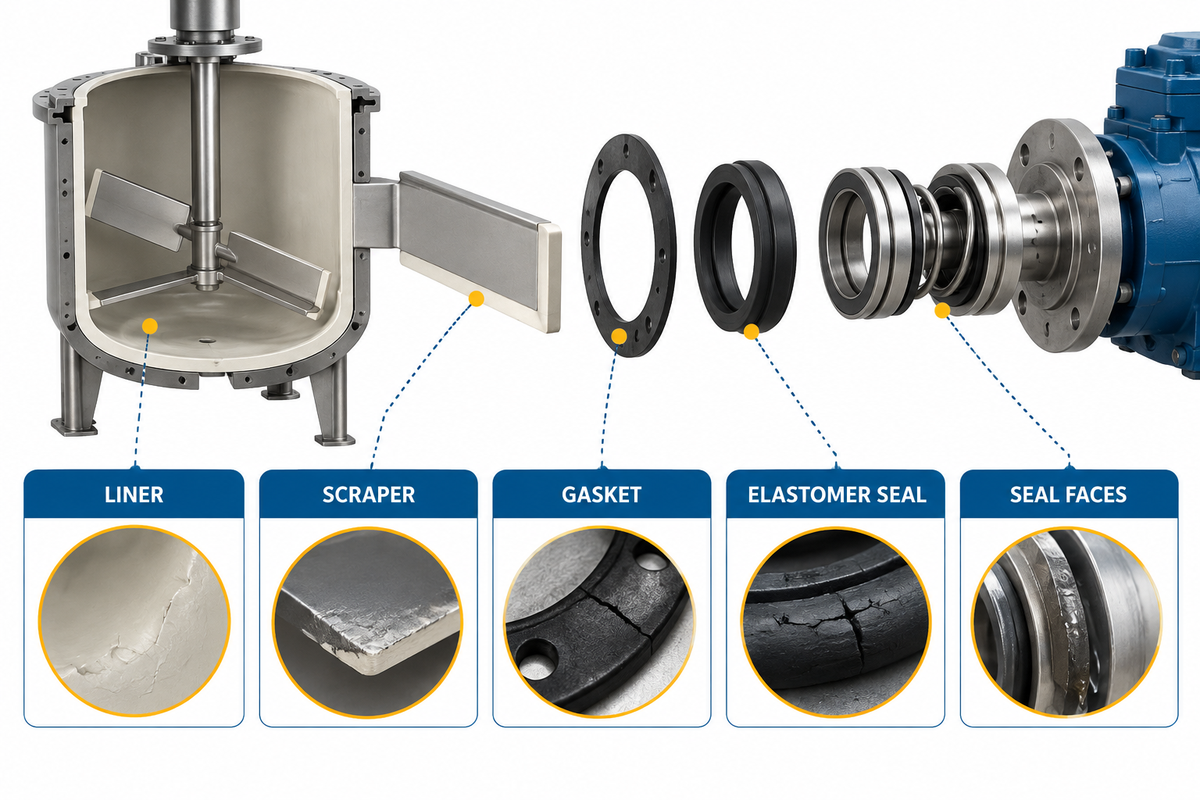
Non-metallics should be screened by exact compound and function. Differences exist in fillers, cure systems, hardness, and reinforcement of polymers. Processing and formulation variances can exist between similarly named polymers. “EPDM” or “FKM” wouldn’t be sufficient for final approval.
| Family | Why buyers consider it | Questions before approval |
|---|---|---|
| PTFE | Broad chemical-resistance screening range and low surface energy | Will creep, cold flow, permeability, wear, deformation, or poor load recovery affect the component? |
| EPDM | Often considered for water, steam, caustic, and selected polar-fluid duties | Does the actual compound tolerate oils, fuels, solvents, temperature, and cleaning cycles? |
| FKM | Often considered for oils, fuels, heat, and selected chemicals | Are ketones, amines, strong bases, steam, or the actual blend incompatible with the compound? |
| Silicone/VMQ | Wide temperature capability and flexibility in selected hygienic applications | Will tear, abrasion, permeability, solvent exposure, or repeated sterilization shorten life? |
| UHMW or other scraper polymers | Wear surface and low friction in suitable duties | What are the chemical, temperature, wear, extractables, and dimensional-stability limits? |
Trelleborg’s technical paper on looking beyond chemical compatibility charts highlights the fact that there are numerous other considerations in addition to fluid chemistry, polymer behavior, temperature, and time. Seals can become too soft, too hard, too large, or too small, even if there’s no obvious evidence of dissolution.
Assess dynamic seals for changes in liquid-related properties and mechanical service conditions. ASTM D471 describes various kinds of liquid exposure tests, which may include changes in mass, volume, dimensions, hardness, tensile strength, and elongation. Compression, motion, extrusion gaps, pressure, surface finish, assembly damage, and actual part geometry may also affect suitability.
“…properties of rubber articles deteriorate during exposure to these liquids, affecting the performance of the rubber part.”
Account for Abrasion, Crevices, Welds, and Galvanic Couples
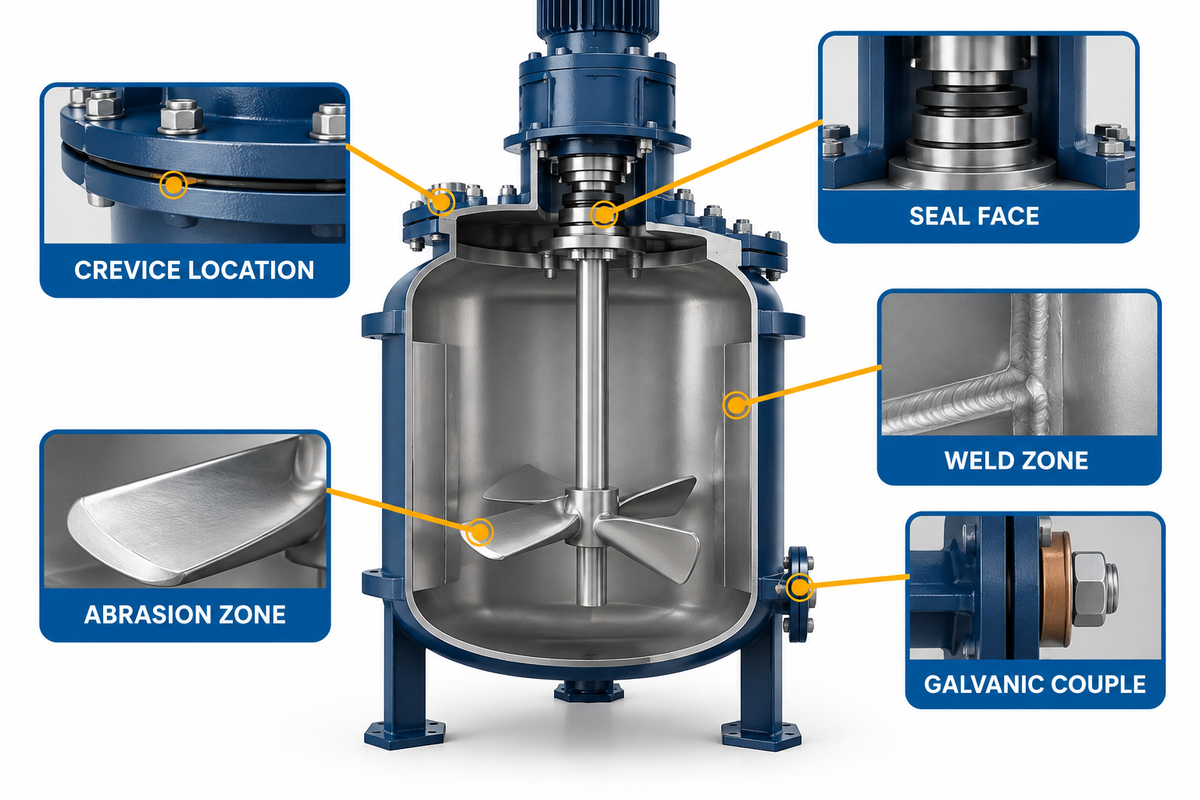
Chemistry is only half the story for mixer service. Use ASTM G31 as controlled immersion evidence for metal attack, then evaluate abrasion, crevices, weld stress, and galvanic coupling separately. Sharp particles can remove protective films and coatings faster than they can reform. High local velocity can promote erosion and corrosion simultaneously. Deposits and gaskets can create protected locations which may differ in chemistry from the bulk of the liquid. Dissimilar metals coupled in an electrolyte can form a galvanic couple.
Inspect the locations where those mechanisms concentrate:
- impeller leading edges and high-velocity discharge zones;
- scraper contact tracks and polymer-to-metal interfaces;
- weld toes, heat-affected zones, incomplete finishing, and heat tint;
- threaded fasteners, lap joints, gasket edges, and dead legs;
- Areas that remain wet after cleaning; bottom outlets, drain pockets;
- dissimilar-metal fasteners, inserts, instruments, and repair patches;
- Seal faces that are exposed to crystallization, dry running and/or abrasive particles;
For abrasion, motion, deposit and/or stress-related issues, provide a representative test or inspection of that mechanism. Replicate the local situation rather than extending the immersion time for a coupon in a calm beaker.
Why Do Cleanability and Product Purity Affect Compatibility?
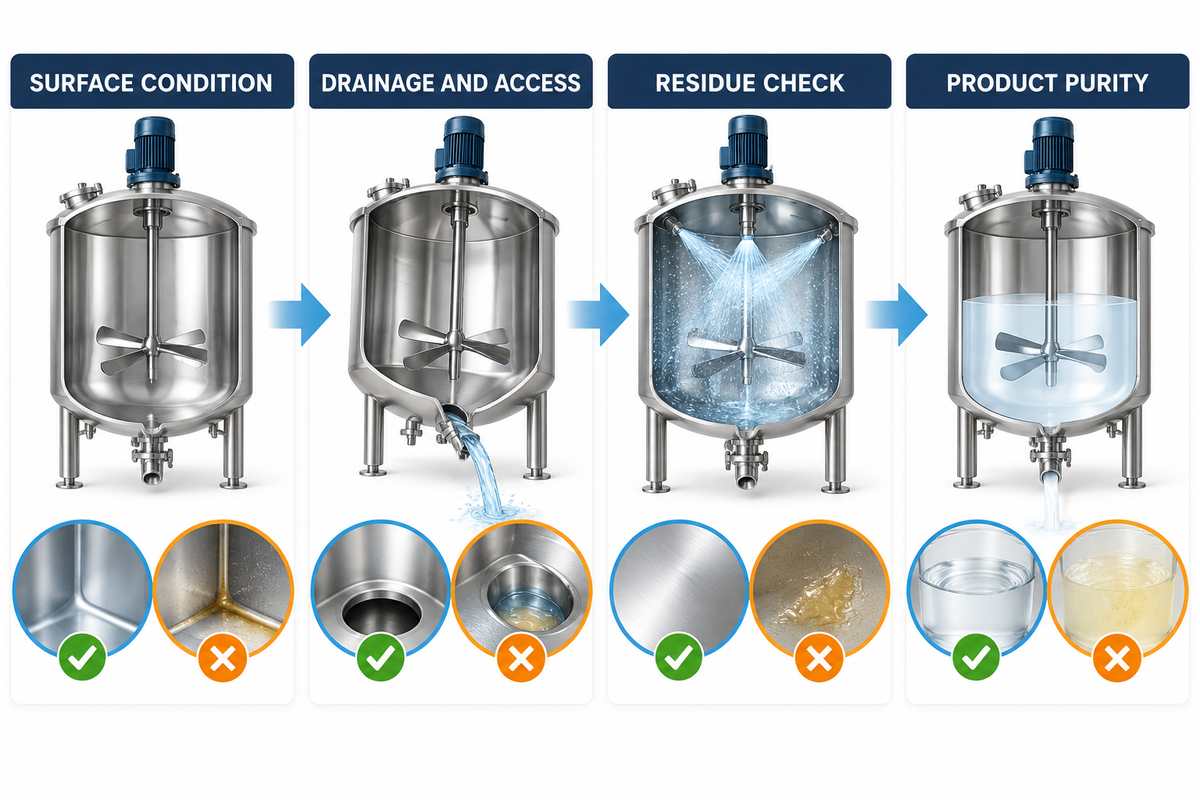
A material can resist gross corrosion and still be unacceptable. Roughening, pits, residue retention, extractables, color transfer, catalytic effects, product adsorption, a non-drainable joint or other issues can result in failure even before a leak occurs.
Alfa Laval’s hygienic-design guidance states that cleanability depends on surfaces, manufacturing quality, and design. Interpret that for mixers:
For the human food equipment within its scope, 21 CFR 117.40 requires equipment to be adequately cleanable and utensils to be constructed to avoid adulteration and to withstand the effects of cleaning in combination with the intended use. That regulatory example isn’t a universal rule for the mixer industry but it illustrates the importance of choosing the right material, its fabrication and installation as well as the manner in which it’s cleaned.
- state the required surface finish and how it will be measured;
- define the acceptance criteria for weld finishing, passivation, electropolishing or coating;
- identify crevice-free, drainable, and inspectable joints;
- specify acceptable extractables, product-contact declarations, and traceability;
- use the actual cleaner at its maximum concentration, temperature, and contact time;
- establish rinse, swab, visual, conductivity and other residue criteria.
Scope also must be precise for regulatory or contact suitability. For example, a food contact statement may be limited to a particular material formulation, supplier, use, temperature, or migration. It can’t be generically concluded based on corrosion resistance, ease of cleaning, or alloy name. Required documentation for suitability must be specifically provided for the component supplied and use for which it’s intended.
How Does the COMPASS Matrix Screen Each Candidate?
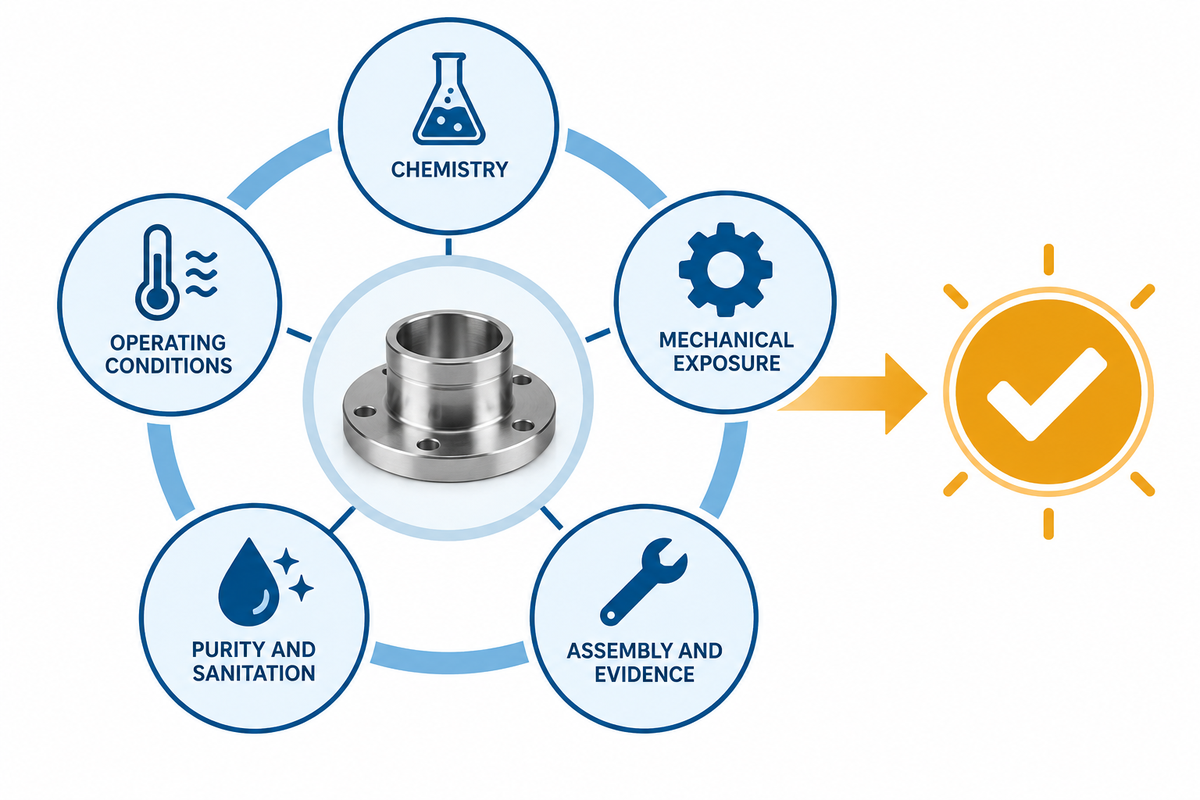
COMPASS is a seven-column screening matrix: Chemistry, Operating envelope, Mechanical duty, Purity/compliance, Assembly interfaces, Surface/cleaning, and Strength of evidence. Its chart-screening boundary follows the Trelleborg technical paper: a general rating is a starting point, not final approval for a specific compound and duty.
| COMPASS field | Ask | Record |
|---|---|---|
| Chemistry | Does the exact grade or compound tolerate every product and cleaning fluid? | Compatible / conditional / incompatible / unknown, with source and conditions |
| Operating envelope | Are temperature, concentration, time, pressure, vacuum, and upset limits covered? | Worst-case value and evidence boundary |
| Mechanical duty | Do abrasion, flexing, rubbing, torque, vibration, and particles change the result? | Failure mechanism and inspection location |
| Purity/compliance | Could the material contaminate product or lack required documentation? | Declaration, traceability, extractables, and acceptance criterion |
| Assembly interfaces | Are welds, crevices, galvanic couples, seals, and fasteners covered? | Joint detail and deviation list |
| Surface/cleaning | Can the assembly be drained, cleaned, inspected, and restored? | Finish, cleaning cycle, residue limit, and repair method |
| Strength of evidence | Is the rating a chart, exact supplier data, a controlled test, or a representative trial? | Evidence level, date, owner, and open questions |
The most important rule is unknown isn’t compatible. Unknown means the buyer requires more evidence or has made a documented risk decision. A matrix that turns blank cells to green check marks is worse than no matrix (because it gives a false sense of certainty).
For flammable service, add electrical and electrostatic suitability to the operating-envelope review. A chemically resistant polymer liner may change charge dissipation. That issue belongs in a qualified hazardous-service assessment; chemical compatibility alone cannot approve ignition risk, grounding and bonding, ventilation, or electrical classification.
How Does the 4-Level Evidence Ladder Resolve Uncertainty?
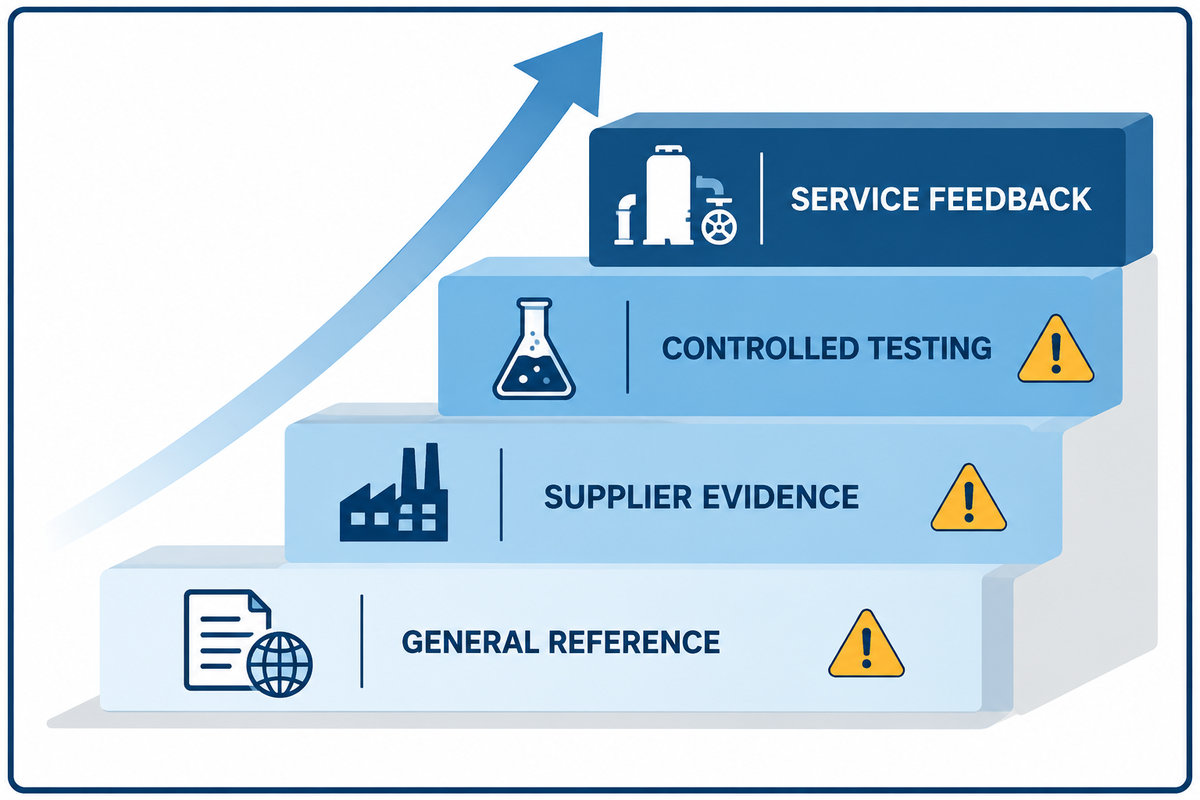
Escalate evidence in proportion to the risk and uncertainty. At Level 3, ASTM G31 provides a recognized metal-immersion framework while representative process trials remain a separate Level 4 step. Higher levels don’t eliminate lower level findings.
- Level 1- Reference screening: Verify the applicability of references (corrosion guides, standards, compatibility tables, known failure mechanisms) to exclude obvious mismatches and identify remaining questions.
- Level 2- Exact supplier confirmation: Documentation (data) for the precise alloy, polymer compound, coating, treatment, and conditions. Indicate exclusions and assumptions.
- Level 3 – controlled coupon or component test: expose a representative metal, weld, elastomer, liner, or component under defined chemistry, temperature, time, and evaluation criteria.
- Level 4 – representative process and cleaning trial: use the actual formulation or worst credible surrogate, the same motion and loading, the cleaning cycle, repeated batches, inspection, and agreed acceptance limits.
Use metal immersion tests for metal attack and elastomer liquid-exposure tests for polymer-property changes. Assess seal life, scraper wear, whole-mixer suitability, and hygienic design under representative service conditions. Define each test’s scope prior to testing.
| Risk signal | Minimum sensible escalation |
|---|---|
| Chart sources disagree or conditions do not match | Level 2 exact supplier review |
| High temperature, mixed solvents, chlorides, oxidizers, or confidential formulation | Level 2 plus Level 3 testing |
| Abrasion, rubbing, crystallization, deposits, or cyclic cleaning | Mechanism-specific Level 3 and usually Level 4 |
| High purity, food, pharmaceutical, battery, or appearance-critical product | Documentation review plus representative cleaning/purity trial |
| Loss of containment has serious safety or environmental consequence | Independent engineering review and application-specific validation |
Write a Compatibility Evidence Pack Into the RFQ
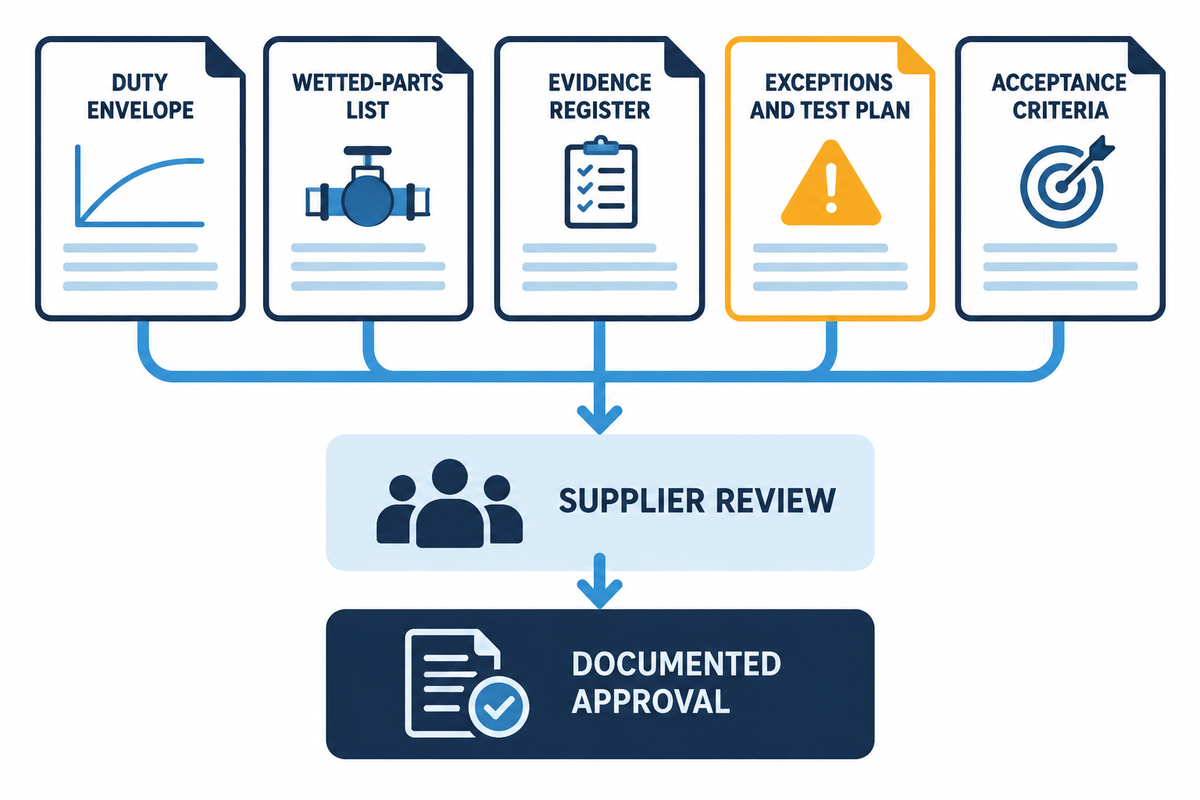
Duty information
- formulation, concentration ranges, impurities, solids, viscosity, density, and particle details;
- normal, cleaning, standby, and upset temperatures and exposure times;
- batch size, pressure or vacuum, speed, torque, and required mixing outcome;
- cleaning agents, concentrations, sequence, temperature, contact time, and frequency;
- hazardous-area, static, hygiene, purity, and documentation requirements.
Supplier response
- complete wetted-material schedule with alloy grades and polymer compounds;
- Include details of welds, surfaces, coatings and linings, gaskets, scrapers, seals, valves, and instruments.
- compatibility assumptions, evidence sources, exclusions, and unresolved combinations;
- material certificates, contact declarations, coating records, and traceability;
- Proposed tests, sample quantities, acceptance criteria, inspection method, and witness points;
- Approved deviations, and the party responsible for each open risk.
Change triggers
Approval is for the documented configuration. Changes to the formulation, supplier, concentration, cleaner, temperature, batch time, solids, seal compound, alloy grade, coating, surface finish, or fabrication route require a new review.
For a butterfly disperser, state the desired viscosity range, state the duty of dispersion, wall scraping, type of vacuum and/or pressure, and provide the material schedule (or equivalent) in the RFQ. Use the Butterfly Disperser Mixer page to discuss equipment configuration and answer the inquiry.
Other configurations of equipment may alter the contact map, even if the function is the same. Compare a triple shaft mixer for high-viscosity mixing, a double planetary mixer for dense pastes, and a basket mill for milling and dispersion only after the duty envelope is complete. For a vessel-centered application, IDA’s CR reactor selection guide illustrates why evidence of compatibility and equipment categories are separate.
Frequently Asked Questions
Is 316L stainless steel always compatible with mixer service?
No. 316L is suitable for many industrial duties, but real suitability depends on the chemical, chloride, concentration, temperature, deposits, crevices, stress, welding, surface, abrasion, and cleaning cycle. For assessment of localized corrosion and stress corrosion cracking consider evidence relating to the actual case.
Can a chemical compatibility chart select every mixer component?
No. Use Level 1 charts to screen the obvious mismatches and identify the candidates. Ratings may use different compounds, test temperatures, exposure times, or definitions of “good.” For combinations where uncertainty or consequences are high, use precise supplier data and application-specific tests to assess motion, compression, abrasion, welds, crevices, coating adhesion, cleaning, and extractables.
What should a buyer send a supplier for a material review?
Submit the entire duty envelope (ingredients, concentration, and impurity range; pH; solids; particle size and distribution; temperature, pressure, or vacuum; exposure time; cleaning chemicals; batch sequencing; upset conditions; purity limits; and required contact documentation). For component-level requests, provide the vessel, shaft, impeller, scraper, seals, gaskets, valves, liners, welds, fasteners, and instrumentation. The supplier should state their assumptions, exclusions, evidence, and unsolved items, in writing.
Which mixer components often reveal compatibility problems first?
Seals, gasket edges, scraper contacts, impeller leading edges, weld zones, crevices, bottom outlets, coating edges, and stagnant regions should be prioritized. They often incorporate a combination of chemistry and one or more of the following: motion, abrasion, deposits, compression or contact loading, or difficult cleaning. The first failure point depends on the compound and design, so inspection locations should follow the expected mechanism.
How should seals and scrapers be checked before approval?
Confirm the exact compound, temperature and chemical limits, dimensional stability, hardness or strength retention, compression or contact load, wear behavior, extractables, and cleaning exposure. Use controlled liquid exposure where appropriate, then test finished components under representative motion and assembly conditions. Define limits of rejection for wear, leakage, fragments, loss of cleaning, swelling, hardening, cracking, or deformation.
When is a butterfly disperser mixer relevant?
It’s important to look for a configuration that performs bulk turnover with wall scraping and high-shear dispersion for a process requiring medium- to high-viscosity liquids. Process fit does not determine mixer material compatibility by itself. You’ll have to evaluate the vessel, shafts, dispersers, butterfly agitator, scraper, seals, valves, and the exposure to cleaning, as separate contact components, and then check the machine configuration with the supplier.
Conclusion: Approve the Evidence Chain, Not a Material Name
There’s a defensible way to evaluate material compatibility for mixers. This begins with the 9-Field Duty Envelope, maps all exposure classes, employs the Weakest-Wetted-Part Rule, and addresses unknowns in the COMPASS matrix, and ultimately escalates them in the 4-Level Evidence Ladder. The assumptions, materials, tests, acceptance limits and change triggers that formed the basis for the final recommendation should be described in the final RFQ.
That process doesn’t generate a “best material” in a universal sense. That process will not produce a universal “best material.” It produces something more useful: a component-by-component decision that an engineer, supplier, quality team, and buyer can review before the mixer enters production.
References & Sources
- ASTM G31, Laboratory Immersion Corrosion Testing of Metals ASTM International
- ASTM D471, Rubber Property, Effect of Liquids ASTM International
- Corrosion Resistance of Stainless Steel Outokumpu
- Looking Beyond Chemical Compatibility Charts Trelleborg Sealing Solutions
- Hygienic Design Improves Safety and Reduces Cost Alfa Laval
- 21 CFR 117.40, Equipment and Utensils Electronic Code of Federal Regulations