Get in Touch with IDA
Double Shaft Mixer
Request a Quote
Professional Double Shaft Mixing Machine with Scraper
IDA industrial twin shaft mixer integrates high-speed dispersion and low-speed stirring, with innovative PTFE wall-scraping technology. Purpose-built for medium to high viscosity materials from 3,000 to 250,000 cps.
20+
Years Experience
50+
Countries Served
3000+
Mixers Delivered
What is a Dual Shaft Mixer?
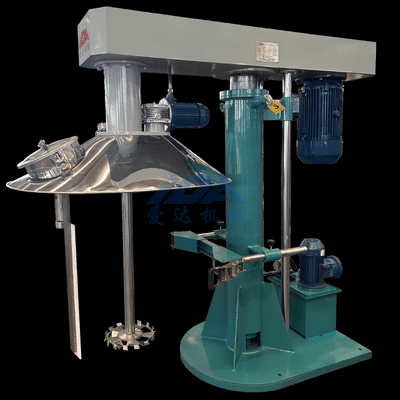
A dual shaft mixer (also known as a double shaft or twin shaft mixer) is the most advanced industrial mixing machine for preparing thick muds or slurries. Two independent shafts work together to achieve greater mixing efficiency than a conventional single-shaft mixer.
This type of mixer uses two distinct mixing shafts: a fast shaft producing very high shear and speed, and a slower agitator shaft that turns at a lower speed and scrapes the walls of the mixing chamber to enhance mixing of bulk materials. The two shafts can operate independently, with separate speed adjustment options.
This type of mixer uses two distinct mixing shafts: a fast shaft producing very high shear and speed, and a slower agitator shaft that turns at a lower speed and scrapes the walls of the mixing chamber to enhance mixing of bulk materials. The two shafts can operate independently, with separate speed adjustment options.
High-Speed Disperser Shaft
This shaft turns up to 1500 RPM, providing aggressive particle dispersion, agglomerate reduction, and high-shear mixing of pigments and fillers.
Low-Speed Anchor Agitator
This shaft moves at speeds up to 60 RPM and has specially designed scraper blades that efficiently move material in the mixing chamber, optimize heat transfer, and eliminate areas that are not being mixed properly (dead zones).
Independent Speed Control
With variable-frequency drives on each shaft, you can control each shaft’s speed separately, optimizing each mixing formulation.
Key Features of IDA Double Shaft Mixing Machine
Engineered for demanding industrial applications, our twin shaft mixer delivers exceptional performance, reliability, and versatility.
1
Lifting method: manual lifting, electric lifting, hydraulic lifting
2
Clamping method: belt clamping, manual clamping, pneumatic clamping
3
Volume: 2L-3000L (customized according to customer requirements)
4
Viscosity range: 3000-250000cps
5
Optional: explosion-proof type, vacuum sealed type, heating type, PLC intelligent type, etc.
6
With the wall scraping function, the material does not stick to the wall
7
High speed and low speed can run independently, frequency conversion speed regulation
8
High stirring efficiency and good quality: Two sets of stirrers work at the same time, and the stirrer is equipped with a scraper and a high-speed disperser, which is more efficient
Double Shaft Mixing Machine Technical Specifications
← Scroll horizontally to view all data →
| Model | Effective volumeL | Dispersion powerkw | Dispersion speedrpm | Mixing powerkw | Mixing speedrpm | Lifting heightmm |
|---|---|---|---|---|---|---|
| TSJ50 | 50 | 4 | 0-1450 | 3 | 0-150 | 450 |
| TSJ100 | 100 | 5.5 | 0-1450 | 4 | 0-150 | 600 |
| TSJ200 | 200 | 7.5 | 0-1450 | 5.5 | 0-150 | 800 |
| TSJ500 | 500 | 18.5 | 0-1450 | 11 | 0-120 | 900 |
| TSJ1000 | 1000 | 30 | 0-1450 | 22 | 0-100 | 1000 |
| TSJ1500 | 1500 | 37 | 0-1450 | 30 | 0-80 | 1200 |
| TSJ2000 | 2000 | 55 | 0-960 | 37 | 0-80 | 1500 |
How Our Double Shaft Mixer Works
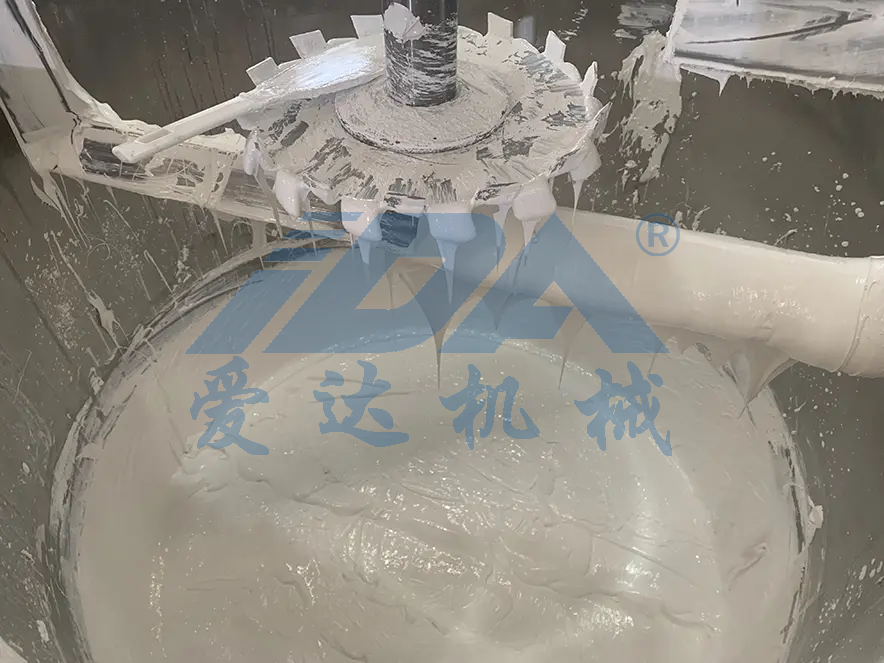
The double-shaft mixer uses two motors to provide power, which rotate under the drive of the power mechanism. During rotation, the material is driven to rotate both axially and radially. The high-speed dispersion shaft is driven by a belt or a synchronous belt, with low power loss, and is equipped with a high-end inverter for speed regulation. Driven by the high-speed shaft, the dispersion plate runs at high speed and performs a strong shearing function; the low-speed shaft is driven by a sprocket chain, with a high transmission ratio, and is equipped with a fixed-speed reducer, which can transmit a large torque, drive the mixing shaft to make a circular motion along the axis direction, and drive the material as a whole to rotate along the axis. At the same time, PTFE scraping materials are used around the agitator to scrape the inner wall and bottom of the barrel, effectively preventing material from adhering to the mixing kettle walls.
High-speed Shaft
Belt or synchronous belt driven with low power loss, equipped with a premium inverter. The dispersion plate provides strong shearing, resulting in excellent particle size reduction.
Low-speed Shaft
Sprocket chain driven with a high transmission ratio and a fixed-speed reducer transmits a large torque, driving the material in circular axial motion throughout the vessel.
PTFE Scraper System
Positioned around the agitator to continuously scrape the inner wall and bottom, preventing material adhesion in the mixing kettle.
Result
Superior mixing efficiency compared to single-shaft mixers, with excellent stirring and dispersion for high-viscosity materials.
Working Principle
Working Principle – View 1
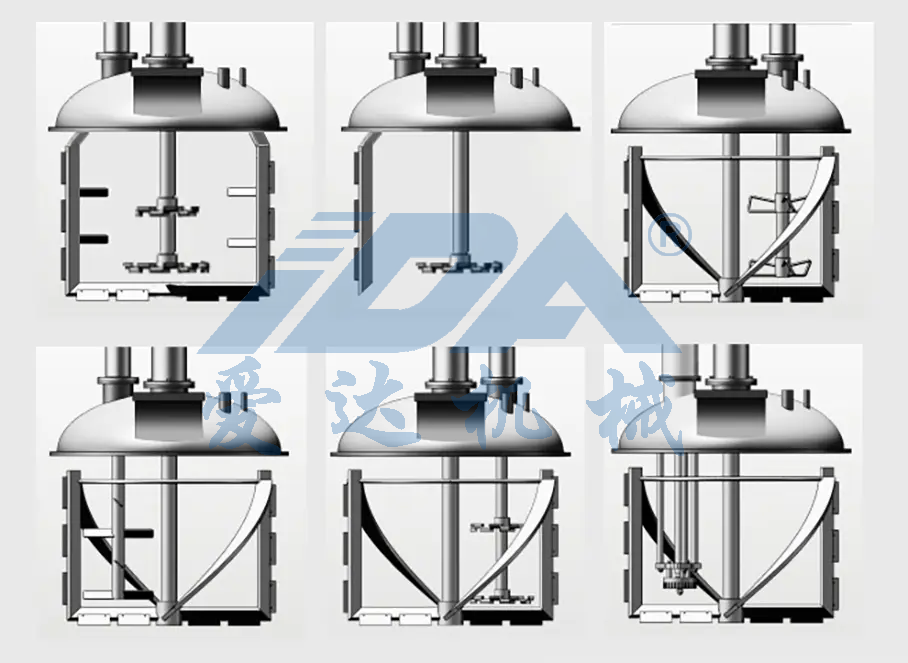
Working Principle – View 2
Click to Play Video
How Our Dual Shaft Mixer Solves These Challenges
The scraper-equipped IDA dual-shaft mixer is designed to address all issues associated with mixing heavy (high-viscosity) products and to provide reliable mixing performance.
PTFE Scraper Technology Eliminates Wall Sticking
As the IDA dual-shaft mixer has PTFE blades (which “scrape” the walls of the process vessel) during operation, it will continuously keep the walls of the vessel & bottom clean to achieve 100% participation of the material in the process mixing.
- Zero dead zones in the mixing vessel
- Reduced material waste and easier cleaning
- Improved heat transfer through vessel walls
Counter-Rotating Dual Shaft System
The anchor agitator (high-speed disperser) rotates counterclockwise while the rotor rotates clockwise. This counter-rotation creates a turbulent flow pattern, enhancing the mixing efficiency of thixotropic products.
- Complete dispersion of pigments and fillers
- Homogeneous mixing up to 250,000 cps
- Superior results vs single shaft mixers
Independent Variable Frequency Speed Control
The VFDs for both shafts can be programmed to independently Optimise Mixing Conditions. The design of the high-viscosity mixer has resulted in time savings, with batch times reduced by up to 40% when using an efficient mixer.
- High-speed shaft: 0-1500 rpm adjustable
- Low-speed shaft: 0-60 rpm with high torque
- Dramatically reduced processing time
Flexible Agitator Configurations
Select from a wide range of agitator configurations to meet your specific Application Needs. High Speed + Low Speed, Dual Dispersers, Dispersion + Emulsifying, etc.
- Anchor, paddle, and frame type available
- Custom configurations for your materials
- Easy changeover between processes
Types of Double Shaft Mixing Machine
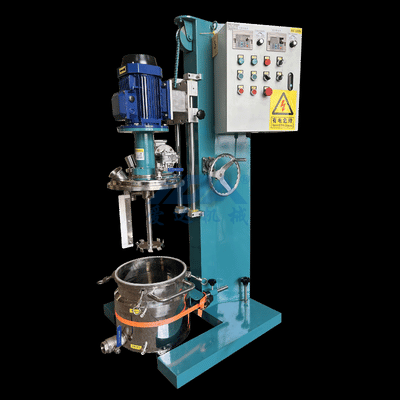
1. 20L Sealed Cylinder Head Hand-Cranked Lifting Single-Scraper Concentric Twin-Shaft Mixer
Introduction
IDA 20L concentric twin shaft mixers provide a laboratory-scale and pilot-production solution, with a compact design for precise mixing and production. They use a sealed cylinder head to provide a clean system, especially when no air should be present or when a vacuum is needed during mixing. This device uses a cost-effective, hand-cranked (manual) lift system and is suitable for batch operations.
Key Advantages
- Versatile Mixing: By combining high-speed dispersion with low-speed stirring, this mixer can effectively mix medium- to high-viscosity materials.
- Sealed Operation: The seal design enables vacuum seal mixing. This feature reduces the amount of air added to thixotropic materials, such as gels or pastes, during mixing and helps remove air.
- Efficient Scraping: With its single scraper that goes around the wall of the burral ensuring all viscous material is evenly distributed without sticking.
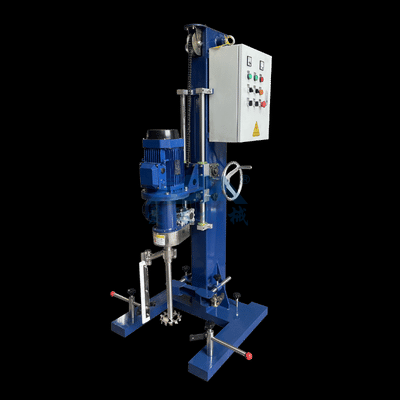
2. 20L Hand-cranked Lifting Single-Scraper Concentric Twin-Shaft Mixer
Introduction
This Model IDA 20L provides the same powerful capability as a Dual Shaft Mixer with its Standard configuration. It was designed specifically for producing small batches of paint, ink, soft ointment, and other materials. The product is equipped with a manual hand-crank lifting system, providing a low-cost, simplified approach to operating the mixer on an ongoing basis.
Key Advantages
- Dual-Action Performance: The low-speed mixer provides a turbulent (agitated) action to move the product through the mixing chamber toward the high-speed disperser head, which significantly improves efficiency compared to a single-shaft mixer.
- Cost-Effective Control: Because lifting is manual, this approach is highly reliable and significantly reduces energy requirements on a small-volume basis.
- Uniform Consistency: The concentric design allows the product to move axially and radially, ensuring uniform mixing throughout the entire product.

3. 30L Electric Lifting Tank Type Concentric Twin-Shaft Mixer
Introduction
The IDA 30L Mixer is an electric lift apparatus with increased capacity. The Electric Lift feature provides automated lifting during loading/unloading and enables smoother operation across a range of viscosities from 3000 to 250000 CPS.
Key Advantages
- Automated Operation: Electric lifting ensures smooth, consistent lifting of the mixing head, enhancing the productivity of the entire process.
- Adaptability: The IDA 30L Mixer can accommodate various types of mixing equipment, including anchor mixers, paddle mixers, and frame mixers, depending on customers’ production requirements.
- No Dead Zones: The scraper system prevents material from adhering to the wall, significantly reducing the time required to create a medium-viscosity batch.

4. 50L Electric Heating Vacuum Concentric Twin-Shaft Mixer
Introduction
The IDA 50L Mixer is designed for use with products that require precise temperature control and air removal. This mixer is ideal for cosmetic creams, face creams, soldering pastes, and other products that require precise temperature and removal of air during the manufacturing process.
Key Advantages
- Temperature Control: The electric heating function maintains the material’s proper temperature throughout the blending process.
- Bubble-Free Results: The vacuum-sealed design prevents air from entering during mixing, which is critical for high-quality electronic glues and medical ointments.
- Complex Material Handling: This specially designed mixer can handle thixotropic materials such as polyurethane glue and silicone sealant without difficulty.
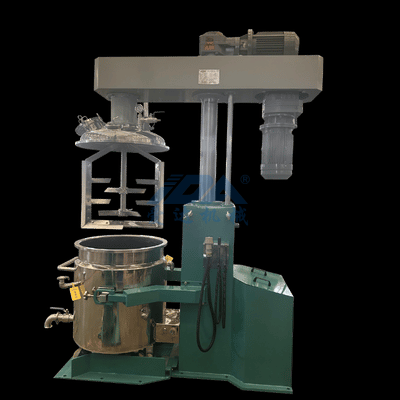
5. 300L Electric Heating Concentric Twin-Shaft Mixer
Introduction
Made for the mid-sized market, the IDA 300L Mixer has a large capacity and is an electric-heating mixer. It was made for heavy-duty mixing of automotive putty, polymers, and offset inks used in printing and coating applications.
Key Advantages
- High-Torque Transmission: The chain drive operates at a lower speed than the gear drive and has a high transmission ratio, producing more torque than is required for most larger, thicker product batches.
- Integrated Heating: The heating element allows thick, heavy products to be mixed, making them easier to work with.
- Independent Speed Control: The use of frequency conversion for both high- and low-speed shafts allows individual control of each shaft, independent of the other, providing improved process adjustment and control.

6. 500L Concentric Twin-Shaft Mixer (Hydraulic Lifting Type with Cover & Single-Scraper)
Introduction
IDA has introduced the 500L series, an innovative advance that enables the manufacture of large quantities at once. The model includes hydraulic lifting for heavy-duty stability, safety, and sanitation, with a top cover, and a single scraper system that can readily manage large volumes of viscous materials.
Key Advantages
- Heavy-Duty Lifting: Hydraulic lifting provides stable and powerful lifting of a large mixing head weighing up to 500 Lbs. for mass production.
- Mass Production Efficiency: The dual scraper design and two-shaft technology result in significant time savings by eliminating wall buildup during the mixing process when producing large amounts of material.
- Versatile Configurations: The IDA 500L series can be fitted with various stirrer combinations to accommodate different reactions, including high-speed dispersion and low-speed stirring.

7. 1000L Explosion-proof Hydraulic Lifting Concentric Twin-Shaft Mixer
Introduction
With a focus on safety and high-volume production, the IDA 1000L Explosion-Proof Mixer is an industrial leader that features Explosion-Proof Electrical Components, making it a mandatory selection for solvent-based and volatile materials such as acrylic paints and some adhesives during processing.
Key Advantages
- Operational Safety: The explosion-proof design provides peace of mind when handling flammable or volatile chemical compounds.
- Powerful Shearing: Thanks to a high-end inverter, the high-speed dispersion plate delivers incredible shear force, even at large volumes.
- Durability: The IDA 1000L Mixer can produce 1000L batches due to its strong hydraulic raising system and high-strength Component Transmission System.

8. 1000L Gantry-type Double-Column Hydraulic Lifting Concentric Twin-Shaft Mixer
Introduction
The IDA 1000L Gantry-type mixer uses a Double-Column Hydraulic-Lifting Structure to provide maximum stability during large-scale mixing operations. This design (“Gantry”) provides superior structural integrity for mixing extremely heavy or highly viscous batches, with complete agitator alignment throughout the process.
Key Advantages
- Structural Stability: The Double-Column (Gantry) design minimizes vibration and wear during mixing of extremely heavy materials, enhancing equipment longevity.
- Superior Mixing Quality: Two sets of stirrers, in conjunction with PTFE scrapers, ensure no material remains stuck on the sides of the mixing tank.
- Process Optimization: Provides a solution to the inability of single-shaft stirring to effectively mix large volumes of viscous materials.
Dual Shaft Mixer Selection Guide & Comparison
Use our interactive tools to find the perfect mixer for your application. Get personalized recommendations or compare single- and dual-shaft technologies side by side.
1
Industry
2
Viscosity
3
Capacity
4
Features
Select Your Industry
What type of products do you manufacture?
Select Viscosity Range
What is the typical viscosity of your materials?
Select Production Capacity
What batch size do you need?
Select Required Features
Select all features you need (optional):
Your Recommended Mixer
DSM-500 Dual Shaft Mixer
Recommended Features:
Single Shaft vs Dual Shaft Mixer Overview
Single Shaft Mixer
Standard Technology
- Viscosity Range 1 - 50,000 cP
- Shaft Speed 500 - 3,000 RPM
- Power Efficiency
- Best For Low-Med Viscosity
Advantages
- Lower initial investment
- Simpler maintenance
- Smaller footprint
Limitations
- Limited high-viscosity handling
- Longer mixing times
Recommended
Dual Shaft Mixer
Advanced Technology
- Viscosity Range 3,000 - 250,000 cP
- Shaft Speed 10-60 + 500-3,500 RPM
- Power Efficiency
- Best For High Viscosity
Advantages
- Superior high-viscosity mixing
- 40-50% faster mixing times
- 98-99.5% homogeneity
Considerations
- Higher initial investment
Key Performance Metrics Comparison
Mixing Time (per batch)
Single Shaft
45-60 min
Dual Shaft
20-30 min
Homogeneity Achieved
Single Shaft
92-95%
Dual Shaft
98-99.5%
Material Waste Rate
Single Shaft
5-8%
Dual Shaft
1-2%
Daily Throughput
Single Shaft
8-10 batches
Dual Shaft
16-20 batches
Energy Consumption
Single Shaft
45-55 kWh
Dual Shaft
35-45 kWh
Cleaning Time
Single Shaft
30-45 min
Dual Shaft
15-25 min
Industry Application Suitability
| Industry / Application | Single Shaft | Dual Shaft | Recommended |
|---|---|---|---|
| Coatings & Paints High-viscosity paints, primers |
Fair | Excellent | Dual Shaft |
| Adhesives & Sealants Silicone, polyurethane, epoxy |
Poor | Excellent | Dual Shaft |
| Cosmetics Creams, lotions, gels |
Fair | Excellent | Dual Shaft |
| Pharmaceuticals Ointments, suspensions |
Fair | Excellent | Dual Shaft |
| Battery Slurry Li-ion electrode materials |
Not Suitable | Excellent | Dual Shaft |
| Low-Viscosity Liquids Water-based solutions |
Excellent | Good | Single Shaft |
3-Year Total Cost of Ownership
Single Shaft Mixer
Initial Equipment
$25,000 - $40,000
Installation
$3,000 - $5,000
Annual Energy
$8,000 - $12,000
Annual Maintenance
$2,000 - $3,500
Material Waste (5-8%)
$15,000 - $24,000/yr
3-Year Total
$157,000+
Dual Shaft Mixer
Initial Equipment
$45,000 - $75,000
Installation
$5,000 - $8,000
Annual Energy
$6,000 - $9,000
Annual Maintenance
$3,000 - $5,000
Material Waste (1-2%)
$3,000 - $6,000/yr
3-Year Total
$116,000+
Investment Analysis Summary
While dual shaft mixers have higher upfront costs, they typically deliver 26% lower total cost of ownership over 3 years through reduced waste, faster processing, and lower labor costs. ROI payback period: 12-18 months.
Request Detailed QuoteIndustry Applications for Dual Shaft Mixer
Our versatile multi-shaft mixer serves diverse industries that require precise mixing of high-viscosity materials.
Coatings & Paints
Architectural coatings, automotive paints, industrial finishes, powder coatings
Adhesives & Sealants
Silicone sealants, PU adhesives, epoxy resins, MS polymers, hot melt
Cosmetics & Personal Care
Creams, lotions, foundations, toothpaste, hair care products
Pharmaceuticals
Ointments, gels, topical creams, transdermal formulations
Battery & New Energy
Lithium battery slurry, electrode paste, separator coatings
Printing Inks
Offset inks, flexographic inks, UV inks, digital inkjet inks
Electronics Materials
Solder paste, conductive adhesives, encapsulants, thermal compounds
Food Processing
Chocolate, peanut butter, sauces, condiments, dairy products
Why Choose IDA Dual Shaft Mixer?
Work with an established, safe plan and an accurate provider who is dedicated to delivering high-quality, innovative, on-time products for customer success.
Factory Direct
Buy direct from the source, without third-party interference, for lower prices. Technical assistance is included throughout the entire process.
Custom Solutions
Each mixer manufactured by IDA can be modified (customized) according to your own individual needs in relation to your materials and the way you use them. Our engineers work with you to optimize performance.
Quality Certified
All products manufactured by IDA are ISO 9001 compliant, as evidenced by the CE marking, and ATEX-certified explosion-proof products are available to ensure safety in potentially hazardous areas.
Technical Support
Comprehensive pre-sales consultation, installation guidance, operator training, and responsive after-sales service.
Proven Engineering Solutions
See how our Dual Shaft Mixing Machines resolve critical challenges for clients in high-viscosity and precision industries.
Industry: Adhesives & Sealants
Overcoming "Dead Zones" in 200,000 cps Silicone Sealant Production
The Challenge
A United States-based company that produces sealants had problems mixing high-viscosity silicone (about 200,000 cps) with its single-shaft mixer, resulting in material sticking to the tank walls and creating "dead zones" where the material did not mix thoroughly, leading to inconsistent curing times.
Our Solution
To resolve this issue, we installed a Dual Shaft Mixer (with a scraper) with a capacity of 1000L. The two shafts counter-rotated, creating a turbulent flow that broke up thixotropic structures, while a PTFE scraper was positioned along the edges of the tank to prevent material from remaining on its walls. This ensured that 100% of the material was used in the final product.
40% Efficiency Boost
Batch time reduced from 5 hours to 3 hours, with zero unmixed residue detected.
Industry: Lithium Battery
Achieving Bubble-Free Homogeneity for Battery Slurry
The Challenge
A R&D laboratory that develops new energy vehicles experienced issues producing a sufficient quantity of cathode paste because air bubbles formed during mixing, resulting in defects when the electrodes were coated. The laboratory's standard mixing equipment had limited ability to create and maintain a vacuum.
Our Solution
To solve this problem, we supplied a laboratory-scale Vacuum Dual Shaft Mixer. This mixer provides an effective vacuum seal (-0.098 MPa) to degas the cathode paste while maintaining precise temperature control as it is processed at high shear rates. Therefore, air bubbles do not form during processing.
Zero Defects
Achieved bubble-free paste with high solid content, enabling successful scale-up to production lines.
Industry: Coatings & Paints
Reducing Raw Material Waste in Automotive Paint Mixing
The Challenge
An Automotive Coatings Manufacturer Lost a Great Deal of Material. This Is Due to The Fact That Some Very Expensive pigment Was Sticking to The Tank, Which Had to Be Manually Scraped out, Causing Colour Discrepancies from Batch to Batch.
Our Solution
The Solution Was to Use a Hydraulic Lifting Double-Shaft Disperser. The Hydraulic Lifting Double Shaft Disperser Provides Independent Speed Control of the Low-Speed Anchor and High-Speed Dispersers. Due to Its Close Tolerance Design, All Pigments Will Be Swept Back Into The Mixing Zone.
15% Cost Reduction
Material waste dropped significantly, and color consistency (Delta E) improved across all production batches.
Frequently Asked Questions (FAQs)
The foundation and electrical setup should be installed according to industry standards and the manufacturer's recommendations to ensure compliance with all load capacity and accuracy requirements. Next, the installation site should be clearly defined, along with the intended use of the mixer. Be sure to run the mixer before installation to ensure everything functions correctly and identify any potential problems before the mixer is fully operational. Installing the double shaft mixer correctly ensures long-term reliability and safety during operation.
When installing the agitator assemblies on a double shaft mixer, refer to the manufacturer's installation instructions for the following items: Shaft alignment, coupling installation, and bearing preload. To properly align the shafts, separate each shaft into sections and use a dial indicator or a laser measuring tool to align the shafts and the drive motor. For a proper setup of the double shaft mixer, a low-speed run-through is necessary to check for excessive noise or vibration. In addition, during the low-speed run-through, inspect the lubrication systems for proper function to achieve long-term durability and reliability. If the lubrication systems do not function during the initial run-through, consult a technician for troubleshooting.
A double-shaft mixer can be installed by an inexperienced installer with the assistance of an experienced team; however, most commercial mixers require professional installation. Equipment needed for the installation of a double shaft mixer includes lifting devices (cranes or hoists) to lift the mixer into place, precision-alignment tools, torque wrenches, electrical testers, and all required safety equipment. Having access to technical documentation and factory support will ensure long-term functionality, especially if the mixer has complex controls or integrated material feeding systems.
When setting up material feed lines, it is important to create an installation environment that prevents dead spots or suboptimal feed flow to the mixing zone. As such, it is important to place feed hoppers, conveyors, or dosing systems so that they provide material feed as close to the double shaft mixer's intended mixing plane as possible, and use metering control valves/ feeders of the highest quality to provide a constant flow of feed materials, while ensuring that feed and double shaft mixer agitators operate in synchronisation with each other, allowing for repeatable mixing cycles for optimum process efficiency.
Once equipped with a double shaft mixer, perform the following safety checks: check for proper function of all emergency shut-off switches; check all guards covering the agitators and moving parts; verify the proper implementation of lock/tag procedures; check for appropriate connections to an adequate ground; inspect all seals and ensures proper ventilation to eliminate escape of any materials from the mixer during operation; verify the proper setup of all interlocks and check for proper operation of all access doors; ensure that operator training is complete. These checks provide a safe working environment for operators, as well as ensuring long life and maximum productivity from the double shaft mixer.
The mixer's performance can be severely impacted by environmental factors at the installation site — temperature, humidity, and vibration from surrounding sources. Too much heat may reduce the drive motor's efficiency, whereas excessive humidity may corrode some mixer components or cause caking of powder materials, thereby affecting feed performance. Isolate the double shaft mixer from vibration-generating equipment, provide controlled ventilation, and install climate controls as needed to create consistent processing conditions and ensure optimal quality output from the double shaft mixer.
A planned maintenance schedule should include routine inspections of bearings, seals, and mixer blades; lubrication of the gearbox and any moving components; and alignment checks and tensioning of couplings. Tracking performance metrics (torque value, mix time, product uniformity) allows the operator to identify changes in accuracy. It is also good practice to keep spare parts available for wear components to ensure minimal downtime and that the mixer continues to produce high-quality, homogeneous mixtures with the mixer's structure at maximum strength.
By installing a double-shaft mixer and paying attention to the placement of the agitator relative to the product being mixed, the distance between the shafts (when mixing dry powders) will be optimal for the particle size and shape. Additionally, the feed location should remain fixed during mixing to prevent the flow of either solid materials or fluids. Proper alignment of the double shaft mixer during assembly will minimize vibration and energy loss, and allow it to achieve better consistency and uniform quality across multiple formulations processed by it.