
Get in Touch with IDA
Adhesive Production Line: Mixing, Dispensing & Turnkey Plant Systems
If you’re setting up a new adhesive plant — or upgrading a line that’s been held together with duct tape and good intentions — you’re in the right place. IDA Equipment designs and builds complete production lines for hot melt adhesive, polyurethane sealant, epoxy resin, silicone, and pretty much any formulation that needs proper mixing, degassing, and filling at scale.
60+
Countries Served
500+
Projects Delivered
15+
Years Experience
100+
Equipment Models

IDA Equipment
Adhesive Manufacturing Equipment & Production Line Systems
Below is what we build. Each piece connects to the next, but you can also buy individual units if you’re retrofitting an existing line.
Mixing — Low/Medium Viscosity
Dual-Shaft Disperser
Butterfly or anchor blade plus high-speed disperser. Handles adhesives under 100,000 cps — think white glue, PVA, waterborne coatings. Vacuum, heating, cooling all optional. Batch sizes from 50L to 3,000L.
Mixing — Medium Viscosity
Tri-Shaft Multi-Purpose Disperser
Anchor scraper + dual high-speed dispersers (or anchor + disperser + spiral). Built for products up to 300,000 cps. Popular with sealant and polyurethane producers. Vacuum degassing and jacketed heating standard on most configs.
Mixing — High Viscosity
Double Planetary Mixing System
This is the workhorse for thick stuff. Paddle, claw, twist, or frame agitators — we match the blade geometry to your formulation. Processes materials up to 1,500,000 cps. From 5L lab units to 2,000L production vessels. No dead zones, no unmixed pockets.
Discharge
Hydraulic Extruder & Discharge Press
Because thick adhesive doesn’t exactly pour itself. Designed for materials with poor flowability — extrusion pressure configured to match your product thickness. Lifting mechanism optional for easy coordination with downstream filling. Residue-free discharge up to 300 tons extrusion force.
Filling & Packaging
High-Viscosity Filling Machine
Semi-auto or fully automatic. Handles packages from 0.5 kg cartridges to 50 kg drums. Integrated filtration before filling removes particulates. Custom nozzle designs for different container types — tubes, cartridges, pails, drums.
Reaction
Reaction Kettle
For when your process involves actual chemistry — sulfonation, polymerization, condensation. Jacketed vessel with agitator, shaft seal, and custom heating (steam, oil, or water). Normal-pressure or pressurized configs. SS304 or SS316L construction.
Material Handling
Automatic Feeding System
PLC-controlled storage tanks, conveying pumps, pneumatic valves, metering tanks, and weighing modules. Sets batching parameters automatically. Replaces manual scooping — which, let’s be honest, is where most batch-to-batch variation comes from.
Support Equipment
Vacuum & Temperature Systems
Water-ring or rotary-vane vacuum pumps for degassing. Jacketed heating and cooling (oil or water circulation). Condensation recovery. Temperature control is critical — especially for hot melt and reactive systems where a few degrees change everything.
Adhesive Production Line Specifications & Capacity
Equipment Specifications
← Scroll horizontally →
| Equipment | Working Volume | Max Viscosity | Motor Power | Material |
|---|---|---|---|---|
| Dual-Shaft Mixer | 50 – 3,000 L | 100,000 cps | 7.5 – 55 kW | SS304 / SS316L |
| Tri-Shaft Mixer | 100 – 2,500 L | 300,000 cps | 15 – 75 kW | SS304 / SS316L |
| Planetary Mixer | 5 – 2,000 L | 1,500,000 cps | 5.5 – 132 kW | SS304 / SS316L |
| Extrusion Press | Matches mixer | — | Up to 300 T force | SS304 |
| Filling Machine | 0.5 – 50 kg/fill | — | 2.2 – 7.5 kW | SS304 / SS316L |
| Reaction Kettle | 50 – 5,000 L | Varies | 5.5 – 45 kW | SS304 / SS316L |
Annual Production Capacity Range
Lab / Pilot Lines
< 50 tons/year
Standard Production
300 – 2,000 tons/year
High-Output Automated
2,000 – 10,000+ tons/year
The actual number depends on batch cycle time, mixer volume, number of mixing stations, and your shift schedule.
Adhesive Type & Recommended Configuration
← Scroll horizontally →
| Adhesive Type | Recommended Mixer | Typical Viscosity | Key Process Steps |
|---|---|---|---|
| Hot melt adhesive | Planetary or Dual-shaft | 5,000 – 500,000 cps |
Melting→Mixing→Pelletizing or block molding
|
| Silicone sealant | Planetary mixer | 200,000 – 1,200,000 cps |
Mixing→Vacuum degas→Cartridge filling
|
| Polyurethane adhesive | Planetary or Tri-shaft | 50,000 – 800,000 cps |
Reaction→Mixing→Degassing→Filling
|
| Epoxy resin | Dual-shaft or Tri-shaft | 10,000 – 200,000 cps |
Resin + hardener mixing→Degassing→Dispensing
|
| PVA / White glue | Dual-shaft mixer | 5,000 – 80,000 cps |
Emulsification→Mixing→Filling
|
| Pressure-sensitive adhesive | Reactor + Dual-shaft | 10,000 – 150,000 cps |
Polymerization→Coating→Drying
|
Wholesale & OEM Adhesive Production Equipment

60+ Countries
Global delivery & installation
01
OEM
Custom branding on control panels, nameplates, and documentation. We’ve done this for about a dozen partners globally.
02
Turnkey Plant Projects
Layout engineering, equipment manufacturing, shipping, installation supervision, PLC programming, operator training. We’ve done full plant builds in Vietnam, Turkey, Saudi Arabia, Nigeria, and Brazil — among others.
03
Spare Parts & After-Sales
Wear parts in stock for most mixer models — blades, seals, bearings. Remote PLC diagnostics available. On-site service within 72 hours for priority accounts in major markets.
04
Bulk Order & Fleet Pricing
Orders of 3+ production lines qualify for project pricing. We’ve structured fleet deals for large chemical groups expanding into multiple facilities. Standardized configs reduce lead time to 45–60 days on repeat orders. Contact us for volume pricing specifics.
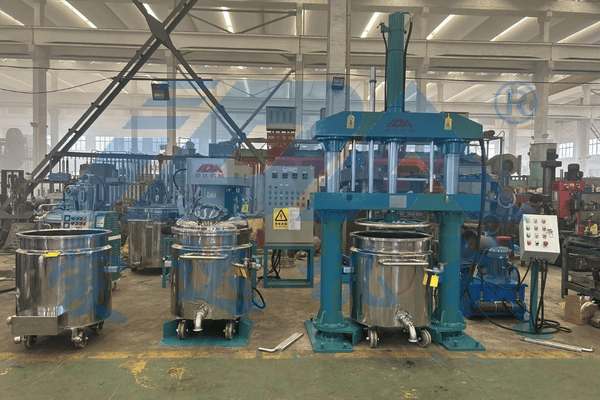
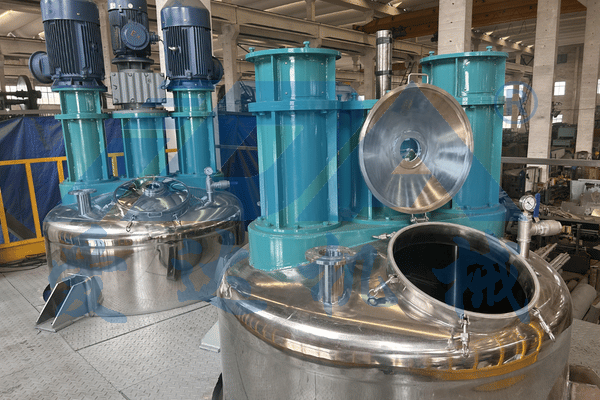
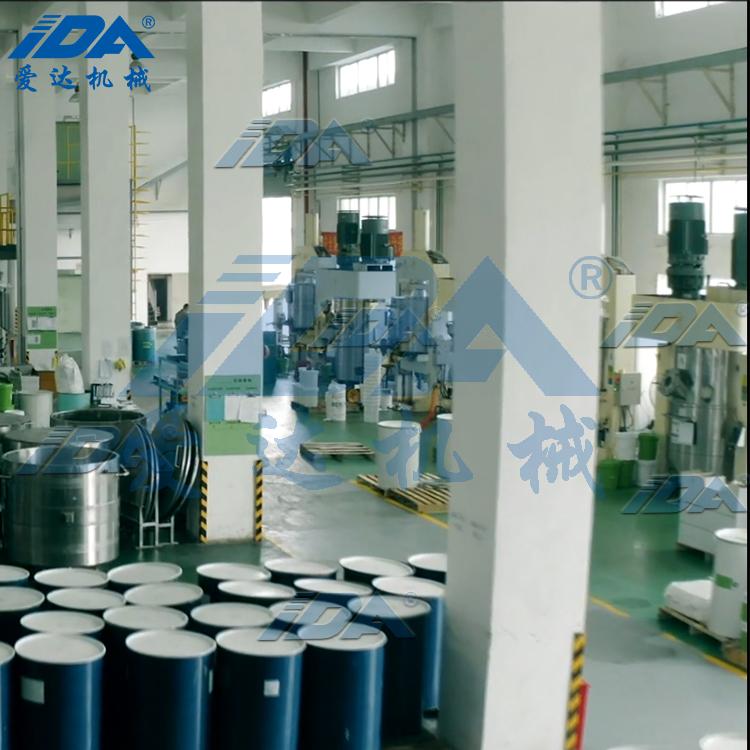
Advanced Manufacturing Facility
Take a look inside our state-of-the-art production base where precision meets industrial scale.



×
![Zoomed View]()
Equipment Selector
Adhesive Mixer Selection Guide
Answer a few questions about your product and we’ll recommend the right mixing equipment for your adhesive production line.
Your Requirements
If unsure, leave blank — we’ll estimate based on adhesive type
Recommended Equipment
Select your parameters
and click “Find My Mixer”
and click “Find My Mixer”
Cost Estimator
Adhesive Production Line Investment Estimator
Get a ballpark investment range based on your capacity needs and automation level. For detailed pricing, request a formal quote.
Project Parameters
Investment Estimate
Configure your project parameters
then click “Estimate Investment”
then click “Estimate Investment”
Comparison Tool
Adhesive Production Method Comparison
Compare equipment requirements, process parameters, and production line configurations for different adhesive types side by side.
Customer Case Studies
Real Projects, Real Production Lines
From plant upgrades to turnkey builds — here’s how our adhesive production line equipment performs in the field.
 Plant Upgrade · 2022
Silicone Sealant Plant Upgrade, Thailand
We got a call from a sealant producer in Thailand back in 2022. They were running about 80 tons per month of silicone-based product on a semi-manual line — two old planetary mixers with manual powder addition. Batch rejection rate was sitting around 8%, mostly viscosity failures. Not catastrophic, but at their volume that’s a lot of wasted material.
We supplied a 1,000L planetary unit with automatic powder dosing and vacuum degassing. Honest moment — the installation took longer than expected because their facility had low ceiling clearance, and we had to redesign the hydraulic lift path on-site. Took an extra week. But once it was running, their rejection rate dropped to under 2% within the first two months. The production manager told us they recovered the equipment cost in about nine months from scrap reduction alone.
Key Result
Rejection rate: 8% → under 2%. Equipment cost recovered in ~9 months.
“We used to re-blend every fourth or fifth batch. Now we might re-blend one in forty.”
— Production Manager, unnamed Thai sealant producer
 Scale-Up · Epoxy
Epoxy Scale-Up, Istanbul
An epoxy adhesive company in Istanbul had been struggling for months to scale a new two-component structural epoxy from their 3L lab mixer to a 300L production batch. Every scale-up attempt changed the curing profile. They’d burned through something like 20 trial batches by the time they reached out.
Here’s what happened: we shipped them a 10L lab mixing unit first, configured with the same blade type and speed ratios as the 300L unit they’d eventually order. They reformulated on the 10L — took about three weeks — and then moved to the 300L with only two adjustment batches. Two. Their head chemist was… let’s say pleasantly surprised. The full line included an extrusion press and semi-automatic cartridge filling station.
Key Result
Scale-up from 3L to 300L with only 2 adjustment batches — after 20+ failed attempts on mismatched equipment.
“We wasted six months trying to scale on mismatched equipment. Should have started here.”
— Head of R&D, epoxy adhesive company, Istanbul
 Automation · Hot Melt
Hot Melt Glue Packaging, UAE
A thermoplastic adhesive producer in the UAE was running a manual drum-filling setup — literally pumping hot melt glue into 25 kg blocks by hand. Two operators, maybe 40 blocks per shift. They needed to triple that number without tripling their crew.
We put together a semi-automatic block molding and cooling line with a metered gear pump and temperature-controlled manifold. The tricky part was maintaining consistent block weight at the higher throughput — hot melt viscosity shifts as it cools through the line, so we added an inline temperature compensation loop. Output went to 120+ blocks per shift with the same two operators. Not going to claim it was perfect from day one — we dialed in the cooling zone timing over about a week of production runs — but the numbers held up after that.
Key Result
Output tripled: 40 → 120+ blocks per shift. Same two operators.
“Same team, triple the output. The math was pretty simple.”
— Operations Director, hot melt producer, Sharjah
 Turnkey · PVA
Turnkey PVA Plant, Nigeria
A Nigerian building materials company wanted to produce PVA-based construction adhesive locally instead of importing. No prior manufacturing experience with adhesives at all. They had a 600 sqm warehouse space and a budget — that’s it.
We designed the full layout: raw material storage area, automatic feeding zone, two dual-shaft mixing stations (each 1,500L), a filtration loop, and a semi-automatic drum filling station. Also specified the boiler, compressed air system, and electrical distribution. Our installation team spent 18 days on-site commissioning everything. The plant hit its rated capacity of 200 tons per month within the first quarter. Not bad for a team that had never made glue before.
Key Result
Zero-to-production in one quarter. 200 tons/month rated capacity achieved by a first-time adhesive manufacturer.
“IDA basically built our factory. We just had to hire operators.”
— Managing Director, construction materials company, Lagos
Frequently Asked Questions
Everything you need to know about adhesive production line equipment, configuration, and project delivery.
A typical line has five main stations: feeding (manual or auto), mixing (the type depends on your viscosity — dual-shaft, tri-shaft, or planetary), extrusion discharge, filtration, and filling. Then there’s the support equipment — vacuum pump, heating/cooling jacket system, PLC panel, piping, and container washing if you run multiple products. We configure each line to match your product list and capacity target.
The low end buys you a small-batch mixer-and-filler setup for pilot production. The high end is a fully automated turnkey plant doing 5,000+ tons a year with PLC control, automatic batching, multi-station filling, and everything in between. Biggest cost variables? Mixer type, automation level, and stainless steel grade. We’ll give you a detailed breakdown once we know your formulation and output target.
It mostly comes down to viscosity. Under 100,000 cps — dual-shaft setup is usually enough. Think white glue, waterborne adhesives, some epoxies. 100,000 to 300,000 cps — a three-shaft unit gives you the extra shear and scraping you need. Polyurethane, some sealants. Above 300,000 cps — planetary mixer, full stop. Silicone sealant, thick epoxy putty, MS polymer, hot melt compounds. We’ll ask for a sample or a formulation sheet and recommend from there. Sometimes we run a trial batch at our facility first — saves a lot of guesswork.
Yeah, that’s actually a growing part of what we do. Turnkey means we handle plant layout, equipment manufacturing, shipping, installation, PLC commissioning, and operator training. You give us the building and the product specs — we give you back a running factory. We’ve done full turnkey projects in Vietnam, Turkey, Saudi Arabia, Nigeria, Brazil, and a handful of others. Usually 120 to 180 days from design sign-off to first production batch.
Standard mixing-plus-filling line — figure 60 to 90 days after we confirm the order and finalize the technical spec. Fully automated turnkey plants take longer, usually 120 to 180 days because of custom PLC work and multi-equipment coordination. Repeat orders on standardized configs ship faster — sometimes 45 to 60 days. We assign a project manager to every order, so you’ll know where things stand at any point.
Somewhat. But our process engineers know how mixing parameters affect product quality, so we can advise on shear rates, temperature profiles, degassing parameters, and batch sequencing. On turnkey projects, we sometimes partner with a local formulation consultant if the client needs recipe development alongside equipment.
We’ve built everything from benchtop setups (a few hundred kilos per month) to full-scale plants pushing 10,000 tons per year. Most mid-range clients land between 300 and 2,000 tons annually. The bottleneck is usually mixing cycle time and the number of mixing stations, not the filling end.