Get in Touch with IDA

Hot Melt Adhesive Equipment Types: A Practical Selection Guide

Contents
show
Hot Melt Adhesive Types Equipment is an awkward way of asking which machines are used to melt, transport, meter, and dispense adhesive on a production line? Hot melt adhesive equipment isn’t a single piece of equipment; equipment configurations vary across the range of hot melt adhesives instead of following one standard hot melt layout. An industrial system may include material feeding, melting, pumping, heated transfer, metering, an applicator, a nozzle or die, and line controls.
This guide compares the main equipment types without treating a product name as a complete specification. It offers a common language for production, maintenance, and procurement teams to discuss the process, compare quotations, and plan acceptance evidence.
Industrial hot melt glue systems are used in packaging, plastic product assembly, electronics assembly, and automotive production, where manufacturers use hot melt materials and hot glue adhesives are used to bond parts repeatably, including products supplied as glue sticks. Small hot melt glue guns and larger automatic glue guns are only one end of that range. The equipment decision changes with the polymer chemistry, adhesion target, bonding strength, heat resistance, impact resistance, and line duty, including whether the bond which forms must provide excellent moisture resistance, whether the material reacts with moisture, and how it behaves in liquid form.
Map the Equipment Chain Before Comparing Models
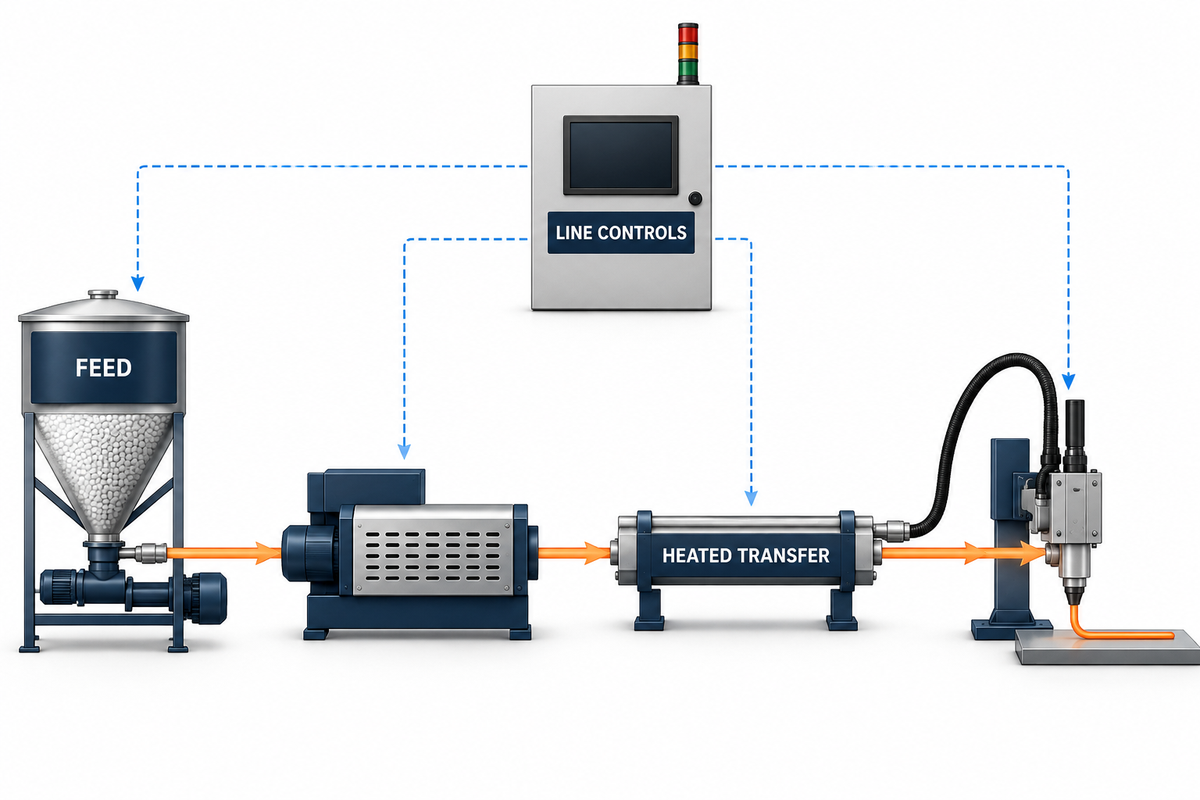
First define the process boundary. A small handgun or benchtop unit may integrate several functions in one package.
| Process role | Common equipment | Question it must answer |
|---|---|---|
| Feed or unloading | Manual refill, hopper, pail or drum unloader, bulk feed | How does adhesive enter the system without contamination or excessive exposure? |
| Melting | Tank melter, grid melter, melt-on-demand unit | Can the system create enough molten adhesive within the allowed thermal window? |
| Pumping and metering | Gear pump, piston pump, pressure regulator, metering unit | Can it deliver stable flow at the required pressure and turndown? |
| Heated transfer | Heated manifold and hose | Can temperature and pressure remain controlled between melter and applicator? |
| Application | Gun, bead nozzle, spray head, fiberizer, extrusion die, slot die, roll coater | Can it create the required pattern on a moving product? |
| Line control | Temperature zones, triggers, encoders, recipes, alarms, interlocks | Can the process be repeated, diagnosed, and safely stopped? |
This Equipment Boundary Map exposes the quotation error where one supplier quotes a complete line, and the other supplier quotes the melter and gun. It also shows ownership. Ask the adhesive supplier for the relevant window and make it part of the equipment trial. The equipment supplier may own the delivery hardware. The line integrator may own the signals, guarding, and timing.
Reactive hot melt and PUR hot melt materials introduce an additional boundary. Their moisture sensitivity before application and moisture-curing behavior afterward may affect bulk hot melt feeding, sealing, purge practice, trial conditions, and hot melt applicators; applications of hot melt in assembly applications require a neat application while the adhesive is in a liquid state and applied in a molten state. Nitrogen protection and a specific cure may not always be assumed for these materials; these requirements should be supplied by the adhesive producer and verified through process validation.
The behavior of some products, such as Polyolefin hot melts, ethylene-vinyl acetate copolymers, pressure sensitive adhesive, and reactive grades, can be different in the same hardware. To choose the right architecture, start with the right hot melt adhesive, its adhesive products, adhesive technology, and hot melt technology, including how the adhesive is heated, not a generic item.
Equipment Types at a Glance
| Type | Primary role |
|---|---|
| Manual glue gun | Operator-controlled bead or dot application |
| Benchtop melter | Small-batch heated supply |
| Tank melter | Stored molten supply for automatic lines |
| Melt-on-demand unit | Melts a smaller inventory near demand |
| Pail or drum unloader | Feeds viscous or reactive material from containers |
| Gear-pump metering unit | Controls continuous or ratio-based flow |
| Automatic bead applicator | Places timed beads or dots |
| Spray or fiberization head | Creates open-area coverage |
| Slot die or extrusion die | Forms a controlled film or profile |
| Roll coater | Transfers adhesive across a surface |
Compare Supply Architectures by the Hidden Bottleneck
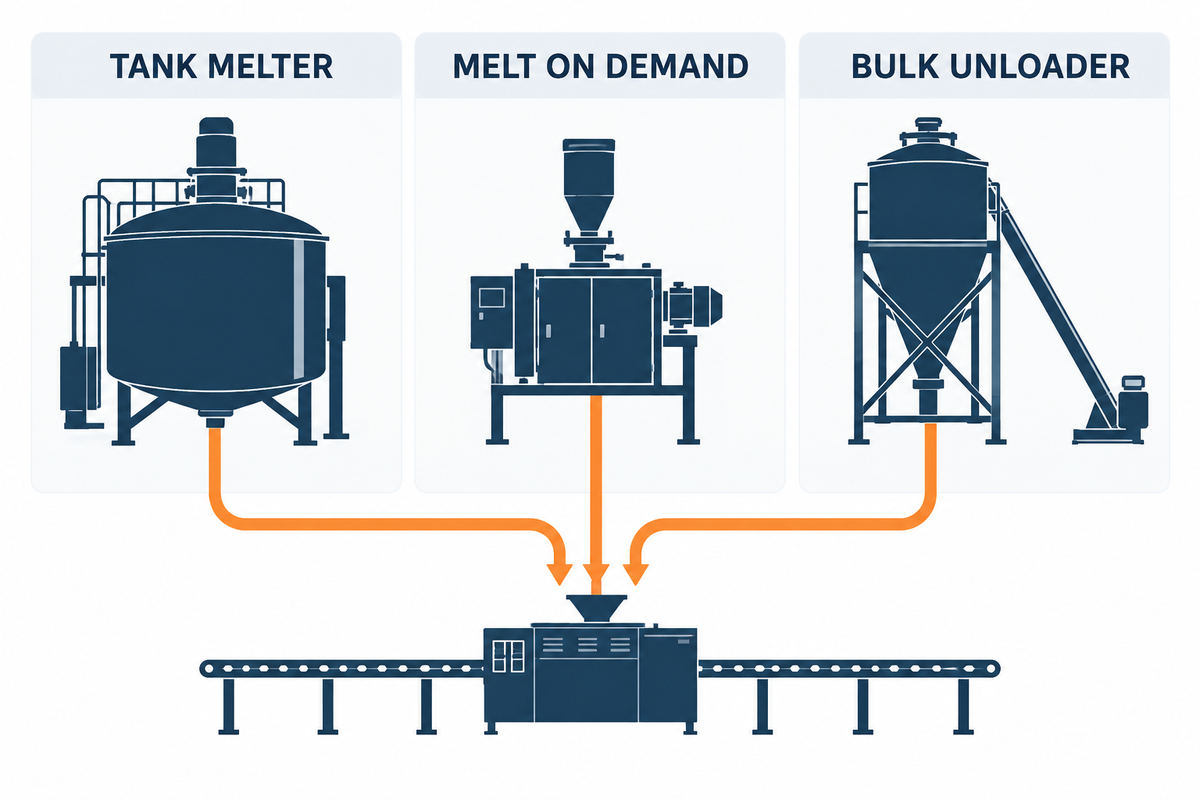
Tank size is visible, and it usually dominates the early discussions, but it isn’t the same as usable line capacity. The limiting factor may be melt recovery, delivery of the pump, hose pressure loss, applicators cycling, refill interruption, the adhesive’s allowable time at temperature, or whether a long open time remains available when the adhesive is applied at the correct application temperature.
| Architecture | Usually fits | Check before selecting |
|---|---|---|
| Handheld or benchtop | Repair, sampling, short runs, manual assembly | Operator consistency, refill frequency, pattern repeatability, ergonomic and burn controls |
| Tank melter | Broad automatic applications with stable demand | Usable recovery with the actual adhesive, exposed molten inventory, refill method, cleaning access |
| Melt-on-demand | Processes seeking less molten inventory and quicker response | Peak recovery, feed reliability, warm-up, adhesive form, control response, maintenance burden |
| Pail or drum unloader | High consumption, viscous or reactive materials, reduced manual handling | Container changeover, follower sealing, residual waste, moisture control, pump service |
| Bulk supply | Continuous high-volume plants | Redundancy, filtration, long transfer paths, shutdown strategy, metering at each user |
Average demand and peak demand (of short duration) are recorded in a Practical Melt-to-Bead Bottleneck Matrix, along with supplier-proven melt rates and pump rates, simultaneous applicators, refill interruption, allowable time at temperature, whether operating at so high a temperature lowers assembly time, and whether the material requires a long shelf life. The smallest verified margin is of interest.
For example, imagine a line that averages 6 kg/h but briefly demands 10 kg/h when several guns fire together. A melter advertised at 12 kg/h may look sufficient. That conclusion is premature if the rating uses a different adhesive form or temperature, if the pump can’t support the combined pressure drop, or if refill recovery overlaps the peak. The example is a method illustration, not a sizing rule.
Heat exposure and recovery matter equally. A manufacturer discussion on heat stability indicates a sample is evaluated after 96 hours at 350°F; that example is a test case, not a universal operating limit. The useful lesson is that color, viscosity, and bond behavior can change with time at temperature. Have the adhesive supplier indicate the operating window and consider it for the equipment trial.
Use Eight Process Inputs to Choose the Architecture
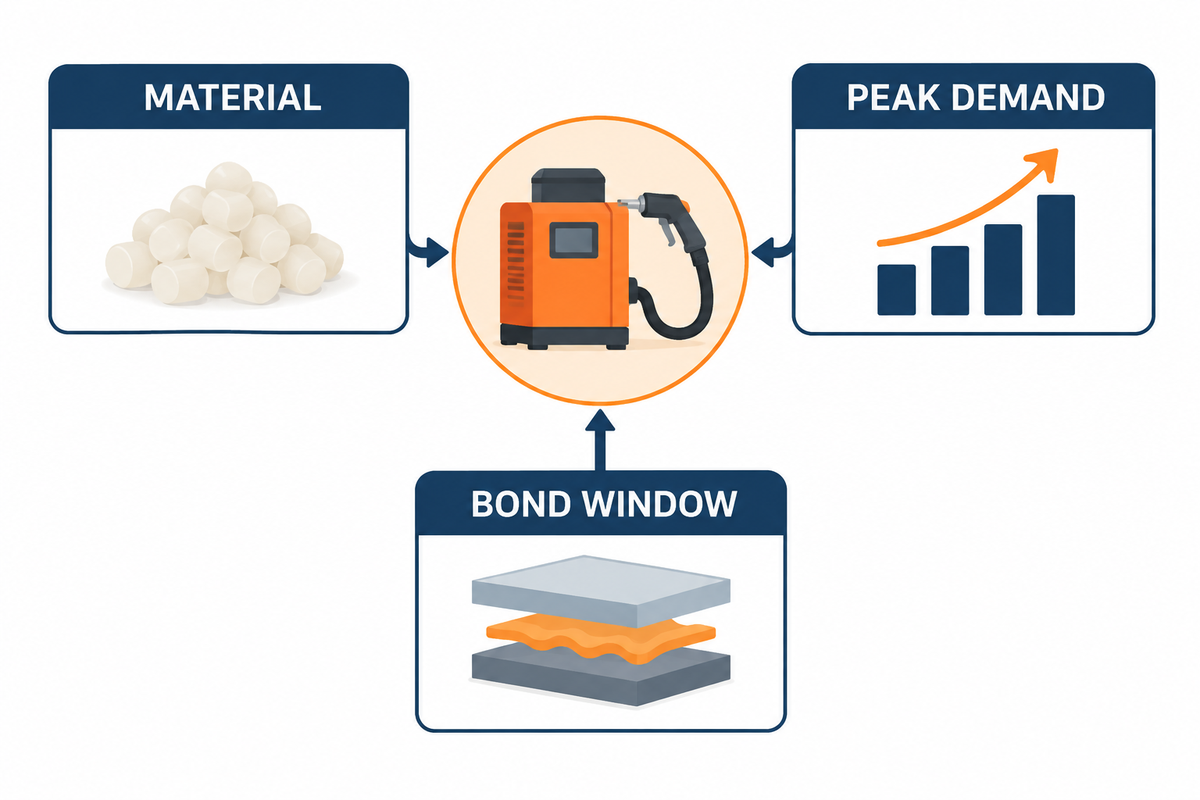
Process inputs should be defined before contacting suppliers for examples. If the inputs are defined vaguely, each supplier will interpret the gaps in their own way and the quotations won’t be comparable.
- Adhesive identity and form: record the commercial grade, lot or representative sample, pellet/block/pillow/drum form, packaging, and any moisture-control requirements.
- Define the supplier’s storage, safe handling, operating-temperature, degradation, and curing guidance, including the softening point temperature and substrate conditions for foam and plastics. Separate thermoplastic hot melts from reactive systems.
- Temperature and viscosity window: give values with their test conditions. A viscosity number without temperature and method cannot guide pump or applicator selection or help a buyer select the best configuration.
- Average and peak consumption: determine from measured pattern mass and production rate if possible. State start-up, simultaneous firing and upset conditions.
- Duty cycle: state shift length, planned stops, weekends off, warm up expectations and how long adhesive may remain molten.
- Pattern and tolerance: describe bead or dot size, spray width, fiber, uniform film or full coating; include placement, coat weight, cut off, edge quality, allowable variation, and the stress or weight the bond must carry.
- Substrate and bond window: describe surface conditions, temperature, open time, compression or nip conditions and cooling or curing conditions downstream.
- Changeover and cleaning. State product changeovers, color or adhesive changes, contamination limits, purge, access, waste and expected maintenance time.
Put numbers and units beside each input: demand in kg/h, temperature in °C, viscosity in mPa·s at a stated method, line speed in m/min, coat weight in g/m², bead width in mm, delivery pressure in bar, open time in s, heater load in kW, supply in V and Hz, tank volume in L, and planned changeover in min. These fields are for specifications and not suggested limits.
The eight inputs correct a blind spot for chemicals. Heat, pressure, and throughput aren’t the whole story. For example, reactive polyurethane hot melts may require material-specific control of moisture before application and defined cure or conditioning afterward. If an adhesive contains isocyanates, occupational exposure assessment must consider the actual material and handling route rather than assuming that air monitoring or thermal personal protective equipment covers every risk.
Choose the Applicator by Pattern and Product Motion
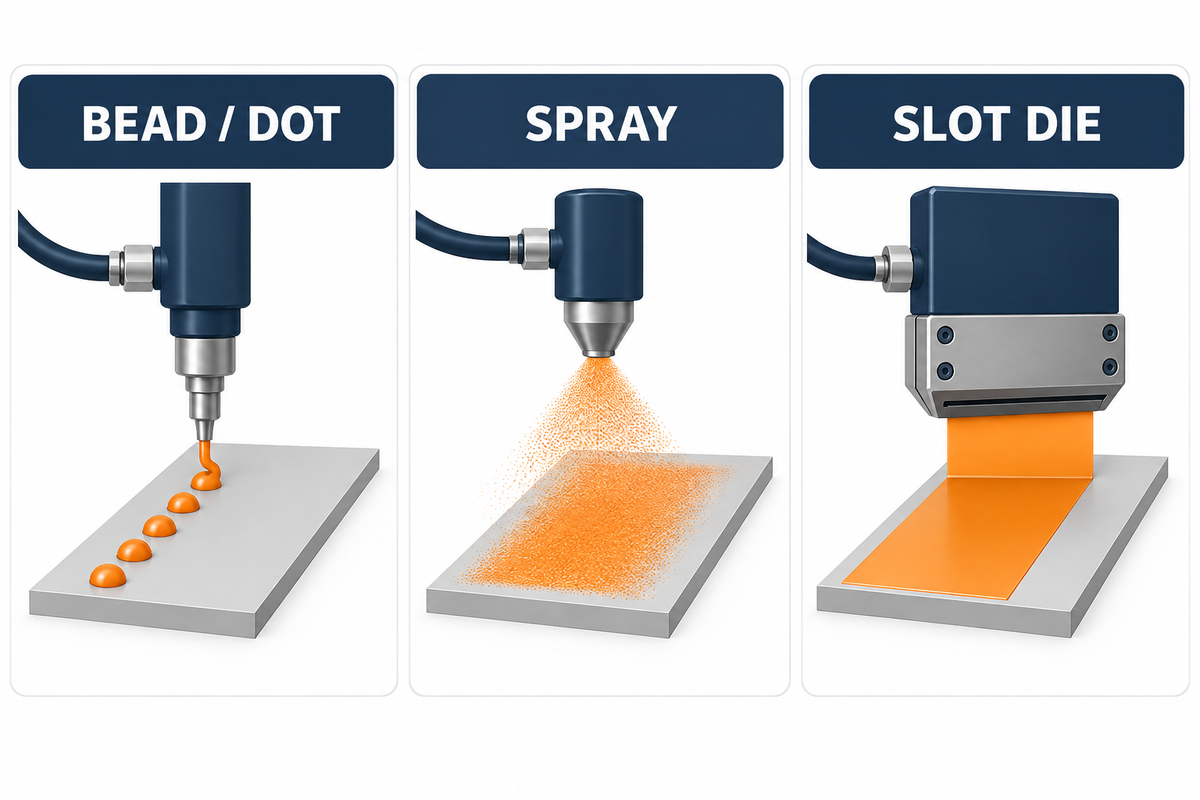
The first boundary is that of continuous and discrete motion. A slot die or roll coater is designed to make a continuous film across a web. A bead gun, dot applicator, or intermittent spray head places adhesive at selected positions on separate products. Choosing the technology before defining the pattern reverses the engineering sequence.
| Required output | Likely starting point | Evidence to request |
|---|---|---|
| Manual bead or small repair | Handgun or cartridge applicator | Operator trial, warm-up, trigger effort, bead stability |
| Timed bead or dot | Automatic gun with nozzle and trigger control | Placement at minimum and maximum speed, cutoff, repeatability |
| Open spray or fiber pattern | Spray/fiberization head | Coverage, overspray, edge control, ventilation and cleaning |
| Profile or curtain extrusion | Extrusion head or die | Profile dimensions, start/stop behavior, pressure stability |
| Continuous controlled film | Slot die | Coat-weight profile, lip condition, web handling, edge quality |
| Surface transfer coating | Roll coater | Gap/nip control, roll temperature, pickup, cleaning, substrate flatness |
Open time relates the application to the motion of the product. Adhesive must wet the substrate and reach the next contact or compression step within its process window. Too little adhesive, weak compression, too much adhesive, or temperatures outside the recommended range can result in different failures. An Institute of Packaging Professionals discussion illustrates why “more glue” and “less glue” are both poor universal rules: the result depends on penetration, compression, set time, and line conditions.
Turn Process Inputs into a Quote-Ready RFQ
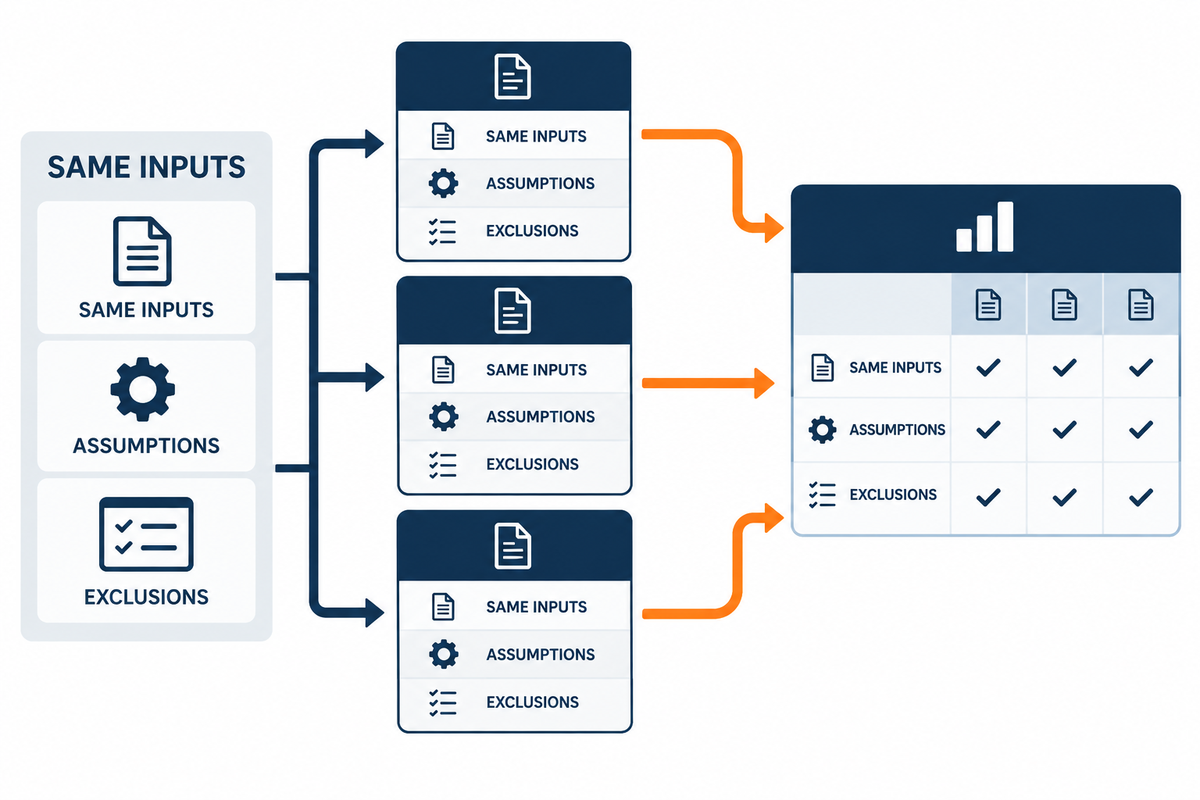
A useful request for quotation does more than list components. It requires the same information from every supplier regarding the inputs, units, assumptions, proof methodology and exclusions. This allows the buyer to differentiate between a scope and a price.
| RFQ field | Buyer supplies | Supplier responds |
|---|---|---|
| Material | Grade, form, package, data sheet, representative quantity | Compatibility, restrictions, required conditioning or sealing |
| Demand | Average/peak mass flow, duty cycle, simultaneous users | Rated and proven capacity with test basis and margin |
| Temperature | Approved material window and start/stop practice | Zone count, sensor/control method, alarm limits, uniformity evidence |
| Transfer | Distance, routing, elevation, environment | Hose/manifold sizes, pressure basis, supports, protection |
| Pattern | Drawing, tolerance, coat weight or bead mass, speed range | Gun/die/nozzle, triggering, expected result and test method |
| Integration | Power, air, network, line signals, available space | Loads, interfaces, permissives, data and responsibility split |
| Safety | Jurisdiction and site requirements | Risk documents, guarding, isolation, pressure release, warnings, manuals |
| Lifecycle | Shifts, maintenance capability, changeovers | Service tasks, spares, consumables, training, support and warranty exclusions |
Ask suppliers to identify what their capacity figure means: adhesive, inlet condition, setpoint, ambient condition, test duration, outlet condition, and allowed deviation. Ask the supplier to list items excluded from their offer, such as guarding, extraction, line encoder, mounting frame, cable runs and commissioning aids.
Keep separate the scope to make the adhesive from the scope to apply the adhesive. IDA Equipment’s adhesive production line and adhesive production guide cover upstream mixing and manufacturing. High-viscosity options such as a triple shaft mixer, double shaft mixing machine, and butterfly disperser mixer don’t cover downstream hot melt application equipment discussed here.
Require Evidence from Sample Trial Through Factory Acceptance
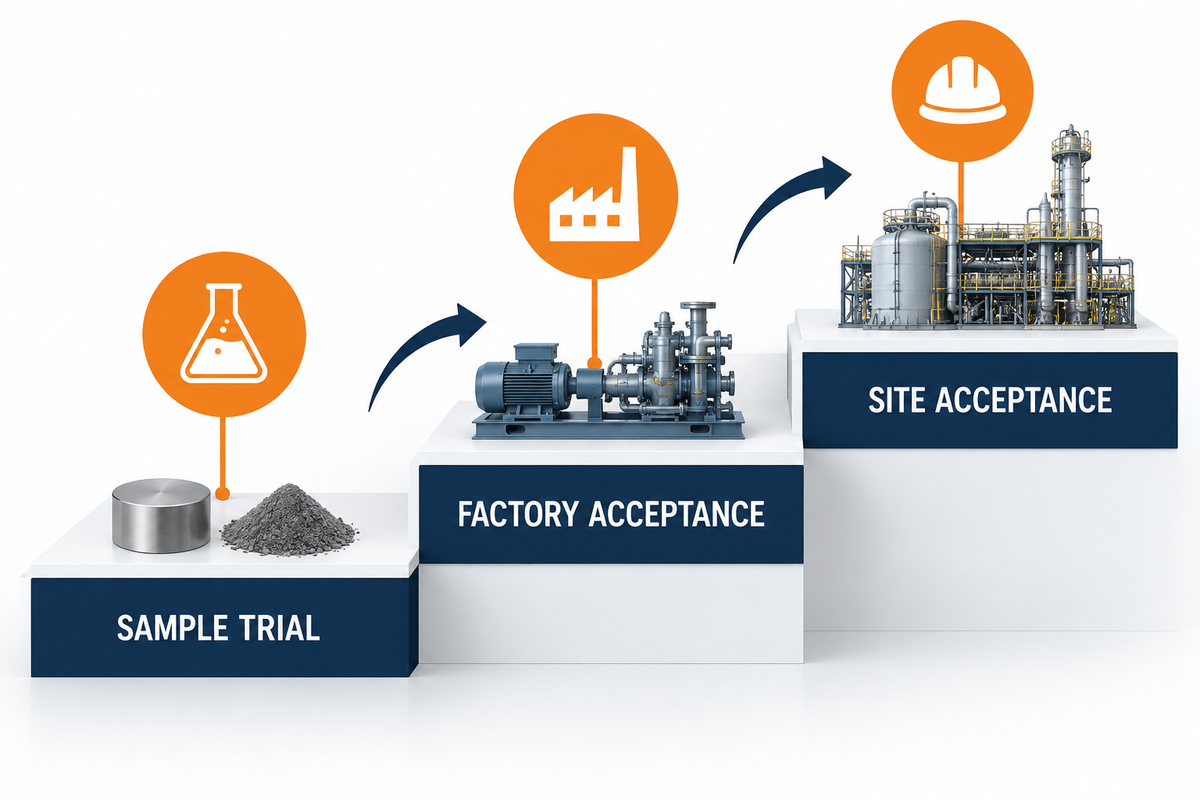
Acceptance begins before the purchase order. A supplier can’t reproduce a process or assess its speed and ease without representative material, product, pattern, speed and stop/start conditions. The evidence ladder below turns a demonstration into a traceable decision.
- Material review: review grade, lot, form, storage, operating window, hazards and special handling.
- Bench or application trial: prove wetting, pattern and placement, cutoff, open time, compression or nip, and downstream results.
- Demand challenge: test the worst credible simultaneous or high-speed condition, not only average production.
- Interruption recovery: record warm-up, short stop, longer stop, refill, restart, alarm, and recovery behavior.
- Factory acceptance: bind the configuration, software/recipe revision, instruments, material, method, result, deviations, and open actions; include the agreed char-control inspection points where relevant.
- Site acceptance: repeat the agreed checks after installation with real utilities, signals, guarding, operators, and product flow.
- Handover: close documentation, training, preventive maintenance, critical spares, backup parameters, and change-control rules.
Because char causes an increase in downtime and affects product quality, it qualifies as a significant process concern. Graco indicates that overheating, contamination, and oxidation are the main causes of char. Bostik indicates that to minimize charring, material turnover and good condition of the tanks are to be maintained. These excerpts are from the product manufacturers, so use them in the development of questions and inspections; use the adhesive supplier’s instructions and the trial results to develop the final operating procedure.
Plan Maintenance and Safety Around Heat, Pressure, Chemistry, and Adhesive Stability
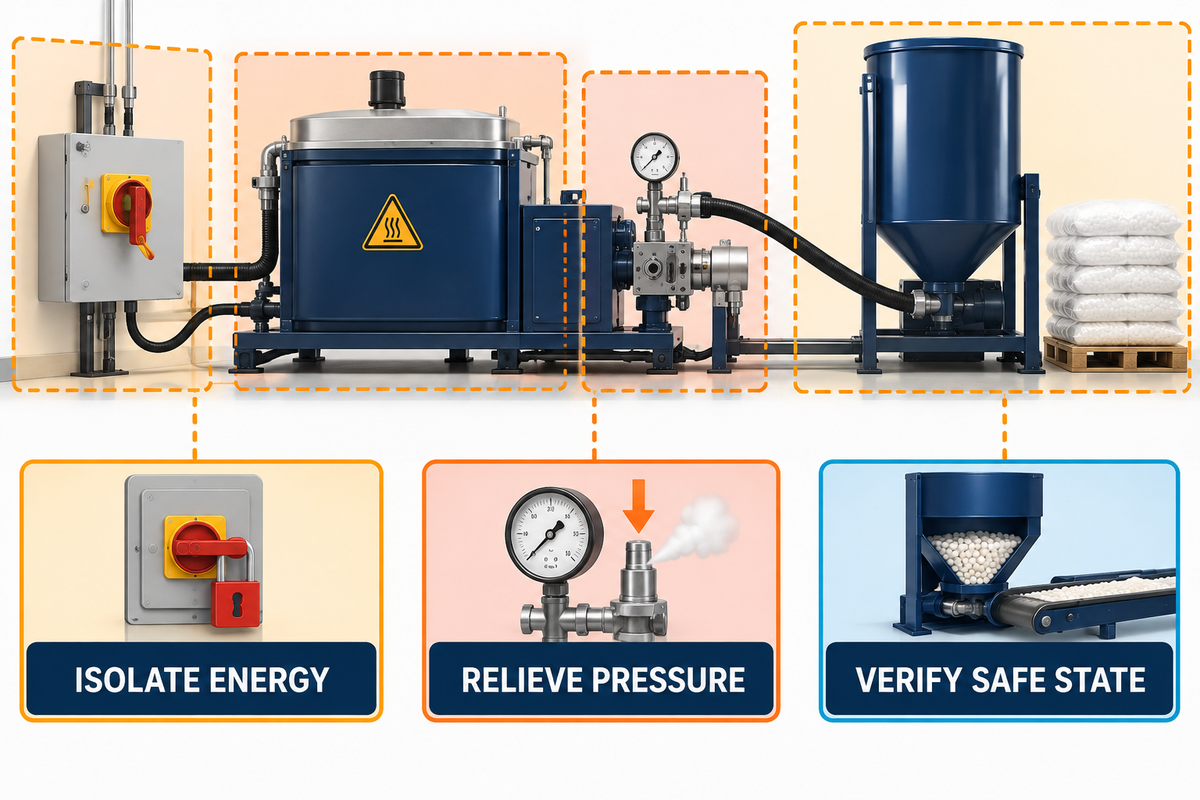
Obvious hazards in adhesive include hot surfaces and molten adhesive. Hazardous energy and stored pressure require special attention during service. The procedures and practices of the equipment and the site should offer a defined means to isolate energy and relieve pressure and verify a safe state and prevent unexpected operation. OSHA’s hazardous-energy regulation is an authority boundary for United States workplaces; local rules and the final risk assessment still govern each installation.
Electrical requirements also need an edition and project boundary. IEC identifies IEC 60204-1:2016+AMD1:2021 as consolidated edition 6.1 and states that the sixth edition replaced the fifth with technical revisions. Quoting this standard doesn’t guarantee the system is in conformity. Determine which parts and which edition will be implemented, and what design and verification records will be provided.
- Guarded Hot Surfaces and Protected Hose Routing
Provide guarded hot surfaces and protected hose routing where the risk assessment requires them. - Pressure Relief and Depressurization
Define pressure-relief and depressurization steps before gun, filter, hose, or pump work. - Adequate Access
Make filters, drains, seals, and wear parts accessible without uncontrolled adhesive release. - Routine Purges, adhesive Changes, Deep Cleaning
Separate routine purges from adhesive changes and deep cleaning from reactive material shutdown procedures. - Safety Data Sheets
Use the most recent safety data sheets and occupational hygiene assessment for the actual adhesive, including skin and respiratory routes where applicable. - Records and Alarms
Record alarm history and maintenance findings. This makes recurring heat, pressure, and contamination problems apparent.
Treat Digital Controls as Evidence, Not a Feature List
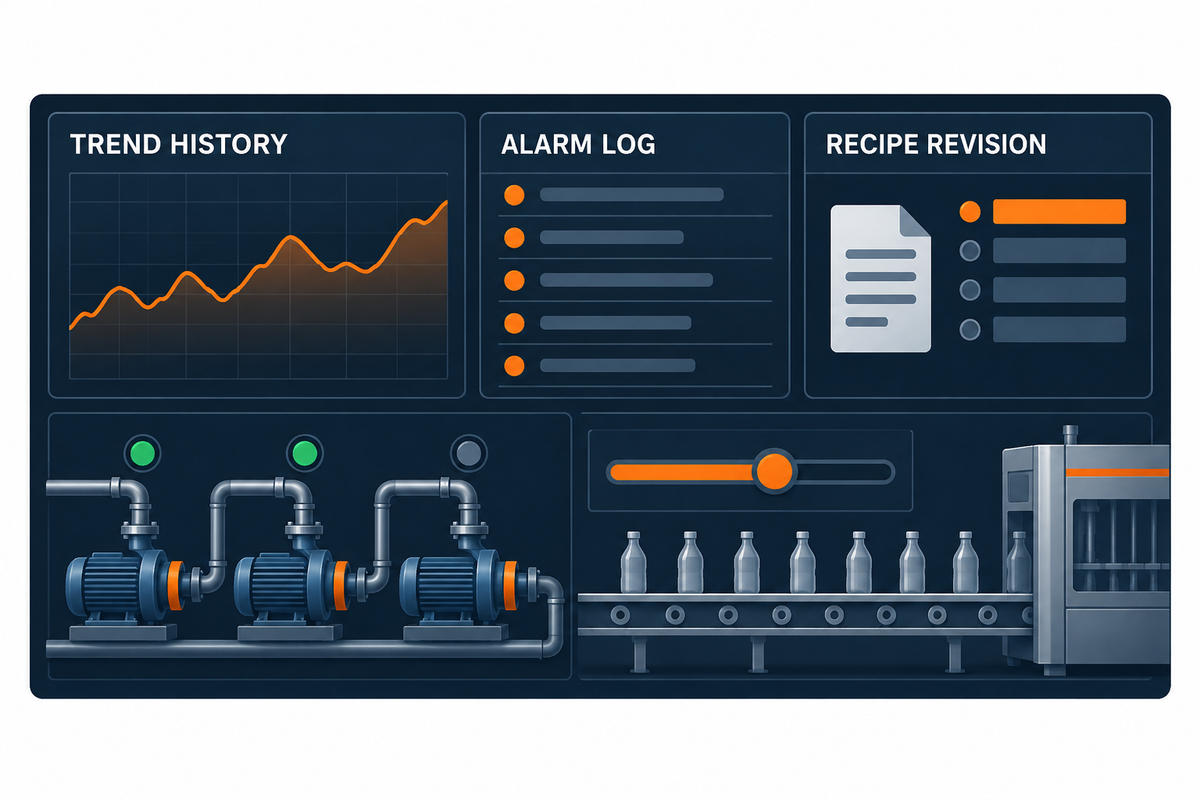
Process Improvement
A touch screen, recipe list, or network port is only valuable when it improves a process. Other valuable records include zone temperature history, ready-state criteria, high/low alarms, motor/pump status, trigger time, line-speed input, recipe revision, and maintenance prompts.
Upon acceptance, force relevant alarms and permissives instead of passively reviewing the screen. Verify behavior downstream of a sensor fault, loss of air, line stop, feed empty condition, over temperature, or communication failure. Reach agreement on values retained, who can change them, and how a restored recipe is signaled.
Contemporary equipment trends favor reduction of molten inventory and greater process monitoring, but neither ensures process improvement. Consider energy and adhesive-stability claims with the same material, schedules, volumes and test windows. The vendor’s preliminary estimate can begin the discussion; a recorded trial should settle the project decision.
Frequently Asked Questions
What are the main types of hot-melt adhesive equipment?
For industrial applications, adhesive dispensing systems typically encompass feed or unloading equipment, a melter, pump or metering device, heated hoses, application heads, nozzles or dies, and line controls that govern how adhesive is applied to a substrate, especially when processing heat sensitive materials. Smaller manual or benchtop applicators integrate functions. Larger automated production lines separate functions so capacity, temperature residence, pattern control, maintenance, production integration, and control the wetting of specially formulated adhesives can be specified and tested independently.
How do I size a hot-melt adhesive melter?
Initially target the consumption of peak adhesive rather than the average consumption of production. Compare the supplier’s proven melt-recovery rate using your adhesive form and temperature window, allowing for refill interruptions, start-up recovery, and simultaneous applicator demand under representative conditions.
What should be included in a hot-melt equipment RFQ?
State your adhesive identity and form, operating-temperature and viscosity basis, average and peak consumption, duty cycle, line speed, pattern and tolerance, substrate, bond window, changeover method, utilities, control interfaces, and safety documentation. Your suppliers must also state their assumptions, exclusions, proof methods, spare parts, training and acceptance criteria in a standard format.
What is the difference between a tank melter and a melt-on-demand system?
A molten inventory is larger in a tank melter, whereas with a melt-on-demand design, the material is melted closer to the time of use. Evaluate both designs based on peak recovery, behavior on refill, form of the material, residence limits, warm-up, maintenance, and test evidence, rather than assuming that one architecture always saves energy or protects adhesive better.
When should slot-die or roll coating replace bead or spray application?
For a continuous film on a web or surface, consider roll or slot-die coating. Beads, dots, and intermittent spray systems usually are suited to discrete bonding locations. The final decision takes into account a combination of coating uniformity and edge control, viscosity, web handling, residues and changeovers, placement tolerances, and evidences from representative materials and product.
Select the System, Then Verify the Process
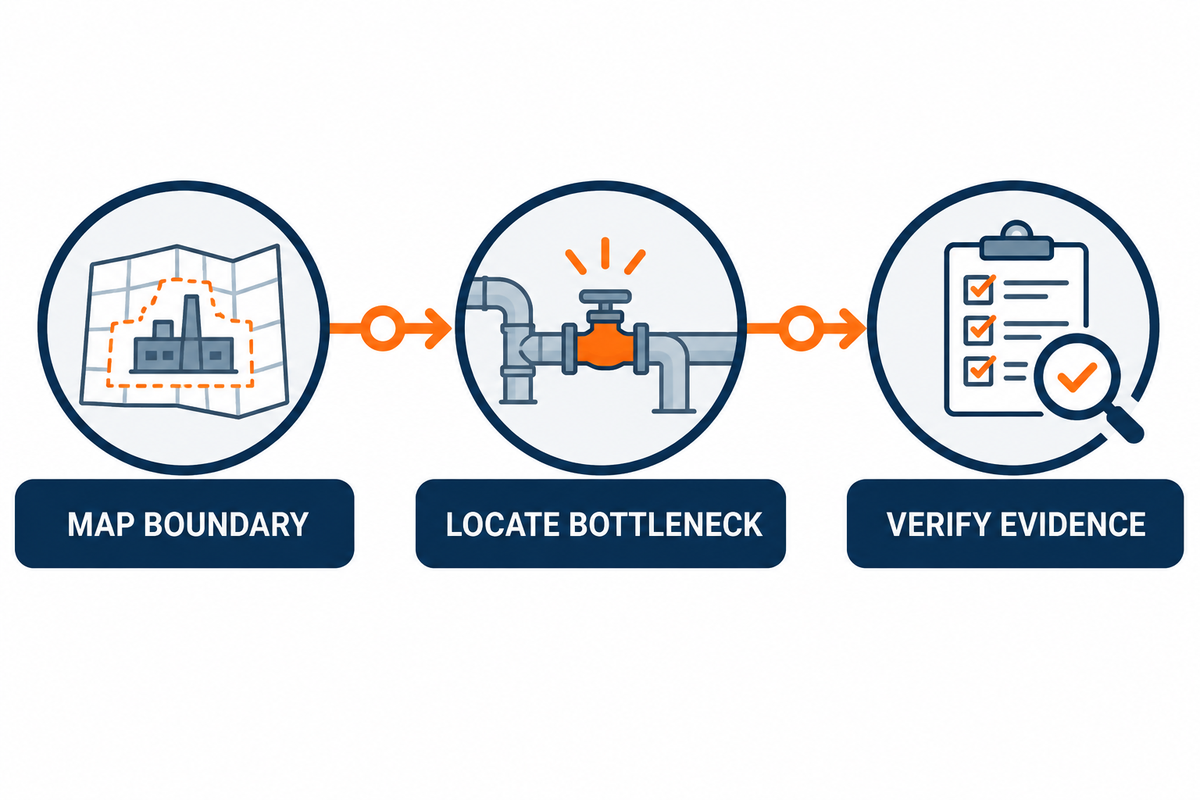
The sequence is simple, even if the equipment isn’t. Create a complete map of the boundary. Locate the melt-to-bead bottleneck. Freeze the eight process inputs. Identify the applicator from pattern and motion. Normalize the quotation. Define acceptance evidence before ordering, including the hazardous-energy isolation steps required for service work under OSHA’s hazardous-energy control rule where it applies. Make a decision.
IDA Equipment can use a completed process-input matrix to discuss a scoped hot-melt production solution. A defensible recommendation, however, relies on the actual adhesive, product, demand profile, utilities, integration boundary, and representative trial evidence.
References & Sources
- OSHA 29 CFR 1910.147, Control of Hazardous Energy
- IEC 60204-1:2016+AMD1:2021 consolidated edition
- Graco, What Causes Hot Melt Adhesive Char?
- Glue Machinery Corporation – Aging Performance of Hot Melt Adhesives
- Institute of Packaging Professionals – Hot Melt Troubleshooting Discussion
- Peer-reviewed study on moisture-curing polyurethane hot-melt adhesive methods