
Get in Touch with IDA


Updated July 2026 · Engineering buyer guide
An adhesive production line is more than a mixer with filling equipment. It is a recipe-specific system that moves materials, heat, atmosphere, process data, and finished packs through a defined operating window. The buyer’s first task is to describe that window well enough for suppliers to select and test the right process train.
Adhesive Production Line design starts with the recipe envelope, not vessel volume. Define rheology, feed forms, heat and atmosphere duties, full cycle time, discharge behavior, quality records, and acceptance tests before selecting equipment or comparing quotations.
TL;DR: four facts that change the buying decision
- High shear at one impeller can coexist with poor whole-vessel turnover. Motor power and local blade speed do not prove a uniform batch.
- Annual good output comes from usable batch mass, full cycle time, scheduled hours, availability, and yield. The slowest connected operation caps the result.
- Factory acceptance testing, site acceptance testing, and recipe-specific process qualification answer different questions. A dry FAT cannot prove the customer’s material at the installed site.
- Compliance can change significantly based upon composition, scale, occupancy, use, source, destination, and local authorities. There’s no one, easy-to-remember worldwide checklist.
Quick Specs for Planning
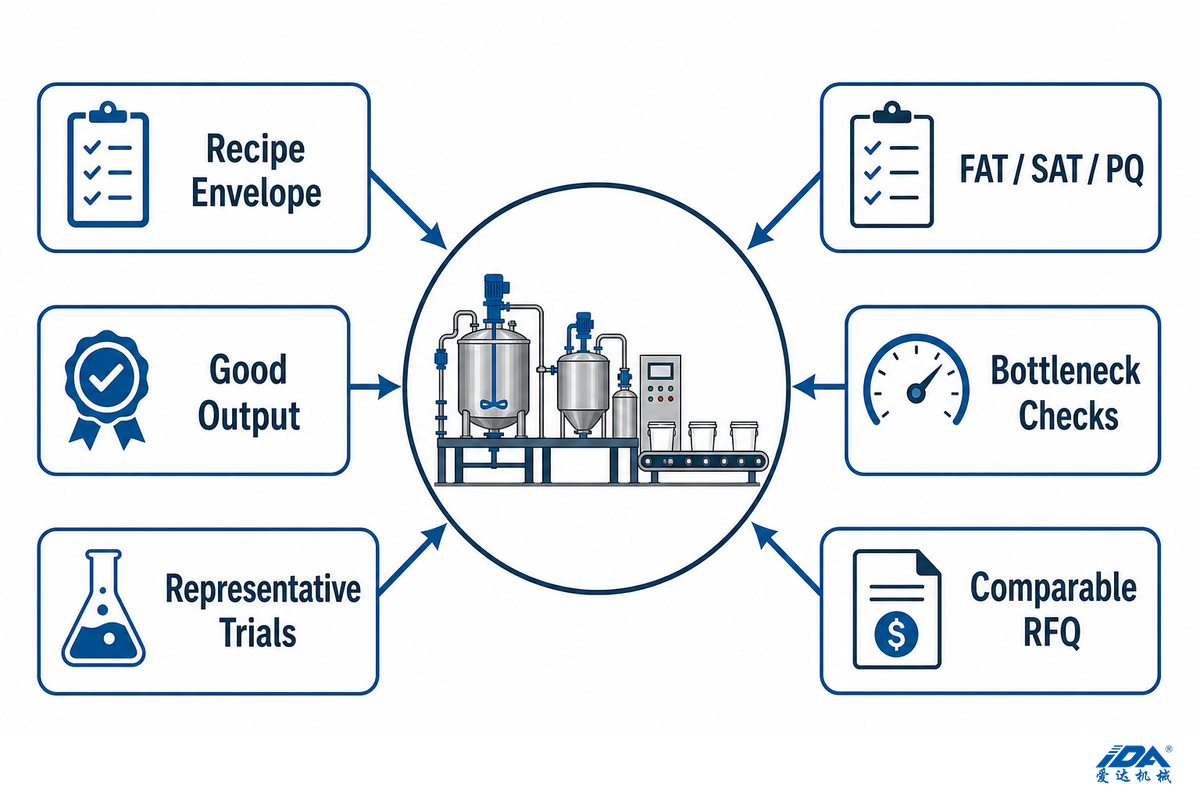
First inputRecipe envelope and raw-material forms
Capacity basisGood output per full cycle, not nominal vessel volume
Core proofRepresentative-material trials plus recorded acceptance tests
Acceptance layersFAT, commissioning, SAT, and process qualification
Primary riskHidden bottlenecks outside the mixer
Commercial handoffComparable RFQ with evidence owners and exclusions
Planning boundary: use OSHA 29 CFR 1910.1200 on hazard communication as a prompt to carry chemical classification, labels, safety data sheets, and worker information into the line scope. It does not provide a recipe-level risk score.
The planning visual maps the connected control boundary; it does not prescribe a universal machine train.
1. What a Complete Adhesive Production Line Must Control
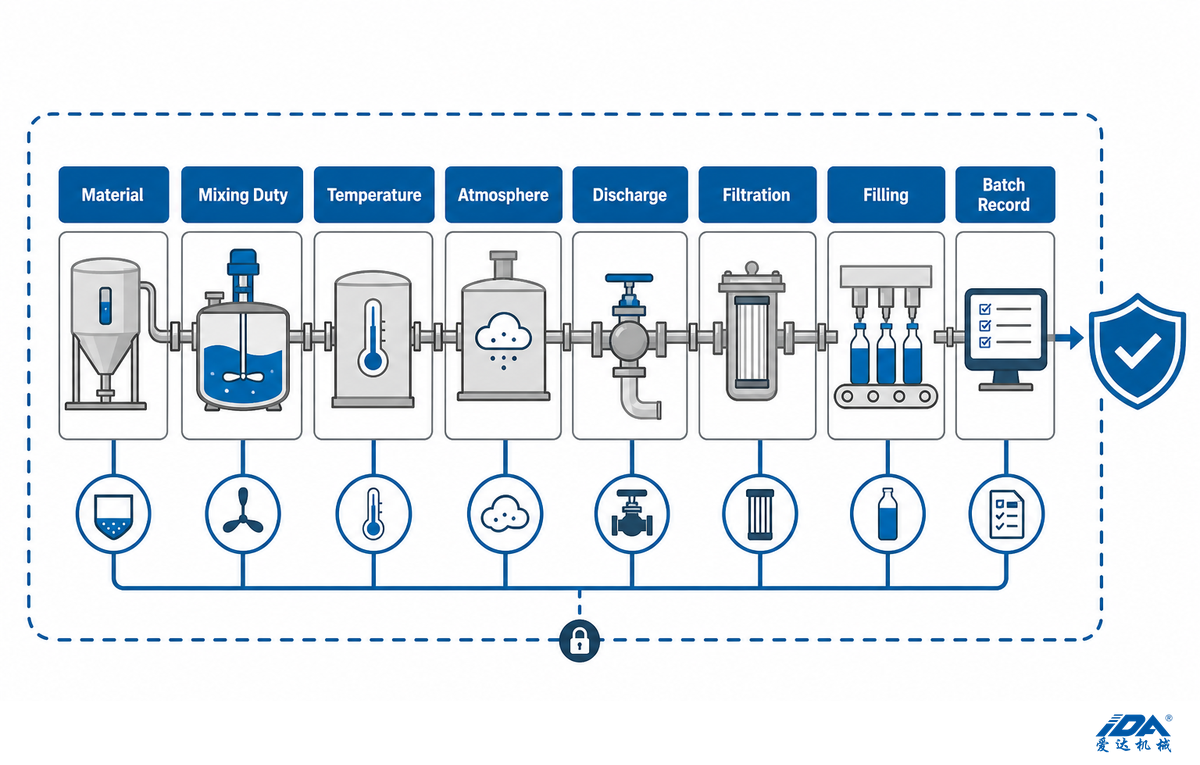
A complete adhesive production line controls the operations that can change material identity, composition, temperature, air content, cleanliness, flow, package mass, or release status. Its boundary runs from verified raw-material receipt to identified, accepted packs. The exact equipment sequence remains specific to the formulation and site. Labels such as industrial glue or PVA glue are starting points, not complete process specifications.
That boundary prevents a common purchasing error: comparing two quotations by mixer power and vessel volume while one supplier includes dosing, thermal utilities, vacuum, discharge, filtration, filling, and records and the other does not. Together, those duties form one complete production system. IDA’s adhesive production line configuration options show supplier-specific combinations, but they are not universal industry ranges.
| Controlled flow | Questions the line must answer | Evidence at release | Limitations / not suitable for assumption |
|---|---|---|---|
| Material | Was the correct liquid, powder, resin, filler, catalyst, or package added in the correct sequence? | Lot identity, actual mass, reconciliation | A recipe name does not prove material identity. |
| Mechanical energy | Did the batch receive the required bulk turnover, dispersion, or kneading duty? | Speed or load trend, time, endpoint test | Motor kW alone does not describe mixing quality. |
| Thermal energy | Were heat-up, hold, exotherm, and cooling stages kept inside the recipe window? | Product-temperature trend and alarm record | Jacket temperature is not always product temperature. |
| Atmosphere | Was air removed, moisture excluded, vapor contained, or inert gas managed where required? | Pressure trend, leak check, vent status | Vacuum is not automatically necessary for every adhesive. |
| Information | Can the plant reconstruct who ran the batch, which version was used, and how deviations were handled? | Recipe version, events, approvals, batch report | A PLC screen without retained records is not traceability. |
| Finished product | Did discharge, filtration, transfer, and filling preserve the accepted batch? | Filter record, fill check, pack code, release status | A good mixer sample does not prove every filled package is good. |
A peer-reviewed review published in 2024 separates adhesive families by feedstock, properties, drawbacks, and uses. That evidence supports a family-specific design approach instead of a single architecture for every adhesive. Review the adhesive-family evidence.
Key takeaway: define the line by controlled flows and release evidence. An equipment list is the result of that definition, not the starting point.
2. Start With 6 Recipe Variables Before Selecting Equipment
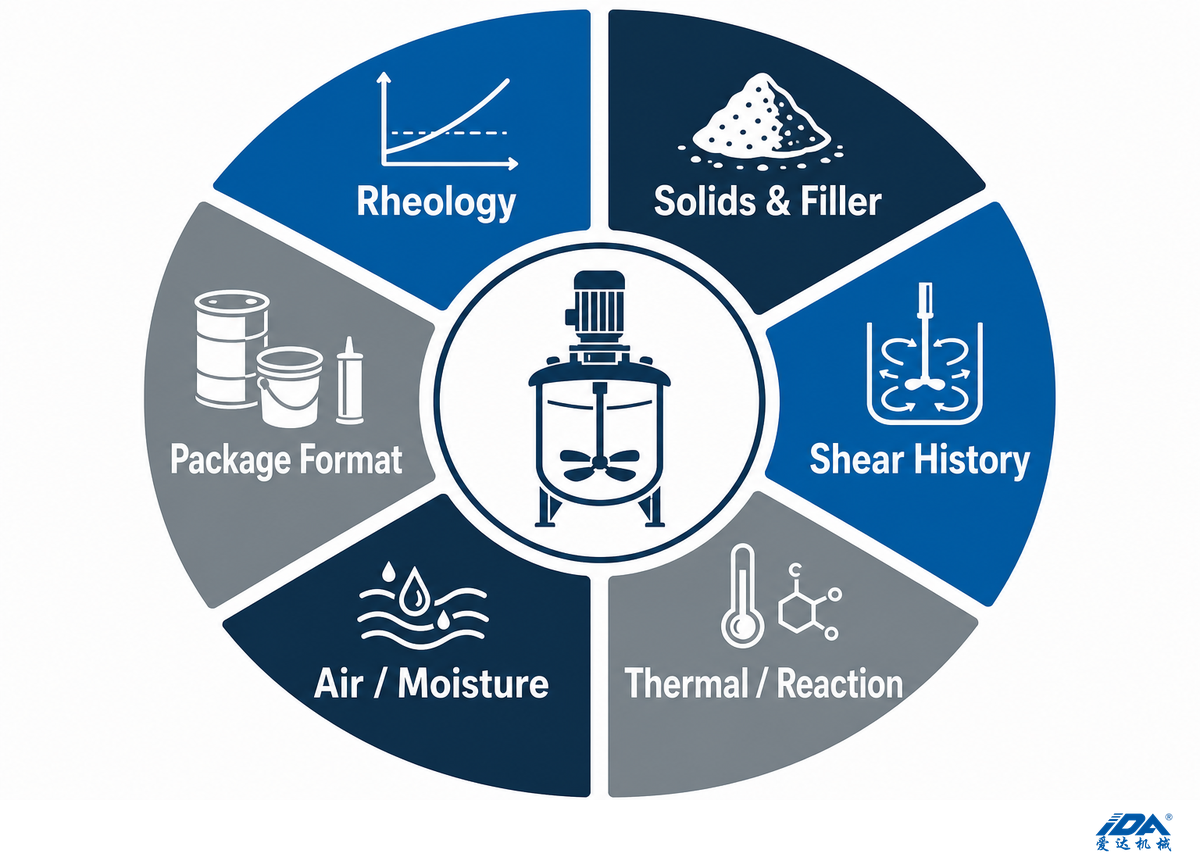
Define six recipe variables as ranges before selecting equipment: rheology through the cycle, solids or filler loading, required shear history, thermal or reaction behavior, air or moisture sensitivity, and finished-package format. Each range changes the mechanism, utilities, seals, controls, discharge method, and trial plan.
“Final viscosity” alone is insufficient. A batch can start as a pumpable liquid, thin during heating, then tighten sharply after filler addition or reaction. In one soy-adhesive formulation study, additive changes reduced viscosity while also reducing wet shear strength, producing an optimum rather than a simple more-is-better relationship. The finding is specific to that formulation, but the design lesson travels: processing ease and product performance can move in opposite directions. See the scoped formulation study.
| Recipe variable | Record as a range | Line decision it changes | Trial question | Limitations / not suitable for |
|---|---|---|---|---|
| Viscosity profile | Start, peak, endpoint, and temperature | Agitator family, drive, discharge, pipework | Does bulk turnover survive the peak? | Do not select from one room-temperature value. |
| Solids and fillers | Mass fraction, density, particle form, addition rate | Feeding, dust control, wet-out, dispersion | Can powder enter without floating or clumping? | A feeder’s water test is weak evidence. |
| Shear history | What needs dispersion and what can be damaged | Disperser, sweep, planetary, rotor-stator duty | Which endpoint proves enough, not maximum, shear? | More rpm may add heat without adding turnover. |
| Heat or reaction | Addition temperatures, exotherm, holds, cooling limit | Jacket, heat-transfer area, utility, dosing logic | Can the worst batch reject heat fast enough? | Utility temperature alone does not prove recovery time. |
| Air, vapor, moisture | Foam tendency, vapor class, moisture sensitivity | Vacuum, condenser, inerting, vent and seal plan | What pressure or atmosphere endpoint matters? | Do not specify vacuum by habit. |
| Package and SKU | Pack size, closure, fill temperature, changeovers | Buffering, filtration, filler, coding, cleanability | Can the line fill the highest-viscosity SKU? | One nozzle trial does not prove the SKU range. |
Engineering note: build an example tag set, not an invented standard.
For illustration, a user-requirement sheet can contain fields such as 25 °C incoming material, 65 °C product setpoint, a ±1.5 °C control band, 100 mbar absolute vacuum endpoint, 12 min hold, 60 rpm sweep, 1,500 rpm disperser, and 250 kg/h discharge. These are examples only. Replace every value with recipe, trial, safety, and site data; machinery standards do not supply adhesive-process tolerances.
Key takeaway: request a recipe envelope with ranges and failure conditions. A supplier cannot responsibly turn a product label into a complete line specification.
3. Map the 8 Unit Operations From Feeding to Filling

A typical process design can be divided into eight connected operations: receiving, dosing, pre-mixing, dispersion or reaction, thermal and atmosphere treatment, discharge, filtration, and filling. Physical units can be combined or omitted when another documented step performs the duty, but every duty still needs an owner and test.
Receive and verify. Identify lots, quarantine status, temperature, packaging condition, and storage constraints before material reaches the batch area.
Meter and charge. Control liquid mass, powder rate, addition sequence, and reconciliation. Feedability can limit the line long before mixer power does.
Pre-mix or dissolve. Create a wetting phase or carrier condition that lets later solids enter without dry pockets or excessive dust.
Disperse, knead, or react. Apply the recipe-specific combination of bulk movement, local shear, residence time, and controlled addition.
Heat, cool, degas, or protect. Use the jacket, vacuum, condenser, vent, or inert-gas system only where the chemistry and risk review require it.
Discharge and transfer. Move the finished batch at its actual endpoint viscosity. High-viscosity lines may need hydraulic discharge equipment rather than gravity alone.
Filter and buffer. Protect downstream packs while controlling filter loading, residence time, hold-up, contamination, and rework rules.
Fill, identify, and release. Match the filling machine options to viscosity, pack size, fill temperature, accuracy method, closure, code, and quality release.
Reactive products can add a dedicated chemical reaction equipment stage. Heavily filled pastes can combine mixing and evacuation in one vessel before press discharge. Waterborne formulations can add foam management and wash-water treatment. These are design choices, not universal steps for every formulation.
A 2024 peer-reviewed review groups bio-based adhesives by feedstock, properties, limitations, and application. That breadth is why the eight-operation map is a duty checklist rather than a fixed route for every chemistry. Review the adhesive-family scope.
Draw material and information flow together. For each process segment, identify its normal state, abnormal state, measurement and unit, control response, retained record, and owner. This exposes safety, data, and handoff gaps that a simplified flow diagram can conceal.
If the user-requirement sheet carries the earlier illustrative 12 min vacuum hold and 100 mbar absolute endpoint, attach both to the atmosphere-treatment operation, its instrument, record, and owner instead of leaving them in a general notes field. The values remain placeholders until recipe trials and the site risk review confirm them.
At the factory layout review, walk the production line with process, EHS, maintenance, controls, and quality owners. Tie every transfer, sample point, isolation, drain, and access route to its operator and the factory acceptance test evidence owner. Include those owners in the FAT record. A process block is not closed until the plant team can state who runs, cleans, isolates, and verifies it.
Key takeaway: every process block needs a purpose, input, output, control point, and omission risk. Optional equipment is acceptable; an unowned process duty is not.
4. Match 10 Adhesive Process Archetypes to a Mixing Train

Mixer selection should follow the material’s changing physical behavior and the dominant process duty, not just the finished-product label. The matrix below is an initial filter for common process archetypes. A likely equipment family is a trial candidate, not a final selection; formulation ranges and production scale can point to a different mechanism.
10 Adhesive Process Archetype Matrix
| Archetype | Evolving process risk | Dominant duty | Likely train to trial | Thermal / atmosphere need | Finishing path | Limitations / trial question |
|---|---|---|---|---|---|---|
| Hot melt adhesive (PSA) | Viscosity rises as temperature falls | Heated turnover and gentle incorporation | Jacketed planetary, kneader, or multi-shaft candidate | Controlled heat; atmosphere by recipe | Heated transfer and fill | Can the coldest transfer point stay pumpable without damaging the product? |
| Reactive polyurethane (PUR) | Moisture sensitivity and reaction history | Closed reaction, mixing, and conditioning | Jacketed reactor with suitable agitation | Moisture control; vacuum or inerting if validated | Closed, dry transfer | Verify seal materials, dryness, residence time, and cleanout. |
| One-part silicone | High viscosity, filler wet-out, entrained air | Bulk turnover plus dispersion | Double planetary mixer or multi-shaft trial | Vacuum often evaluated; recipe decides | Ram or hydraulic discharge | Prove dry-zone elimination and discharge at endpoint viscosity. |
| Two-part silicone | A/B contamination and ratio integrity | Separate component manufacture | Independent trains sized to each component | Component-specific vacuum and temperature | Separate packs or metering interface | A shared line may create cleaning and cross-contamination risk. |
| Filled epoxy | Abrasion, heat, powder incorporation | Wet-out, dispersion, and turnover | Triple-shaft mixing system or planetary candidate | Jacket duty and vacuum by formulation | Filter only if compatible with fillers | Test wear, temperature rise, and whether filtration strips desired solids. |
| PVA emulsion | Foam, addition sequence, heat removal | Agitation, dissolution, and controlled addition | Agitated reactor or double-shaft mixing machine candidate | Thermal control; vacuum only if justified | Pump, filter, and fill | Confirm foam response and cleaning-water plan. |
| Waterborne acrylic | Foam, contamination, solids distribution | Agitation and optional dispersion | Agitated vessel plus high-speed disperser where trials support it | Temperature control; vent strategy | Filter and fill | Shear-sensitive grades may reject the same disperser setting. |
| Solventborne rubber | Vapor, fire, occupational exposure | Closed dissolution and controlled mixing | Closed, jurisdiction-reviewed mixer train | Ventilation, electrical, and vapor controls | Closed transfer and compatible fill | Do not copy a waterborne line or assume one hazardous-area classification. |
| Cyanoacrylate | Moisture, contamination, compatible materials | Clean, controlled, low-contamination processing | Dedicated compatible vessel and closed transfer | Dryness and temperature by recipe | Small-pack precision fill | Validate every wetted material and cleaning method before scale-up. |
| High-filled structural paste | Peak torque, dead zones, discharge | Kneading, turnover, deaeration | Planetary or multi-shaft train with press discharge | Jacket and vacuum if trials require them | Ram transfer to cartridge or pail fill | A no-load mixer test cannot prove wet performance. |
Application-to-Process Language Register
Market labels often mix an end use, an adhesive family, and an equipment feature in one phrase. Translate that language into a process duty before comparing quotations. The register below shows what each label should prompt a buyer to define; it does not imply that every application uses the same train.
| Application or quotation language | Process interpretation | RFQ question | Boundary |
|---|---|---|---|
| Paperboard hot melt | A hot melt adhesive production line for paperboard packaging operations can connect hot melt glue preparation to a conveyor and packaging machine. “Hot glue” is a market label, not a recipe. | If the scoped web case runs at 70 ft/min, 5 oz/yd², and 5 ft width, is upstream demand near 730 lb/h? | High-speed production lines still need a demand calculation for the actual coat weight and width. |
| PUR for woodworking | PUR hot melt used in woodworking adds moisture handling, cure behavior, and bond strength targets. | Which dryness and residence-time evidence protects long-term performance? | A generic heated tank does not prove reactive-PUR suitability. |
| Epoxy assembly | An epoxy adhesive based on epoxy resin can require filler wet-out, reaction control, and controlled discharge for product assembly. | Which recipe changes adapt products to meet weather resistance and performance requirements, and how will they be tested? | The equipment supplier should not create product-performance claims. |
| Pressure-sensitive coating | A pressure-sensitive product for automotive, textile, or plastic converting changes substrate contact, coating demand, and the adhesive properties that quality must retain. | Which rheology and coat-weight window must the process preserve? | One coating trial cannot qualify every substrate. |
| Multi-SKU portfolio | Different adhesive products can place product type, specific production sequence, and changeover ahead of headline capacity. | Which adhesive options share a cleanable train, and which require segregation? | A family name cannot establish cross-contamination acceptance. |
| Automated dosing | A fully automatic claim usually combines automatic batching, interlocked line equipment, and exception recovery. | Which faults stop the batch, and which records prove production efficiency without hiding rework? | Automation cannot repair a weak material or recipe definition. |
| Paste and cartridge line | High-viscosity production equipment can pair mixing equipment with a tri-shaft mixer, hydraulic lifting, and controlled extrusion pressure. | What representative test proves turnover, deaeration, discharge, and pack feeding? | No-load motion is not proof at endpoint viscosity. |
| Reactive batch plant | A reaction kettle brings heating and cooling duties into the recipe sequence. | Which process parameters control addition, exotherm, hold, and cooling? | Jacket settings alone do not define product temperature. |
| Release and records | Quality control should connect material identity, batch events, test results, and pack codes to the adhesive production process. | Can one released pack be traced back to actual lots, recipe version, and deviations? | A saved recipe is not a complete batch record. |
| Turnkey supply | Quotes for complete production lines or turnkey projects can span equipment manufacturing, professional equipment selection, technical support, and commissioning. | Which supplier-owned evidence demonstrates efficient production at the agreed recipe limits? | “Turnkey” has no useful boundary until interfaces and exclusions are listed. |
| Cleaning and finishing | Container washing, filtration, filling, and other finishing tasks belong in the scope, including packaging interfaces. | Who owns residue acceptance, waste routing, fill checks, and changeover time? | A quotation limited to the mixer can leave these duties unpriced. |
| General line description | Production processes become testable only when adhesive solutions and adhesive systems are broken into operations. Ask whether the proposed line is suitable for the production envelope, what the line consists of, and which device is used for mixing each stage. | Can every process duty be linked to an owner, test method, and stop condition? | Broad sales wording does not replace a process-flow boundary. |
“High shear at the blade does not necessarily indicate that the entire volume of the batch is circulating.”
Practitioner synthesis from a reviewed anonymous adhesive-mixing discussion; used as a failure-mode prompt, not a universal mixer rule.
In the reviewed field discussion, lightweight silica appeared to mix only around a high-shear impeller. Replies focused on feed rate, baffles, slow-sweep turnover, multiple impellers, and dual-shaft arrangements. Because the account is anonymous, it cannot support a performance guarantee. It does identify a useful trial observation: watch the whole vessel, not only the vortex.
Key takeaway: shortlist by rheology, dominant duty, atmosphere, and discharge. The decisive question is the representative-material trial that could disqualify the candidate.
5. Control Heat, Vacuum, Atmosphere, and Batch Records
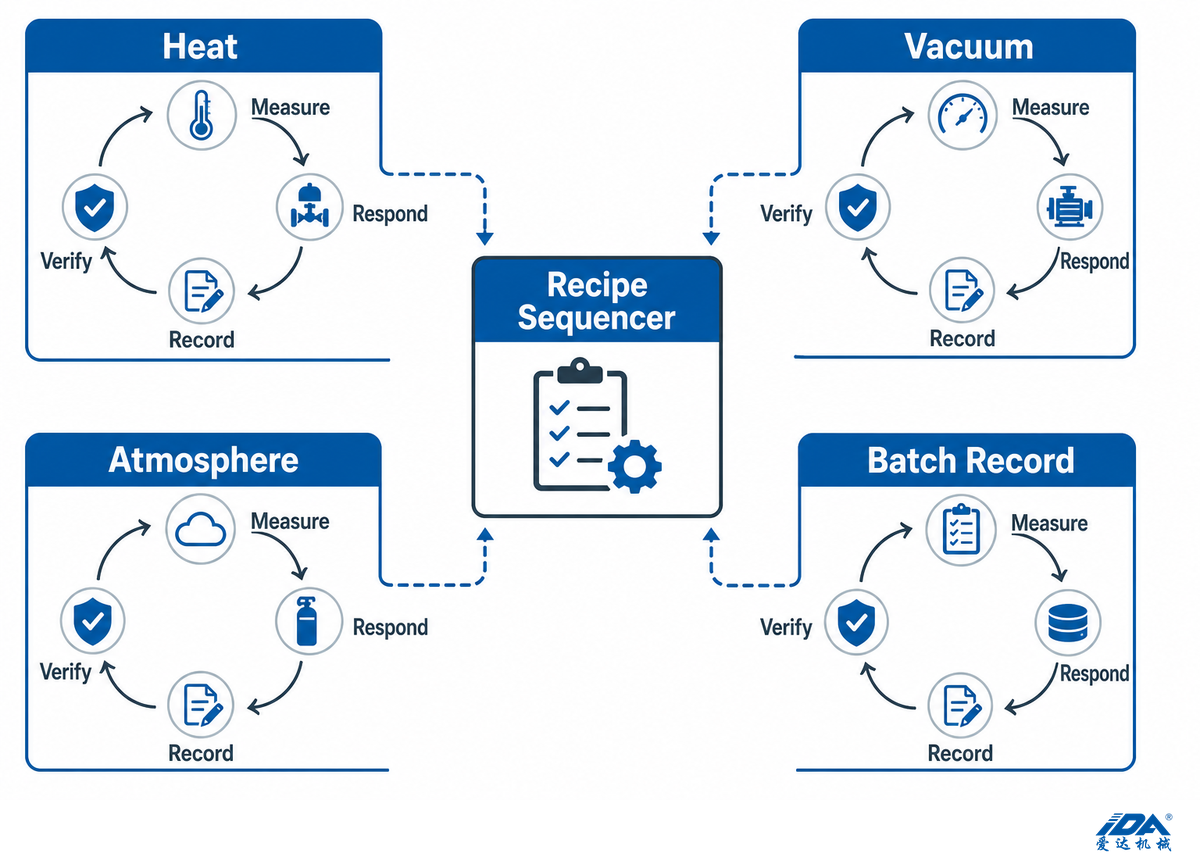
A defensible control strategy names what is measured, where it is measured, the alarm or response, what is recorded, and how the signal is verified. It also separates recipe controls from safety and legal requirements. A temperature trend, for example, is useful only when the sensor location and response match the process risk.
| Control variable | Measure | Alarm or response | Record | Verify | Limitations / failure boundary |
|---|---|---|---|---|---|
| Material identity | Lot or container ID | Block wrong or unreleased material | Actual lot and mass | Challenge test and reconciliation | Barcode success does not prove contents without material governance. |
| Addition sequence | Step state and feeder status | Prevent or hold out-of-order charge | Time, amount, operator action | Simulated wrong-step test | Sequence control cannot fix a poor recipe. |
| Product temperature | Representative product sensor | Hold, slow feed, cool, or stop | Trend and excursions | Calibrated comparison and response test | Jacket inlet temperature may hide an internal hotspot. |
| Vacuum or pressure | Vessel pressure at a defined point | Leak check, hold, vent, or abort | Endpoint and hold trend | Leak-rate or pressure-decay method | A pump nameplate does not prove vessel performance. |
| Mixer duty | Speed, torque, current, or load | Respond to overload or endpoint rule | Profile by recipe stage | Representative wet trial | Equal rpm at two scales does not mean equal mixing. |
| Discharge | Pressure, rate, time, or remaining mass | Stop on blockage or abnormal delay | Transfer time and yield | Worst-viscosity demonstration | Warm-water commissioning cannot represent paste discharge. |
| Fill | Checkweigh or volumetric confirmation | Reject, adjust, or stop | Sample results and rejects | Approved pack and product test | A 20 L water trial does not prove a 20 L high-viscosity adhesive fill. |
| Batch status | Electronic or controlled manual state | Prevent filling before release | Review, deviation, approval | Access and audit-trail test | A saved recipe is not a complete batch record. |
Current regulatory evidence also argues against a copied safety checklist. A July 2026 NFPA technical FAQ states that NFPA 30 applicability depends on the liquid, quantity, occupancy, and use. Enforcement rests with the authority having jurisdiction, and local rules can be stricter. Read the NFPA applicability guidance.
For machinery electrical equipment, IECEE lists IEC 60204-1:2016 and national or group differences. Buyers should name the destination, supply characteristics, conformity route, and local deviations in the RFQ instead of writing “IEC compliant” without scope. Check the official IEC/IECEE entry.
10-Reference Standards Applicability Register
Use this register to ask the right owner for an applicability decision. Verify the current edition, local adoption, and destination requirements at design freeze. No row supplies a universal recipe temperature, mixer speed, safety function, or product-release limit.
| Reference | Decision it can inform | Evidence to request | Boundary |
|---|---|---|---|
| NFPA 30 applicability guidance | U.S. scoping for flammable or combustible liquids | Liquid classification, quantity, occupancy, use, and authority-having-jurisdiction decision | Applicability and enforcement depend on the site and local adoption. |
| IEC 60204-1:2016 | Electrical equipment of machinery | Destination supply basis, deviations, drawings, protective measures, and test records | A general “IEC compliant” statement does not identify the adopted edition or national differences. |
| ISO 12100:2010 | Machinery risk assessment and risk reduction during design | Hazard identification, risk evaluation, reduction measures, verification, and residual-risk records | The standard gives a method; it does not perform the project risk assessment. |
| ISO 13849-1:2023 | Design and integration of safety-related parts of control systems | Safety-function list, required performance basis, architecture, validation route, and software scope | It does not prescribe which safety functions or required performance levels apply to this line. |
| OSHA 29 CFR 1910.1200 | U.S. hazard communication for workplace chemicals | Hazard classification, labels, safety data sheets, written program, and training interfaces | Confirm employer and material applicability; this is not a process-control specification. |
| OSHA 29 CFR 1910.147 | Control of hazardous energy during servicing and maintenance | Energy-source register, isolation points, lockout capability, procedures, training, and inspection ownership | It does not replace the machine risk assessment or define normal recipe operation. |
| ASTM D1084-16(2021) | Viscosity methods for free-flowing adhesives with Newtonian or near-Newtonian behavior | Named method, spindle or cup, temperature, sample history, timing, and acceptance range | The published scope excludes thixotropic and plastic materials whose result depends on shear history. |
| ASTM D2556 | Apparent viscosity of shear-rate-dependent adhesives | Viscometer geometry, rotational schedule, temperature, time intervals, and reporting basis | Use only when the formulation and agreed method fit the standard’s scope. |
| ASTM D1002 | Comparative single-lap shear testing for metal-to-metal adhesive bonds | Adherends, preparation, cure, environment, specimen geometry, test conditions, and acceptance rule | A small-specimen apparent shear result is not a design-allowable stress for a different joint. |
| ASTM D903 | Comparative peel or stripping characteristics of adhesive bonds | Specimen, pretreatment, temperature, machine speed, peel geometry, and acceptance rule | Apply only where the product and joint geometry make peel evidence relevant. |
Return the register with one of four dispositions for every row: applicable, not applicable, superseded by a local requirement, or pending an authority decision. Each applicable row needs an owner and a deliverable in the RFQ or commissioning evidence pack.
Key takeaway: control narratives need measurements, responses, records, and verification. Standards define boundaries; the recipe and risk review define the process values.
6. Why Low-Emission Chemistries and Automation Raise the Control Burden
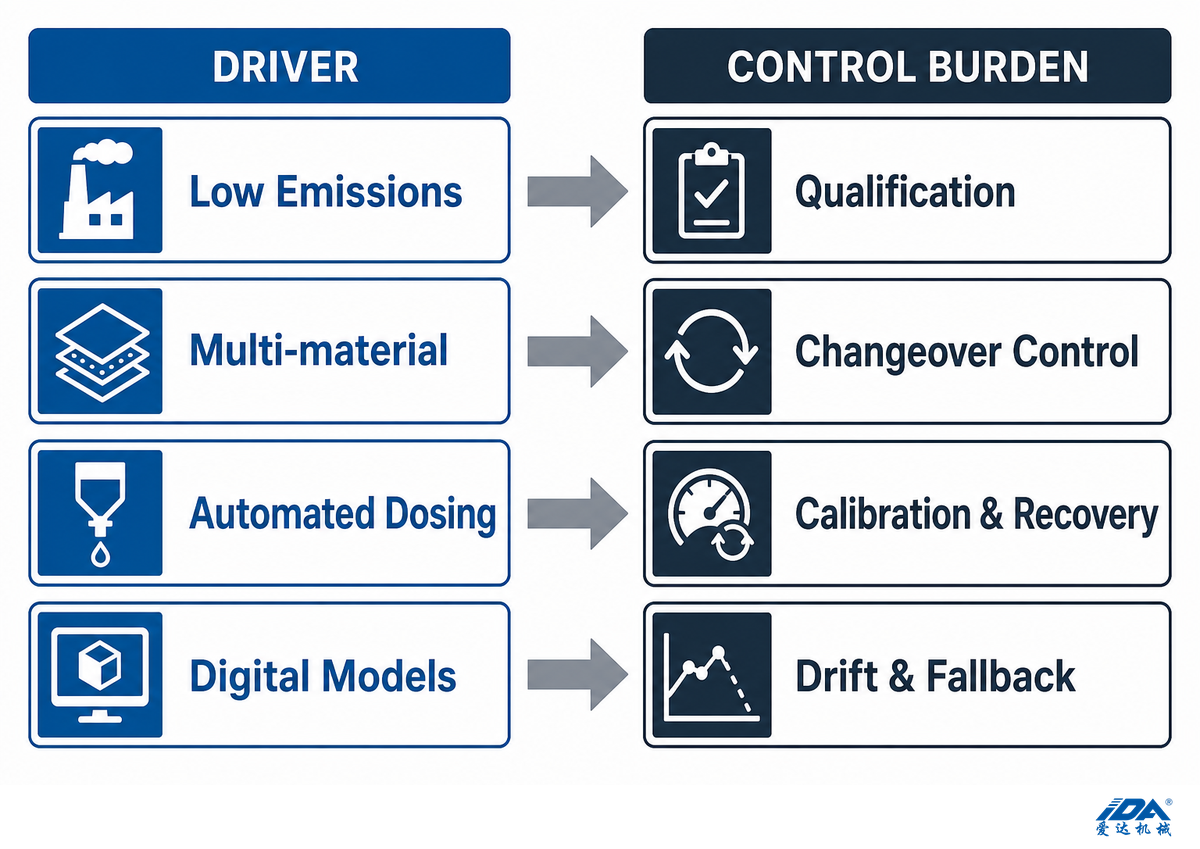
Low-emission formulations, broader substrate demands, faster changeovers, and deeper automation can reduce one risk while creating another. In a 2026 specification, the practical response is better recipe controls, synchronized feeding, cleaning evidence, drift ownership, and qualification planning, not an unsupported promise that more automation is automatically safer or more efficient.
| 2025-2026 driver | Line implication | RFQ evidence to request | Limitations / decision boundary |
|---|---|---|---|
| Lower-emission chemistry | New feedstock, temperature, wet-out, cleaning, and qualification behavior | Material compatibility review and representative trial plan | A lower footprint claim does not prove process interchangeability. |
| Multi-material bonding | More SKUs and narrower formulation windows | Recipe segregation, changeover matrix, traceability demo | One successful SKU does not release the whole family. |
| Automated multi-feed dosing | Higher synchronization, exception-handling, and calibration burden | Feed permissives, recovery logic, calibration ownership | More automated devices create more coordinated failure modes. |
| Digital process models | Need drift detection, recalibration, and manual fallback | Model limits, alarm owner, fallback procedure, change control | A static model may miss abrupt or gradual process drift. |
ChemQuest’s 2025 trade article identifies low-emission chemistry, multi-material bonding, and automation or digital control as linked development drivers. Review the trade analysis. A separate 2025 Henkel-Dow hot-melt initiative is useful as a material-qualification example, but its company-reported footprint target should not be generalized to another chemistry or plant.
Peer-reviewed process-control work published in 2026 warns that static models can miss abrupt and gradual drift. It points toward explicit detection, recalibration, and a controlled manual fallback. See the process-drift study. A project being specified in 2026 should put those ownership questions into the controls scope before site acceptance.
Key takeaway: new chemistry and digital control increase the need for qualification and failure governance. They do not remove process uncertainty.
7. Size Capacity With the 5-Factor Throughput Equation
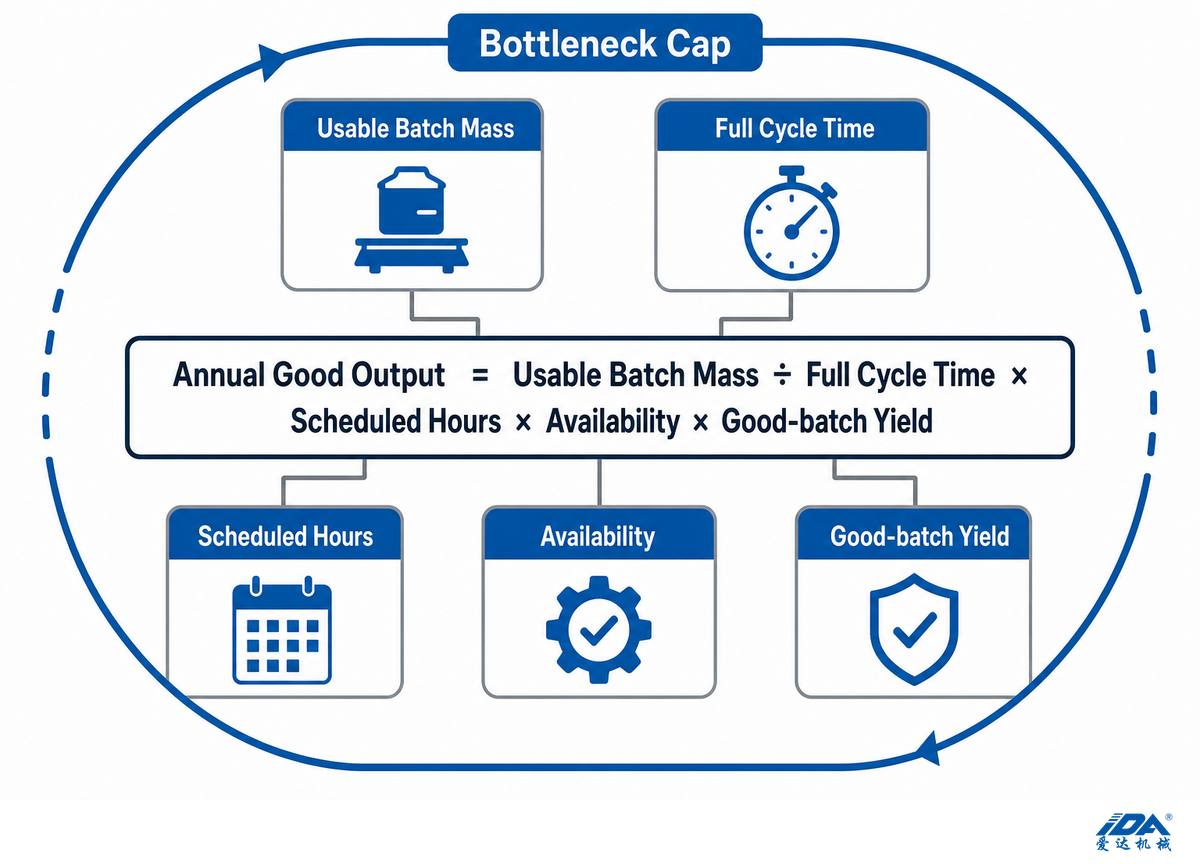
Annual adhesive capacity is a scenario result, not a vessel label. Calculate usable batch mass divided by full cycle time, then multiply by scheduled operating hours, expected availability, and good-batch yield. Cap the result at the capacity of feeding, heat removal, discharge, filtration, filling, cleaning, or any other limiting operation.
5-Factor Throughput Worksheet
Planning equation: annual good output = (usable batch mass ÷ full cycle time) × scheduled operating hours × availability × good-batch yield. Put a hypothetical 30 min cleaning allowance inside full cycle time, not outside the calculation.
| Factor | Definition | Hypothetical base input | Evidence needed | Limitations |
|---|---|---|---|---|
| Usable batch mass | Released output after heel and planned loss | 1,200 kg/batch | Mass balance and discharge trial | Nominal vessel volume is not usable mass. |
| Full cycle time | Charge through release-ready discharge and changeover | 4.5 h/batch | Time study by recipe family | Mix time alone excludes major losses. |
| Scheduled time | Planned staffed operating hours | 4,000 h/year | Shift and maintenance calendar | Calendar hours are not production hours. |
| Availability | Share of scheduled time actually available | 82% | Changeover, fault, and maintenance model | Do not copy a benchmark without plant data. |
| Good-batch yield | Released mass divided by produced mass | 97% | Quality and rework history | First-pass and final yield are different. |
Worked example: 1,200 kg ÷ 4.5 h = 266.7 kg/h. Multiplying 266.7 kg/h by 4,000 h/year, 82% availability, and 97% yield gives about 848,000 kg/year, or 848 t/year. Every input is hypothetical, so the answer demonstrates the calculation rather than claiming IDA equipment performance.
To expose sensitivity, rerun that hypothetical worksheet at 1,000 kg/batch and 1,400 kg/batch, then at 4.0 h/batch and 5.0 h/batch while holding availability at 80% and good-batch yield at 85%. These are stress-test inputs, not IDA performance data.
| Scenario | Usable mass | Cycle | Schedule | Availability | Yield | Calculated good output | What could still cap it |
|---|---|---|---|---|---|---|---|
| Constrained | 1,200 kg | 5.5 h | 4,000 h/y | 75% | 95% | About 622 t/y | Slow cooling, discharge, or cleaning |
| Base | 1,200 kg | 4.5 h | 4,000 h/y | 82% | 97% | About 848 t/y | Feeding, filtration, or filler availability |
| Recovery | 1,200 kg | 4.0 h | 4,000 h/y | 88% | 98% | About 1,035 t/y | Requires evidence for every improved input |
A vendor-authored 2022 analysis starts with 70 ft/min web speed, 5 oz/yd² coat weight, and 5 ft width, which converts to roughly 730 lb/h adhesive demand. Its case then uses two staggered 1,600 lb mixers, a 4,000 lb buffer, a 4 h batch cycle, and 11 feed streams to support about 800 lb/h in that arrangement. This is useful demand-first logic, not a universal design ratio. Inspect the worked in-line case.
One peer-reviewed 2024 bioadhesive model uses a declared 30 metric-tonne-per-batch basis and finds steam to be the primary modeled greenhouse-gas contributor. Those values belong to that modeled plant. The transferable lesson is to state the batch basis, cycle, and utilities instead of hiding them behind an annual-capacity headline. Review the modeled plant study.
Hidden Bottleneck Map
Run the capacity equation against at least five bottleneck zones: feedability, bulk turnover, thermal recovery, discharge, and finishing. Add cleaning, laboratory release, operator coverage, and utility recovery where relevant. The controlling zone can change by SKU; a low-viscosity emulsion and a filled structural paste can reverse the same line’s bottleneck.
Key takeaway: publish a capacity range with assumptions and bottleneck evidence. Reject a single annual number that cannot be rebuilt from batch and operating data.
8. Use the 9-Gate Recipe-to-Line Fit Matrix
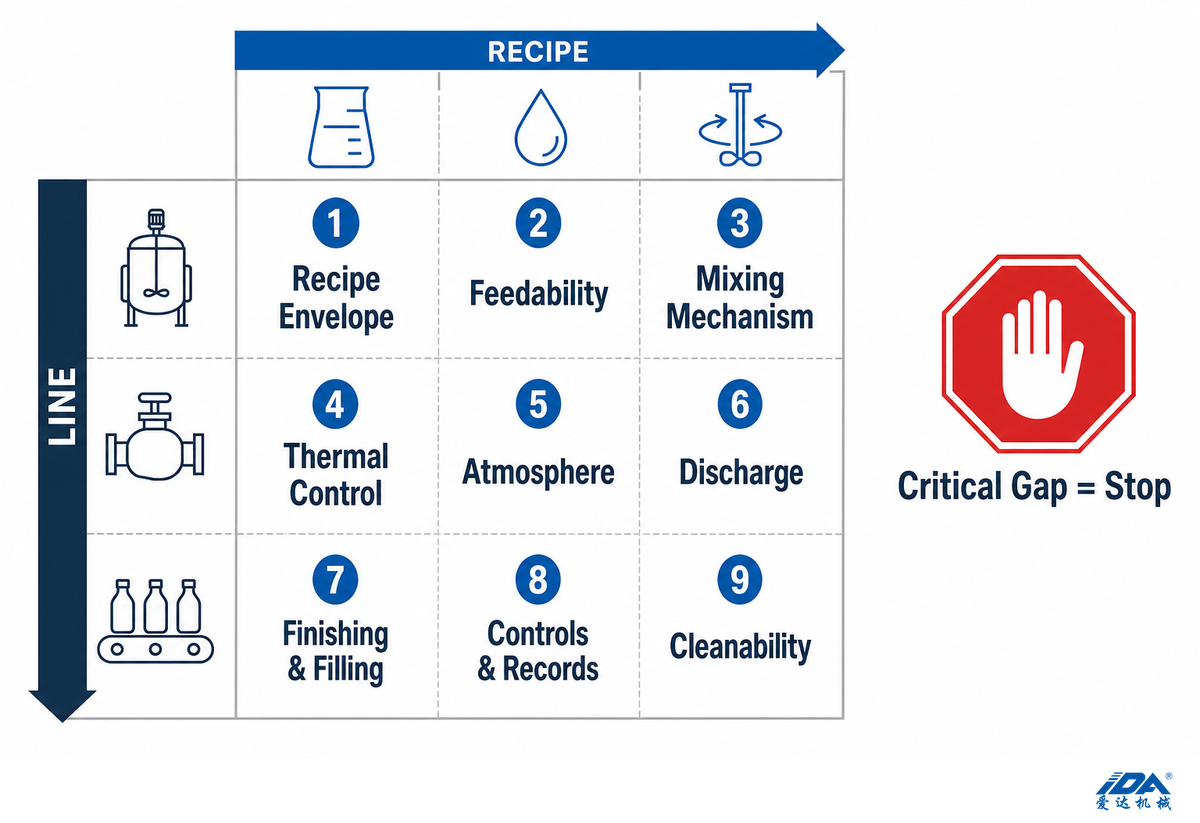
Our 9-Gate Recipe-to-Line Fit Matrix turns a quotation into an evidence review. A concept advances only when each gate has a buyer input, a vendor response, a testable proof item, and a stop condition. This method avoids invented weighted scores: one unresolved critical gate can matter more than eight attractive features.
Use the fit matrix alongside, not instead of, a formal machinery risk process. ISO 12100:2010 specifies basic terminology, principles, and a methodology for machinery risk assessment and risk reduction, but it does not select an adhesive process or certify a project. Check the official ISO scope.
| Gate | Buyer input | Vendor must show | Stop condition | Limitations / not suitable for |
|---|---|---|---|---|
| 1. Recipe envelope | Viscosity, solids, shear, heat, atmosphere ranges | Defined operating window and exclusions | Concept depends on an unstated formulation assumption | A product name cannot pass this gate. |
| 2. Feedability | Raw-material form, bulk density, addition rate | Feeder or charging trial and containment concept | Powder behavior is represented only by water | Vendor catalogue accuracy is material-dependent. |
| 3. Mixing mechanism | Bulk-turnover and dispersion duties | Representative wet trial, load trend, sample plan | Selection is based only on rpm or kW | Use an equipment decision guide as a shortlist, not proof. |
| 4. Thermal control | Heat-up, exotherm, hold, cooling targets | Heat-transfer basis, utility data, control response | Product temperature is inferred from jacket settings | Scale changes heat-transfer area per unit volume. |
| 5. Atmosphere | Foam, vapor, oxygen, moisture, vacuum endpoint | Pressure basis, vent path, condenser or inerting scope | Vacuum or hazardous-area duty is assumed | Jurisdiction and chemistry control applicability. |
| 6. Discharge | Endpoint rheology, heel, transfer distance | Worst-condition discharge method and time | Gravity or pump selection lacks material evidence | No-load trials cannot show high-viscosity transfer. |
| 7. Finishing and filling | Filter need, packs, fill temperature, accuracy method | Compatible test and changeover plan | Filtration or filling changes the accepted product | Filter fineness is not a universal quality setting. |
| 8. Controls and records | Recipes, roles, alarms, data, interfaces | Cause-and-effect, record sample, failure recovery | Manual fallback or data ownership is undefined | Automation cannot remove process uncertainty. |
| 9. Cleanability and changeover | SKU matrix, residues, solvents or water, waste route | Access, drainability, sequence, inspection evidence | Cleaning time, acceptance, or waste is missing | “Easy to clean” is not an acceptance criterion. |
Use the matrix twice. During concept selection, mark unknowns and assign experiments. Before purchase-order release, turn the surviving items into contractual documents: user requirements, process description, equipment data sheets, cause-and-effect, test protocols, and an interface register. A cell passes because evidence exists, not because a meeting agreed it “should be fine.”
When not to buy a turnkey line yet
Delay design freeze when the formulation is still moving, peak viscosity is unknown, a reactive or volatile material lacks a reviewed handling basis, the destination compliance route is undecided, representative product cannot be tested, or the buyer cannot state an acceptance method. A pilot, recipe freeze, or bounded engineering study can be the cheaper next step.
Key takeaway: the fit matrix is a stop/go system. It makes unresolved risk visible before price and promised delivery dominate the decision.
9. Specify the 12-Point Commissioning Evidence Pack
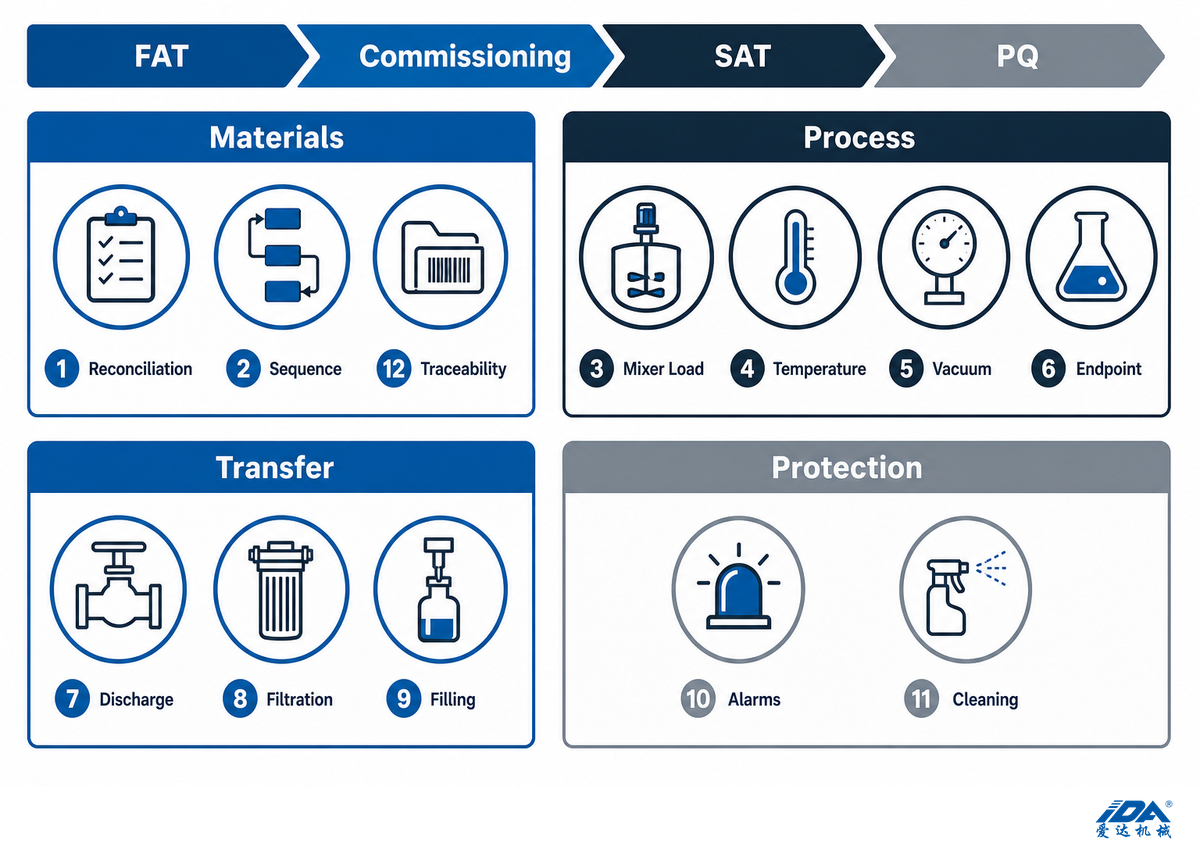
A commissioning evidence pack separates supplier-site factory acceptance testing (FAT), site installation and commissioning, site acceptance testing (SAT), and recipe-specific process qualification. Each item names the test method, acceptance source, evidence file, and owner. That separation prevents a dry functional test from being treated as proof of capacity, product quality, cleaning, or site utility performance.
CSIA-linked 2025 automation guidance places FAT at the integrator’s facility, with sign-off permitting shipment, then treats installation and commissioning, SAT, training, and support as separate stages. SAT follows agreed protocols while checking installed operation and integration. Review the FAT and SAT staging guidance.
12-Point Commissioning Evidence Pack
| Evidence point | Primary layer | Method | Acceptance source | Evidence file | Owner | Limitations |
|---|---|---|---|---|---|---|
| 1. Material reconciliation | FAT + PQ | Challenge IDs, masses, wrong-material block | URS and recipe | Charge and reconciliation report | Buyer quality | Simulant proves logic, not product behavior. |
| 2. Sequence control | FAT | Normal, skipped, and out-of-order steps | Approved sequence | Event and exception log | Controls lead | A screen walk-through is insufficient. |
| 3. Mixer speed or load | FAT + PQ | Command, feedback, trend, wet load | Trial-derived process window | Trend and calibration record | Process engineer | Dry rotation cannot prove wet duty. |
| 4. Temperature control | FAT + SAT + PQ | Sensor check, heat-up, hold, cool, alarm | URS plus recipe range | Temperature trend | Process and utilities | Site utility capacity affects the result. |
| 5. Vacuum or pressure | FAT + SAT + PQ | Leak test, endpoint, hold, safe vent | Risk review and recipe | Pressure trend and leak record | Mechanical lead | Empty-vessel pressure is not deaeration proof. |
| 6. Mixing endpoint | PQ | Agreed sampling and product test | Approved product specification | Lab result linked to batch | Buyer quality | Endpoint method must represent the vessel. |
| 7. Discharge performance | SAT + PQ | Worst-viscosity transfer, heel, time | URS and capacity model | Mass balance and time study | Production lead | Warm simulant may overstate performance. |
| 8. Filtration | PQ | Pressure, loading, product effect, change rule | Quality and process plan | Filter batch record | Quality and production | A finer filter can remove intended solids. |
| 9. Filling accuracy | FAT + SAT + PQ | Approved pack, sample size, reject challenge | Contract and legal metrology review | Fill study and rejects | Packaging lead | Water accuracy may not transfer to adhesive. |
| 10. Alarms and interlocks | FAT + SAT | Cause-and-effect challenge, reset, recovery | Risk assessment and C&E | Signed challenge sheet | Controls and EHS | Bypassed tests must remain open items. |
| 11. Cleaning and changeover | SAT + PQ | Timed sequence, inspection, residue criterion | SKU matrix and quality plan | Cleaning report | Production and quality | Visual cleanliness may not prove carryover control. |
| 12. Batch traceability | FAT + SAT + PQ | Rebuild one batch from material to pack | Data and quality requirements | Complete batch dossier | Quality systems | A historian without version context is incomplete. |
Write numerical values only where their authority is clear. A hypothetical protocol can sample a temperature trend every 1 s, require a 30 min recovery test, demonstrate three consecutive batches, check 20 L packs, and measure cleaning within 45 min. Those values are not recommendations; the approved URS, recipe, risk assessment, law, and contract must replace them.
Hypothetical trial-sheet example: record a 10 kg/min powder charge at 0.72 kg/L bulk density over 18 min; heat product to 75 °C within a ±2 °C project band; cool to 40 °C within 25 min; reach 80 mbar absolute for a 10 min hold; trend a 55 rpm sweep and 1,200 rpm disperser; then demonstrate 300 kg/h discharge into 18 kg packs at an agreed ±0.3% check and complete the defined clean within 50 min.
Contracts should also state who supplies material, how much is needed, whether waste can be shipped or treated, what happens when a test is invalid, who approves a deviation, and which open items block shipment or acceptance. Evidence ownership is part of the equipment scope.
Key takeaway: FAT checks the built system before shipment; SAT checks the installed system; process qualification checks the buyer’s defined recipe and product evidence. Keep all three visible.
10. Build an RFQ That Exposes Scope Gaps

Useful adhesive-line RFQs give suppliers the same bounded inputs and request the same evidence structure. They should state recipe ranges, materials, capacity scenarios, packs, utilities, site, hazard-communication and conformity assumptions, cleaning, automation, acceptance layers, documents, training, service, and exclusions. Comparable scope matters more than identical quotation formatting.
1. Recipe envelopeBuyer supplies ranges; vendor lists assumptions and exclusions.
2. Raw-material registerForm, density, package, addition rate, storage, compatibility.
3. Capacity scenariosBatch mass, full cycle, hours, availability, yield, bottlenecks.
4. Product and SKU matrixHighest viscosity, shortest run, packs, closures, changeovers.
5. Process-flow boundaryIncluded, optional, buyer-supplied, and future interfaces.
6. Utilities and siteElectrical supply, thermal media, cooling, air, vacuum, space.
7. Materials of constructionWetted parts, seals, finish, compatibility, wear parts.
8. EHS and conformityChemistry, destination, occupancy, AHJ, standards, documentation.
9. Controls and dataRecipes, roles, alarms, history, interfaces, cybersecurity owner.
10. Cleaning and wasteMethod, residue criterion, time model, effluent and solvent route.
11. Acceptance evidenceFAT, SAT, PQ, material, methods, criteria, owners, open-item rules.
12. Lifecycle scopeDrawings, manuals, training, spares, response, warranty, change control.
Ask each supplier to return an interface register and a deviation list. “Included” should identify the equipment, instrument, document, software, connection point, and test responsibility. “By buyer” should name the boundary. “To be confirmed” should have an owner and deadline. That discipline makes omissions visible before they become site change orders.
When the recipe brief, capacity range, utility limits, process-flow draft, commissioning evidence pack, and RFQ are ready, the buyer has enough information for a configuration review. The educational guide should then hand commercial intent to the dedicated adhesive production line solution page instead of duplicating its supplier and quotation role.
Key takeaway: a strong RFQ makes assumptions, exclusions, interfaces, and acceptance evidence comparable. The lowest headline price may simply contain the most unpriced scope.
Turn Your Recipe Envelope Into a Line Concept
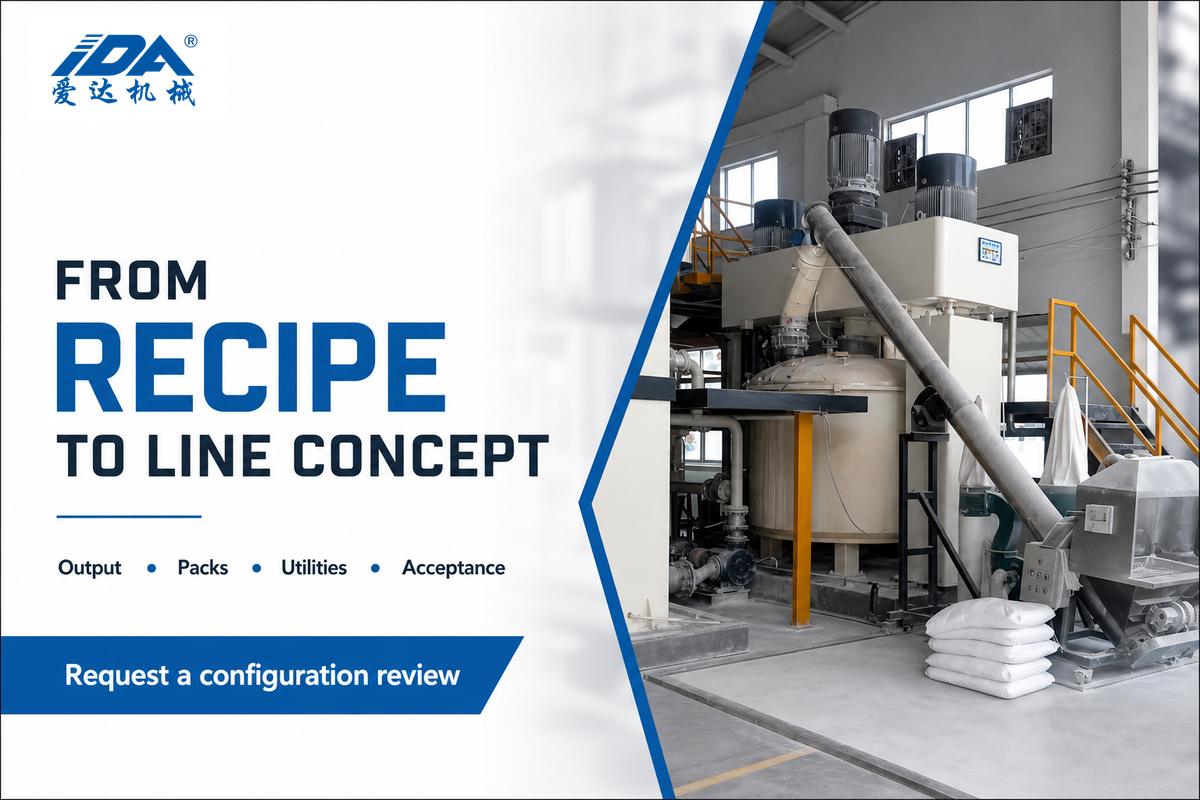
Share the formulation ranges you can disclose, target output, pack formats, utility limits, and acceptance priorities. IDA Equipment can use that brief to discuss a recipe-specific configuration and the trials still needed.
FAQ: Adhesive Production Lines
These answers are planning guidance, not universal process specifications. This peer-reviewed review of adhesive families and applications shows why chemistry and use conditions must remain part of the equipment decision.
What equipment is included in a complete adhesive production line?
Complete lines can include raw-material receiving and dosing, pre-mixing, a disperser or reactor, a high-viscosity mixer, heating and cooling, vacuum or atmosphere control, discharge, transfer, filtration, buffering, filling, coding, controls, and batch records. The required combination depends on formulation and site. If a supplier omits a stage, the quotation should explain where that process duty occurs instead and how the buyer will verify it.
Which mixer do I need for my adhesive formulation?
Select from the rheology profile, filler loading, wet-out need, shear sensitivity, reaction or heat duty, air sensitivity, and discharge behavior. A planetary, dual-shaft, triple-shaft, disperser, kneader, or reactor can be a candidate. Ask why the proposed mechanism provides both local processing duty and whole-vessel movement. Final selection should survive a representative-material trial that examines bulk turnover, temperature rise, dispersion endpoint, air removal, cleaning, and discharge at the worst expected condition, with a disqualification rule agreed before the test.
How much does an adhesive production line cost?
There is no responsible universal price because scope changes with batch size, wetted materials, mixing duty, thermal utilities, vacuum, hazardous-area requirements, automation, filling, conformity records, and acceptance testing. Compare quotations only after issuing one bounded RFQ. Ask suppliers to separate core hardware, options, site utilities, installation, testing material, commissioning, training, spares, freight, taxes, and buyer-supplied items. Normalize exclusions and interfaces before comparing totals; a low figure can reflect missing scope rather than lower lifecycle cost.
How do you manufacture adhesive?
Manufacture verifies and meters raw materials, creates a carrier or resin phase, adds powders or reactants in sequence, mixes or disperses under controlled heat and atmosphere, tests an endpoint, then discharges, finishes, fills, identifies, and releases the batch. Chemistry determines the exact route.
Is vacuum mixing necessary for every adhesive?
No. Vacuum is useful when entrained air, foam, moisture, vapor removal, or a defined degassing endpoint justifies it. It can also change evaporation, cooling, reaction, seal, and condenser requirements. Decide from the formulation and product-quality need, then specify the vessel pressure, measurement point, hold or leak method, safe venting, and representative trial. A vacuum-system rating alone is not process evidence.
How do you calculate adhesive production-line capacity?
Start with usable batch mass and the full cycle time, including charging, mixing or reaction, cooling, discharge, cleaning, and changeover. Multiply the resulting hourly rate by scheduled operating hours, expected availability, and good-batch yield. Run constrained, base, and recovery scenarios, then cap each result at the capacity of feeding, utilities, discharge, filtration, filling, laboratory release, or another connected bottleneck.
What should I ask an adhesive equipment supplier before requesting a quote?
Send a recipe envelope, raw-material register, batch and annual output scenarios, product and pack matrix, destination, utilities, materials-of-construction needs, cleaning plan, automation and data scope, and proposed FAT, SAT, and qualification methods. Ask the supplier to return assumptions, exclusions, interfaces, test requirements, drawings, manuals, spare parts, service terms, and a deviation list. Request the trial-material amount, acceptance owner, open-item rules, and a milestone schedule. This response makes competing quotations technically comparable and exposes work that might otherwise become a site change order.
What is the lead time for an adhesive production line?
Lead time depends on design maturity, fabrication, bought-out components, controls, conformity work, FAT material, shipping, site readiness, and commissioning. Request dated milestones from design freeze through process qualification, each tied to buyer inputs and approvals.
References & Sources
- 2024 peer-reviewed review of adhesive families, properties, limitations, and applications.
- NC State BioResources soy-adhesive formulation study.
- 2024 peer-reviewed bioadhesive plant model.
- NFPA 30 flammable and combustible liquids FAQ, July 2026.
- IECEE entry for IEC 60204-1:2016 and national or group differences.
- Peer-reviewed process-drift detection and recalibration study.
- 2025 CSIA-linked automation project guide covering FAT, commissioning, and SAT.
- Scoped 2022 worked example of in-line adhesive manufacturing.
- 2025 trade analysis of adhesive and sealant development drivers.
- ISO 12100:2010 machinery risk-assessment and risk-reduction scope.
- ISO 13849-1:2023 safety-related control-system scope and limitations.
- OSHA 29 CFR 1910.1200 Hazard Communication and OSHA 29 CFR 1910.147 hazardous-energy control.
- ASTM D1084 adhesive-viscosity scope and ASTM D2556 shear-rate-dependent viscosity scope.
- ASTM D1002 comparative lap-shear scope and ASTM D903 comparative peel scope.
Related Engineering Guides
Editorial and engineering boundary: This article was prepared for IDA Equipment from public first-party pages, official guidance, peer-reviewed studies, and reviewed trade sources. It provides a planning framework, not a recipe, safety determination, conformity certificate, or performance guarantee. Reported figures remain scoped to their cited study or worked example. Final equipment, process values, and acceptance criteria require representative materials, the destination jurisdiction, and review by the buyer’s process, quality, EHS, and procurement teams. Company identity was checked against IDA Equipment’s About page.