Get in Touch with IDA


Polyvinyl acetate (PVAc, CAS 9003-20-7) is a synthetic thermoplastic homopolymer made through free-radical polymerization of vinyl acetate monomer; emulsion polymerization produces waterborne dispersions. Emulsion polymerization yields waterborne dispersions. Manufacturers supply this resin as a waterborne dispersion or solid thermoplastic beads. Upon evaporation of water above the minimum film forming temperature, the polymer coalesces to give a clear, rigid film. This cured film provides a strong adhesive interlocking bond with high shear strength to porous substrates.
Industrial formulators use polyvinyl acetate to manufacture carpenter’s wood glue, packaging adhesives, paper coatings, and food-grade gum bases. Suppliers of polyvinyl acetate resin and dispersions include Celanese Corporation and Wacker Chemie. PVAc polymerization uses a jacketed reactor with heat removal, whereas purchased dispersions can be compounded without a polymerization reactor. Compounding moderate-to-high-viscosity adhesives combines an anchor sweep agitator with a high-speed disperser in a multi-shaft mixer, or uses a double-planetary vacuum mixer with hydraulic discharge.
| Parameter | Standard Industrial Value / Range | Reference Standard / Notes |
|---|---|---|
| Chemical / IUPAC Name | Polyvinyl acetate (PVAc) / Poly(1-acetyloxyethylene) | Discovered by Fritz Klatte in 1912 (Germany Patent 281687) |
| CAS Registry Number | 9003-20-7 (Polymer); 108-05-4 (Vinyl acetate monomer) | Distinct from polyvinyl alcohol (PVOH, CAS 9002-89-5) |
| Repeating Unit Formula | (C4H6O2)n (Repeat unit molar mass: 86.09 g/mol) | Atactic, amorphous vinyl ester polymer chain |
| Solid Resin Density | 1.19 g/cm3 (solid homopolymer resin) | Specify density measurement conditions from grade-specific PVAc data |
| Glass Transition Temperature (Tg) | Near 28 °C (neat homopolymer PVAc) | Modified via external plasticizers, copolymerization, or crosslinking |
| Minimum Film-Forming Temperature | Plasticizers and coalescents lower PVAc MFFT; ethylene incorporation can lower VAE MFFT | Application below MFFT can produce chalky white glue lines |
| Wood Adhesive Durability Classes | EN 204 D1, D2, D3, and D4 (non-structural thermoplastic) | Tested per EN 205:2016 on thin beech lap joints; ASTM D4317 |
| Compounding Viscosity Window | 500 cP (base latex) to 4,000,000 cP (filled construction mastic) | Specify grade-specific rotational viscometry conditions per ISO 2555 |
What Is Polyvinyl Acetate (PVAc) and How Does Its Chemical Structure Work?
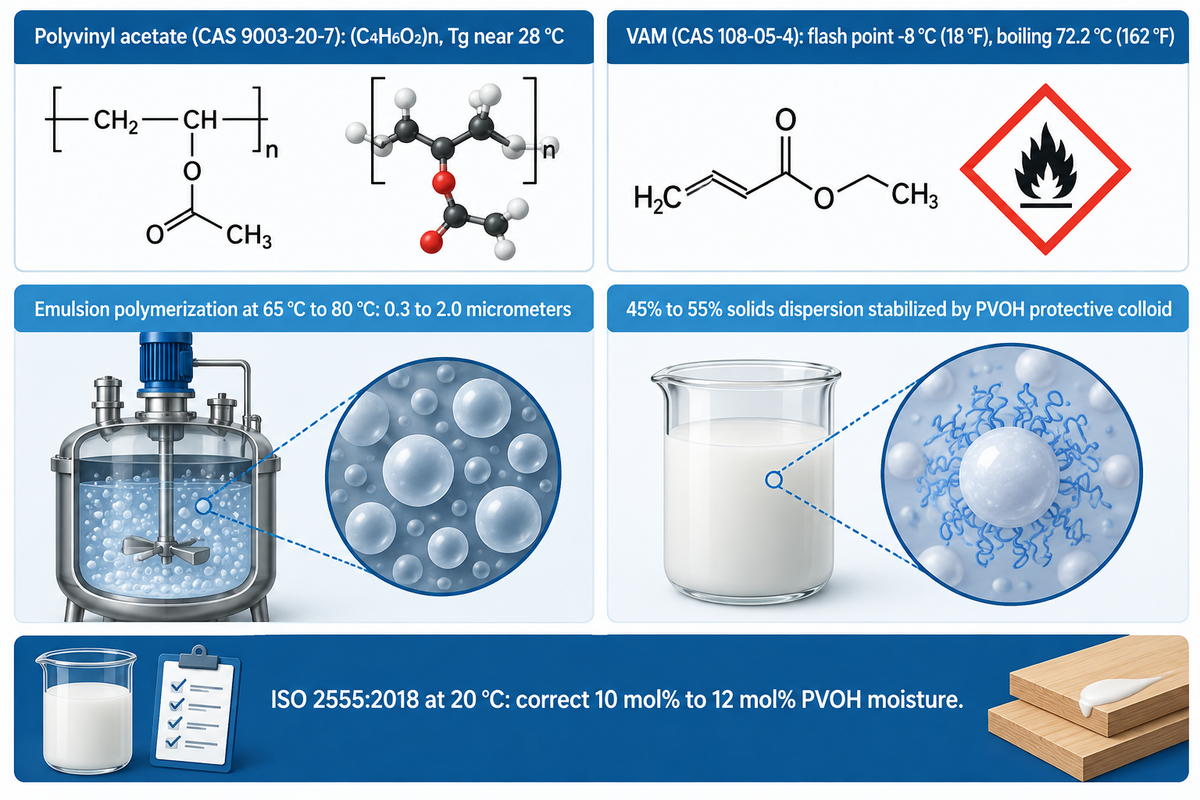
Polyvinyl acetate (CAS 9003-20-7) is an atactic amorphous thermoplastic polymer represented by the formula (C4H6O2)n. Polymerization combines vinyl acetate monomer units to form polyvinyl acetate. Pendant acetate ester groups (-OCOCH3) along its carbon backbone form strong dipole interactions and hydrogen bonds with porous materials like wood and paper. This causes the PVAc dispersion to have rapid wet-tack and high dry tensile strength.
The first synthesis of the polymer was accomplished by German Chemist Fritz Klatte in 1912. The polymer’s precursor monomer is produced by large scale industry via reaction of ethylene and acetic acid in the presence of oxygen and a palladium catalyst. Unlike aromatic solvent glues based on benzene derivatives, modern aqueous PVAc dispersions operate as low VOC, water-based binders.
Because the bulky acetate side groups sit randomly along the main chain, solid polyvinyl acetate cannot pack into a crystalline lattice. According to SpecialChem’s polymer film formation guide, Poly(vinyl acetate) has a glass transition temperature (Tg) of approximately 28 °C. At room temperature, the unmodified polymer behaves as a tough, leathery solid.
How is PVA glue made?
Industrial PVA glue is made through aqueous free-radical emulsion polymerization of vinyl acetate monomer (CAS 108-05-4) at 65 °C to 80 °C. In a jacketed reactor, water, polyvinyl alcohol (PVOH) protective colloid, nonionic surfactant, and a persulfate initiator convert monomer droplets to stable polymer particles of 0.3 to 2.0 micrometers at 45% to 55% solids.
Controlling reaction kinetics and heat removal during the manufacturing process is critical. According to the NIOSH Pocket Guide for Vinyl Acetate, vinyl acetate monomer has a flash point of -8 °C (18 °F) and a normal boiling point of 72.2 °C (162 °F). During vinyl acetate polymerization, cooling removes reaction heat, condensers recover condensable vapors, and nitrogen inerting limits oxygen in the reactor atmosphere. Engineers can review our industrial chemical reactor design and heat-transfer guide for jacket sizing and reflux safety calculations.
During polymerization, persulfate free radicals graft polymer chains onto the polyvinyl alcohol protective colloid shell. As documented in peer-reviewed emulsion polymerization research on PMC, protective colloid dosage affects the particle size distribution and the viscosity of the final emulsion. However, the uptake of ambient moisture in the raw protective colloid creates a hidden batching problem. This creates a hidden batching trap.
According to Ascent Petrochem’s analysis of PVA viscosity drift, partially hydrolyzed PVA with 10 mol% to 12 mol% residual acetyl content is hygroscopic at 25 °C and 65% relative humidity. Weighing a nominal 4% w/w aqueous solution without moisture correction skews the apparent viscosity measured at 20 °C under ISO 2555:2018 rotational viscometry. ISO 2555 apparent viscosity also varies with the rotational velocity gradient. Quality laboratories must therefore specify the exact Brookfield spindle and rotational speed.
Polyvinyl Acetate vs. Polyvinyl Alcohol (PVOH) vs. VAE Copolymer Emulsions
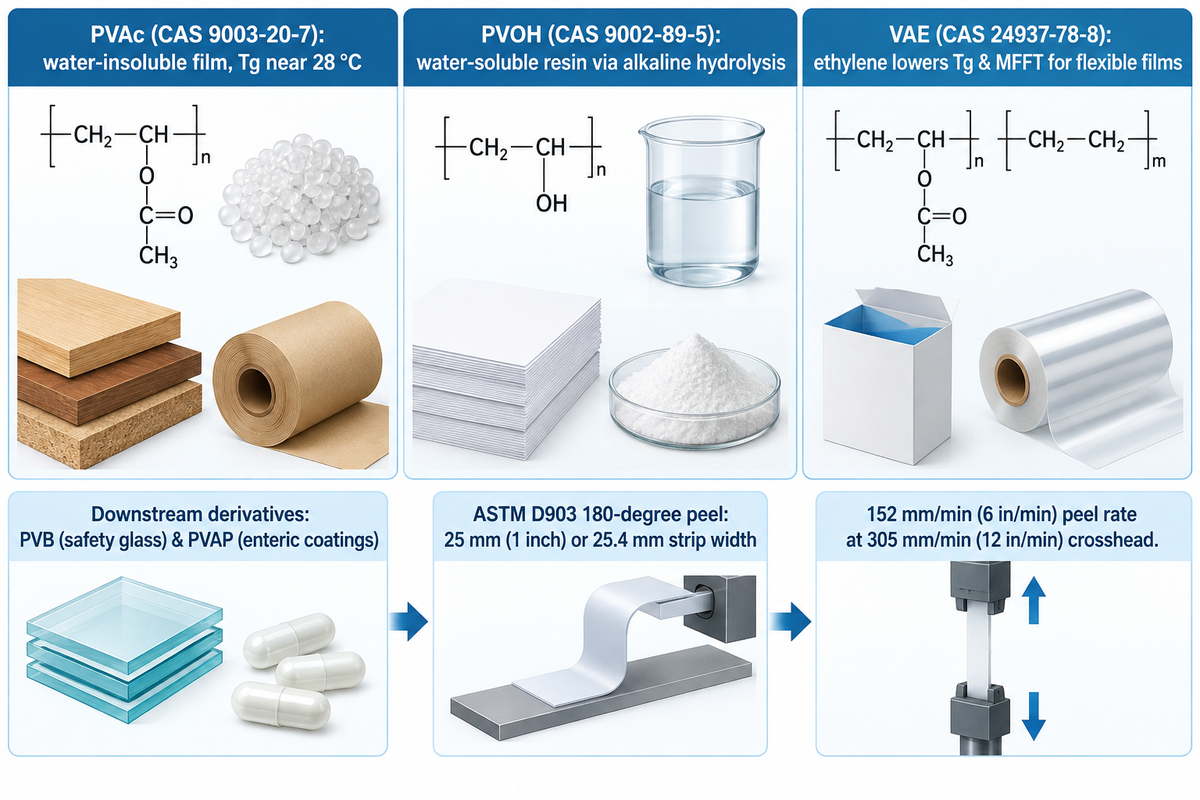
Polyvinyl acetate (PVAc, CAS 9003-20-7) is a water-insoluble polymer supplied as aqueous dispersion. Polyvinyl alcohol (PVOH, CAS 9002-89-5) is a water-soluble resin made by alkaline hydrolysis of PVAc. Vinyl acetate ethylene (VAE) copolymers contain ethylene in the backbone, thus have a lower Tg for better adhesion of flexible films.
Trade literature often uses “PVA” ambiguously to refer to either polyvinyl acetate wood glue or water-soluble polyvinyl alcohol film. This can lead to mistakes when a purchase order is placed, and negatively affect a production batch. Homopolymer dispersions of unmodified PVAc also show low adhesion to non-porous plastics, such as polypropylene and untreated polyethylene. Formulators often evaluate VAE copolymer dispersions for lower-energy packaging films and coated paperboard.
| Property / Selection Criterion | Polyvinyl Acetate (PVAc Homopolymer) | Polyvinyl Alcohol (PVOH / PVA) | Vinyl Acetate-Ethylene (VAE Copolymer) |
|---|---|---|---|
| CAS Number & Supply Form | 9003-20-7; aqueous emulsion or solid thermoplastic beads | 9002-89-5; dry powder or granules dissolved in hot water | 24937-78-8; aqueous copolymer dispersion or redispersible powder |
| Synthesis Route | Free-radical polymerization of vinyl acetate monomer | Alkaline hydrolysis (methanolysis) of polyvinyl acetate | High-pressure copolymerization of vinyl acetate and ethylene |
| Water Solubility of Dry Film | Insoluble in water (swells slightly unless crosslinked) | Water-soluble (solubility varies with degree of hydrolysis) | Water-insoluble film; copolymerized ethylene provides internal plasticization and reduces the need for added plasticizers |
| Glass Transition Temperature (Tg) | Near 28 °C for neat homopolymer (rigid film at room temperature) | Grade-dependent crystalline/amorphous transition in dry state | Lowered by copolymerized ethylene units (verify grade-specific datasheet) |
| Minimum Film-Forming Temp (MFFT) | Plasticizers and coalescent additives lower PVAc MFFT | Forms film by water evaporation from true solution | Ethylene incorporation can lower VAE MFFT without external plasticizers |
| Primary Target Substrates | Solid wood, particleboard, MDF, kraft paper, porous board | Paper surface sizing, textile warp sizing, PVAc colloid stabilizer | Coated paperboard, packaging films, flexible lamination |
PVAc is converted to PVOH by a methanolysis process. Sodium hydroxide catalyst is used in this process. PVOH is recovered as a solid product resin. Further reacting PVOH with butyraldehyde yields polyvinyl butyral (PVB) for laminated safety glass. Reacting PVAc derivatives with phthalic anhydride produces polyvinyl acetate phthalate (PVAP) for enteric tablet coatings. PVAc is also combined with polyvinylpyrrolidone (PVP) or butyl acrylate copolymers for remoistenable and pressure-sensitive adhesive tapes.
In flexible packaging lamination, engineers test peel adhesion using ASTM D903 180-degree peel testing. According to Infinita Lab’s ASTM D903 testing guide, the standard specimen uses a 25 mm (1 inch) or 25.4 mm wide flexible strip bonded to a rigid panel. As detailed by Universal Grip’s ASTM D903 protocol, achieving a 152 mm/min (6 in/min) bondline separation rate requires a 305 mm/min (12 in/min) crosshead speed. Our technical article on industrial mixing principles for non-Newtonian fluids explains how shear-thinning rheology governs roll-coating before peel testing.
Industrial Applications of Polyvinyl Acetate Across Adhesives, Coatings, and Food
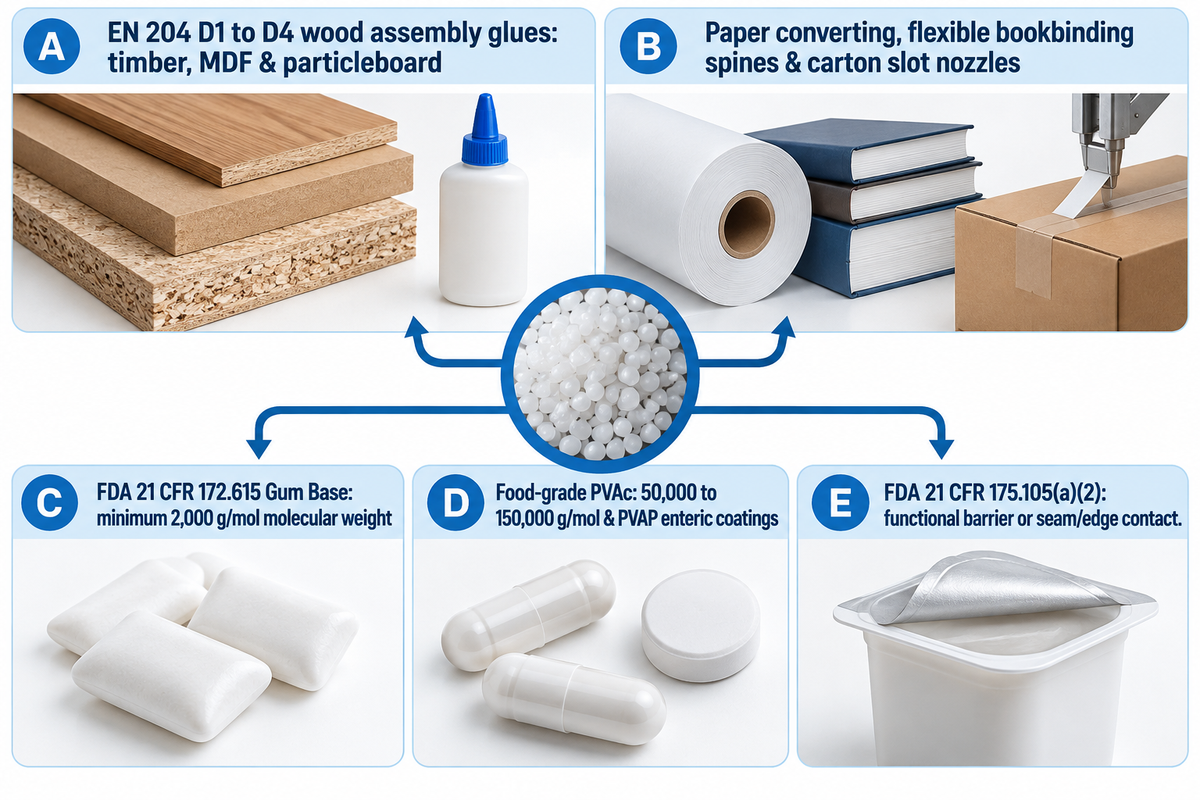
Polyvinyl acetate has four main industrial markets, EN 204 D1 to D4 wood assembly glues, paper converting and bookbinding dispersions, interior architectural primers, and food-grade chewing gum bases. Each market has distinct requirements for molecular weight, particle size, and level of monomer residue.
In woodworking and furniture manufacturing, PVAc emulsions quickly wet cellulose fibers. Clear-drying PVAc wood adhesives can form a transparent glue line and produce wood failure in dry-bond tests when joints are well fitted, adequately pressed, and fully dried. Consumer craft products, e.g., non-toxic Elmer’s school glue, paper art glues, and archival scrapbooking adhesives, use lower-solids dispersions for easy water cleanup. Industrial woodworking plants, however, run higher-solids dispersions, which are formulated for rapid wet tack. Formulators compound these grades with aluminum chloride catalyst or inorganic mineral fillers to bond particleboard, medium-density fiberboard, and hardwood veneers.
PVAc dispersions find applications in paper converting and bookbinding processes in competition with hot melt adhesives and polyurethane reactive systems. Unlike animal glues which oxidize and crack with age, plasticized PVAc emulsions remain flexible along textbook spines. High-speed carton sealing lines also extrude fast-setting PVAc beads through precision slot nozzles as a clean-machining binding agent.
Is polyvinyl acetate toxic or safe for food contact and cosmetics?
Polymerized food-grade polyvinyl acetate is cleared for specific direct and indirect food applications under U.S. FDA regulations when manufactured to statutory purity specifications. Industrial safety requires controlling unreacted vinyl acetate monomer, coalescing solvents, and acidic crosslinkers. Food packaging applications must also satisfy regulatory migration and barrier conditions.
For direct use as a masticatory gum base, FDA 21 CFR 172.615 (Chewing Gum Base) sets a minimum molecular weight of 2,000 g/mol for synthetic polyvinyl acetate. Gum-grade PVAc solution viscosity is specified at a defined solvent composition, polymer concentration, and temperature. A viscosity value alone does not establish molecular weight, though Patsnap Eureka’s materials engineering profile reports food-grade PVAc molecular weights of 50,000 to 150,000 g/mol. Pharmaceutical companies also use polyvinyl acetate phthalate in enteric coatings that dissolve only in the neutral intestine.
For food packaging materials, listing PVAc under FDA 21 CFR 175.105 (Adhesives) does not clear an adhesive for direct food contact. Under 21 CFR 175.105(a)(2), adhesives may be separated from food by a functional barrier. Limited contact is also permitted under specified conditions, including trace contact at seams and edges where performance properties and water resistance are maintained.
Performance Properties, Limitations, and EN 204 D1, D4 Water Resistance Classes
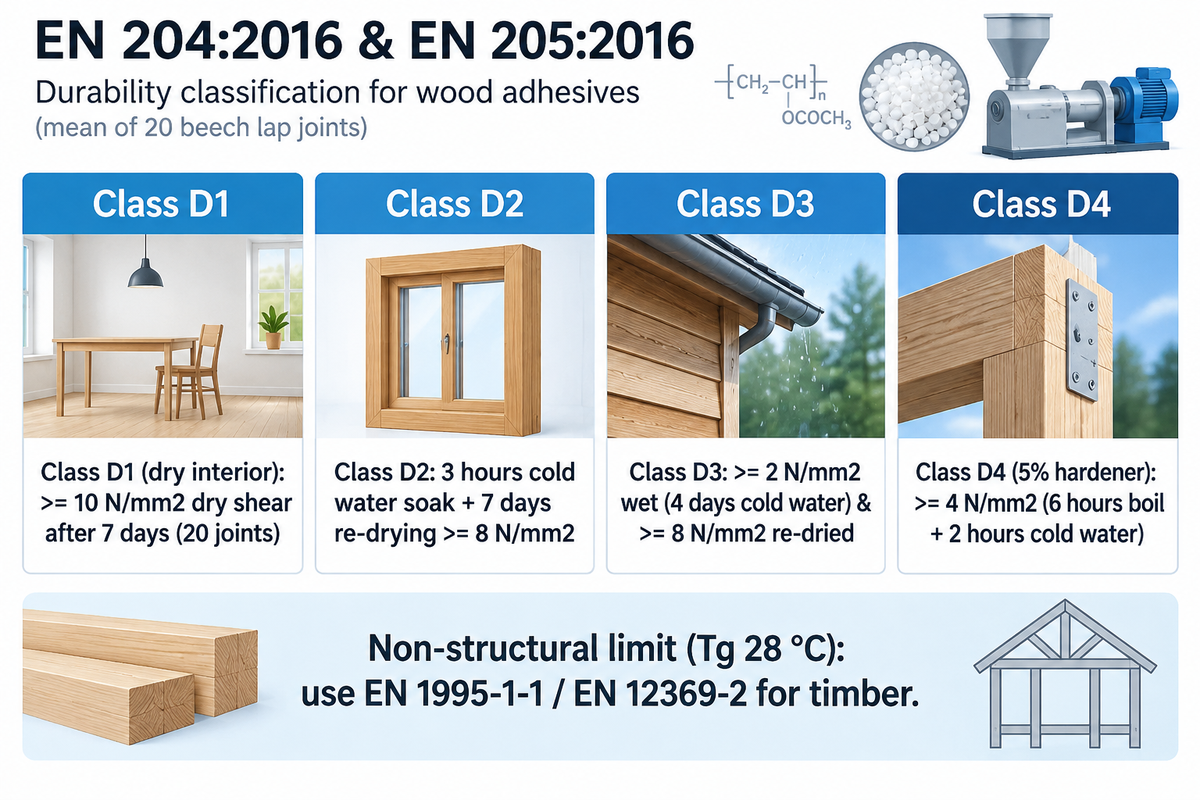
European standard EN 204:2016 classifies non-structural thermoplastic wood adhesives into four water resistance classes (D1, D2, D3, and D4) tested per EN 205:2016 on thin beech lap joints. Every class requires at least 10 N/mm2 dry shear strength after 7 days. Class D3 includes cold-water conditioning, while Class D4 includes a boiling-water sequence followed by cooling in cold water.
According to the CEN EN 204:2016 official standard catalog and Saral’s EN 204/EN 205 laboratory testing breakdown, laboratories pull apart 20 overlapping beech (Fagus sylvatica) specimens per conditioning sequence. Uncrosslinked homopolymer PVAc meets Class D1 or D2 for interior furniture. NMA-containing copolymers and compatible aluminum chloride complexation or polymeric isocyanate crosslinking systems can improve PVAc water resistance. A commercial PVAc adhesive is rated D3 as a one-component product and D4 with 5% hardener; finished adhesives qualify for these classes by passing the corresponding EN 204 tests.
| Durability Class | Service Environment & Interior/Exterior Scope | 7 Days Standard Climate (Dry) | Water Immersion Conditioning (Wet) | Re-Dried Conditioning Strength |
|---|---|---|---|---|
| Class D1 | Dry interior furniture where wood moisture content stays in normal indoor equilibrium | >= 10 N/mm2 | Not required | Not required |
| Class D2 | Interior joinery with occasional short-term condensation or brief humidity | >= 10 N/mm2 | 3 hours cold water soak (tested after 7 days re-drying) | >= 8 N/mm2 |
| Class D3 | Interior with frequent brief water runoff or exterior sheltered from weather | >= 10 N/mm2 | >= 2 N/mm2 (measured wet after 4 days cold water) | >= 8 N/mm2 |
| Class D4 | Interior with heavy water exposure or exterior protected by an adequate surface coating | >= 10 N/mm2 | >= 4 N/mm2 (4 days cold water) AND >= 4 N/mm2 (6 hours boiling water + 2 hours cold water) | Evaluated wet per EN 205 sequence |
In North America, wood and laminate fabricators qualify dispersions under ASTM D4317-16(2023) Standard Specification for Polyvinyl Acetate-Based Emulsion Adhesives. As summarized by MAT-CS’s technical review of ASTM D4317, the standard tests dry shear at specified temperatures, two-cycle boil, 48-hour water soak, humidity exposure, freeze-thaw stability, and storage life. ASTM D4317 covers PVAc and copolymer emulsions for wood, wood-based panels, and plastic laminates. However, the standard explicitly excludes adhesives used for bonding flexible films.
What are the downsides of using PVA glue?
The main shortcomings of PVA glue are cold creep under shear loads and thermal softening; the Tg of the neat homopolymer is 28 °C, while plasticizers, copolymers, and cross-linking alter its thermal behavior. Conventional, unfilled PVAc wood glues also have limited gap-filling capability because water evaporation shrinkage prevents strong bonds across wide gaps, and they adhere weakly to untreated, non-porous metals or polyolefins.
Even EN 204 D4 grades are unsuitable for load-bearing structural timber engineering, and EN 204:2016 durability testing evaluates moisture conditioning on thin beech lap joints only. For structural timber or roof panels designed under Eurocode 5 (EN 1995-1-1), bonding systems include phenolic, resorcinol, polyurethane, and melamine-based adhesives, with suitability established through the applicable product specifications and performance requirements. EN 12369-2 provides characteristic values for plywood used in structural design.
Industrial Emulsion Polymerization and High-Shear Adhesive Compounding Equipment
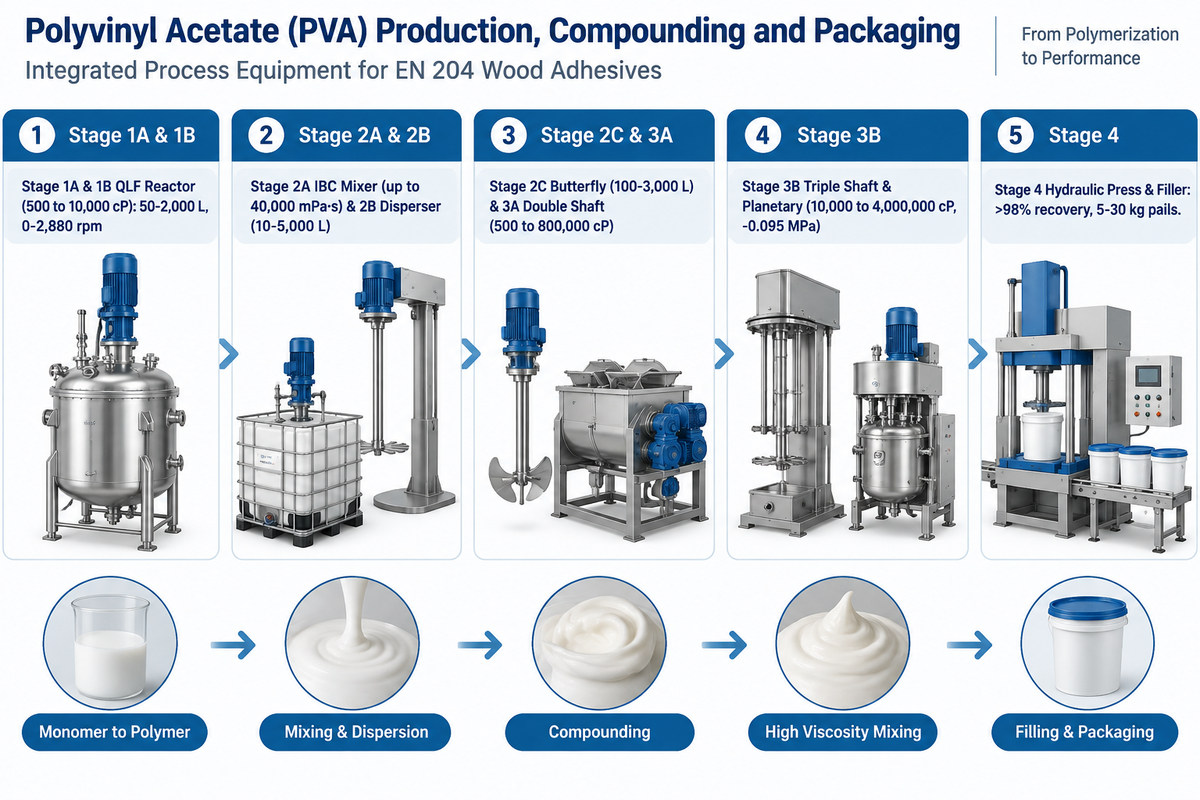
Integrated PVAc producers use temperature-controlled reactors for emulsion polymerization, while adhesive compounders can blend purchased dispersions without an on-site polymerization step. The choice of mixer depends on formulation operating viscosity across low viscosity emulsions and heavy fill mastics.
As highlighted in the Chemical Processing article on High Viscosity Mixing, too much high shear without bulk turnover can coagulate fragile latex emulsions. Running a single-shaft agitator in a heavily filled PVAc mastic leaves stagnant dead zones along the vessel wall. Appropriate selection of vessel architecture from Jiangyin IDA Equipment Co. Ltd. can reduce air entrainment. Appropriate selection of vessel architecture from Jiangyin IDA Equipment Co., Ltd. can help reduce air entrainment, while shear and temperature control along with formulation compatibility help limit batch gelation.
| Process Stage & Adhesive Grade | Operating Viscosity Tier | Recommended IDA Equipment Model | Verified Capacity, Power & Process Method |
|---|---|---|---|
| Stage 1A: PVOH Protective Colloid Dissolution | 500 to 10,000 cP | QLF Series Chemical Reactor | 50–2,000 L capacity, 2.2–75 kW dispersion power, SS304 jacketed vessel |
| Stage 1B: VAM Monomer Emulsion Polymerization | 500 to 10,000 cP | QLF Series Chemical Reactor | 50–2,000 L capacity, 0–2,880 rpm speed, reflux condensation & thermal control |
| Stage 2A: In-Tote Homogenization & Coalescent Blending | Up to 40,000 mPa·s | IBC Tank Mixer | 1,000–1,250 L IBC tote capacity, 0.75–4 kW motor, collapsible 350–600 mm impeller |
| Stage 2B: Mineral Slurry Pre-Dispersion | Low-to-medium viscosity slurry | High Speed Disperser | 10–5,000 L capacity, 2.2–75 kW motor, high-shear sawtooth dispersion disc |
| Stage 2C: Medium-Viscosity Dispersion & Folding | 10,000 to 500,000 cP | Butterfly Disperser | 100–3,000 L capacity, dual-action butterfly fold and high-speed dispersion |
| Stage 3A: Anchor Sweep + High-Speed Disperser Compounding | 500 to 800,000 cP | Double Shaft Mixing Machine | 50–10,000 L capacity, anchor sweep + high-speed disperser disc, vacuum defoaming |
| Stage 3B: High-Solids PVAc Mastics & Construction Adhesives | 10,000 to 4,000,000 cP | Triple Shaft Mixer / Double Planetary Vacuum Mixer | 50–5,000 L (Triple Shaft, ±1 °C jacket, -0.095 MPa vacuum); 5–2,000 L (Planetary, -0.1 MPa) |
| Stage 4: High-Viscosity Pressing & Retail/Pail Packaging | Up to 2,000,000 cP | Hydraulic Discharge & Filling Machine | >98% material recovery (10–50 Tons press); 5–30 kg pails, 150–300 containers/hr, ±0.2 to 0.5 percent filling accuracy |
What mixing speed and temperature control are required for PVAc dispersion?
In the PVOH-stabilized process summarized in the research, vinyl acetate emulsion polymerization runs at 65 °C to 80 °C while QLF reactor and disperser shafts operate across 0 to 2,880 rpm. Before post-polymerization filler dispersion and vacuum deaeration, operators use jacket cooling to control batch temperature according to the specific formulation and protective colloid system.
In Stage 1 monomer polymerization, QLF Series jacketed chemical reactors offer 50 to 2,000 L batch volumes and 2.2 to 75 kW drive power up to 2,880 rpm. For medium-viscosity woodworking glues filled with calcium carbonate or kaolin clay, engineers use industrial high-speed disperser machines. These high-speed discs wet out particulate powder agglomerates rapidly without overheating the latex.
Once viscosity exceeds 500,000 cP in heavily filled D3/D4 joinery adhesives or construction mastics, single-impeller vortexing fails. At this stage, a high-viscosity adhesives vacuum triple-shaft mixer is employed. This vacuum triple-shaft mixer has a PTFE wall scraper, a high-shear dispersion saw blade, and a pitched-blade auger. This three-shaft configuration maintains complete top-to-bottom turnover across 500,000 to 4,000,000 cP while holding batch temperature within ±1 °C under -0.095 MPa vacuum and discharging via a hydraulic press. This mixer is employed for a viscosity in the range of 500,000 to 4,000,000 cP. You can find comparative torque impeller curves for these mixers in our high-viscosity adhesive mixers guide.
Bulk Procurement Guide: Polyvinyl Acetate Price per Ton, Packaging, and Supplier Qualification
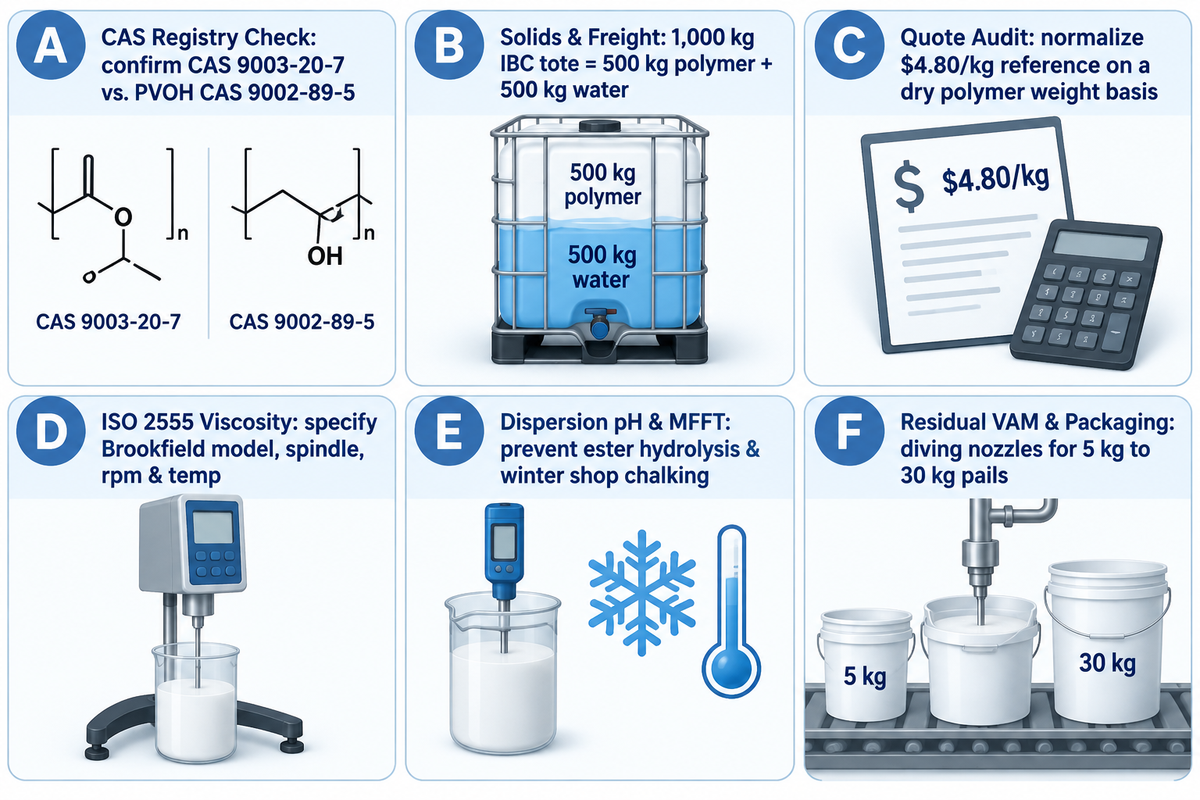
According to Pezetech’s polyvinyl acetate market overview, a reported reference price for polyvinyl acetate is $4.80/kg (four thousand eight hundred USD per metric ton). That listing, however, does not specify the resin grade, solids percentage, or delivery terms. Public technical sources also do not give separate bulk prices for aqueous emulsion versus solid resin or a standard minimum order quantity (MOQ). Therefore, it is necessary to request supplier quotes to ascertain cost differences and quote comparison on a dry polymer weight basis.
During a bulk quote audit, procurement teams must normalize wet dispersion prices by solids content. A 1,000 kg intermediate bulk container (IBC tote) of equal-weight PVAc emulsion holds 500 kg of active polymer and 500 kg of water. Therefore, to transport the same dry ton of polymer, the wet dispersion would cost double to transport, by freight, compared to solid resin beads.
Most of the major international producers of polyvinyl acetate dispersions and solid resins have documentation in their technical literature, and include Celanese Corporation and Wacker Chemie. Prior to signing a supply contract or unloading a tanker, quality teams should review this six-point Certificate of Analysis (COA) checklist:
- CAS Registry Verification: Confirm CAS 9003-20-7 on both the Safety Data Sheet and COA so warehouse staff never substitute polyvinyl alcohol (CAS 9002-89-5).
- Non-Volatile Solids Content: Verify solids percentage against the grade specification to protect dry coat weight and bondline shrinkage.
- ISO 2555 Apparent Viscosity: Require the exact Brookfield viscometer model, spindle number, rotational speed (rpm), and temperature on the COA.
- Dispersion pH: Acidic conditions can catalyze hydrolysis of PVAc ester groups during storage; D3/D4 classifications describe water resistance rather than a prescribed pH range.
- Minimum Film-Forming Temperature (MFFT): Match the MFFT of the grade to the lowest temperature in the shop floor in the winter.
- Residual Vinyl Acetate Monomer: Verify residual monomer limits and the absence of formaldehyde-donor crosslinkers where required by the end-use specification.
At the packaging line, high-speed filling of shear-sensitive PVAc emulsions into 5 kg to 30 kg pails can trap air bubbles at the nozzle. Our engineering walkthrough on preventing foaming during automated liquid adhesive filling addresses bottom-up diving nozzles and vacuum deaeration.
Troubleshooting Polyvinyl Acetate Adhesive Defects and Emulsion Storage Failures
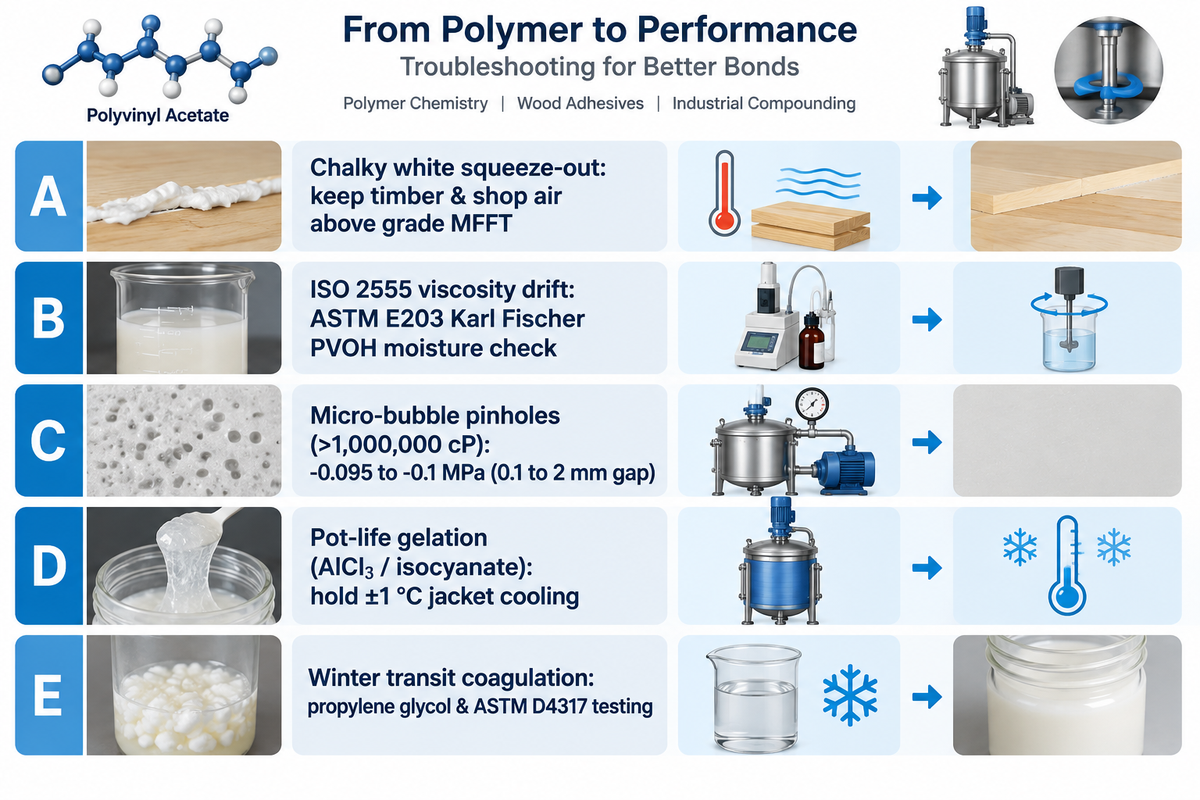
The five most common polyvinyl acetate failures include chalky white glue lines from curing below MFFT, viscosity drift caused by moisture in the PVOH colloid, and micro-bubble pinholes. Formulators also experience premature gelation in the vessel with catalyzed D3/D4 grades and irreversible coagulation upon sub-zero freezing.
PVAc dispersions, when used below the grade-specific minimum film-forming temperature, fail to coalesce to form a continuous polymer film. Instead, they leave behind a chalky white glue line of negligible shear strength. Charging hygroscopic PVOH protective colloid without moisture correction also skews batch rheology during polymerization and compounding.
| Observed Defect / Failure Mode | Primary Root Cause | Corrective Formulation or Equipment Action |
|---|---|---|
| Chalky white, opaque, brittle squeeze-out | Substrate or ambient shop air below the grade-specific MFFT prevents latex particle coalescence | Keep timber, adhesive, and shop air above the adhesive’s specified MFFT, or validate a suitable coalescent addition |
| Batch-to-batch ISO 2555 viscosity drift | Hygroscopic partially hydrolyzed PVOH absorbed ambient moisture or viscometer spindle/rpm changed | Operators verify raw PVOH colloid moisture via ASTM E203 Karl Fischer titration using suitable water-release or extraction conditions for polyvinyl alcohol, whereas vacuum drying measures mass loss from water and any other volatiles removed without establishing water content unless a validated constant-weight protocol is used; also lock Brookfield spindle and rpm |
| Micro-bubble foaming and dry film pinholes | Air vortexing during high-speed filler wetting in atmospheric tanks | Compound under -0.095 to -0.1 MPa gauge vacuum in a Double Planetary or Triple Shaft Mixer with defoamer |
| Premature thickening or pot-life gelation | Excessive heat buildup or local concentration spikes during acidic chloride catalyst (AlCl3) or isocyanate addition | Maintain jacket cooling circulation (±1 °C on Triple Shaft Mixer) and controlled feed during catalyst addition |
| Cottage-cheese coagulation after winter transit | Sub-freezing transit exposure beyond the grade’s freeze-thaw stability limit causes irreversible latex particle coagulation | Propylene glycol stabilizers can improve freeze-thaw tolerance in PVAc emulsions; evaluate freeze-thaw recovery under specified conditions per ASTM D4317 and use temperature-controlled transit |
Air pockets trapped in ultra-high-viscosity PVAc sealants and putties (>1,000,000 cP) are unable to rise to the surface under atmospheric pressure. Engineers can review our breakdown of the double planetary mixer working principle under vacuum. That guide details how intermeshing planetary blades and wall clearances of 0.1 to 2 mm strip micro-bubbles at -0.1 MPa.
2026 Market and Regulatory Outlook: Recyclable Packaging Adhesives and Compliance Shifts
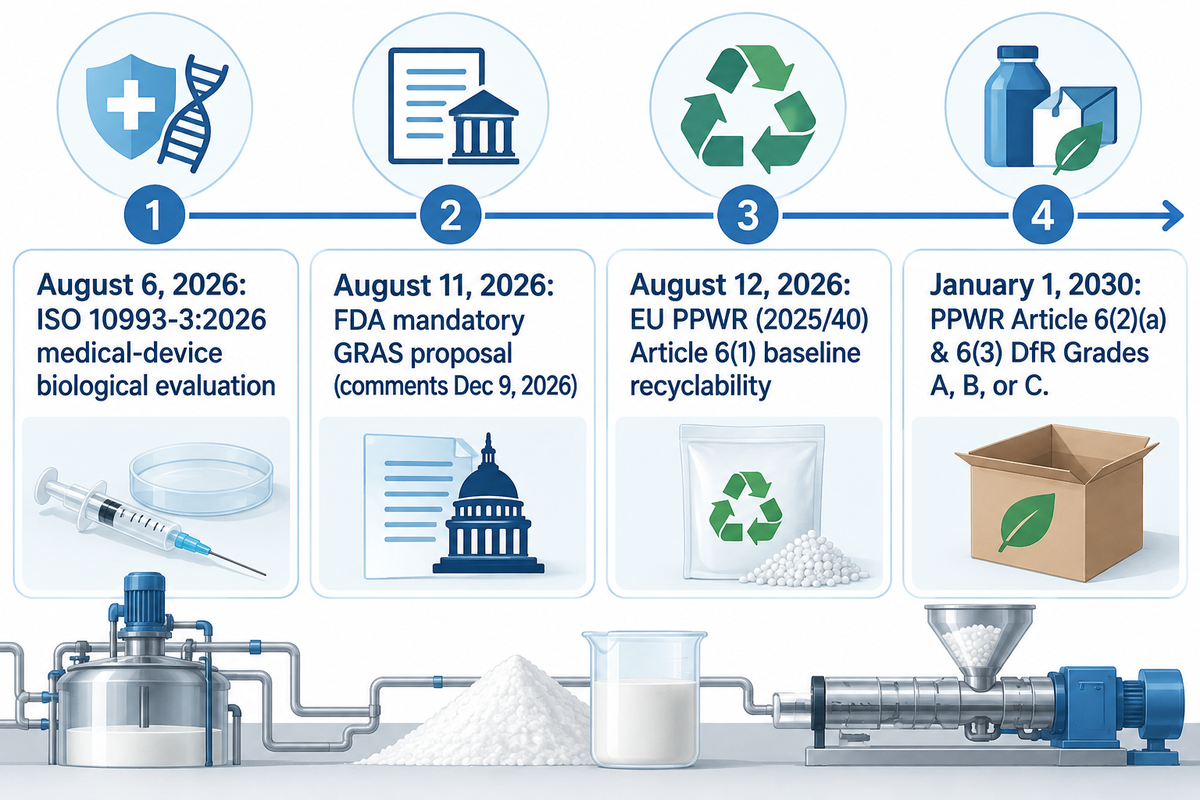
Three regulatory milestones in 2026 are reshaping polyvinyl acetate formulations across Europe and North America. Key shifts include the EU PPWR baseline recyclability date on August 12, 2026, the U.S. FDA mandatory GRAS proposal on August 11, 2026, and the updated ISO 10993-3:2026 biocompatibility standard.
In the EU, Regulation (EU) 2025/40 (PPWR) drives paper converters away from non-repulpable wax coatings and toward water-dispersible PVAc and VAE binders. As per REACH24H’s EU PPWR compliance guidance and Projet Celsius’s PPWR timeline analysis, the date for applying the Article 6(1) baseline recyclability is August 12, 2026. Under Article 6(2)(a) and Article 6(3), Design-for-Recycling (DfR) grades A, B, or C apply from January 1, 2030. If the Article 6(4) delegated acts enter into force later, those grades take effect 24 months after that entry date.
United States food-grade PVAc gum base and food-contact adhesive suppliers face increased scrutiny by federal agencies. According to Chemsafe Consulting’s August 2026 regulatory bulletin, the FDA published a proposed rule on August 11, 2026, with public comments due December 9, 2026. That bulletin notes the proposal would replace the voluntary GRAS notification pathway with a mandatory notification requirement. The same bulletin notes that ISO published ISO 10993-3:2026 on August 6, 2026. ISO 10993-3 addresses genotoxicity, carcinogenicity, and reproductive toxicity in medical-device biological evaluation; packaging adhesive constituents are relevant when transfer to the device creates patient exposure.
Frequently Asked Questions (FAQ)
Does polyvinyl acetate dissolve in organic solvents like acetone or ethyl acetate?
Yes, polyvinyl acetate dissolves readily in polar organic solvents like acetone, ethyl acetate, methyl acetate, and toluene, whereas dry PVAc film is insoluble in water. Homopolymer films absorb and swell in the presence of water. Lower alcohols like methanol, ethanol, and isopropyl alcohol also dissolve solid PVAc when blended with a small amount of water, while non-polar hexane does not dissolve the resin.
What happens if polyvinyl acetate emulsion freezes during winter transit?
PVAc emulsions that have not been stabilized for freeze-thaw have a tendency to coagulate upon exposure to sub-freezing conditions. Propylene glycol stabilizers can help improve the freeze-thaw tolerance of PVAc emulsions. MAT-CS’s summary states ASTM D4317 covers PVAc or PVAc copolymer emulsion adhesives for wood and wood based substrates. Freeze-thaw testing assesses how the emulsion recovers under specified exposure conditions; colder or longer winter transit exposure can still damage the emulsion.
How long should wood joints bonded with polyvinyl acetate remain clamped?
Consult the adhesive manufacturer’s technical datasheet for clamping duration and pressure for bonding wood joints with polyvinyl acetate. Assemblers clamp close fitting timber joints until initial handling strength develops, and then cure before performing heavy machining. For EN 204 classification using EN 205 tensile-shear testing, dry-strength specimens are conditioned in standard atmosphere for a period of 7 days, and D3 and D4 testing include water conditioning.
Can you paint or stain over cured polyvinyl acetate wood adhesive?
Waterborne acrylic latex and alkyd primers adhere well over cured and sanded PVAc joints, but penetrating oil or water wood stains cannot penetrate because the cured PVAc film completely seals the wood pores. However, oil or water-based wood stains can’t penetrate because the film of cured PVAc seals the pores of the wood, resulting in unstained blotches during furniture finishing. Unremoved glue squeeze-out leaves pale, unstained blotches during furniture finishing unless assemblers wipe the joint clean with a warm, damp cloth before the dispersion cures.
What is the shelf life of sealed polyvinyl acetate dispersion in IBC totes?
Unopened 1,000 L HDPE IBC totes of homopolymer PVAc dispersion maintain specification viscosity and pH for 6 to 12 months when stored in a cool, indoor warehouse away from direct sunlight. Acid-catalyzed D3 and D4 wood adhesive grades carry a shorter storage life as specified on the supplier’s Certificate of Analysis.
Why does polyvinyl acetate dry clear instead of staying milky white?
Unfilled homopolymer PVAc dispersions can dry to a transparent film as water evaporates above the grade-specific minimum film-forming temperature and suspended polymer particles fuse into a continuous film. Water has a refractive index of 1.333 while polyvinyl acetate sits near 1.467, so once discrete phase boundaries disappear in an unfilled film, light passes through with minimal scattering.
References & Sources
- European Committee for Standardization (CEN) – EN 204:2016 Classification of Thermoplastic Wood Adhesives for Non-Structural Applications
- ASTM International ASTM D4317-16(2023) Standard Specification for Polyvinyl Acetate-Based Emulsion Adhesives
- ASTM International ASTM D903-98(2025) Standard Test Method for Peel or Stripping Strength of Adhesive Bonds
- U.S. Code of Federal Regulations – 21 CFR 172.615 Chewing Gum Base (Polyvinyl Acetate Minimum Molecular Weight Specification)
- U.S. Code of Federal Regulations 21 CFR 175.105 Indirect Food Additives: Adhesives
- National Institute for Occupational Safety and Health (NIOSH) – NIOSH Pocket Guide to Chemical Hazards: Vinyl Acetate (CAS 108-05-4)
- International Organization for Standardization (ISO) ISO 2555:2018 Plastics, Resins in the Liquid State or as Emulsions or Dispersions, Determination of Apparent Viscosity
- National Center for Biotechnology Information (PMC) – Protective Colloid Control and Particle Size Distribution in Emulsion Polymerization
- Ascent Petrochem Technical Library PVA Quality Disputes: Viscosity Drift, Moisture Titration (ASTM E203), and ISO 2555
- Chemical Processing – Process Engineering: Appreciate the Art of High-Viscosity Mixing
- REACH24H Consulting EU PPWR Guidance FAQ 2026: Article 6 Recyclability Deadlines
- Chemsafe Consulting August 2026 Regulatory Updates: FDA Mandatory GRAS Proposal & ISO 10993-3:2026