Get in Touch with IDA

Batch vs Continuous Reactor: A Practical Selection Guide

Batch vs continuous reactor refers to the operating-mode choice between discrete production cycles and ongoing feed-and-product flow. Neither mode is universally better; the practical choice is the one that provides the more reliable solution for the production duty. A batch reactor handles separate charge, react, and discharge cycles, while a continuous reactor receives feed and removes product while it is running. Batch operation often fits changing recipes and discrete lots; continuous production can fit long, stable campaigns.
For most plants, choosing the right reactor means selecting the mode that delivers acceptable product across the real operating calendar. Chemical engineering comparisons of batch and continuous flow must therefore include charging, heating, cooling, sampling, cleaning, changeovers, startup, shutdown, disturbances, and downstream scheduling; the difference between batch production and flow chemistry affects how these chemical processes are planned. The focus of this document is to turn those actions into a production mode decision without repeating the contents of the site’s general chemical reactor guide or providing a detailed mechanical design.
Batch vs Continuous Reactors: The Production Boundary
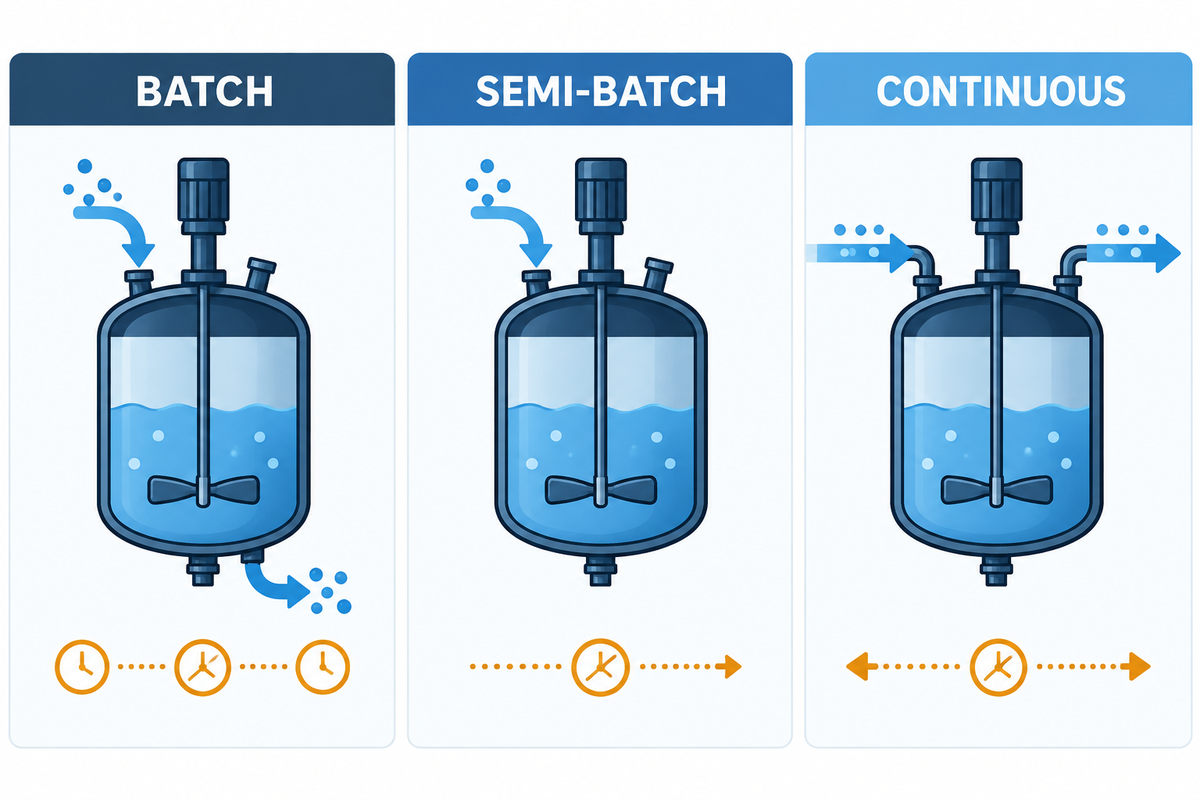
What is the practical difference between a batch reactor and a continuous reactor during real production?
In batch operation, the material in the vessel moves through time together, and composition and temperature can change throughout the cycle. In continuous operation, feed enters and product leaves while the reactor runs, so the design is judged by flow rate, residence-time behavior, stable control, and the operating window.
The process is designed around flow rate, residence-time behavior, stable control, and an acceptable operating window. Startup and shutdown are separate operating states, not footnotes. FDA’s ICH Q13 guidance likewise treats residence-time distribution, startup, shutdown, disturbances, and material diversion as linked parts of continuous-manufacturing control.
| Mode | Material boundary | Time basis | Typical planning unit |
|---|---|---|---|
| Batch | Charged and discharged as a lot | Total cycle time | Lots per shift or year |
| Semi-batch | One or more streams added or removed during a batch | Recipe plus controlled addition | Lots with a feed profile |
| Continuous | Feed and product flow during operation | Residence time and on-stream time | Mass or volume per hour |
These modes of operation describe the way a process is run, and not how equipment is designed. There are many considerations still to be engineered.
Do Not Treat Continuous as a Single Reactor Design
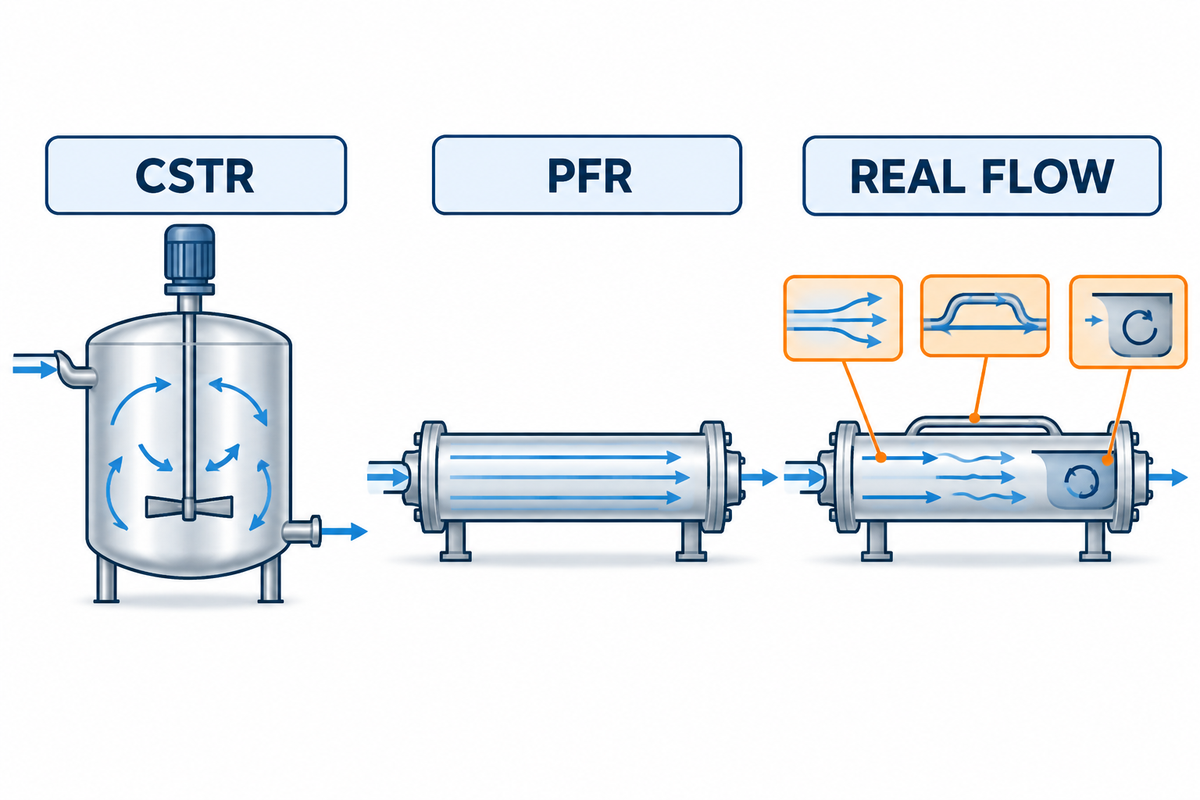
A continuous stirred-tank reactor (CSTR) and a plug-flow reactor (PFR) represent different residence-time and mixing behaviors. A CSTR is commonly modeled as well mixed, so its outlet has the same composition as the vessel contents. An ideal PFR is modeled as flow progressing along the reactor axis, with no back-mixing. Real world equipment departs from both models with dispersion, bypass, dead zones, recirculation, and poor mixing. The University of Michigan’s reaction-engineering reference sets out the ideal batch, CSTR, and plug-flow models that make those departures visible.
This is why “batch reactor vs CSTR” and “CSTR vs batch reactor” are narrower design and operation questions than the broader batch versus continuous comparison. A CSTR may be the relevant option when process requirements include a liquid-phase reaction requiring agitation, while a tubular or staged system may be the better choice for another process. Do not attribute a configuration-specific benefit to continuous operation as a whole.
Compare Effective Output, Not Nameplate Capacity
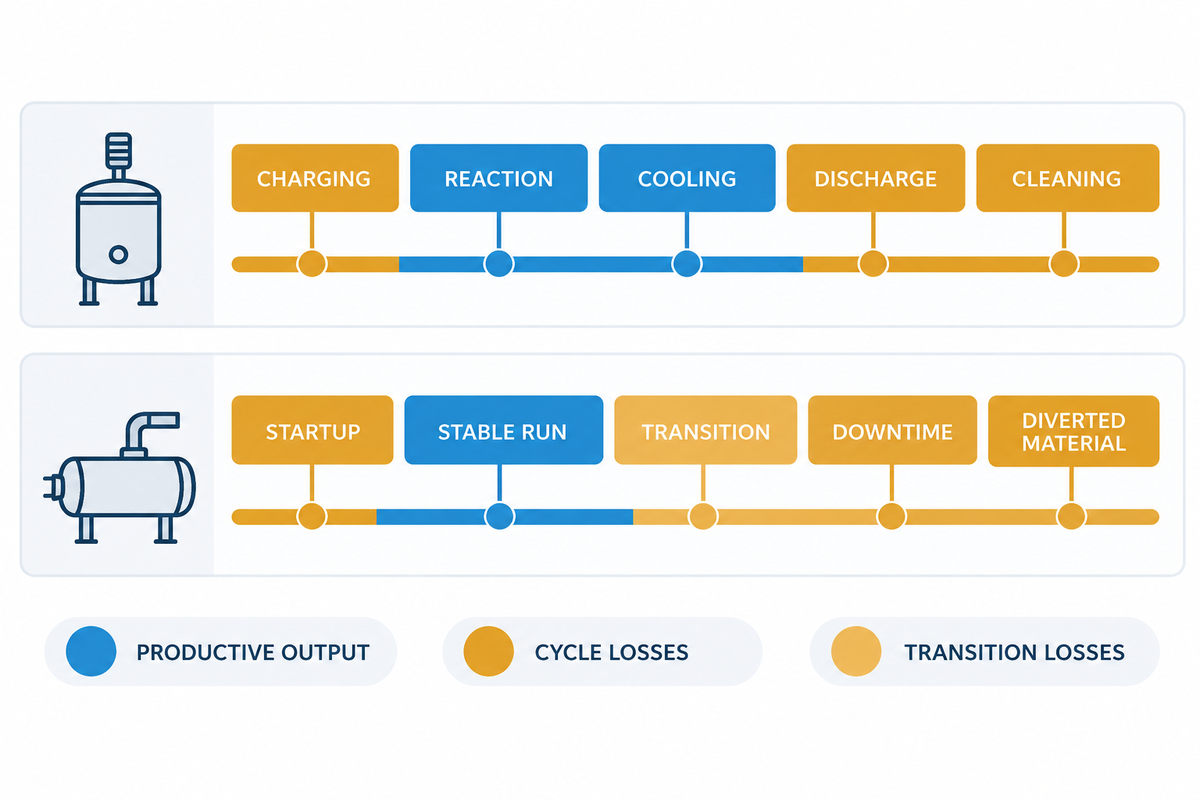
How should throughput, residence time, heat removal, cleaning, changeovers, and off-spec losses be compared?
To begin, there are two transparent expressions. These expressions are screening equations and shouldn’t represent a final economic model. The FDA’s implementation of ICH Q13 also shows why a continuous-output calculation must account for startup, shutdown, disturbances, and diverted material rather than steady-state rate alone.
Batch Effective output = Acceptable Mass per batch X Completed batches per Period.
Continuous Effective Output = Acceptable Production Rate X Scheduled Time X On-Stream Fraction.
For batch, completed batches per period depends on the whole cycle: charge, heat-up, reaction, hold, cool-down, sampling, discharge, cleaning, inspection, and waiting for shared resources. For continuous operation, the on-stream fraction must exclude planned and unplanned stops. Acceptable output must also exclude startup, shutdown, grade-transition, and disturbance material that cannot go forward.
| Decision factor | Batch question | Continuous question |
|---|---|---|
| Demand | How many complete lots are needed? | Is the campaign long enough to justify startup and shutdown? |
| Residence time | What time profile gives the required conversion and selectivity? | What distribution, not just mean time, can the system hold? |
| Heat removal | Can cooling follow the peak transient duty? | Can heat removal remain adequate across flow and turndown? |
| Cleaning | How often and how long between lots or products? | Can the campaign run before fouling or cleaning forces a stop? |
| Quality losses | What is the reject or rework rate per lot? | How much transition material is diverted during non-steady states? |
| Labor | Which manual recipe and material-handling tasks repeat every cycle? | Which monitoring and intervention tasks remain during a long run? |
| Inventory | How much material is committed to one lot? | How much reacting and in-process material is held across the system? |
| Turndown | Can a smaller batch preserve mixing and heat transfer? | Can the continuous process hold quality at minimum flow? |
| Integration | Where is intermediate storage required? | Can upstream and downstream units accept a steady flow? |
Continuous systems can outproduce a discontinuous system during stable campaigns. However, this comparison changes when campaigns are short or changeovers are frequent, or if fouling reduces availability. A batch process may lose time every cycle yet avoid a long transition between products. Continuous systems have many costs, and demand and yield usually drive the crossover. There is no universal cost crossover: production volumes, production scale, actual demand, yield, labor, cleaning, utility, inventory, and downtime determine both process efficiency and production efficiency. The advantages and disadvantages outweigh a nameplate comparison.
Use the Production Mode Gate
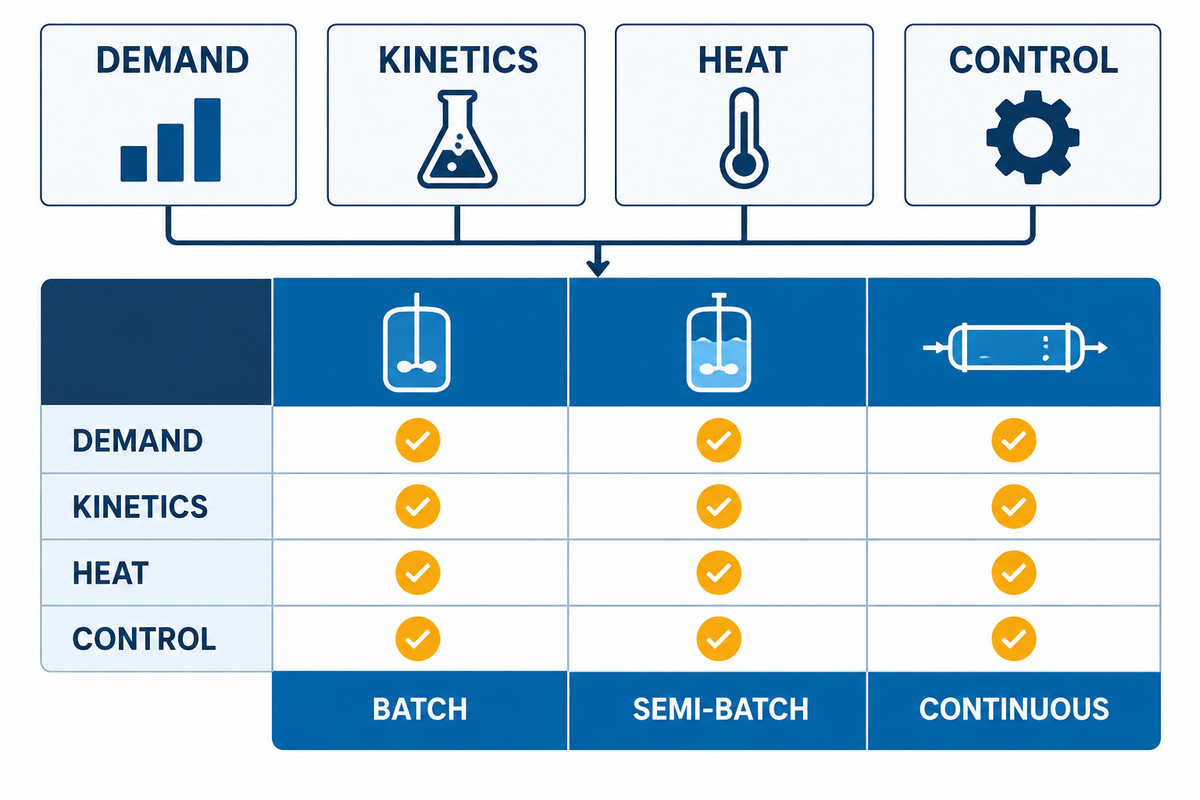
Which process conditions should make an engineer choose batch, semi-batch, or continuous reactor operation?
Use the following seven gates in sequence. The University of Michigan reactor models provide the idealized starting point, while each gate below tests whether real production conditions support that model. A weak answer at an early gate is a reason to test the assumption, not to force a preferred technology.
- Demand and campaign length: stable, long campaigns and continuous demand make the continuous case stronger. Flexibility to hold less than continuous demand favors batch.
- Product variety: frequent recipe changes, colors, grades, or customer-specific lots increase transition and cleaning burdens.
- Kinetics and concentration history: compare conversion, selectivity, concentration change, controlled addition, and residence-time distribution on the same product-quality basis.
- Heat release and reactive inventory: compare peak heat-generation rate, heat-transfer area, coolant response, feed-interlock strategy, and the amount of reacting material present.
- Confirm that feeds remain pumpable, solids do not settle or plug a flow path, and the proposed mixing system handles the expected rheology. Also evaluate expected rheology against anticipated mixing.
- Controls, turndown, disturbances. Define the flow conditions, process temperature, pressure, level, gas flow where relevant, and composition ranges that maintain acceptable product through the required reaction time. Include the effects of sensor lag and recovery after a disturbance.
- Plant continuity. Determine if upstream supply and downstream separation can accept a steady stream. Buffers may be needed for surrounding operations that are batch-based.
Semi-batch is the escape route from a false binary. Metering one reactant can limit its instantaneous concentration and moderate the heat-release rate. The University of Michigan’s reaction-engineering material specifically notes feed-rate control as a temperature-control advantage. The result still needs reaction-specific calorimetry, kinetics, and relief analysis; a feed profile is not a substitute for a safety basis.
A number of different types of reactor systems can fulfill the same operating-mode need. Reaction conditions, heat and mass transfer, mixing time, heat-transfer area, and the concentrations of reactants and products decide whether a stirred vessel, tubular train, or another reactor type can optimize the chosen mode. Fine chemical production makes these trade-offs especially visible because product variety and cleaning burdens can be high.
Count Cleaning, Changeovers, and Transition Material
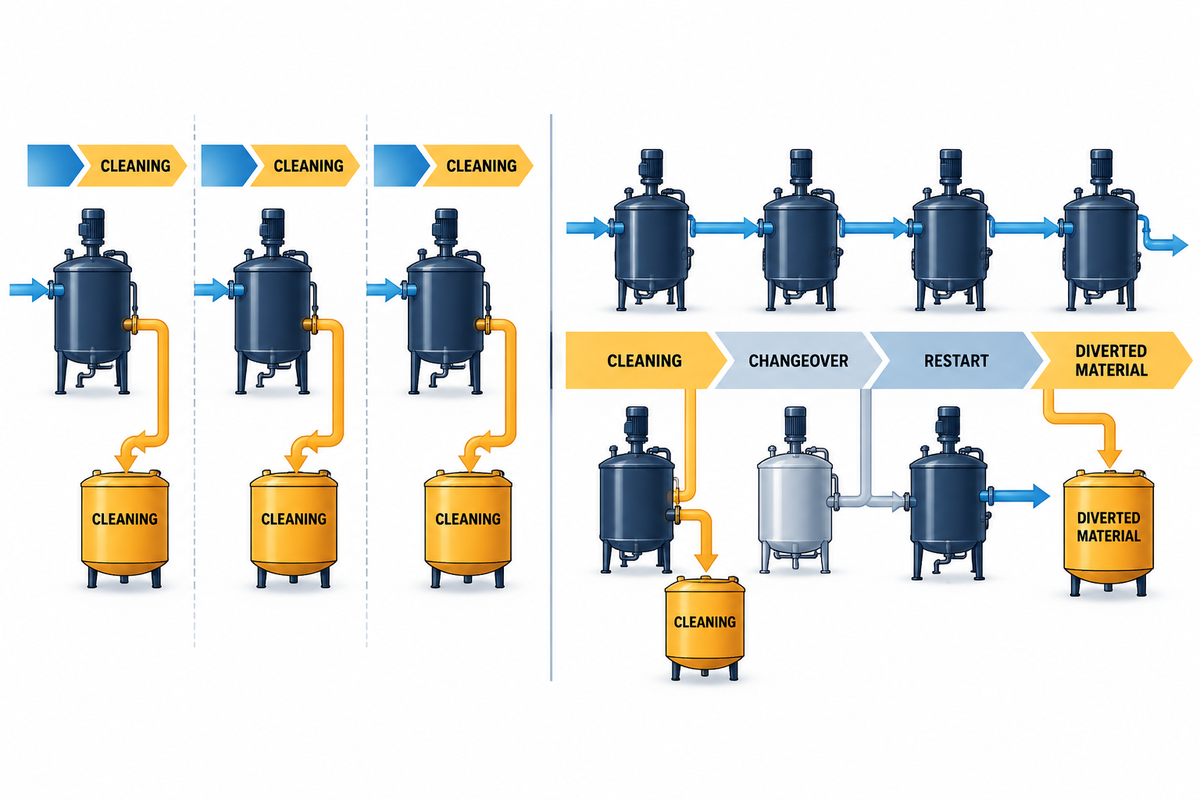
Losses from cleaning occur in both operating modes, but at different limits. A batch plant may clean between lots, families, or campaigns. A continuous plant may go longer between cleans, but a shutdown may require draining, flushing, verifying, restarting, and the diversion of material until the variables of the system return to their limits.
Use one common accounting window. For instance, compare a month, or a complete product campaign. Record productive hours, cleaning hours, changeover hours, waiting time, startup and shutdown quantities, rejected output, and rework. Do not compare a batch cycle that includes cleaning with a continuous hourly rate that assumes perfect availability.
Grade transitions deserve their own mass balances. The amount depends on system holdup, residence-time behavior, control strategy, sampling delay, and downstream segregation.
IDA’s company profile provides context on the manufacturer while its articles on reactors and process equipment discuss adjacent process engineering topics, without altering this guide’s focus on operating modes.
Test the Operating Window, Not Only Steady State
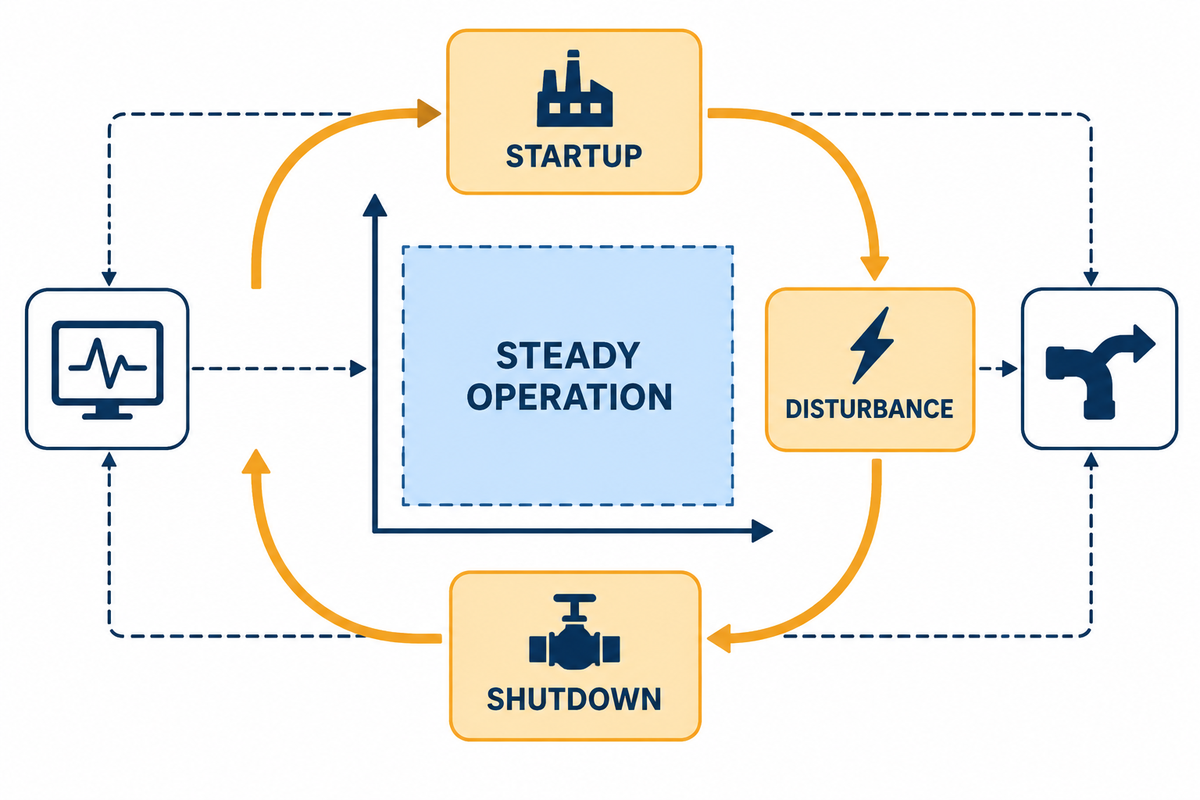
A steady-state study shows only a single part of continuous operation. AIChE guidance treats startup, normal operation, normal shutdown, emergency operation, product transitions, cleaning, and maintenance as distinct modes requiring procedures. FDA’s ICH Q13 continuous-manufacturing guidance likewise connects residence-time understanding with disturbance handling and material diversion.
A qualification plan should therefore test:
- The sequence of events during startup and the point at which product meets acceptance criteria;
- The amount of normal shutdown product and/or material diverted;
- minimum and maximum sustainable rates;
- feed-composition and temperature variability;
- sensor failure, drift, delay, and control-loop response;
- fouling, pressure-drop growth, bypassing, or dead-zone formation;
- recovery after a short stop or process disturbance.
Residence time is not the same as mixing quality. A stirred-tank study, published in a peer-reviewed journal, indicated that measured mixing could deviate significantly from the ideal CSTR case at higher flow rates. Representative tracers, mixing, and heat transfer tests, are valuable when those assumptions control product quality.
Consider the available family of equipment for a broader perspective, particularly that published by the IDA in their list of process equipment; configuration of equipment is determined by the operating window.
Build a Mode-Selection Data Sheet Before Requesting Quotes
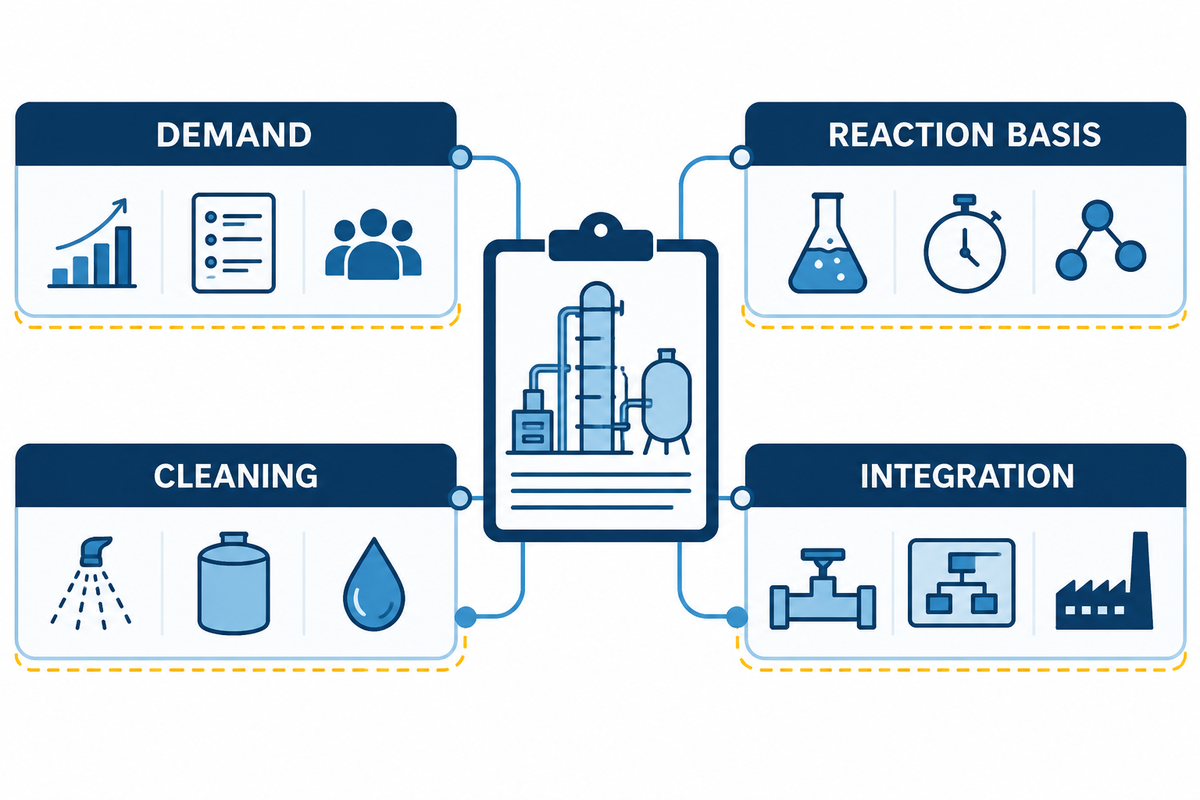
What production and process data should I send a reactor supplier before asking for a recommendation?
Give every candidate mode the same basis by defining the desired product, process parameters, and the overall process boundary. FDA’s ICH Q13 guidance illustrates the value of documenting residence-time, control, disturbance, and material-disposition assumptions before equipment configuration begins. As a minimum, information regarding:
- annual and peak demand, operating days, shifts and expected campaign length;
- number of products or grades and expected changeover frequency;
- size of batch or required hourly product, yield basis and loss;
- reaction scheme, kinetics, and required residence time;
- feed variability, phases, viscosity, solids, and fouling;
- heat-release data, temperature limits, pressure basis, and utility conditions;
- cleaning method, cleanliness endpoint, incompatible residues, and campaign constraints;
- required turndown, control variables, sampling delay, and off-spec disposition;
- upstream feed availability and downstream continuity or buffer capacity.
This is a mode selection exercise, not a complete mechanical specification. Once the operating mode is narrowed, the full duty envelope should cover wetted materials, pressure and temperature design, agitation, seals, nozzles, instrumentation, compliance, documentation, and site integration.
Hand the Decision to Equipment Configuration
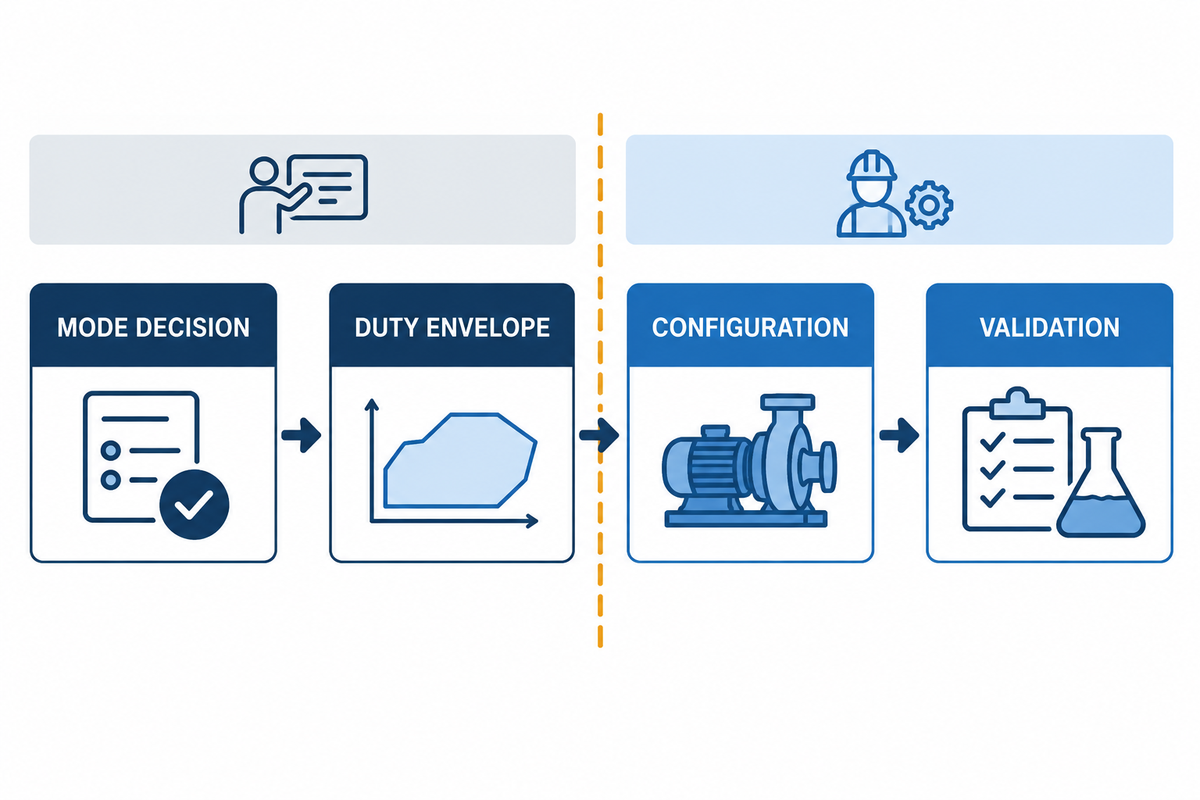
Who can configure a chemical reactor after I have narrowed the operating mode?
The process owner or reaction engineer should define the chemistry, kinetic window, heat release, phases, quality limits, and production basis. Based on this, equipment vendors define vessel geometry, agitation, heat transfer surfaces, materials of construction, pressure boundaries, nozzles, and fabrication. Controls and plant-integration specialists then address automation, utilities, feeding, downstream handling, and safeguarding.
If your operating basis is ready, you can review custom chemical reactor configurations from IDA Equipment. Keep the decision record attached to the inquiry so a batch, semi-batch, or continuous recommendation can be checked against the same assumptions.
Frequently Asked Questions
What is the main difference between a batch reactor and a continuous reactor?
A batch reactor is a device that, within the constraints of a given recipe, processes a charge in a time-based, batch operation and then discharges it. In contrast, a continuous reactor (or similar) accepts a feed and gives up a product. The practical comparison must include the full cycle of batch systems, including small-batch production, and the continuous system’s startup, shutdown, transition, and downtime losses.
Is a CSTR always a continuous reactor?
CSTR stands for continuous stirred-tank reactor, so an ideal CSTR model in continuous mode provides for continuous feeding and withdrawal and complete mixing; the difference between CSTR and batch operation is the material boundary, not merely the vessel shape. However, a stirred vessel can also be used in a batch or a semi-batch mode. “Stirred tank” describes a configuration and batch, semi-batch, and continuous describe how materials cross the process boundary during production.
When is semi-batch better than either batch or continuous operation?
Because of the effect of process variables on timing with additions, Semi-batch should be considered. Metering a reactant can moderate its concentration, heat-release rate, gas evolution, or side reactions while retaining a discrete lot. It can also fit processes with limited feed availability. Selection still requires calorimetry, kinetics, mixing, feed-failure analysis, and an appropriate relief and interlock strategy.
Does continuous operation always cost less?
A continuous system may improve effective output during long production runs, but operating costs, operational costs, capital, automation, development, cleaning, maintenance, transition material, and downtime can change the result; batch reactors are commonly used when flexibility matters, and batch reactors are well-suited to some small-scale production schedules. Compare modes over the same production horizon with the same yield and quality basis. Short campaigns or frequent product changes can erase an hourly-rate advantage.
What information should I send before requesting a reactor recommendation?
Send demand and campaign data, product variety, reaction and residence-time requirements, heat-release information, phases and physical properties, fouling and cleaning needs, control ranges, acceptable losses, utilities, and upstream/downstream constraints. A supplier can then identify the tests needed before translating the process basis into a mechanical configuration.
References & Sources
- University of Michigan, Industrial Reactors
- AIChE – Process Safety Information for Reactivity Hazard Evaluation
- FDA, ICH Q13 Continuous Manufacturing Guidance
- Industrial & Engineering Chemistry Research – Continuous Blend Time and Residence Time Distribution
- ICH, Quality Guidelines and Q13 implementation status
Trending now