Get in Touch with IDA

Lipstick is made of waxes, oils and colorants, which is the short answer to what is lipstick made of. Wax holds the bullet’s shape, oil gives it glide, and pigment supplies color. Other ingredients adjust texture, wear and stability.
A long-wear liquid can work differently: a carrier evaporates after application and leaves a colored film. In some cases, a carrier can evaporate, leaving behind a colored film. Even two red bullets can use different wax blends or pigment preparations. Those differences explain why an ingredient substitution can change both the feel on your lips and the equipment needed to make the product.
Key points
- Ready-made pigment dispersions can remove a separate preparation step.
- Cruelty-free certification and vegan ingredients answer different questions.
- A shared shade label may list colors absent from a particular shade.
What Is Lipstick Made Of? Main Ingredients
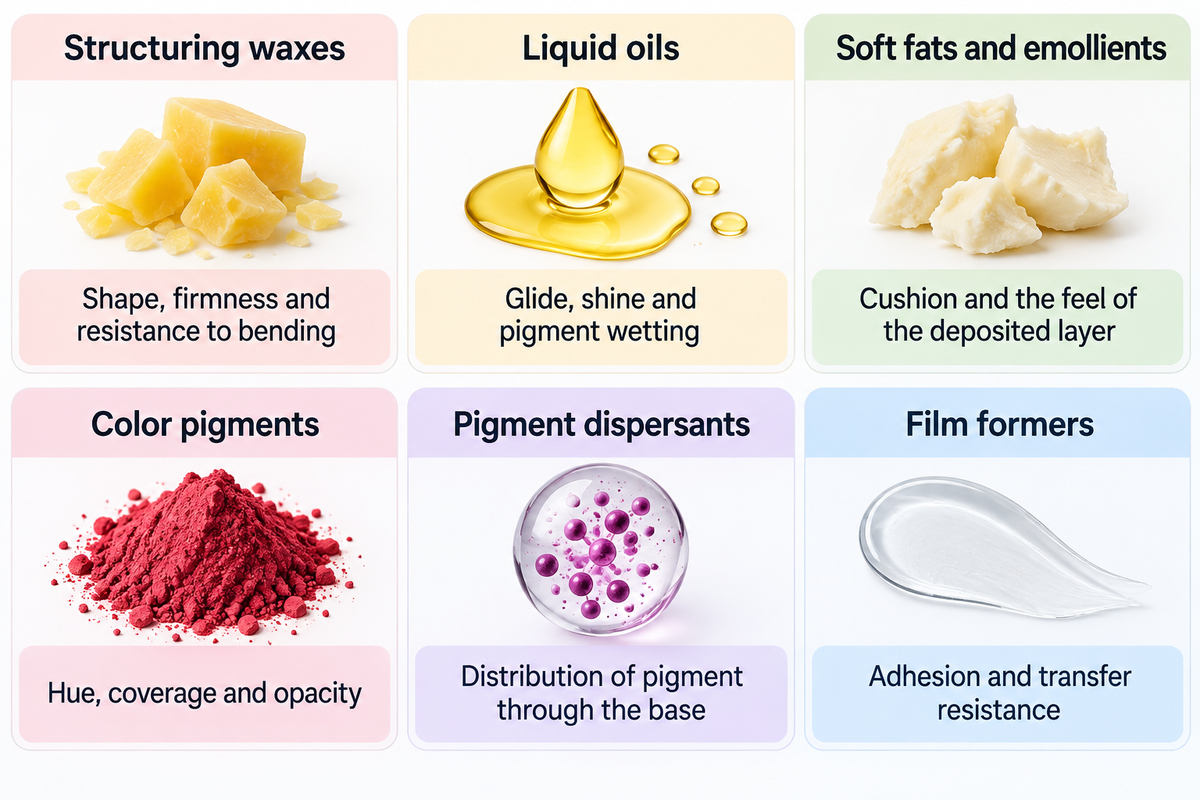
Most traditional lipsticks combine a structured fatty base with colorants. Oils and waxes work together: wax holds the solid form, while oil and softer fats help it spread. Optional ingredients change gloss, scent, wear or stability. Read each ingredient by its job within the complete formula.
| Ingredient group | Examples | What it changes |
|---|---|---|
| Structuring waxes | Beeswax, candelilla, carnauba wax, ozokerite | Shape, firmness and resistance to bending |
| Liquid oils | Castor oil, mineral oil, selected plant oils | Glide, shine and pigment wetting |
| Soft fats and emollients | Cocoa butter, lanolin, petrolatum | Cushion and the feel of the deposited layer |
| Color pigments | Iron oxide, titanium dioxide, carmine | Hue, coverage and opacity |
| Pearlescent materials | Mica-based pearlescent pigments | Shimmer and reflected light |
| Pigment dispersants | Formula-compatible wetting and dispersing agents | Distribution of pigment through the base |
| Film formers | Selected silicone resins and other polymers | Adhesion and transfer resistance |
| Antioxidants | Tocopherol, also called vitamin E | Protection of susceptible ingredients against oxidation |
| Antimicrobial preservatives | A preservation system selected for the product | Control of microbial growth when required by the formulation |
Fragrance or flavor may be added for a sensory experience. An antioxidant and a preservative do different things: the former helps slow down oil oxidation and the latter gives microbial protection. The formulator evaluates the complete product, including its packaging and likely use, before choosing either system.
An example: a developer replacing an oil should take into account the compatibility of the new oil with the existing wax blend and pigment dispersion. Matching the old oil’s percentage still leaves those compatibility interactions unresolved. A smooth bulk mixture can still become a poor stick after cooling.
Under the FDA’s ingredient-labeling guide, US non-color ingredients at 1% or less have an ordering exception, while colors follow separate rules. Therefore, label order does not reveal formula percentages. A shade line can use a shared declaration where some colorants appear after “may contain.” Those colorants need not be present in every shade.
How Waxes and Oils Shape a Lipstick
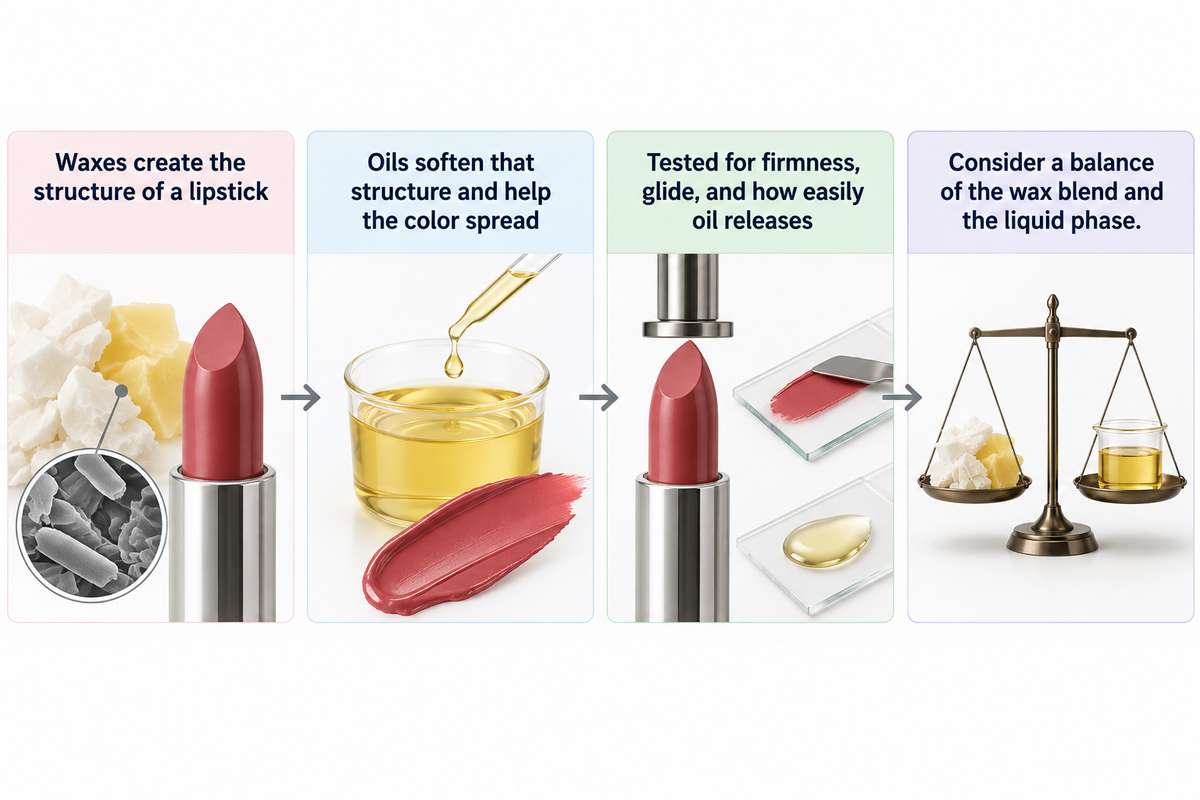
Waxes create the structure of a lipstick; oils soften that structure and help the color spread. Visualize a gel holding a liquid phase. The balance impacts how easily the bullet bends, how much material transfers in one stroke, and how much oil remains in the final stick.
Carnauba and candelilla are plant waxes. Beeswax is an animal-derived wax. Mineral and synthetic waxes are also available. Castor oil is found in many lip products. Other oils such as jojoba can be added to adjust the feel.
In a 2022 study of plant-wax substitution, researchers found that performance was dependent on the balance of wax and oil. None of the evaluated candidates replaced the chosen synthetic reference weight for weight in the tested formula. A wax could be similar to the reference in one aspect and fall short in another.
What if a brand wanted to produce a vegan version of one of their existing product bullets? They would replace beeswax with candelilla and make adjustments to other components of the formula to keep the pigment system constant. A sample of the new formula would be tested for firmness, glide, and how easily oil releases. If the new stick holds its shape but drags during application, adding more wax would move it farther from the desired feel. The formulator would consider a balance of the wax blend and the liquid phase. This is a trial formulation, and a finished product comparison is made before a buying team commits to purchasing larger quantities of the raw materials.
Pigments and Dyes: Where the Color Comes From
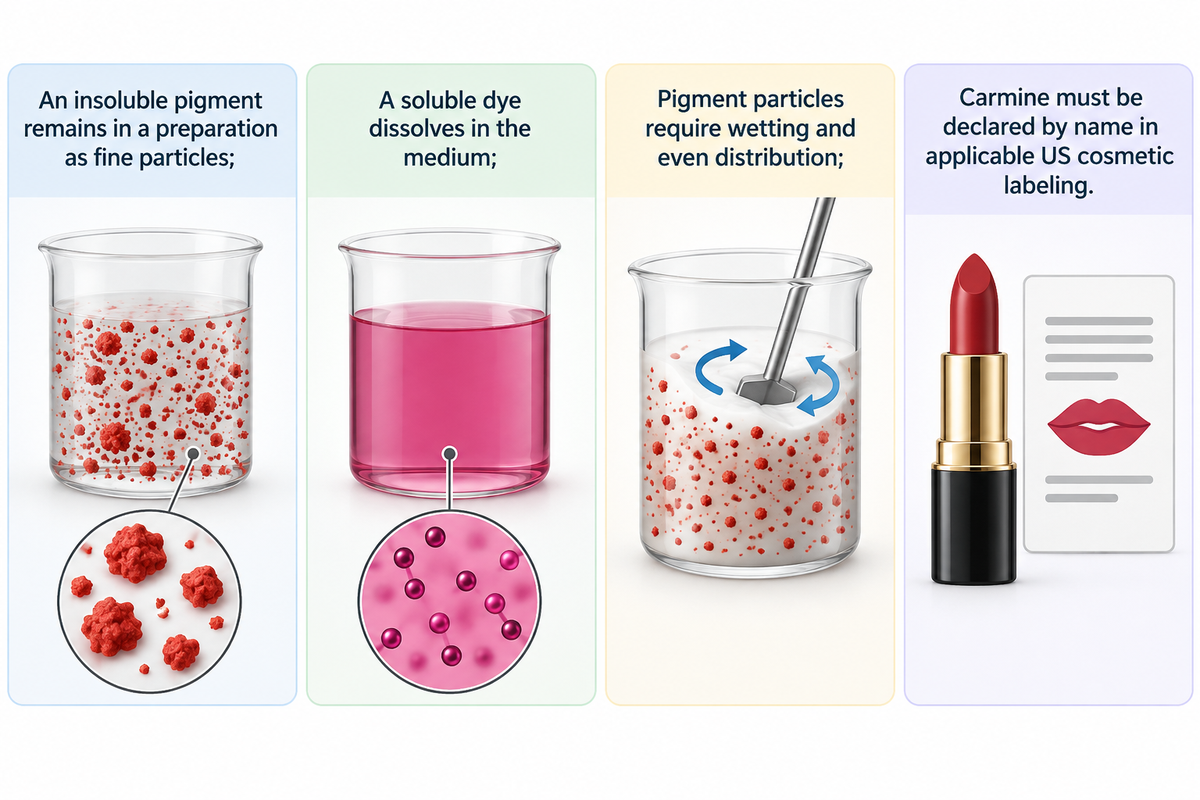
Color comes from colorants dispersed or dissolved in a base. An insoluble pigment remains in a preparation as fine particles, and a soluble dye dissolves in the medium. The distinction changes preparation: pigment particles require wetting and even distribution so the applied layer has consistent color and feel.
Iron oxides provide colored mineral pigments, while titanium dioxide can add opacity and lighten a shade. Materials based on Mica produce pearlescent effects. A red dye and a red pigment are not interchangeable processing inputs, even when both contribute to a similar crimson finish.
Permission for use also depends on where the cosmetic will be applied. The FDA color-additive table separates external application from general use, which includes lipsticks. A color suitable for one cosmetic application is not necessarily suitable for lips. Its listed identity, specifications and restrictions still apply.
During the development of a new shade, compare shades in the same base before changes in color are made. Dispersion is key. Uniform dispersion of a pigment preparation is critical. If both pigment and its preparation method are changed at the same time, the cause of an effect becomes difficult to determine.
Which insect is used to make red lipstick?
Cochineal insects are the source of carmine, an animal-derived red colorant used in some cosmetics. Carmine red is one example of many; red lipstick doesn’t necessarily contain it. For a given product, consult the ingredient declaration for that particular shade and the brand’s ingredient-origin information.
In its guidance, the FDA specifies that labeling for both cochineal extract and carmine must be declared. Carmine must be declared by name in applicable US cosmetic labeling. Use the FDA’s carmine-labeling guidance along with its shared-shade labeling to interpret a given color list.
Solid vs Liquid Lipstick and Lip Balm
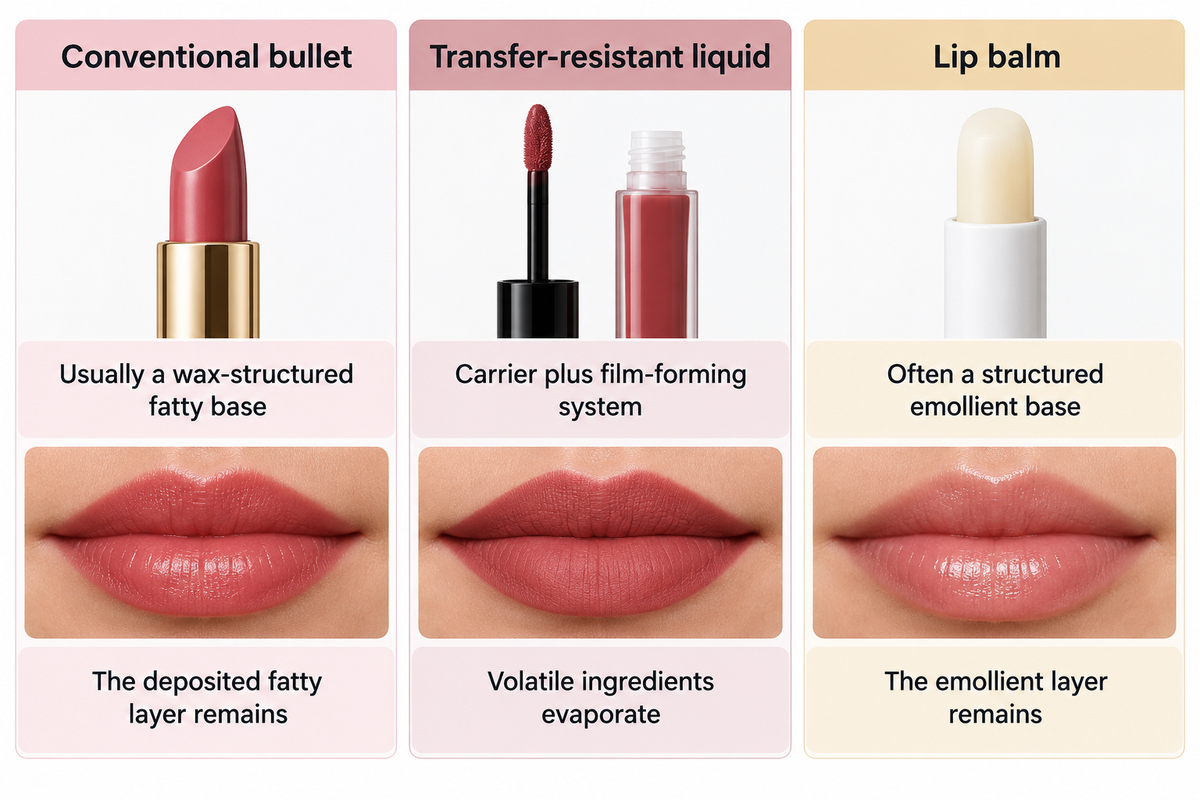
A standard bullet has an oil-and-wax body, and many transfer-resistant liquids have a volatile carrier and a film former. Lip balm generally focuses more on emolliency and protection of the lips as opposed to opaque color. These are some design trends.
| Feature | Conventional bullet | Transfer-resistant liquid | Lip balm |
|---|---|---|---|
| Supporting body | Usually a wax-structured fatty base | Carrier plus film-forming system | Often a structured emollient base |
| Application | Material transfers from the stick | Liquid spreads before the film forms | A lubricating layer spreads over lips |
| Color emphasis | Sheer through opaque | Depends on pigment loading and film | May be clear or tinted |
| Gloss control | Oils, wax structure and surface finish | Carrier, resin and deposited film | Emollient blend and surface layer |
| After application | The deposited fatty layer remains | Volatile ingredients evaporate | The emollient layer remains |
| Production focus | Dispersion, melting and molding | Dispersion and controlled blending | Base preparation and filling |
| Packaging concern | Support and protect the bullet | Limit carrier loss through closure | Match stick, pot or tube format |
| Useful development check | Payoff, firmness and stability | Film feel and transfer behavior | Spreadability and stability |
| Possible exception | Other gelling agents can contribute | Liquid formulas can contain wax | Experimental wax-free gels exist |
In published formulation examples, ingredients such as isododecane act as volatile carriers. Discussed film-forming choices include Silicone resins and acrylic-based polymers. Change is explained by evaporation and film formation. By comparison, balm formulas use their emollient base to help moisturize lips.
Researchers have also created liquid lipsticks containing microcrystalline wax and have created wax-free lip balms with trehalose-based gelators. Examples explain the distinction between the terms “liquid” and “wax-free.”
A brand moving from a bullet to a liquid should define the desired dried film as well as the bulk texture. A batch that pours easily can still leave an uncomfortable layer after its carrier evaporates.
Do Lipsticks Have Animal Ingredients?
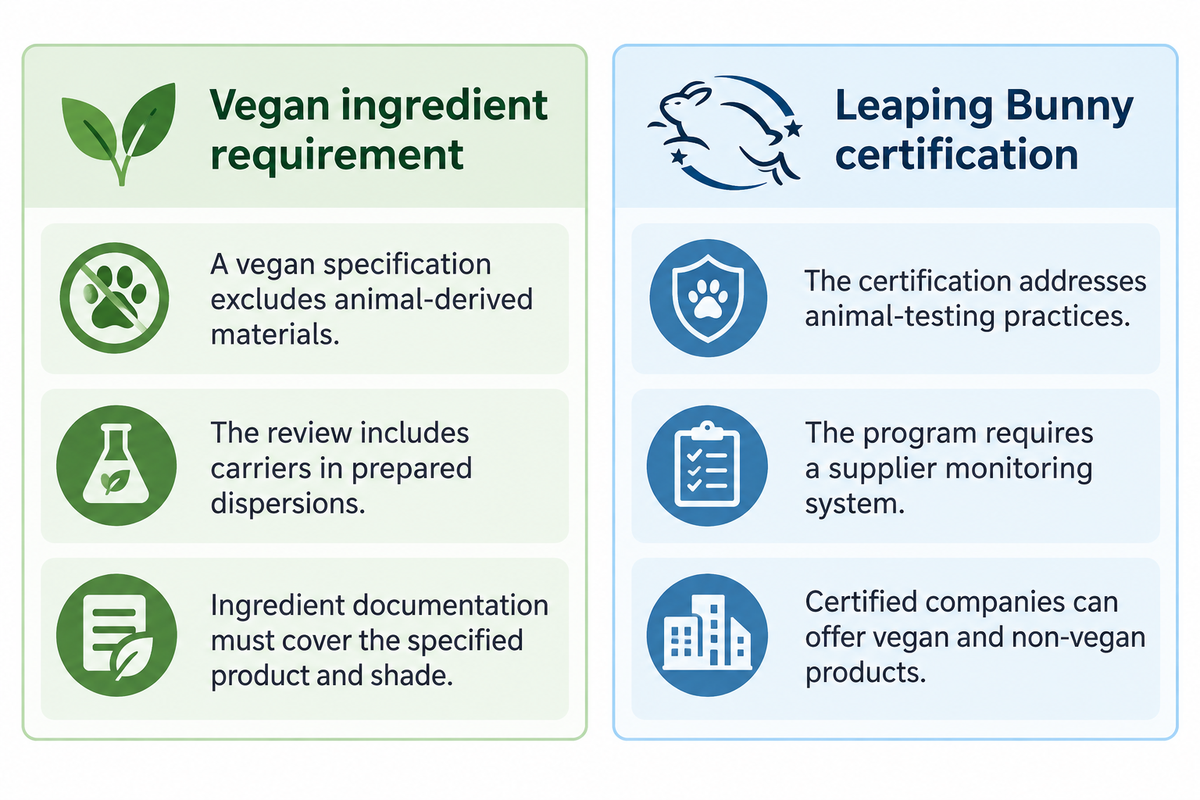
Some lipsticks contain animal-derived ingredients, such as beeswax, lanolin, or carmine. Other formulations contain plant-derived or synthetic choices. Vegan status concerns ingredient origin, while cruelty-free certification concerns animal testing. For a vegan shade, consider product-specific ingredient-origin information and its color declaration.
Beeswax and lanolin are of animal origin, and carmine is of insect (cochineal insects) origin. Other ingredient names can cover materials made through different supply routes. “Natural pigments” doesn’t mean animal-free: origin and function are separate issues.
Vegan ingredient requirement
- A vegan specification excludes animal-derived materials.
- The review includes carriers in prepared dispersions.
- Ingredient documentation must cover the specified product and shade.
Leaping Bunny certification
- The certification addresses animal-testing practices.
- The program requires a supplier monitoring system.
- Certified companies can offer vegan and non-vegan products.
“The Leaping Bunny list does not provide information about the composition of ingredients.”
For a brand purchasing a prepared pigment dispersion, the origin of the pigment isn’t the only concern for the vegan specification. The carrier and dispersing ingredients also become part of the finished product. Therefore, the raw material specification must be tied to the product and color match. A new supplier or carrier change also requires the same assessment.
How Lipstick Is Made: From Mixing to Cooling
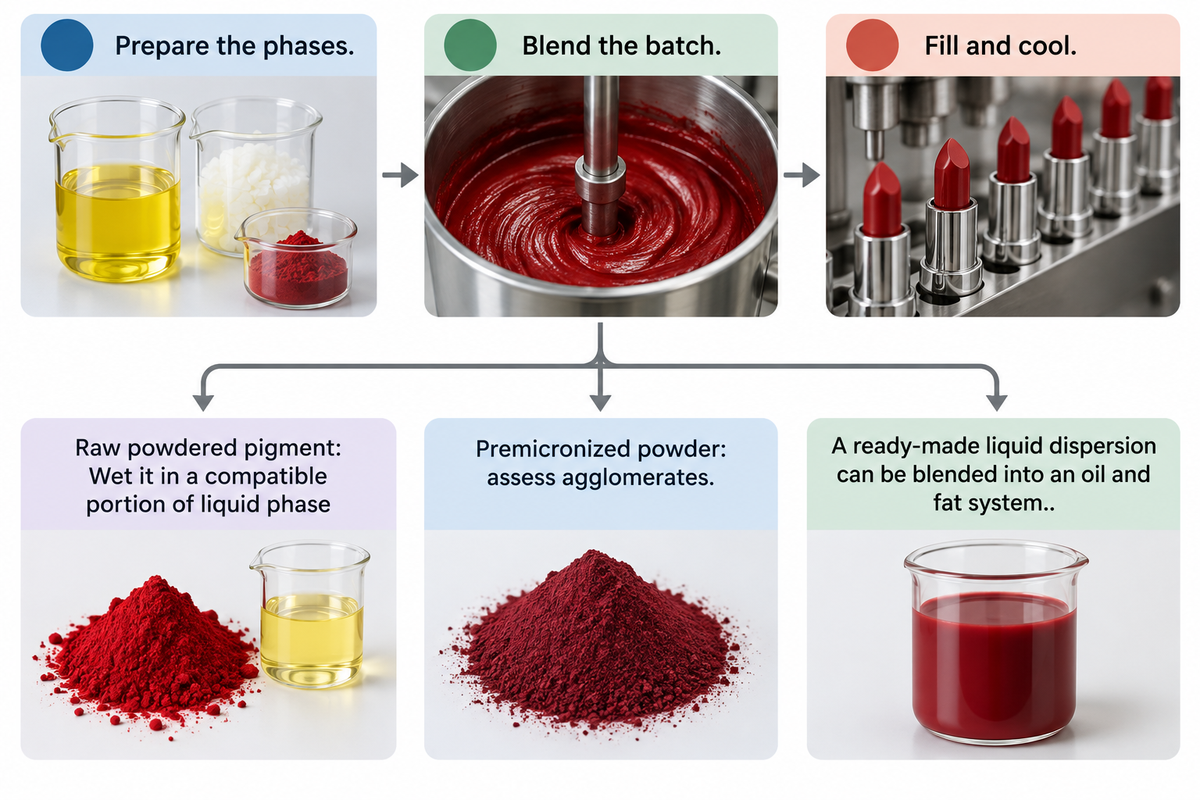
Conventional lipstick is made by preparing the color dispersion, melting and combining the fatty ingredients, blending the phases, then molding and cooling the product. Preparing the pigment dispersion affects the final quality of the product. The stick product is dependent on the heat loss and the internal structure it develops.
Silverson’s manufacturing report describes preparing wax and oil separately and blending with the pigment grind. A mixer that circulates the melt and equipment that breaks pigment agglomerates perform different duties.
- Prepare the phases. Weigh the ingredients, melt the wax phase and prepare the pigment dispersion.
- Blend the batch. Combine the phases until the mixture is homogeneous.
- Fill and cool. Form the product and assess the finished stick.
Pigment Feedstock Fork
Start with the pigment in its supplied form, and follow the first preparation step to obtain a dispersion. Then, check if the dispersion is formed in the base in which it’s needed.
- Raw powdered pigment: Wet it in a compatible portion of liquid phase and prepare a dispersion. Silverson mentions a triple roll mill, bead mill, or similar equipment, for the pigment grind.
- Premicronized powder: assess agglomerates. The primary particles are fine, but still clustered, and may require shear to separate.
- A ready-made liquid dispersion can be blended into an oil and fat system. Include the carrier of the dispersion in the formula.
What if the developer moves a shade from raw pigment to a purchased dispersion? The incoming material now contains carrier and colorant. Adding the old pigment weight as if the dispersion were pure pigment changes both shade strength and liquid balance. The developer, initially, relies on the supplier’s pigment content information to reformulate the addition, and later, compares a trial batch to the approved shade. Procurement can evaluate the added ingredient cost against the preparation work removed. The equipment trial, however, follows the revised mixture, and doesn’t repeat the original milling step automatically.
After blending, the batch is conditioned prior to filling into a mold or mould. Cooling causes the wax to crystalize and set which in turn affects the volume and dimension of the batch. A low-wax lipstick study investigated some of these phenomena and looked at rubber molding to alter these behavioral changes. Filling and cooling, along with pigment dispersion, deserve their own trials.
Why Lipstick Can Feel Gritty, Sweat or Break
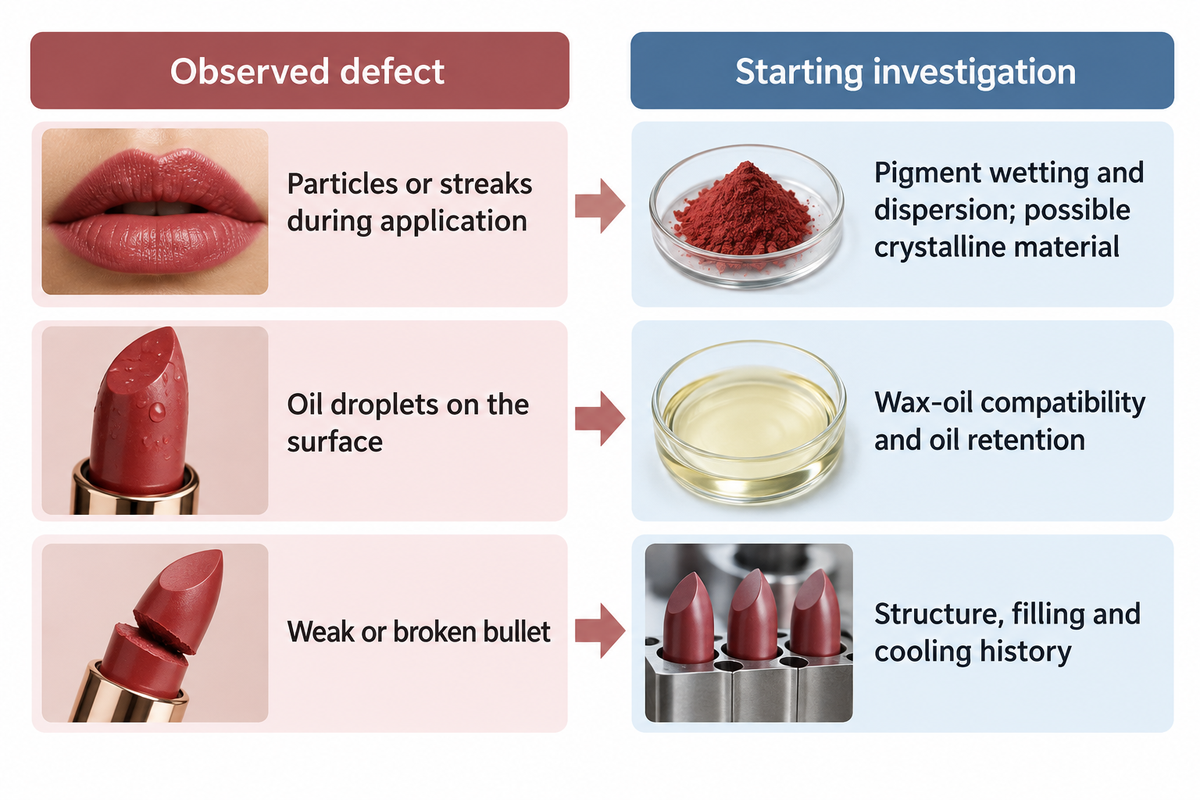
Grittiness can involve poorly dispersed particles or changes in the fatty structure; sweating can involve oil release; breakage can involve mechanical weakness or cooling defects. These, however, can lead to different lines of investigation. For development work, retained samples and process records should be compared, prior to any changes in ingredient or equipment settings.
| Observation | Investigation to start | Useful comparison |
|---|---|---|
| Particles or streaks during application | Pigment wetting and dispersion; possible crystalline material | Incoming dispersion, fresh bulk and retained sticks |
| Oil droplets on the surface | Wax-oil compatibility and oil retention | Unchanged formula across recorded storage conditions |
| Weak or broken bullet | Structure, filling and cooling history | Break location, internal voids and matched trial samples |
A technical article on oil binding notes that adding a wax with greater oil binding capacity can reduce bleeding, but this won’t resolve the incompatible oil-wax pairing. Hence, more wax won’t always be the remedy for sweating.
Consider a development batch that appears smooth after molding, but later develops droplets during storage. The lab compares it with samples of the previous formula, and if needed checks which raw material changed. If only the new oil changed, the team focuses on the oil’s compatibility. If the formula and the process remained the same, but the cooling media changed, the process record becomes equally useful. The team preserves the samples and changes one trial variable at a time. It does not diagnose the droplets as harmless, microbial or purely cosmetic from a photograph, and it does not add a preservative to conceal a physical stability problem.
How long does lipstick last?
Follow the product’s expiration date. If a period-after-opening date is listed, discard the product after that date. For lipstick, many factors including formulation, packaging, use and storage can impact suitability. Stop using a product if it develops an unusual odor, appearance or texture.
The FDA’s shelf-life guidance separates ordinary cosmetics from products that are also drugs. A lip product marketed as a sunscreen with SPF brings additional requirements; having a UV-related ingredient alone is not a basis for claiming sun protection.
Choosing Equipment for the Formula
Production of Lipstick requires equipment for pigment dispersion, bulk circulation, melting and filling as separate operations. Select each unit based on the supplied ingredients and intended product format. The trial should also cover the formulation’s hazard classification, packaging and molding, and other requirements to ensure an acceptable bulk product becomes an acceptable finished product.
For a pigment grind, three roll mills for pigment dispersions are an option for evaluation. Heated bulk preparation, on the other hand, finds IDA offering multi-shaft mixers with anchor circulation and dispersing functions. The configuration is dependent on the working volume, the behavior of the material, and the nature of the processing duty.
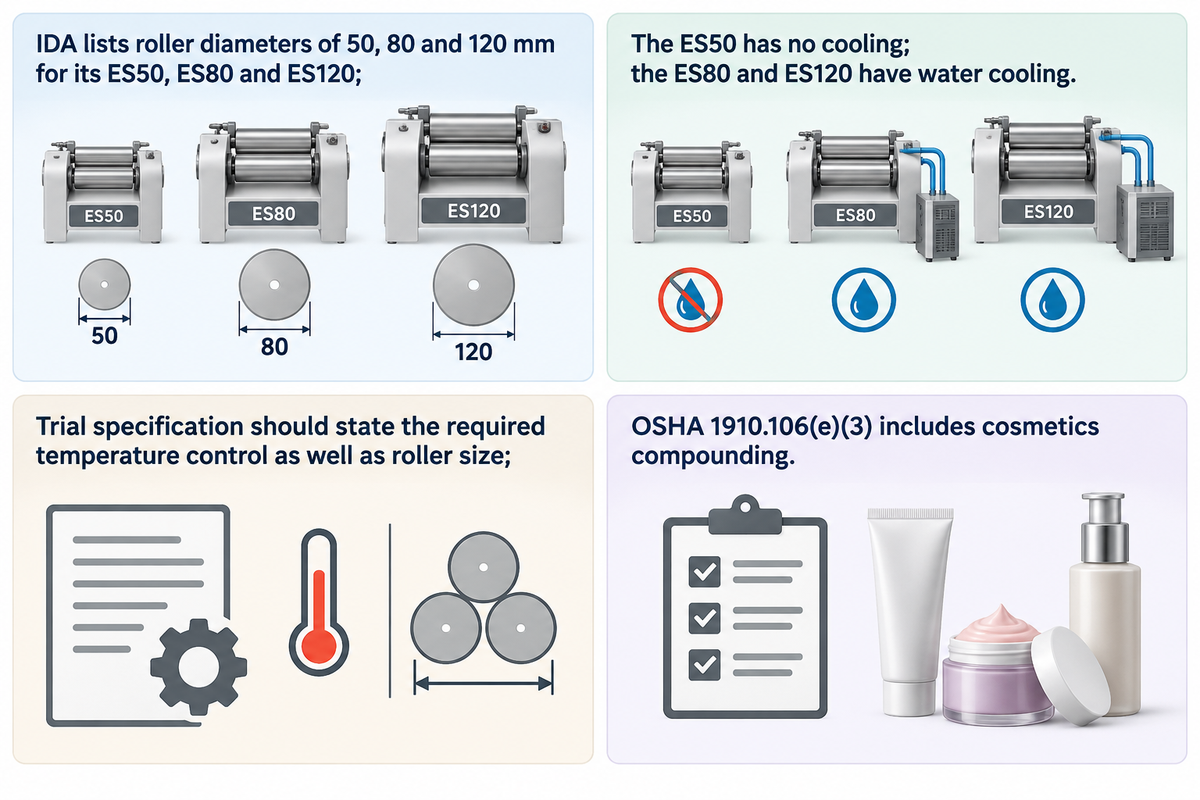
IDA lists roller diameters of 50, 80 and 120 mm for its ES50, ES80 and ES120, respectively. The ES50 has no cooling; the ES80 and ES120 have water cooling. These published configurations show why the trial specification should state the required temperature control as well as roller size.
A different high-speed disperser handles dispersion duties and a double planetary mixer offers another mixing arrangement for viscous materials. Examine these arrangements using the proposed material trial, and think about how the batch moves through the vessel.
Some lipstick formulations contain an aqueous phase. In a published water-in-oil lipstick study, researchers accomplished emulsification using a high-shear mixer. This is a different mixing duty from melting a conventional fatty base.
If the actual formulation contains flammable liquids, the equipment and the facility must be designed to address these hazards. In the US industrial operations, OSHA 1910.106(e)(3) includes cosmetics compounding as an applicable physical operation. The raw-material safety data and mixture classification inform ventilation, ignition-source control and equipment requirements.
What does lipstick development cost?
JEM Labs suggests a US$15,000 development budget typically covers formulation and testing, according to its supplier FAQ. This is JEM’s scope-specific example. Packaging, production commitments and processing equipment belong in separate budget lines. A prepared pigment dispersion also shifts spending from in-house preparation toward the purchased ingredient; compare those costs for the proposed batch and shade range.
What to send for a material trial
Send the pigment supply form, carrier composition, intended batch size and target product format. Provide material safety data sheets, acceptable processing conditions, and a reference standard for color and feel. Describe how the trial stick or final product will be evaluated, including packaging and storage.
IDA’s material-trial service comprises sample processing and analysis and a recommendation on the equipment to be used in the service. Using the dispersion and finished product from the service, determine the production configuration.
Frequently Asked Questions
Is lipstick made from pig fat?
Pig fat isn’t a required lipstick ingredient. Lipsticks can use plant, mineral, synthetic or animal-derived materials. An ingredient’s name doesn’t always reveal its supply route, so a vegan requirement belongs in the product specification and supplier documentation. Beeswax, lanolin and carmine are familiar animal-derived examples. Check the particular shade rather than assuming every product in a range uses the same ingredients.
Are lipstick and lip gloss made of the same ingredients?
Lipstick and lip gloss can share oils, emollients and colorants, but their structure and application differ. A conventional bullet needs enough structure to hold its shape; a gloss is designed to spread as a softer, shinier layer. A moisturizer-like feel doesn’t identify the ingredient system by itself. Compare the ingredient declaration with the intended texture and finish.
Does natural lipstick contain chemicals?
Yes. Plant oils, waxes and pigments are chemical substances too. “Natural” describes an origin or product positioning; it doesn’t replace ingredient identification, suitability checks or finished-product assessment. To formulate for a particular claim, define the allowed materials and evaluate how the resulting product performs. A plant-wax substitution, for example, can change firmness and glide even when its amount stays the same.
Is lipstick edible?
No. Lipstick is a cosmetic for application to the lips, not a food. Lip-use suitability isn’t a reason to eat the product. Follow its directions and keep it away from children who might swallow it.
Can lipstick be made without wax?
Yes. Some lip-color systems use other structuring or film-forming ingredients. A long-wear liquid is one possible approach; experimental gelled lip balms illustrate another. A crayon or bullet shape alone doesn’t identify every ingredient used to make it.
References & Sources
- FDA: Cosmetics Labeling Guide
- OCL: Substitution of Synthetic Waxes by Plant-Based Waxes in Lipsticks
- FDA: Color Additives Permitted for Use in Cosmetics
- FDA: Cochineal Extract and Carmine Labeling Guidance
- Cosmetics & Toiletries: Traditional vs. Transfer-Resistant Lipstick
- Jurnal Ilmu Kefarmasian Indonesia: Sesame-Oil Liquid Lipstick Research
- Self-assembled Trehalose Amphiphiles as Molecular Gels: A Unique Formulation to Wax-free Cosmetics
- Leaping Bunny: Certification FAQ
- Journal of Oleo Science: Realization of Low-wax Lipstick by Rubber Molding Technology
- Cosmetics & Toiletries: Oil-binding Capacity with Natural Waxes
- FDA: Shelf Life and Expiration Dating of Cosmetics
- PubMed: Water-in-oil Lipstick Emulsion Research
- Occupational Safety and Health Administration: 1910.106, Flammable Liquids