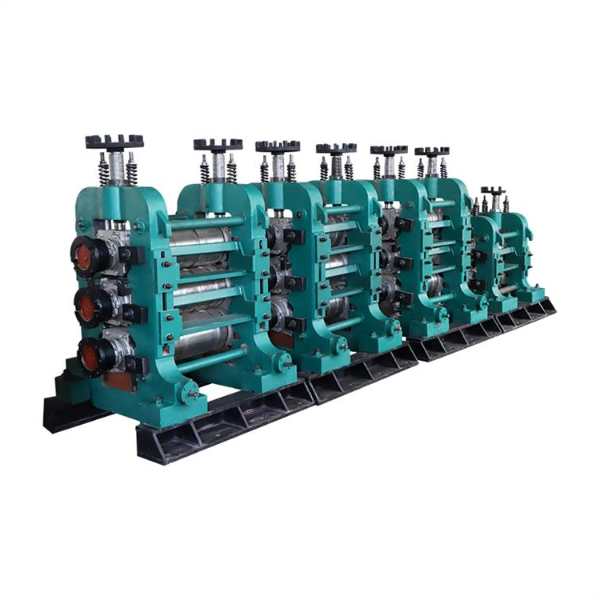
Get in Touch with IDA


Three roll mill vs ball mill is a comparison every paste and coating manufacturer runs into sooner or later: both machines reduce particle size, but they suit opposite ends of the viscosity scale, and picking the wrong one either wastes throughput or stalls the batch entirely.
Quick Specs
| Grinding mechanism | Three roll mill: shear force between 3 rollers | Ball mill: impact + friction from tumbling media |
| Viscosity range | Three roll mill: up to 2,000,000 mPas | Ball mill: practical ceiling ~100,000 mPas |
| Fineness | Three roll mill: 1–20 μm (≤5 μm typical) | Ball mill: 5–50 μm (can reach 0–10 μm in vibratory/dry setups) |
| Contamination risk | Three roll mill: very low (ceramic, no media) | Ball mill: higher (grinding media wear) |
| Best for | Three roll mill: paint, ink, cosmetics, electronic paste | Ball mill: dry powders, mining, cement, bulk low-viscosity slurries |
Three roll mill vs ball mill is a decision most paste and coating manufacturers eventually face, and it comes down to a factor you might not even have on your radar as a buyer: viscosity. Both run a wet-grinding milling process that reduces the size of agglomerated particles, but through different principles, and that difference means they’ve differing limits at opposing ends of the viscosity scale – and making the wrong choice means your mill either won’t effectively process a low viscosity fluid or it will seize up trying to manage a viscous material. Indeed, the three roll mill is a classic technology that remains one of the best methods for preparing very fine, narrow-distribution pastes, and it still competes directly with ball mills across many paste-heavy industries today.
Three roll mill grinds high viscosity (up to 2,000,000 mPas) paste via shear force between 3 rollers. Ball mill works by impact from tumbling media but is limited to about 100,000 mPas. Paint, ink, cosmetic paste need three roll mill while dry powders and mine ore would use ball mill.
Key Points
- Ball mills will obtain a smaller median particle size than 3 roll mills under the correct dry/low-viscosity set-up-but with a much wider particle size distribution.
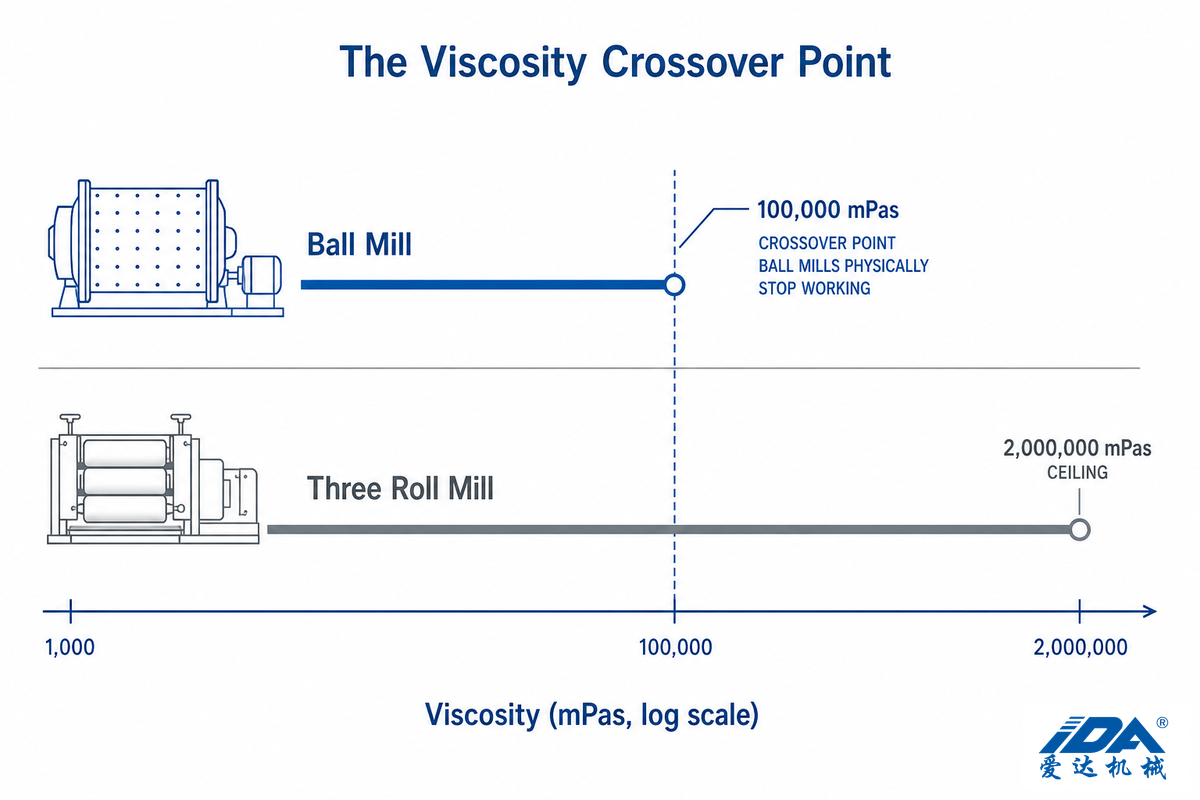
- Beyond ~100,000 mPas the practical application of ball mills comes to its end. Three roll mills master the paste to 2,000,000 mPas – a value 20 times higher.
- A conversion from ball mill to a three roll mill for the high-viscosity grinding of pigment achieved a pay back in eight months on one instance, and it was thanks to a change in process from two hours to forty-five minutes.
- Zero media-wear contamination with Ceramic three roll mill rollers – ball mill grinding media wears and breaks off into your product.
- No other peer-reviewed technical literature reports a specific ceiling in mPas to ball milling – the 100,000 mPas shown below comes from practical equipment engineering, not a specified technical specification (we’re candid in H2-3 to point this out).
Three Roll Mill vs Ball Mill at a Glance, And Which “Ball Mill” We Mean
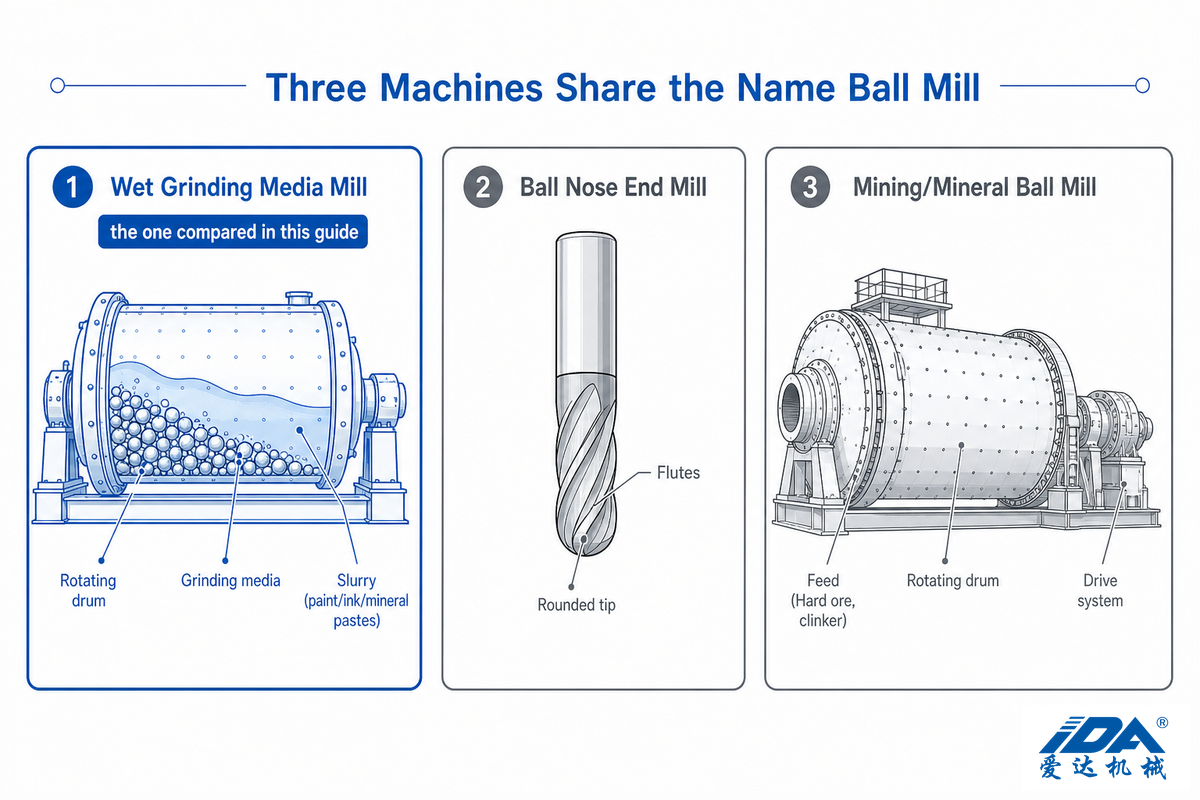
A preliminary clarification: The term “ball mill” is one of the most overused and ambigous in the industrial vocabulary. One type of ball mill is a wet grinding media mill for producing pastes and slurries (paint, ink, ceramics, minerals prep)-the type of machine we’re comparing to the three roll mill in this guide. The other two are ball nose end mills-a CNC machining tool bit that has a round tip used for milling-and very large (multi-ton per hour) mining or mineral processing ball mills which grind ore and cement clinker into fine particles.
These three are very different machines which happen to have the same name. This guide compares one of them-the wet grinding media type-to the three roll mill in their application: grinding and dispersing in liquids to achieve particle sizes down to microns. For perspective, in online discussions comparing equipment for the processing of minerals where the topic might be ball mills, rod mills, or roll mills for breaking down large pieces of ore, the terminology and metrics for fineness refer to particle sizes measured by mesh screen size (i.e., 400 mesh and under for ball mills, 150-200 mesh for rod mills) – an entirely different concept from the micron-based paste grinding discussed in this guide.
With that in mind, the two machines attack the same fundamental viscous material challenge-comminuting the lumps and clods into uniformly fine particles-via fundamentally opposite physics, which explains why our Quick Specs table shows such different performance for the two at either end of the viscosity/contamination continuum. Should your material fall somewhere between low and medium viscosity, you can consider this article in conjunction with our separate three roll mill vs. bead mill guide to tackle the third side of the fineness/viscosity/contamination triangle.
How Each Mill Actually Works
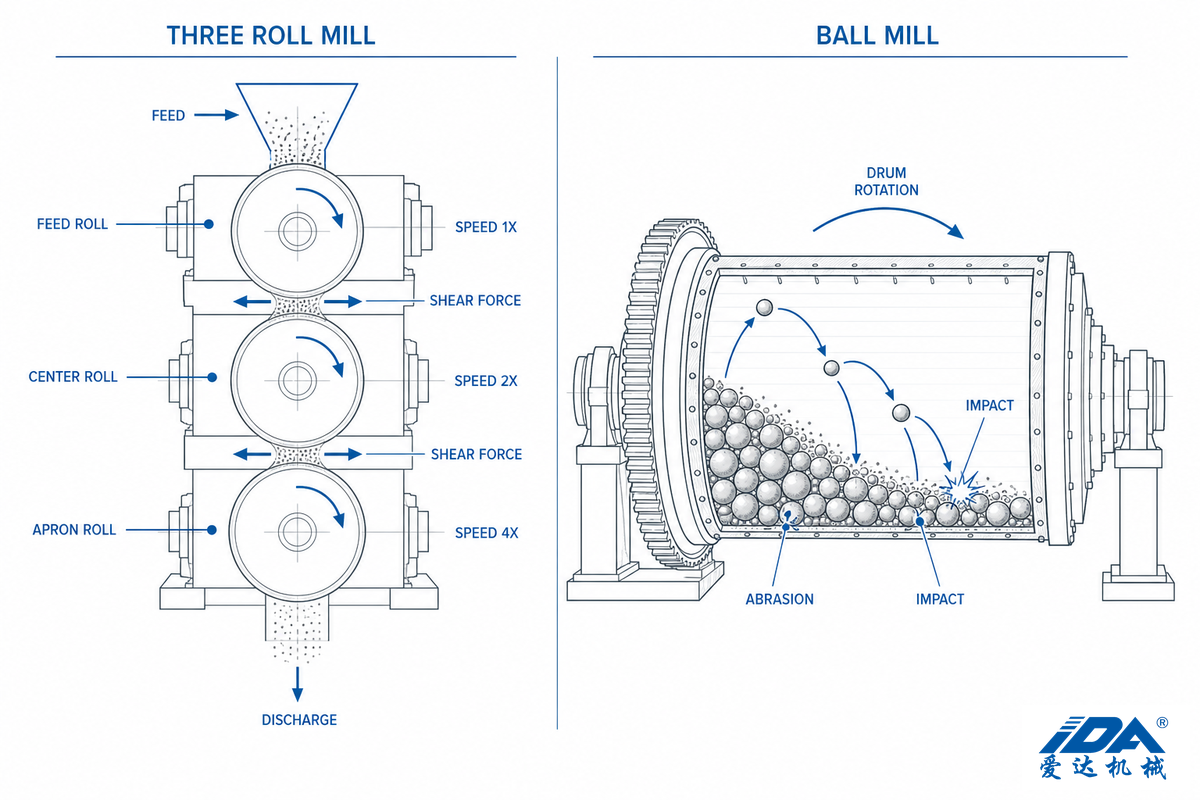
Three roll mills are widely used across the paste and coatings industry because each mill incorporates three horizontally positioned rolls rotating in opposite directions, and the shear force between the feed and center rolls is what breaks down agglomerated particles; a ball mill, by contrast, is a machine that uses impact force from tumbling media instead. That mechanical difference is why the two machines end up suited to opposite ends of the viscosity scale.
Those three rolls – called the feed roll, center roll, and apron roll – are cast from alloy steel or ceramic mill material and separated from a few microns to a few thousandths of an inch, turning at differing speeds, generally in ratios such as 1:2:4 or 1:3:9. Material is placed into the space, or “nip”, between the feed roll and the center roll, which rotate in opposite directions. As the center roll move at a faster speed, the substance adheres to the center roll and then to the even faster-moving apron roll – it’s a long established technology, whereby the differing speed of these three adjacent rolls makes it possible for substances to be passed from one to the other; these differing speeds between adjacent rolls provide a force, called shear, that causes larger groups of agglomerated particles to break down.
A journal study investigating the processes involved in dispersion of substances within very thick materials concluded that dispersion via the laminar shear-flow forces generated by a three roller mill is quite a different mechanism from those that cause impact and cavitation within the high-shear devices or stirred media mills; the power is derived from shear force within the spaces between rollers, rather than from particle impacts or turbulence (Stress mechanisms acting during dispersing in highly viscous systems, ScienceDirect).
More precision comes with the trade journals. It’s in the second nip that the dispersion is effected, and the first nip feed into it, to set the feed-through amount of the dispersion step that’s the main work-horse of New-Generation Three Roll Mills Meet Today’s Challenges (PCI Magazine). And finally the milled material is scraped off the apron roll by a take-off knife blade, where it’s typically produced at around a 0.001 in gap on heavy duty hydraulic three roll mill units used for continuous production capacity. This gap-and-blade finishing step is common across the entire three roll mill series, from benchtop lab units to heavy-duty hydraulic production models; well-known brands in this category include EXAKT, Torrey Hills, and the Ross three-roll mill line (Charles Ross & Son Company), and some manufacturers also offer a five-roll mill variant for even finer, multi-stage dispersion.
How does a three roll mill reduce agglomerate size?
Shear stress between rollers rotating at different speeds rips apart agglomerates as material moves through the feed-to-center nip, then the center-to-apron nip. Gap is tightened after each pass, and passes are repeated to improve dispersion or until particle size equilibrium is reached and a uniform particle size is achieved — usually below 5 μm after three to five passes. Operators confirm the desired level of dispersion with a grind gauge (see ASTM D1210) after each pass.
A ball mill operate by entirely different principle; it relies on impact and abrasion. Its cylindrical drum body is mounted on a horizontal axis and rotates about it, partially filled with a load of wear-resistant metal balls, ceramic media, or (in older ceramics-industry setups) flint pebbles, all tumbling the process product. Those metal balls bounce off each other, off the body, and these impacts grind down the process product into fine particle dispersions. That’s the essence of the ball mill process: wear-resistant media tumble and mill the slurry until impact energy breaks the particles down, which is why ball mills offer a lower up-front cost and remain the standard in industries such as cement, mining, and dry powder processing.
It has neither a shear zone nor a roller gap to adjust; the operating variables are the roller speed, the media sizes and the fill factor. The lowest cost option, which is generally used for most of three roll mills, are standard rollers made from special alloy steel or stainless steel; SiC roller costs a bit more but offers wear resistance and the addition of SiC roller is practically eliminating contamination of the process product which is a prerequisite for producing cosmetics, pharmaceutical or electronics pastes and requires using rollers made of ZrO2. You can also make use of our roller material selector guide to select the optimal material for your application before asking for a price.
The Viscosity Crossover, Where Ball Mills Physically Stop Working
The 100,000 mPas Crossover Point
Once you’re over around 100,000 mPas, a ball mill’s grinding media really stops moving freely; rather than tumbling and colliding with each other, they’re now stuck in the thickening product, the impact energy which does the grinding disappears, and your batch just sits in the ball mill warming up instead of getting finer. It’s because of that limit-which is more of an engineering heuristic than a peer-reviewed number but holds true across both paste and coating production-that processors working over that viscosity move up to a three roll mill, capable of handling materials up to 2,000,000 mPas-a full 20x difference in viscosity range.
| Viscosity range | Ball mill | Three roll mill |
|---|---|---|
| <1,000 mPas (thin liquids) | Works, but bead/sand mills are usually faster | Too thin — material drips through the rolls |
| 1,000–100,000 mPas | Workable, efficiency declining toward the top of the range | Workable, though may be overkill below ~10,000 mPas |
| 100,000–2,000,000 mPas | Practical ceiling reached — media stops moving freely | Core operating range; roller gap gives precise control |
| >2,000,000 mPas | Not viable | Above rated ceiling — needs pre-thinning or a different process |
“If you’re processing anything above 100,000 mPas, a three roll mill is really your only practical option, ball mills can’t handle that viscosity, and bead mills will clog. Thinner materials under 1,000 mPas are better served by bead mills, which give you faster throughput. Three roll mills really shine in the 10,000 to 2,000,000 mPas range, especially when you need quick color changes or zero media contamination.”
IDA Process Optimization Team
📐 Engineering Note
Gap settings are often specified down to the 0.001 in (25 μm) level in industrial three roll mills, while even better accuracy down to 1 μm is possible with PLC controlled hydraulic roller mills. Published patent filings describing high-viscosity paste dispersion further reinforce this operating regime: a 2025 filing for conductive silver paste indicates an 80 μm roller gap at first pass that narrows to 40 μm by the third pass (WO2025044445A1), and another filing for an azelaic acid compound formulation indicates 0.1 mm (100 μm) roller gaps (CN115590777B).
Before we dive into when each machine makes more sense, let’s talk frankly about that 100,000 mPas number above: there’s no definitive academic source stating a “ball mill mPas limit” the way ASTM D1210 gives us fineness of grind test standards. We drew it from equipment engineering experience across paste and coatings manufacturing – it’s not a proven, published constant. It’s also an over simplification of denser physics: there’s peer-reviewed rheology research on highly-concentrated slurries showing that whether a thick suspension flows or jams is about its proximity to a “jamming” solids fraction, the history of how you stirred it, and surfactant arrangement – not just the viscosity value itself. Consider 100,000 mPas as a guide line when planning and always run free sample tests with your specific formulation before changing processes. If you’re working from a datasheet with a viscosity value in centipoise, poise, or Pascals, you can use our viscosity unit converter which has a three roll mill viability marker built in.
Contamination Risk, Throughput, and Energy Use
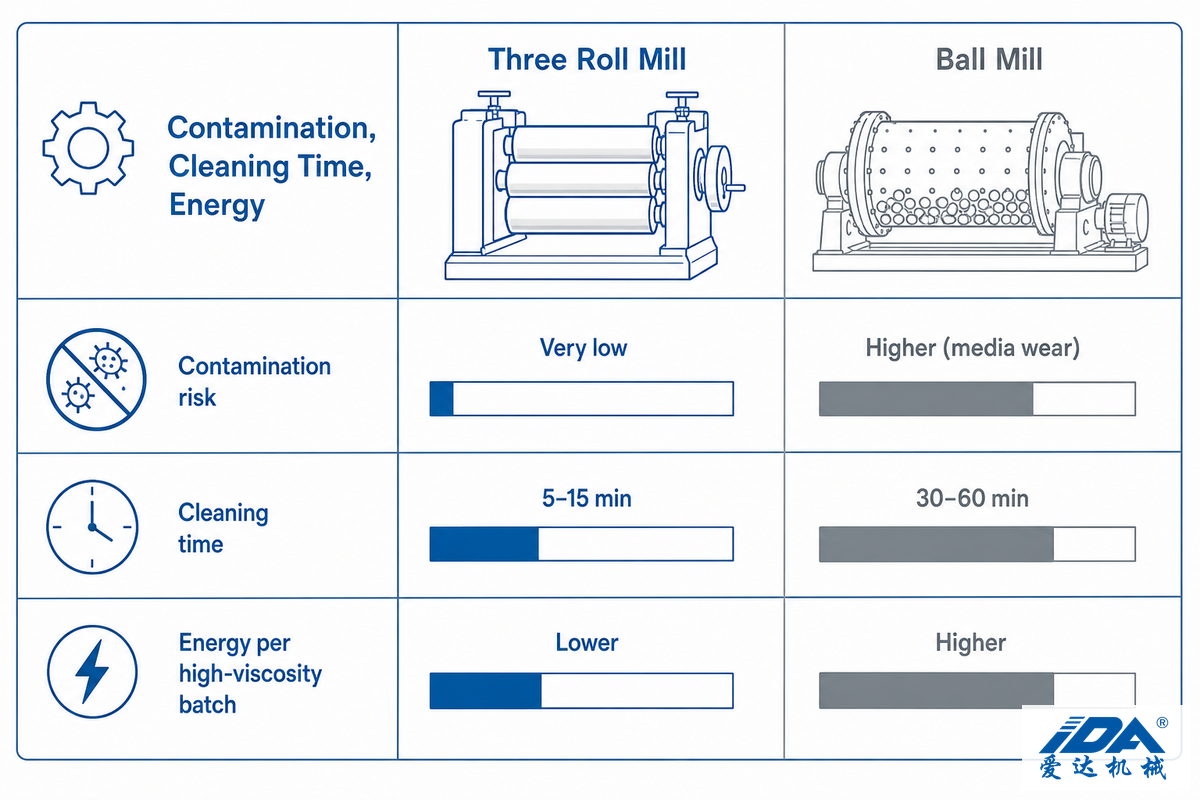
Beyond the mPas value, here are the three other key factors in determining which machine is the better choice: your product’s allowable level of contamination, your desired batch throughput time, and your operating costs for both machines.
| Factor | Three Roll Mill | Ball Mill |
|---|---|---|
| Contamination risk | Very low — ceramic rollers introduce no media wear | Higher — steel/ceramic media wears and can shed into product |
| Cleaning time | 5–15 minutes (open roller surface, quick wipe-down) | 30–60 minutes (enclosed vessel, media removal) |
| Energy per batch | Lower for high-viscosity paste (shear-only, no media mass to move) | Higher — energy also spent accelerating grinding media |
| Color/batch changeover | 15 minutes on well-designed equipment | Slower — media and vessel both need cleaning between runs |
That “energy gap” isn’t just a phenomenon in paste-processing: we’ve seen it show up in rigorous academic testing as well. A 2024 peer-reviewed study on a vibratory ball mill reported that by switching from 12mm to 15mm grinding media, they achieved a 22.5% reduction in processing time to a particle size class of 0-10 μm (a 0 to 10 micrometers size range). Since energy draw in their setup was almost perfectly proportional to processing time, energy consumption was reduced by the same amount. That’s a tangible advantage that exists within a ball mill’s operating range, but it’s also an illustration of just how sensitive a ball mill’s energy consumption is to media size – and how much operator diligence is required to keep it optimized, compared to a three roll mill whose operation only hinges on shear gap.
Which Materials and Industries Fit Each Mill

✔ Three Roll Mill Fits
- Paint and pigment pastes (including those based on titanium dioxide, carbon black, iron oxide and organic colorants)
- Cosmetics and pharmaceutical pastes (lipstick, foundation, ointments, dental composites)
- Electronic paste, including conductive silver paste, battery electrode slurry, and thick-film pastes
- Ink (screen print, UV, offset) and specialty adhesives
- Nanomaterial dispersions, such as CNT and graphene nanoplatelet suspensions, where added heat may damage the material
✔ Ball Mill Fits
- Mining and mineral ore comminution (coarse-to-medium grinding, large tonnage)
- Cement clinker and dry powder processing
- Pre-grinding / bulk reduction ahead of a finer downstream grinding process
- Low-viscosity slurries where free media movement is possible
- Applications where product fineness matters more than distribution tightness
| Material / Application Type | Recommended Mill | Typical Consistency | Why |
|---|---|---|---|
| Titanium dioxide paint pigment | Three Roll Mill | High-viscosity paste | Needs tight, repeatable D90 control for color consistency |
| Printing ink (offset/UV/screen) | Three Roll Mill | High-viscosity paste | Batch-to-batch color depth consistency is the core requirement |
| Lipstick / liquid foundation | Three Roll Mill | High-viscosity paste | Ceramic rollers give zero metal contamination for skin-contact product |
| Dental composite paste | Three Roll Mill | High-viscosity paste | Medical-grade contamination limits rule out media-based grinding |
| Conductive silver paste (solar/electronics) | Three Roll Mill | High-viscosity paste | Sub-5μm fineness target plus zero metal contamination |
| Battery electrode slurry | Three Roll Mill | High-solids paste | High solids loading behaves as a paste, not a pourable slurry |
| Mining ore (gold, copper concentrate) | Ball Mill | Slurry or dry feed | Large tonnage, coarse-to-medium grind — media tumbling scales better |
| Cement clinker | Ball Mill | Dry powder | Bulk dry grinding at volumes no three roll mill can approach |
| Ceramic glaze slip (pottery) | Ball Mill | Low-to-medium viscosity | Traditional wet ball milling handles the viscosity range fine |
| Pharmaceutical dry powder blend | Ball Mill | Dry powder | No paste form exists yet — a three roll mill cannot process solids |
| Pre-grind stage ahead of final dispersion | Ball Mill, then Three Roll Mill | Medium → high viscosity | Two-stage combo: bulk reduction, then fine dispersion and finishing |
| Chocolate / confectionery refining | Ball mill refiner, or a combined roll-and-ball line | Thick paste | Industry-specific equipment exists that runs both technologies together |
What are the two types of ball mills?
In practical application, there are two types of wet grinding ball mills: batch and continuous. Batch design, most common for paste and coatings pre-grinding, fills a vessel with a fixed volume of product and media, runs it, then empties it. Continuous mills (often vibratory, as in the grinding media study cited above) feed material in and remove output continuously, trading batch-to-batch flexibility for higher throughput.
Here’s the finding that contradicts the basic assumption that “the three-roll mill always gets finer”: In specific conditions – dry or low-viscosity feeds, small grinding media, vibrating operation – traditional ball mills can reach the 0-10 micrometer (μm) class (the same vibratory-mill 0-10 μm result cited earlier, see the 2024 grinding-media study) which overlaps or is even finer than the 1-20 μm low end range that’s characteristic of the three roll mills. However, this comes with a trade-off. Industry process literature related to wet grinding equipment indicates that ball mills result in a wider, or sometimes multimodal particle-size distribution (PSD) than in shear-based dispersal, so even if the median particle is fine, there’s a loose distribution. For color critical applications, such as the production of paints or electronic paste, where a narrow distribution is as important as a fine median particle, this is the primary reason for preferring the three-roll mill – not due to the inability of ball mills to get fine, but rather their relative incapability of consistently maintaining both fine particle size and narrow distribution with increased viscosity.
It should also be avoided to maintain a strict “either/or” perspective. For example, in chocolate and confectionary production – where ball and roller mill refiners often work side-by-side – practitioners sometimes acknowledge that the technologies aren’t completely incompatible. For example, at least one equipment manufacturer offer roll-and-ball combination refining lines. Similarly, some paste and coating production facilities first process bulk ingredients with a coarse grinding process (such as a ball mill or a bead mill) followed by a three-roll mill for final dispersing and color developing operations, rather than choosing between the two options.
Additionally, neither mill technology is necessarily the only option. For conductive silver paste specifically, for example, there’s peer-reviewed research on cavitation technologies that use high-frequency sound waves instead of media or mechanical rollers as a promising low-cost substitute for the three-roll mill. A 2024 study published in AIP Advances indicates that cavitation technology for producing the conductive Ag paste results in 21% solar cell efficiency compared to 22% achieved using conventionally milled paste. While still facing some unresolved issues concerning contact resistance, the technology achieves finer grid lines and lower silver usage, offering a potential alternative to conventional methods.
Real Case: An 8-Month Payback Converting From Ball Mill to Three Roll Mill
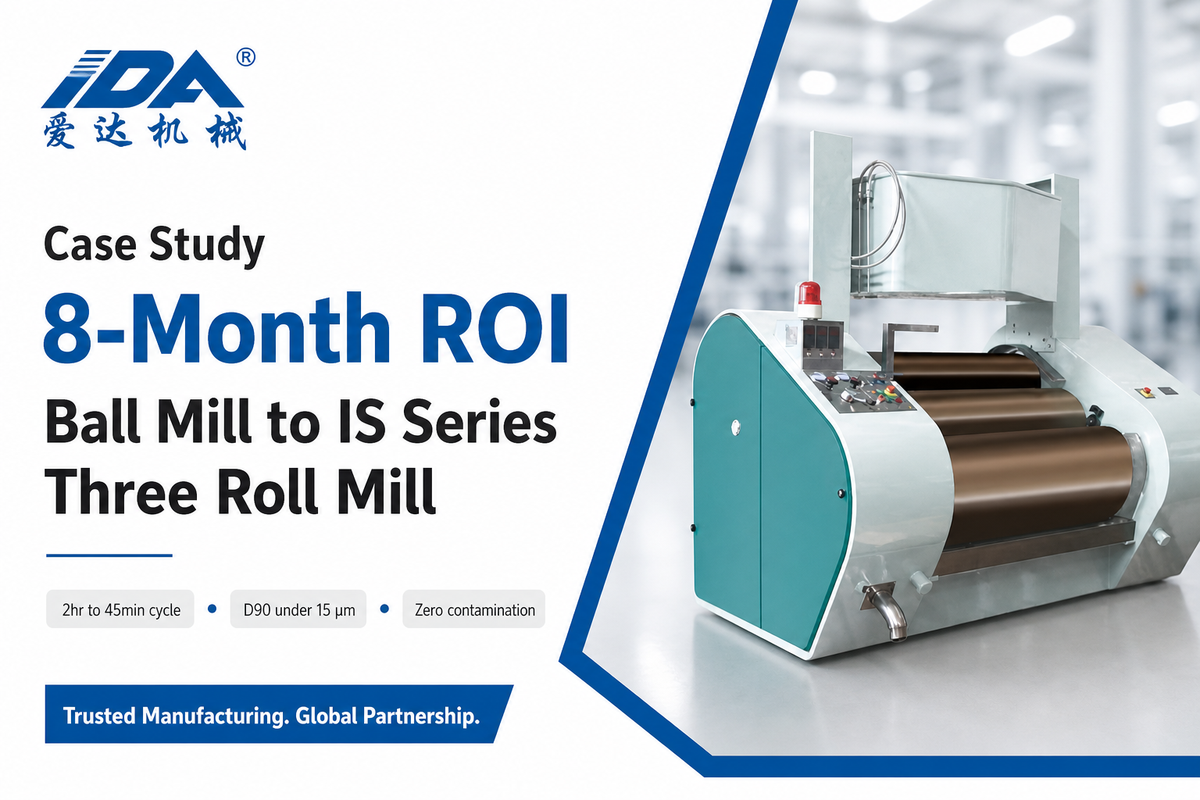
A South American paint manufacturer used a ball mill to grind TiO2 pigment for architectural paint. After decades of service with the ball mill, they sought to investigate if investing in a three-roll mill system would be justified from a cost perspective. The following outlines the changes they observed after upgrading to the IS Series industrial three-roll mill.
Before — Ball Mill
- Inconsistent particle distribution batch to batch
- 2-hour batch processing time
- D90 particle size varied between 18–25 μm
- Grinding media contamination
- High energy consumption per batch
- Difficult to clean between color runs
After — Three Roll Mill
- Consistent, repeatable particle distribution
- 45-minute batch cycle
- D90 consistently below 15 μm
- Zero media contamination
- Lower energy cost per kg processed
- 15-minute color changeover
8 months
Full ROI payback
2hr → 45min
Batch cycle time
<15μm
D90, down from 18–25μm
With a shorter cycle, lower reject rate, and reduced energy consumption per batch, we received full ROI in just 8 months. This improved line also provides better production throughput without having to change our batch size, and our staff noted improved batch-to-batch color matching and significantly fewer customer issues – improvements not represented on the ROI worksheet, but nonetheless as valuable to a recurring business. This same trend is apparent through out the industry.
The same trends seen with our experience also reported by other equipment manufacturers who have witnessed an equal amount of product-yield and throughput increases for other manufacturers of high-viscosity paste production using 3-roll mills over their existing ball mills – even the specific percentages are varying for the particular process and the existing machinery. Using the throughput calculator to determine expected hourly throughput based on target roller size and your particular viscosity will help in determining your replacement size.
What Each Mill Gets Wrong (Honest Limitations)
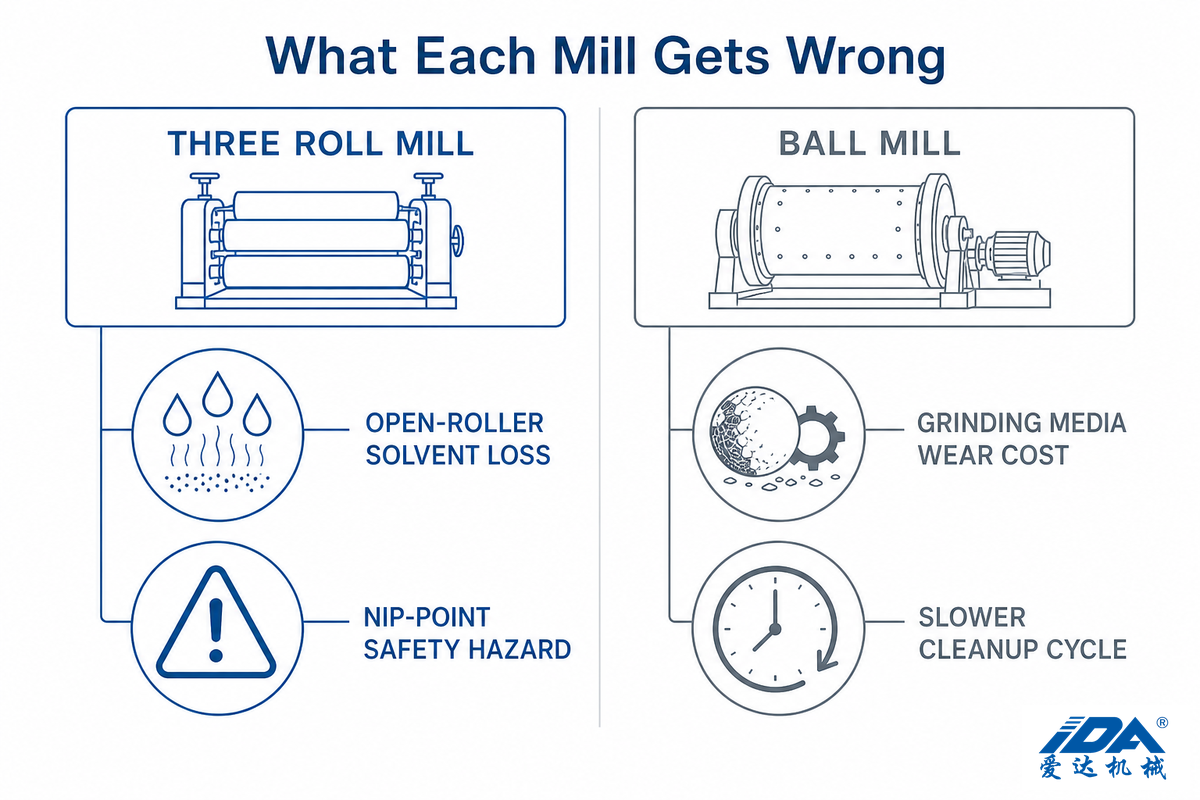
Most of the comparison reviews that you find only mention the pros for buying a three roll mill. Both machines have genuine flaws worth knowing before you invest capital: a three roll mill loses volatile solvent components on its open rollers and carries a real nip-point safety hazard, while a ball mill wears through consumable grinding media and runs slower cleanup cycles. Neither is a one-sided winner once you look past the sales pitch.
⚠ Three Roll Mill Limitations
- Open roller surface lets volatile solvent components evaporate off during processing- serious limitation for solvent intensive formulations
- Lower throughput than continuous bead/sand mills on lower-viscosity work
- Finishing can result in increased fineness pass to pass without an operator’s attention for a gap adjusted system
- Can’t handle dry powders/solids in their natural state – the material must be a paste or solvent needs to be added to “wet out” the material
- The open nip between the two rollers is a real mechanical hazard – machine guarding was OSHA’s 10th most-cited violation category in FY2024, with 1,541 citations – and has even resulted in OSHA requiring nip point guarding on forming rolls and calenders under its machine-guarding regulations (29 CFR 1910.212), a component that needs to be incorporated in the planning for purchase/installation, not an add-on later.
⚠ Ball Mill Limitations
- Progressive grinding – wear the grinding balls as the size of ball decrease then the effect of collision strength fall off so the processing capacity also falls.
- Can’t manage thick pasty media, medium stops flowing around 100.000 mPas max.
- More energy usage for each batch, particular at the smaller target particle sizes
- Enclosed vessel design slows cleaning and color change over compared to open-roller three roll mill
One cost factor not often seen in vendor brochures is that of the cost to replace media and the media’s specification. As one engineering discussion on ball mill media requirements explains, the grinding balls also wear and the food grade wear-resistant nature required of some media translates to a continuous, substantial cost factor – largely bypassed by a ceramic three roll mill roller that actually does the grinding (instead of consumable grinding media). You may want to look at our grinding media selection guide to compare ongoing media costs to media-free grinding options.
Which Should You Choose?
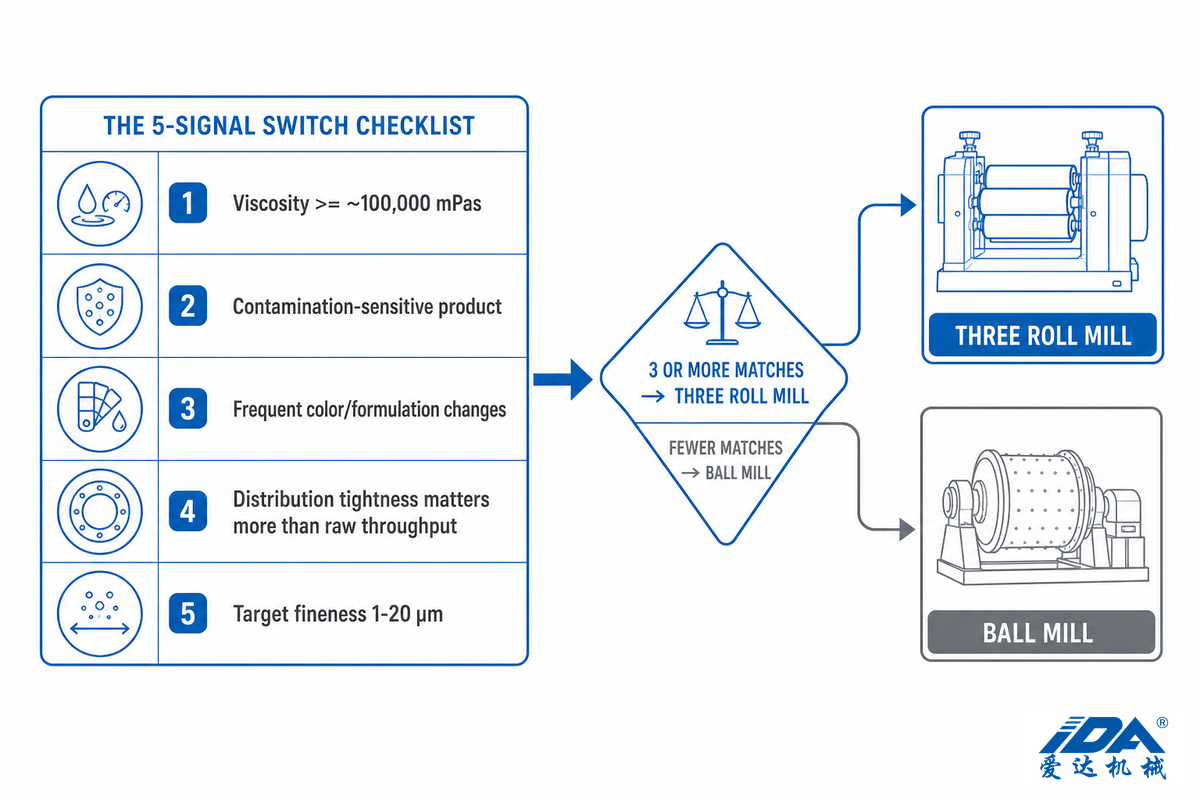
The choice comes down to five practical signals in your process, not a blanket rule for every buyer. Check your material’s viscosity, contamination sensitivity, changeover frequency, distribution tightness needs, and target fineness against the checklist below — three or more matches point toward a three roll mill over your current or a new ball mill. If your process spans multiple product lines, our broader equipment decision guide walks through the same logic across our full mill and mixer range.
The 5-Signal Switch Checklist
Run your process against these five signals. If you get three or more matches a three roll mill is most probably better suited for your application than your existing (or new) ball mill.
- Your material has a viscosity of >= ~100,000 mPas OR you’re unable to obtain a consistent throughput at the current viscosity.
- Contamination-sensitive product (cosmetics, pharma, electronic paste, food-contact), you can’t tolerate any media trace wear
- Change your colour or formulation many times each shift, and want to get the cleaning done in under 15 minutes
- batch-to-batch particle size distribution consistency is more important to you than sheer throughput volume
- your target fineness is 1-20 μm with consistent particle size and your existing mill machines can’t achieve that reliably through the final grinding step
If you’re otherwise grinding dry powders, mine ore, cement, or very low viscosity slurry at high volumes, you won’t see either of those indicators – go with a ball mill, or perhaps look at one as a bulk reduction pre-step to a three roll mill finish pass, but not a replacement for a ball mill.
Industry Outlook, Why Demand Is Shifting Away From Ball Mills
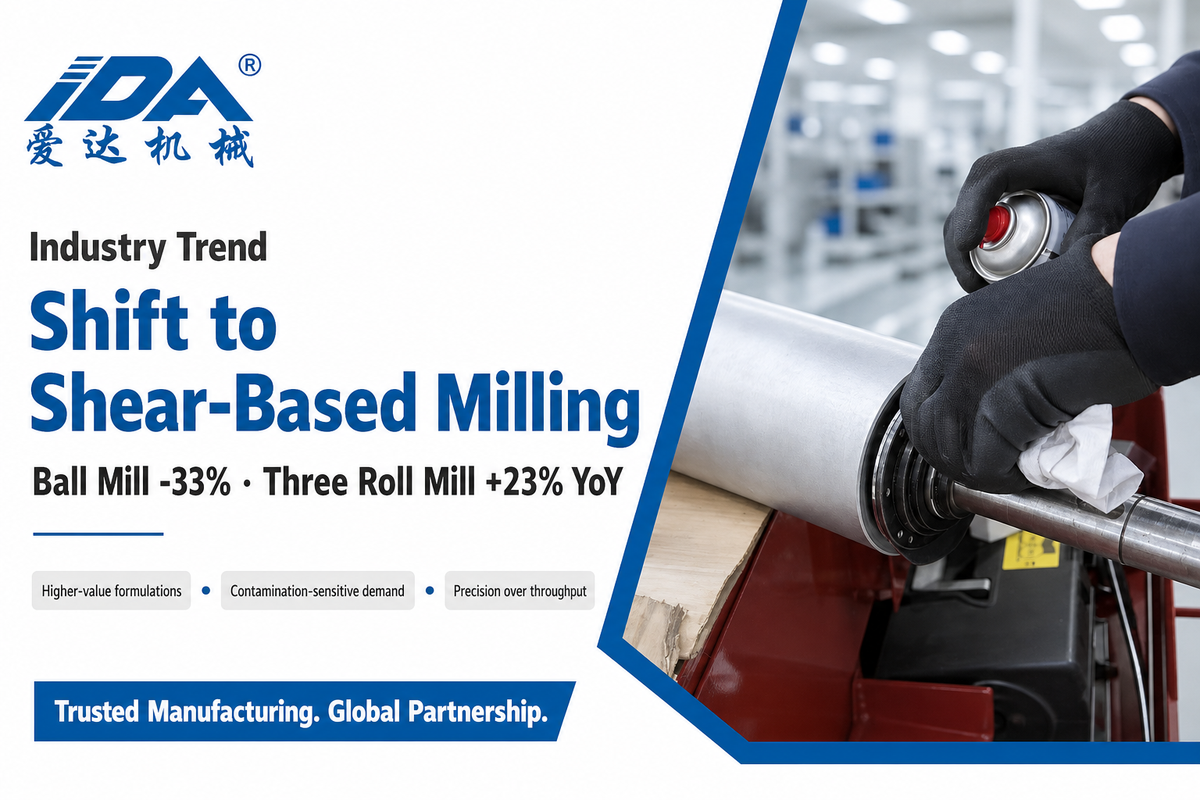
In paste and coating applications in particular, ball mills are being replaced not so much for cost reasons as for the demands of contamination sensitivity and consistency from batch-to-batch — as manufacturers increasingly adopt higher-value, more color sensitive, or contaminant-sensitive formulations (think electronic pastes, cosmetics, precise coating applications) the tolerances for media wear and variation in particle distribution tighten, driving users to shear-based mills. These signals are evident in real-world search data, with searches for “ball mill” (the broad, mostly mining-and-industrial term) down around 33% year-over-year in the past 12 months, searches for “three roll mill” up around 23% over the same timeframe, and “bead mill” searches up around 85%.
Industry experts cite factors such as buyers’ preferences for improved consistency in color and texture versus just pure throughput as driving the transition from what can be characterized as a capacity-focused strategy to one that’s precision focused. For purely directional market context (this isn’t a basis for the above recommendation): industry experts put the total market size for ball mill alternative/three roll mill applications around $0.8-$1.8 billion in the US in 2024-2025 with forecasts for moderate mid-single-digit CAGR through the early 2030s for adjacent equipment.
So, if you’re in the midst of an equipment refresh that’s scheduled for 2026 and your existing ball mill is currently being strained to process a higher-viscosity or more contamination-sensitive material than it was originally specified for, that’s your practical cue to investigate a three roll mill before you experience a batch failure that forces the issue. If your material sits closer to the low-viscosity end instead, our bead mill comparison covers that same migration pattern from the other direction.
FAQ
Q: What are the disadvantages of a ball mill?
View Answer
Ball mill media wears down as it’s used and over time this gradually reduces impact and capacity until media replacement is necessary – this adds consumable costs to operations. Above around 100,000 mPas, media no longer tumbles easily in a ball mill, it has higher energy requirements compared to shear mixers, and is typically slow to clean (30-60 minutes) compared to an open roller, three roll mill (5-15 minutes).
Q: Which is more efficient: a three-roll mill or a ball mill?
View Answer
Depends on the viscosity! If your pastes are high-viscosity (roughly over 100,000 mPas), then a three roll mill is hugely more efficient; in one instance, batch cycle time dropped from 2 hours to 45 minutes and the ROI paid out in 8 months! If you’re dealing with low-viscosity slurries or dry powders, then a ball mill is generally the better bet for economy and efficiency – a three roll mill can’t directly handle dry solids and offers no speed advantage for very fluid material. There isn’t one “more efficient” machine across the board; efficiency depends on the match between the machine and the material.
Q: What materials are suitable for a three roll mill versus a ball mill?
View Answer
A three roll mill is best for high-viscosity, sticky but moderately fluid pastes, such as paints and pigment pastes, printing inks, cosmetic and pharmaceutical creams, dental composites, and electronics pastes like silver paste or battery electrode slurries. Ball mills are best for dry powders, mined ore, cement clinker, and low-viscosity slurries where the grinding media need space to move. If a material is too thin for a three roll mill, it’ll flow out of the roller gap and bypass the grinding process. If a material is too thick for a ball mill, it will gum up the grinding media and prevent the grinding action.
Q: Can I convert an existing ball mill line to a three roll mill without a full rebuild?
View Answer
At the equipment level, yes. A three roll mill replaces the ball mill as a stand-alone machine in your process line – you don’t retro fit it to the ball mill itself. Everything else in your line – mixers, fill-and-package equipment, etc. – remains the same. It’s always best to request a free sample test with your specific material at our lab to determine the appropriate gap settings, roller material and number of passes.
Q: Is a three roll mill more expensive to buy than a ball mill?
View Answer
There’s no single answer for up-front price since it varies by size, material of the rollers, and level of automation – get a factory direct quote based on your batch size. A more important consideration is the total cost of ownership; in the 8-month ROI case cited above, a three roll mill won even at a higher purchase price.
Q: Do I need different roller materials if I switch from ball mill to three roll mill?
View Answer
Yes, in terms of material compatibility. Select the roller material based on contamination concerns, not whatever material your ball mill grinding media used – for example, alloy steel for paints and inks; zirconia for cosmetics, pharma, and electronics.
Send Your Material for a Free Test →
Why We Write This
We’ve provided this deeper comparison because our Three Roll Mill vs Ball Mill vs Bead Mill table only had room for a summary, and buyers weighing a viscosity-driven switch need the full engineering rationale, ROI evidence, and honest limitations of both technologies. The viscosity and contamination data here reflects tests our applications engineers ran on customer materials at our Jiangyin laboratory.
Reviewed by: Technical Team of Jiangyin IDA Equipment Co., Ltd.
References & Sources
- ASTM D1210, Standard Test Method for Fineness of Dispersion of Pigment-Vehicle Systems by Hegman-Type Gage — ASTM International
- Stress Mechanisms Acting During the Dispersing in Highly Viscous Systems — ScienceDirect / Chemical Engineering and Processing
- The Influence of the Grinding Media Diameter on Grinding Efficiency in a Vibratory Ball Mill — PMC / Materials (MDPI), 2024
- New-Generation Three Roll Mills Meet Today’s Challenges — PCI Magazine
- Pigment Dispersion I, The Basics — American Coatings Association
- Comparison of Methods to Assess Pigment Dispersion — American Coatings Association Journal
- WO2025044445A1, Conductive Silver Paste for Solar Cell and Preparation Method — Google Patents / WIPO
- 29 CFR 1910.212, General Requirements for All Machines — U.S. Occupational Safety and Health Administration
- Conching Chocolate: A Prototypical Transition From Frictionally Jammed Solid to Flowable Suspension With Maximal Solid Content — Proceedings of the National Academy of Sciences (PNAS)
- Cavitated Ag Paste for Cost-Effective Solar Cell — AIP Advances, 2024
Related Articles
- Three Roll Mill Guide — full working principle, specs, and selection framework
- Silver Paste Grinding — electronic paste dispersion, including a ball-mill-to-three-roll-mill conversion case
- High-Speed Disperser — pre-mixing and wetting stage ahead of fine dispersion