Get in Touch with IDA


Quick Specs, ES50 Lab-Scale Model
| Roller Diameter | 50 mm |
| Roller Material | Ceramic (standard) |
| Fineness | 1-20 µm |
| Max Viscosity | up to 2,000,000 mPa·s |
| Gap Precision | ≤1 µm |
| Speed Control | VFD |
| Cooling | None (standard); water-cooling optional on most vendors’ lab models. |
A lab three roll mill is a benchtop machine that uses three rollers turning at progressively faster, opposite-direction speeds to shear-disperse thick pastes and formulations for research and small-batch testing.
If you run an R&D bench, a university materials lab, or a formulation-development group, the question is rarely “does this technology work” – it’s whether a 50 mm lab unit is worth the line item, and whether what you learn on it will still be true once you scale up.
A lab three roll mill is a benchtop version of an industrial paste-dispersion machine, using three ceramic or steel rollers spinning at different speeds to break up agglomerates through shear force.
Lab models like a 50 mm ES50 use the same rotor geometry as their production-scale counterparts – only roller diameter, throughput, and cooling capacity change as you move up in scale.
In This Guide
- Lab, pilot, and production three roll mills share the same rotor geometry – only diameter and throughput change.
- Roller diameter, not automation tier, looks like the dominant cost driver – a 50 mm lab unit is a small fraction of a 400 mm+ production machine.
- Roller speed ratios (1:2:4, 1:2.5:6.25, 1:5:10) vary by manufacturer and model – there’s no single fixed industry ratio.
- Ceramic rollers remove metal-contamination risk for cosmetics, pharma, and electronic-paste work, at a cost premium over alloy steel.
- The rollers’ in-running nip points are a genuine pinch hazard under OSHA 29 CFR 1910.212, even on a benchtop unit.
What a Lab Three Roll Mill Is (and Isn’t)
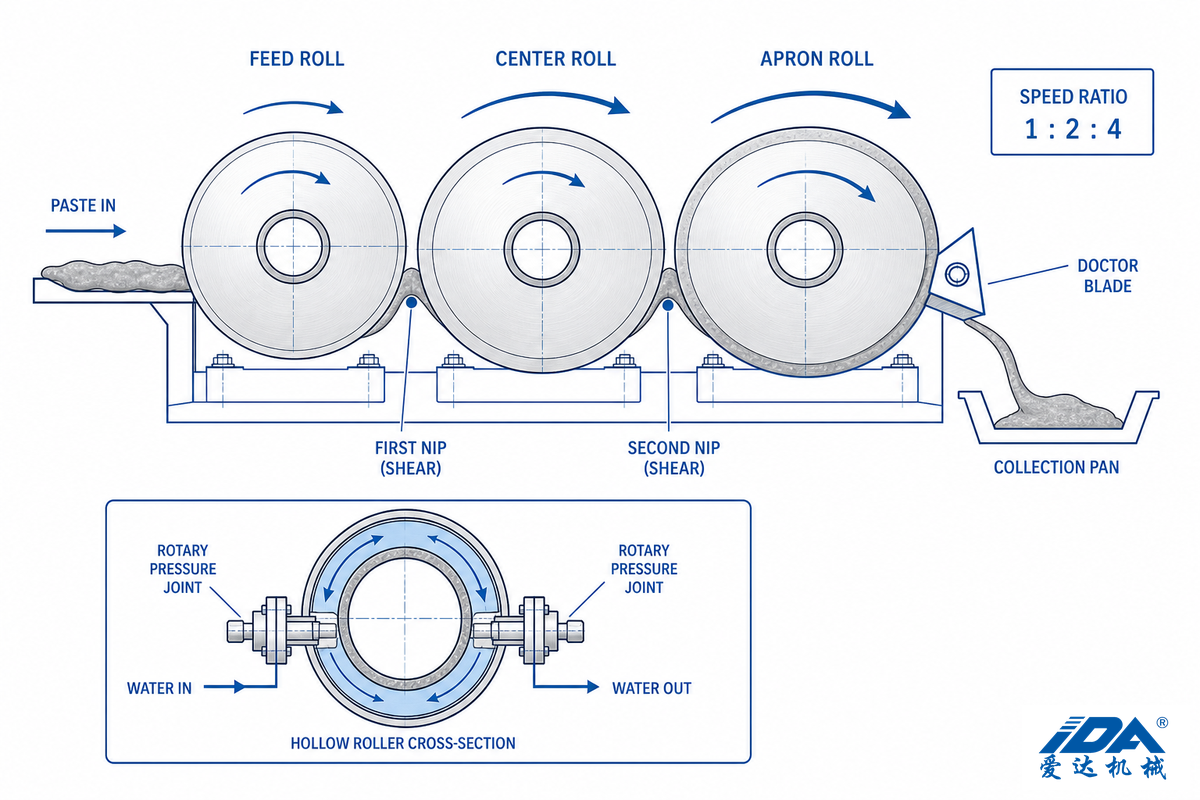
A lab three roll mill is a benchtop dispersion machine that de-agglomerates paste-like material by passing it through two nips formed by three horizontally mounted rollers – the feed roll, the center roll, and the apron roll – each spinning faster than the one before it, with the finished paste scraped off the apron roll into a collection pan.
Material enters between the feed and center rollers, then gets sheared again between the center and apron rollers before that final scraping step. Published dispersion-mechanics research confirms that this laminar shear-flow dispersing is a distinct mechanism from the impact-and-friction grinding used in ball mills or the acoustic/cavitation mechanisms in ultrasonic homogenizers – the three-roll approach specifically favors high-viscosity pastes rather than free-flowing liquids or dry powders, a distinction also grounded in laboratory-scale mill research on predicting particle-size outcomes from mill data.
Inside the housing, three horizontally positioned rolls rotating in opposite directions and at cascading, unequal speeds generate the shear: this speed friction produces the grinding effect that breaks down agglomerates as paste passes through each nip in turn. Hydraulic roll pressure between the middle and back rollers sets the working gap – tighten it and the output gets finer, loosen it and throughput rises at the cost of fineness. Each roller is hollow, and on cooling-capable lab units a water-cooled cooling system routes cooling water through rotary pressure joints at the roller ends, pulling frictional heat out of the paste before it can degrade a heat-sensitive formulation. Material transfers across the horizontal three roller surface from one nip to the next until it reaches the final roller.
Material is scraped from that final roller by a fixed doctor blade after each pass, and the cycle can be repeated – or performed many times – until the batch is fine enough to move to the next process step. Getting real size reduction on a hard-to-disperse paste takes friction to achieve full de-agglomeration across multiple passes; running the same batch through three to five passes tends to obtain small, consistent particle sizes rather than expecting one pass to finish the job. What comes out the other side is fine particle dispersions, not a paste that only looks mixed.
The underlying mechanism stays the same whether a vendor calls it a three roll mill lab model, a 3 roll mill, a laboratory three roll mill, or – less precisely – a three roll mills machine; the triple roller architecture doesn’t change with the label. Some buyers still search by brand name for a Ross three roll mill (Ross Mixers is one of the category’s original manufacturers and still sells under that name), but the working parts – three positioned rollers, a hollow cooling system, and a doctor blade – are functionally the same across brands, which is why comparing on roller diameter, material, and gap precision matters more than the badge on the housing. On the output side, this design is used to mix, homogenize, and produce finely dispersed batches of adhesive, ink, pigment paste, and many other viscous materials and viscous substances that would otherwise trap air or stay lumpy under lower-shear equipment – the processed material comes out visually smooth and functionally uniform, batch after batch. Vendors package that same mechanism into bench-top, bench and floor models, and explosion-proof motor variants for solvent-heavy runs, with a few still selling a dedicated bar pressing tool for loading stiff paste onto the feed roller by hand. Some vendors also offer a five-roll mill design for coarser, higher-throughput feed, but it adds cost and mechanical complexity most lab benches don’t need. That range is also why three roll mills, lab-scale and production alike, are utilized in the production of printing inks, coatings, and cosmetic creams at real volume production, not just in a one-off lab trial.
The “three rolls” design sits at a sweet spot in a broader family of roller mills. Single-roll (1-roll) designs press material against a fixed bar and work for less demanding jobs at lower cost.
A five-roll (5-roll) design adds two more running parts, which lets it handle coarser feed material at higher throughput – but it’s mechanically more complex, harder to operate, and more expensive to buy and maintain. Three rollers is where most lab and production dispersion work actually lands: enough shear stages to hit single-digit-micron fineness, without the operating complexity of a five-roll line.
One distinction worth getting right before you shop: a lab two roll mill isn’t a smaller three roll mill. Two-roll mills use a single nip and are built mainly for rubber and plastics compounding, where the goal is mixing and masticating a solid or semi-solid mass – not shearing a liquid-like paste to a target micron fineness. If your material is a paste, gel, or slurry rather than a rubber compound, a three roll mill is almost always the correct category, not a two-roll unit.
Lab Three Roll Mill vs. Lab Ball Mill, Bead Mill, and Sand Mill
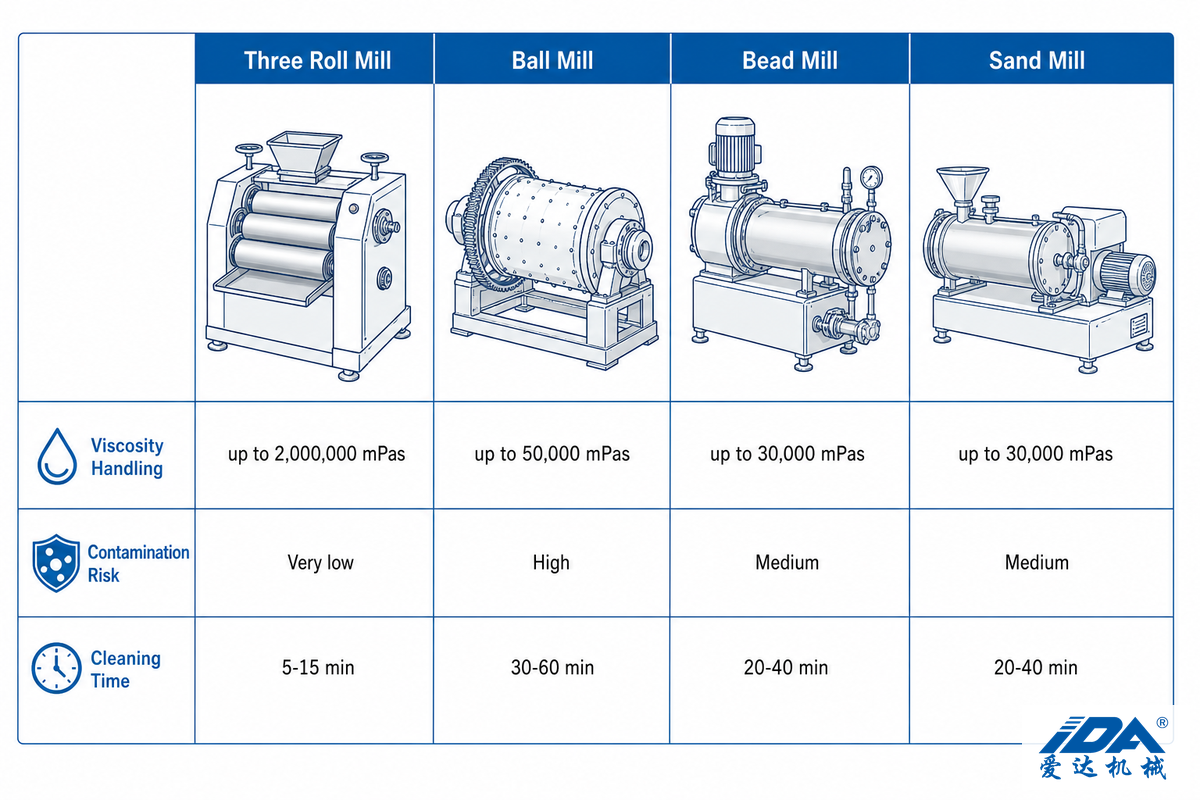
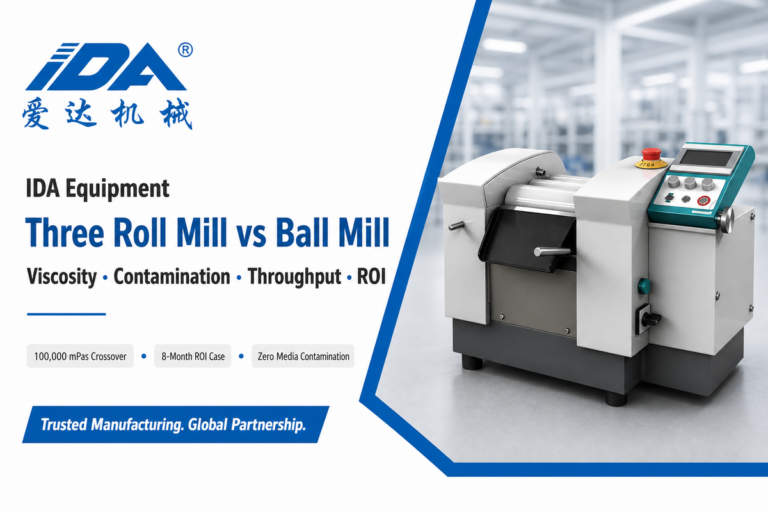
Most equipment makers that sell a lab three roll mill also sell a lab ball mill, a lab bead mill, and a lab sand mill – and the right choice depends on your material’s viscosity and your target fineness, not on which machine is cheaper or which one a sales rep pushes. Because none of the three roll mill vendors we reviewed publish an explicit viscosity crossover number between these families, the comparison below is built from the published spec ranges across these equipment types, cross-checked against independent lab-scale milling research on particle-size prediction, rather than a single vendor’s claim.
| Equipment | Typical Viscosity Range | Contamination Risk | Cleaning Between Batches |
|---|---|---|---|
| Three roll mill | High-viscosity pastes, up to 2,000,000 mPa·s | Very low (no media; ceramic option eliminates metal pickup) | Fast — wipe rollers, no media to separate |
| Bead / sand mill | Low-to-mid viscosity, continuous flow | Medium (bead wear over time) | Slower — beads must be flushed and recovered |
| Ball mill | Dry powders or low-viscosity slurries | Higher (grinding-media wear) | Slowest — media unload/reload cycle |
When Each Family Actually Wins
- If your paste is already thick enough to resist pouring and needs sub-10-micron fineness with zero media contamination → choose a three roll mill.
- If your material is a pumpable, lower-viscosity slurry that needs continuous processing at volume → choose a bead or sand mill.
- If you’re grinding a dry powder or a coarse feed down to a moderate particle size → choose a ball mill.
This is a product-fit question worth asking before you compare specific vendors, because the same manufacturer’s lab three roll mill, lab bead mill, and lab basket mill are usually built for different jobs, not different price points on the same job. IDA’s own horizontal sand mill series and basket mill line exist specifically because a three roll mill is the wrong tool for lower-viscosity, higher-volume dispersion work.
Which Applications Actually Need Lab-Scale Three-Roll Grinding

Lab-scale three roll mills earn their place on an R&D bench in a specific set of applications: electronic thick film inks and conductive pastes, high-performance ceramics, dental cosmetics, cosmetic and pharmaceutical creams and ointments, epoxy and sealant formulations, and coating or pigment dispersions where a formulator needs to validate a recipe before committing to a production run.
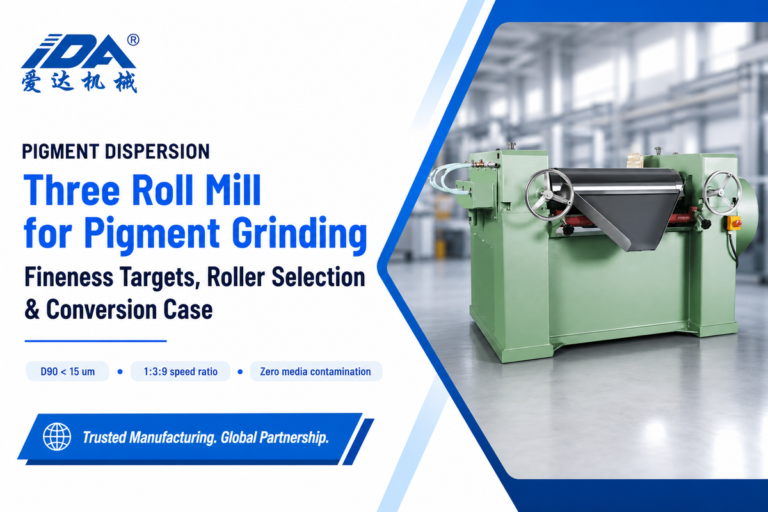
What these viscous materials share is a need for high shear force to obtain a small, uniform particle size in a small-batch trial rather than a full production run – a real engineered-graphene patent filing describes exactly this kind of lab-scale three-roll homogenization for advanced nanomaterial R&D. (If pigment or paint dispersion is your primary use case, IDA’s dedicated pigment three roll mill guide and general three roll mill selection guide go deeper on those specifics than this article does.)
Avoid assuming one setting of gap and speed applies equally to all these applications. According to vendor guide lines for lab dispersing equipment, common operating failures are inconsistent dispersion quality, excess heat generation and abnormal vibration-and their advice for grinding and dispersion operations routinely states roller gap and speed are material specific, not a generic setting. An electronic paste that requires tight particle size control won’t necessarily share its gap setting with a cosmetic cream that tolerates a wider particle size distribution, even on the same machine. Re-qualifying the gap and speed each time with the specific material-instead of assuming last week’s numbers will work this week-is the takeaway for your practice.
ES50 Specs Decoded, Roller Material and Gap Precision
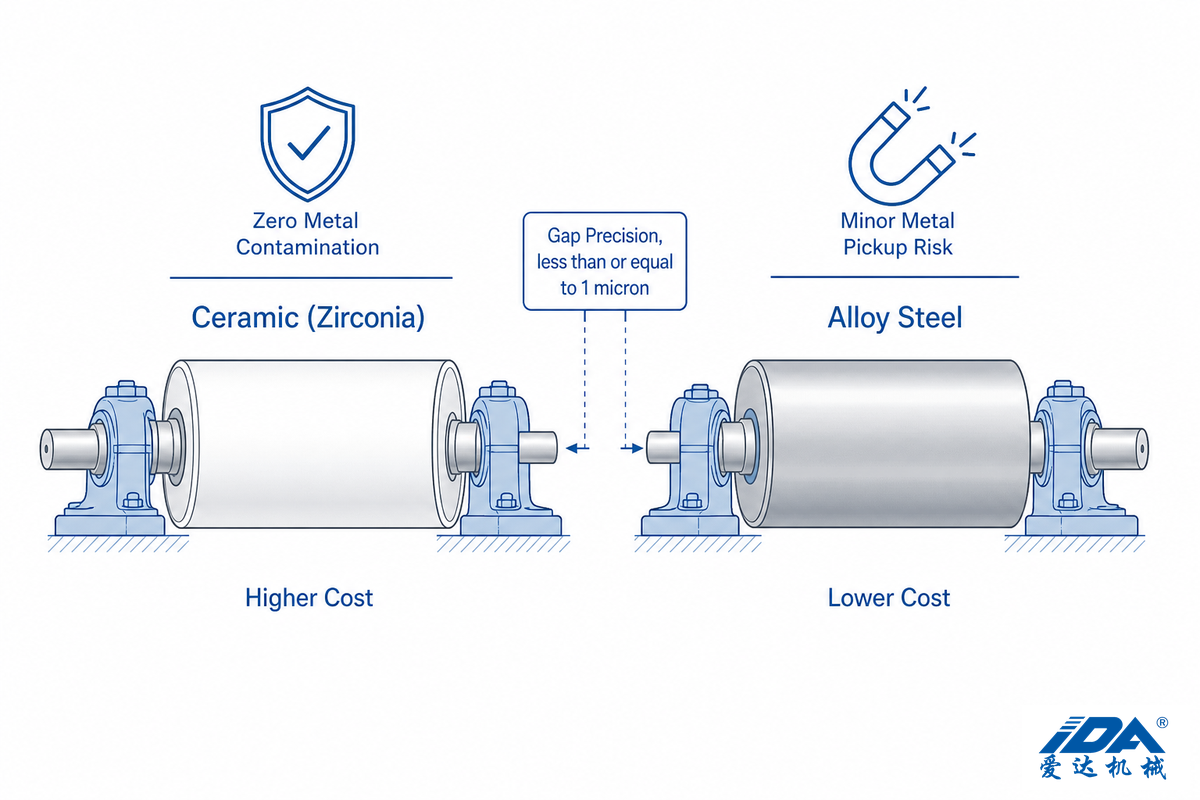
At its most basic level, reading a lab three roll mill specification sheet comes down to understanding these four numbers: Roller Diameter, Roller Material, Fineness, and Gap Precision. With 50mm roller diameter, the ES50 sits in the lab machine tier; comparable lab three roll mills from other vendors provide 65-80mm diameters at similar price points-which means that 50-80mm range is likely where a market’s “lab tier” range exists, before jumping up to 120mm+ for pilot and production machines.
Roller material dictates contamination risk. The 50mm lab three roll mill ES50’s ceramic (commonly zirconia) rollers ensure that no metal particles from roller wear enter your product – critical for pharmaceuticals, cosmetics, or electronic pastes where a Mill Test Certificate or ICP-MS contamination analysis needs to come back clean. Alloy-steel rollers cost less and carry a minimal but present risk of metal pickup over the roller life; that’s why most lab model vendors, including IDA, default to ceramic rollers and offer steel at a reduced price rather than the reverse.
The lab 50mm mill’s ≤1 µm gap precision is what ensures repeatable 1-20 µm fineness targets. A useful visual comparison for scale: typically on a lab unit, all three rollers rotate at a set ratio (i.e. 1:2:4 on one manufacturer, or up to 1:5:10 on another). On a 1:2:4 machine running at 20 RPM for the feed roll, the other rollers are rotating at 40 RPM and 80 RPM respectively. This widening speed gap between rollers creates the shear action needed, and reducing roller gap while increasing roller speed ratio can both improve fineness, but decrease throughput. Since the three machines reviewed had three different fixed speed ratios, your unit’s spec sheet value for this parameter is your working figure-not some assumed general industry standard.
📐 Engineering Note
Because your three roll mill’s two nips are in-running rotating machine parts, these points are precisely what OSHA’s standard 29 CFR 1910.212 addresses when it requires machinery guarding to protect against “ingoing nip points” and “forming rolls or calenders.” A safety guard or interlock is essential at the feed nip, and an accessible e-stop should be present; even on a small 50mm benchtop model, the lack of a clearly designated, integrated safety guard/interlock at the feed nip, or a prominently located, functional e-stop should be a critical “red flag” on your list, not a post-purchase consideration.
| Parameter | ES50 Lab Model | ES80 Pilot Model | ES120 Production Model |
|---|---|---|---|
| Tier | Lab / R&D | Pilot | Small production |
| Roller Diameter | 50 mm | 80 mm | 120 mm |
| Roller Material | Ceramic (standard) | Ceramic available | Ceramic/steel options |
| Fineness | 1-20 µm | 1-20 µm | 1-20 µm |
| Max Viscosity | 2,000,000 mPa·s | 2,000,000 mPa·s | 2,000,000 mPa·s |
| Gap Precision | ≤1 µm | ≤1 µm | ≤1 µm |
| Speed Control | VFD | VFD | VFD |
| Cooling | None (standard) | Water cooling | Water cooling |
| Ideal For | R&D, formulation development | Small-batch pilot production | Cosmetics, ink, pigment paste batches |
One standard you’ll encounter regarding fineness testing is ASTM D1210, for measuring “fineness of grind” with a Hegman gauge. Worth being precise on what it actually proves: it certifies the fineness of your milled output; it doesn’t attest to your mill’s roller material, gap tolerances, or quality of manufacture. ISO 8781-2 and ISO/TS 22107, a pair of ISO standards, document other, similar, dispersion-characteristics tests, useful if your lab follows a non-US standard regime.
Budget Reality, Why Lab-Scale Costs a Fraction of a Production Mill
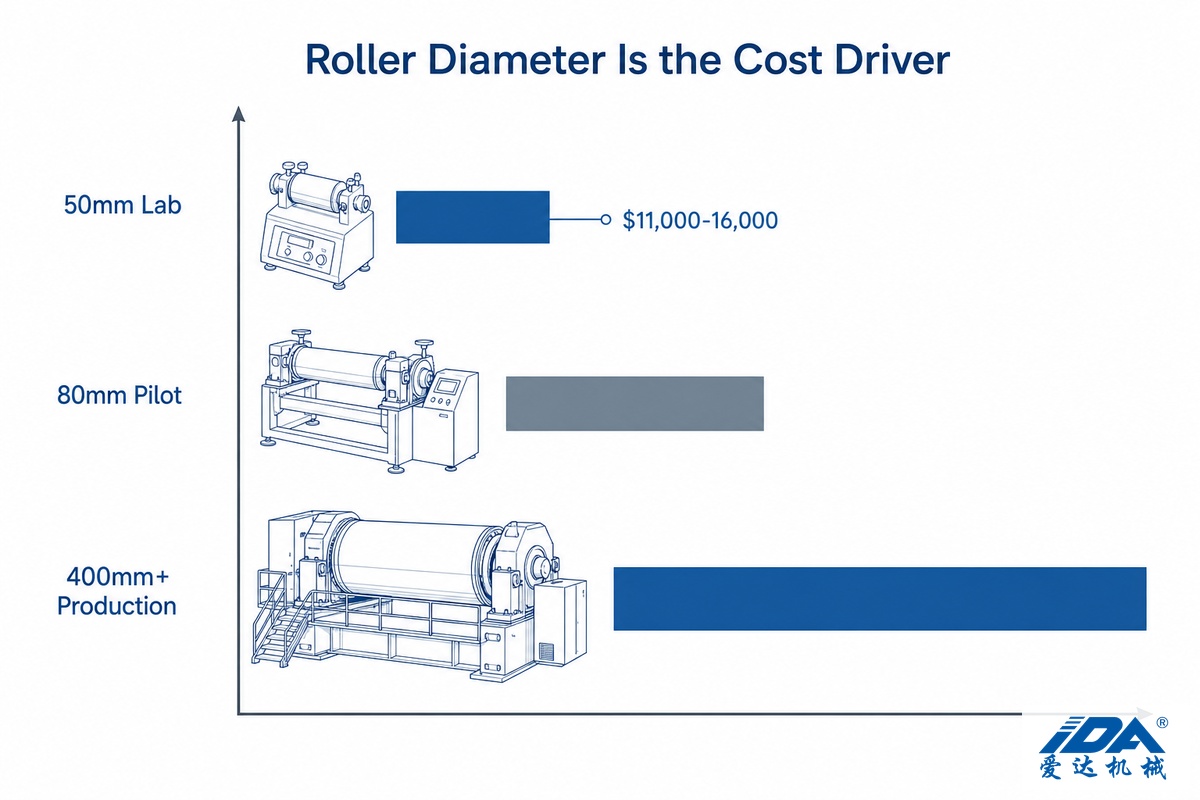
The 50mm Rule
Based on the two lab-scale listings priced for this article, roll diameter-not brand or level of automation-looks like the dominant cost factor, a pattern that also holds directionally as machines scale toward production size.
Two three-roll lab-mills priced for this article – one 65-mm stainless-steel unit, another 80-mm ceramic-roller unit – both list at $11,000-16,000 USD, putting three-roll lab mills firmly in the five-figures USD band irrespective of the roller composition. For a 400-mm+ production mill, multiply that price by a factor of 10 or so-not because the fundamental machine operation changes, but because large rollers mandate larger frames, bigger motors, and tighter tolerances throughout the machine.
Many university and corporate R&D operations can fund this five-figure purchase without a special capital request, drawing instead on a standard capital-equipment grant. For illustration, published equipment-procurement thresholds at U.S. research universities below which an agency isn’t required to issue a competitive request range from $5,000 (USAF) to $10,000 (ONR) at many institutions. The question, then, is less “can we buy a three roll mill,” but “under which departmental budget line or equipment grant category should we submit this request?”
Budget Framing Checklist
- Check your own institution or department’s threshold before proceeding with a full capital equipment request.
- When comparing multiple three roll mills, clearly separate roller and frame cost from optional components like water-cooling, PLCs, or automated recipe storage.
- If this purchase represents only the first step, inquire about the total cost to scale up from 50 mm to 80 mm to 120 mm (ES50-80-120 line, or comparable, as applicable) at a minimum.
Lab-to-Pilot-to-Production: Will Results Actually Scale Up?
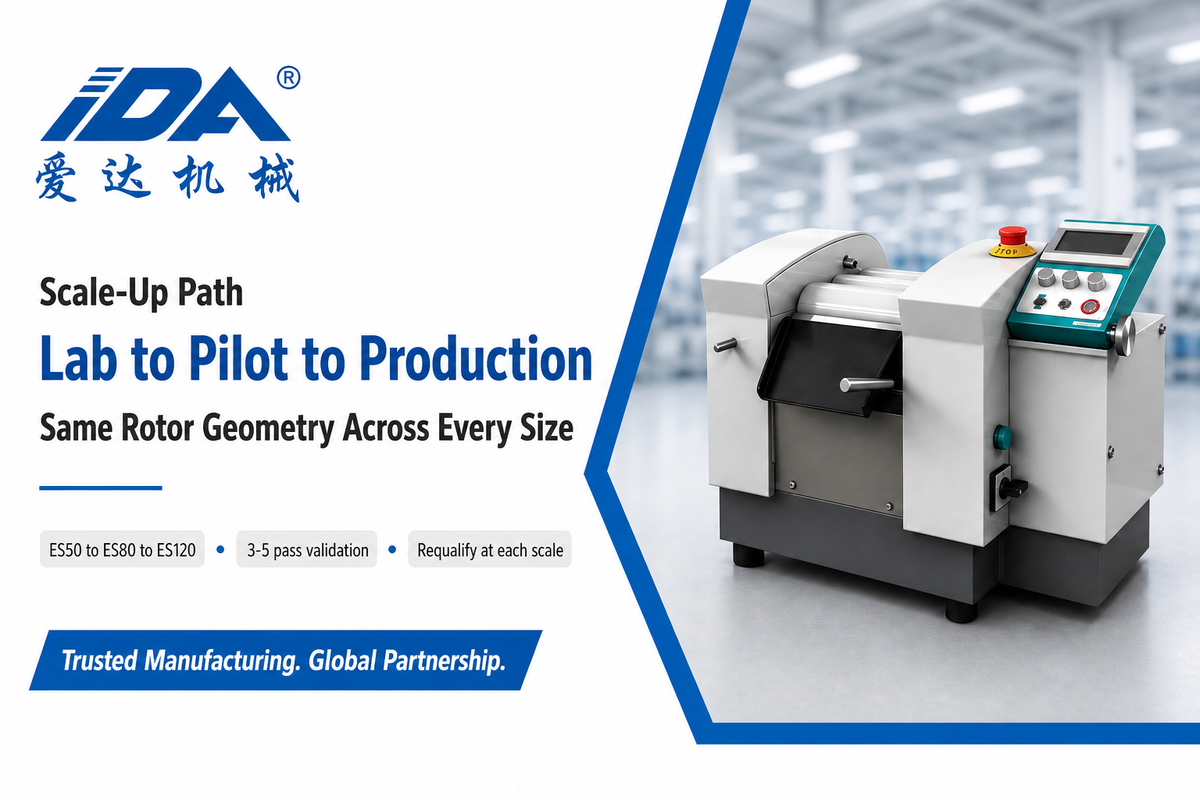
Yes, in most cases – if the lab and production machines share the same roller geometry and speed-ratio design, results from a 50 mm lab three roll mill transfer to larger machines with only minor requalification. What changes at scale is throughput, heat management, and batch-to-batch consistency, not the fundamental dispersion chemistry.
The Lab-to-Pilot-to-Production Transfer Test
If a 50 mm lab test doesn’t automatically translate to a larger production machine (120 or 400 mm, or higher), figure out which factors actually carry over and which don’t.
IDA’s ES50-to-ES80-to-ES120, or equivalent, product line preserves same rotor geometries and roller ratios across the range; that’s precisely why roller setting, speed ratios, and materials tested at 50 mm are a valid reference point when scaled up. Indeed, a US patent for silicone rubber compounding explicitly mentions a three-roll mill’s “sample size flexibility” and “ease of scale-up.”
What doesn’t automatically carry over, however, is throughput, thermal behavior, and batch-to-batch uniformity at volume. Literature on scaling-up from the pharma and process engineering realms is fairly united on the idea that translating a result from lab-scale to pilot-scale to full production is an engineering effort, not a linear extrapolation-since larger rollers disperse heat differently, batch homogeneity becomes more difficult to maintain at volume, and the accumulation of mechanical tolerances becomes a more significant factor at a larger scale. In practice this usually translates to accounting for a brief requalification at each larger scale-a gap check, temperature validation, and sample-consistency check-rather than assuming your 50 mm recipe ports will somehow continue unchanged at larger sizes.
“Most operators run three to five passes on a lab three roll mill – the first pass breaks large agglomerates, and each subsequent pass refines the distribution further. Checking with a grind gauge after each pass is how you know when to tighten the gap again.”
Test Before You Buy, Reducing Wrong-Equipment Risk
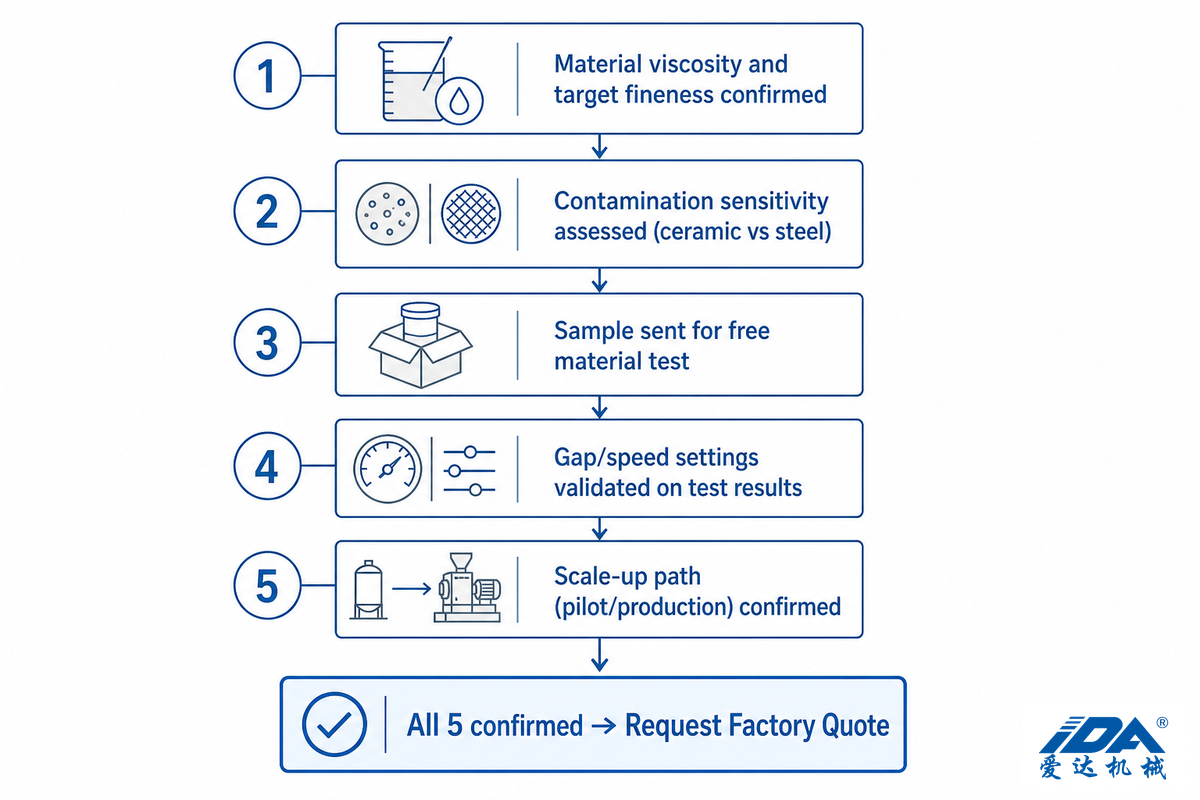
The 5-Point Fit Check Before You Buy a Lab Three Roll Mill
Five checks confirm a lab three roll mill actually fits your material before you commit budget to it, following the same lab-scale validation logic used in published particle-size-prediction research: verify fit at bench scale before assuming it elsewhere.
- Confirm your material’s viscosity falls inside the mill’s rated range.
- Confirm target fineness is achievable in a reasonable pass count.
- Confirm roller material matches your contamination tolerance.
- Confirm gap precision matches your tightest spec requirement.
- Confirm cooling is available if your material is heat-sensitive.
Running this checklist against a spec sheet gets you most of the way – but the only way to fully close the gap is to test your actual material.
Per IDA’s published service description, its Jiangyin lab operates a documented six-step material testing process: book an appointment with the applications team, ship raw material and target specifications, the team runs grinding trials across multiple configurations, particle size is measured and documented, a detailed report with recommended specs is produced, and processed samples are shipped back for evaluation – typically within a 5-7 business day turnaround.
This kind of pre-purchase sample testing isn’t something every equipment category offers, and for a lab-scale purchase in the five-figure-USD range, it converts an educated guess into a verified fit before money changes hands.
Industry Outlook, Why Lab-Scale Demand Is Rising
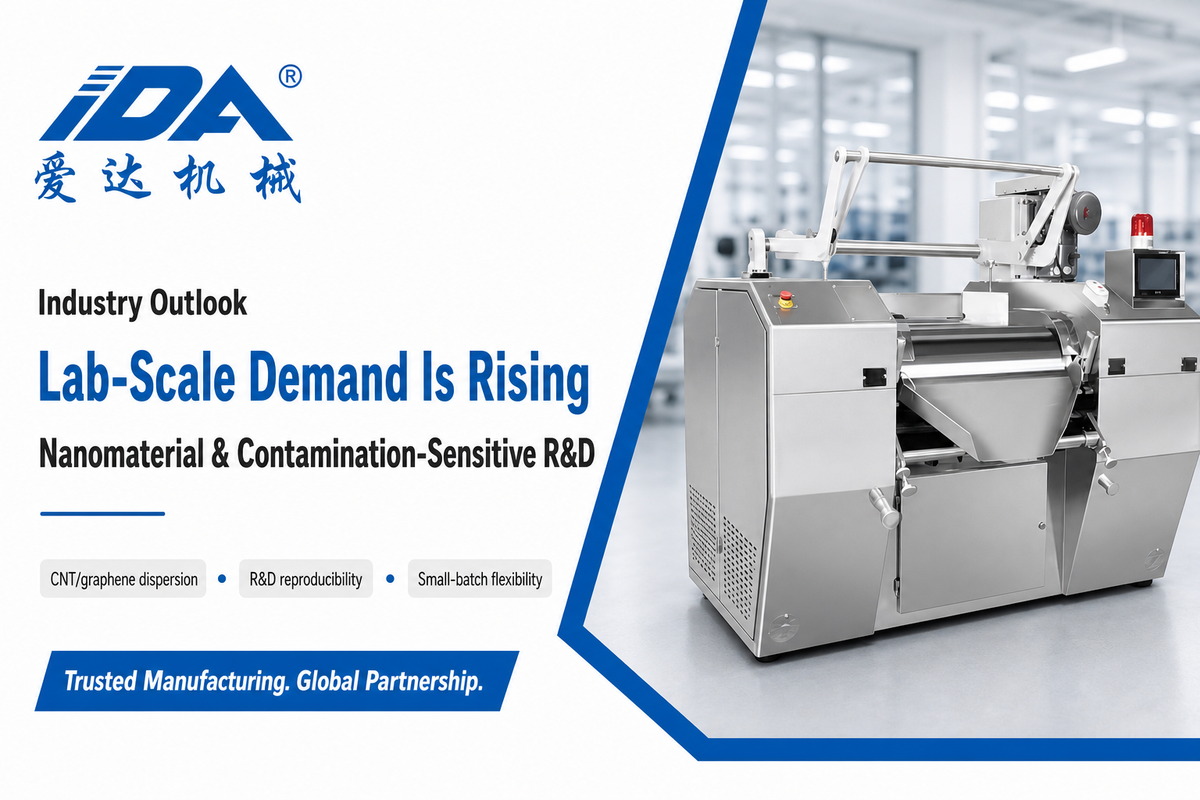
What actually drives lab-tier three-roll demand isn’t a market-size number – it’s that formulation work in electronic paste, battery-slurry R&D, and cosmetics/pharma development (the kind of work reflected in recent materials-R&D patent filings using three-roll dispersion) keeps generating a need to validate a recipe at small scale before committing production capacity to it. That’s a demand-side story about R&D activity, not a supply-side story about the mills themselves, and it shows up indirectly: equipment manufacturers building out dedicated lab-to-production model lines (IDA’s ES50/ES80/ES120 among them, and comparable modular lab-scale platforms from other equipment makers) are themselves evidence that vendors see enough R&D-stage demand to justify a dedicated lab tier rather than just scaling down a production machine on request.
On the compliance side, electrical safety requirements are a concrete, dated reason to check paperwork before you buy: IEC 60204-1, the standard IDA and other manufacturers cite for electrical safety on this class of machine, has an active revision history – the 2016 edition received Amendment 1 in 2021, consolidated into BS EN 60204-1:2018+A1:2025. When your institution’s procurement process requires current-edition compliance documentation, ask which edition and amendment level a quote is certified against, not just whether it’s “IEC compliant.”
Broader lab-equipment and dispersion-machine market forecasts exist (some citing CAGRs in the mid-single digits through the early 2030s), but they describe the category in general rather than lab three-roll mills specifically – treat those figures as directional market context, not a precise growth rate for this exact equipment type.
Frequently Asked Questions
Q: Can you operate a lab three roll mill manually, or is automation required?
View Answer
Both options exist at the lab tier. Entry-level machines feature manual hand-wheel adjustment to set the roller gap, which works fine for occasional or exploratory runs. Mid-range to higher-end models add variable-speed drives (VFD) and, on some units, PLC control with stored programs for gap settings – useful if you run the same formulation repeatedly and want reproducible results without re-dialing the gap by hand each time.
Q: How do you safely clean the rollers between formulation batches?
View Answer
For regular operation and switching between materials, most users run a clean cycle (reversing the roller direction if the machine supports it) while running a solvent – often alcohol or another organic solvent – across the rollers with the guards in place, then let the machine air-dry thoroughly before the next batch. If your machine uses steel roller surfaces, take precautions against raw product residue contacting any exposed metal. Always follow proper lockout-tagout procedure and let rollers come to a full stop before opening any guard.
Q: Can a lab three roll mill process temperature-sensitive materials?
View Answer
Yes, but check the product specs carefully – a good number of lab three roll mills ship with hollow rollers that aren’t equipped with a cooling hookup as standard equipment unless requested, and they won’t have an internal cooling path unless a coolant supply line is provided and connected. When you’re working with pharmaceuticals or heat-labile binders, remember that shear action creates significant heat; factor in integrated water cooling before you order, rather than discovering you need it after the first hot, degraded sample.
Q: What’s the difference between a lab three roll mill and a lab two roll mill?
View Answer
They aren’t the same job at a different scale – they process fundamentally different materials. A two-roll mill is a single-nip compounding device mainly used to create blends of rubbers or plastics. A three-roll mill uses two nips across three rollers to shear material and break down particle size, dispersing pigments or actives in pastes and slurries down to a target fineness.
Q: Can results from a 50mm lab mill really predict production-scale performance?
View Answer
Partially, and it depends which variables you mean. Geometry-dependent parameters – roller gap setting, speed ratio, and roller-material choice – transfer well to a larger machine sharing the same rotor design. Batch-to-batch consistency, thermal behavior, and overall production throughput won’t scale linearly without additional adjustment and validation. Published pharmaceutical and process scale-up literature treats lab-to-pilot-to-production as a genuine engineering step requiring its own verification phase for gap, temperature, and product consistency – your lab-scale data is a strong starting point, not a guarantee of production performance.
Q: What materials shouldn’t go through a three roll mill?
View Answer
Free-flowing, low-viscosity liquids – a bead mill or disperser fits those better. Very abrasive or gritty feed can also scratch or wear the rollers, especially alloy steel ones.
Our Perspective
This guide was prepared with reference to IDA’s ES50/ES80/ES120 lab-to-production specifications and Laboratory Testing Center Service description, and was further reviewed and validated against the published specs of other lab three roll mill manufacturers, published literature in the field of dispersion mechanics, U.S. Patent & Trademark Office filings and O.S.H.A. and I.E.C. machine safety specifications. Review of technical details by Jiangyin IDA Equipment Co., Ltd. technical team.
Is it hard to find a lab three roll mill to process your material?
Whether you’re comparing a lab three roll mill price across vendors, browsing a lab three roll mill for sale listing, or sourcing lab three roll mill parts for a unit you already run, the fit-check and cost logic above still apply before you commit.
Request a Factory Quote →
Book a Free Lab Test
Discover the full specs of IDA’s Three Roll Mill Series (ES50 Lab model) from lab to production.
References & Sources
- Stress mechanisms acting during the dispersing in highly viscous media — ScienceDirect (Chemical Engineering Research and Design)
- Predicting Product Particle Size Distribution Using Laboratory-Scale Mill Data — Colorado School of Mines repository
- 29 CFR 1910.212, General Requirements for All Machines — U.S. Occupational Safety and Health Administration
- ASTM D1210-05(2022): Fineness of Dispersion of Pigment-Vehicle Systems — ASTM International
- ISO 8781-2:1990, Pigments and Extenders, Dispersion Characteristics — International Organization for Standardization
- US20110112406A1, Silicone Rubber Compositions Comprising Bismuth Oxide — USPTO / Google Patents
- WO2019199659A1, Applications of Engineered Graphene — WIPO / Google Patents
- Pharmaceutical Process Scale-Up — M. Levin (Informa Healthcare)
- Equipment and Instrumentation Grants — Cornell Research Services
- Research Equipment: Procurement, Management, Transfer and Disposition — Rice University
- Changes in Edition 6.0 of IEC 60204-1 — Siemens
Related Articles
- Three Roll Mill Guide: Working Principle, Selection & Use — the general selection framework for all three roll mill scales
- Roller Material Selector — interactive tool for choosing ceramic vs. alloy-steel rollers by contamination sensitivity
- Viscosity Unit Converter — convert cPs, Pa·s, and Poise with three-roll-mill suitability markers
- High Speed Disperser — pre-mixing and wetting equipment for lower-viscosity formulations
- About IDA Equipment — company background and the Jiangyin Laboratory Testing Center