Póngase en contacto con IDA


Especificaciones rápidas, modelo a escala de laboratorio ES50
| Diámetro del rodillo | 50 mm |
| Material del rodillo | Cerámica (estándar) |
| Finura | 1-20 µm |
| Viscosidad máxima | hasta 2.000.000 mPa·s |
| Precisión de brecha | ≤1 µm |
| Control de velocidad | VFD |
| Enfriamiento | Ninguno (estándar); refrigeración por agua opcional en los modelos de laboratorio de la mayoría de los proveedores. |
Un molino de laboratorio de tres rodillos es una máquina de mesa que utiliza tres rodillos que giran a velocidades progresivamente más rápidas en direcciones opuestas para cortar y dispersar pastas y formulaciones gruesas para investigación y pruebas en lotes pequeños.
Si dirige un banco de I+D, un laboratorio de materiales universitario o un grupo de desarrollo de formulaciones, la pregunta rara vez es “esta tecnología funciona” (es si una unidad de laboratorio de 50 mm vale la pena el elemento de línea y si lo que aprende en él seguirá siendo cierto una vez que aumente su escala.
Un molino de laboratorio de tres rodillos es una versión de mesa de una máquina industrial de dispersión de pasta, que utiliza tres rodillos cerámicos o de acero que giran a diferentes velocidades para romper los aglomerados mediante la fuerza de corte.
Los modelos de laboratorio como un ES50 de 50 mm utilizan la misma geometría de rotor que sus homólogos a escala de producción (solo el diámetro, el rendimiento y la capacidad de enfriamiento de los rodillos cambian a medida que se asciende en escala).
En esta guía
- Los molinos de rodillos de laboratorio, piloto y de producción comparten la misma geometría del rotor (solo cambio de diámetro y rendimiento).
- El diámetro del rodillo, no el nivel de automatización, parece el factor de costo dominante. Una unidad de laboratorio de 50 mm es una pequeña fracción de una máquina de producción de más de 400 mm.
- Las relaciones de velocidad del rodillo (1:2:4, 1:2.5:6.25, 1:5:10) varían según el fabricante y el modelo 'y no existe una relación industrial fija única'.
- Los rodillos cerámicos eliminan el riesgo de contaminación metálica para trabajos cosméticos, farmacéuticos y de pasta electrónica, a un costo superior al del acero aleado.
- Los puntos de contacto internos de los rodillos son un verdadero peligro de pellizco según OSHA 29 CFR 1910.212, incluso en una unidad de mesa.
Qué es (y no es) un molino de tres rodillos de laboratorio
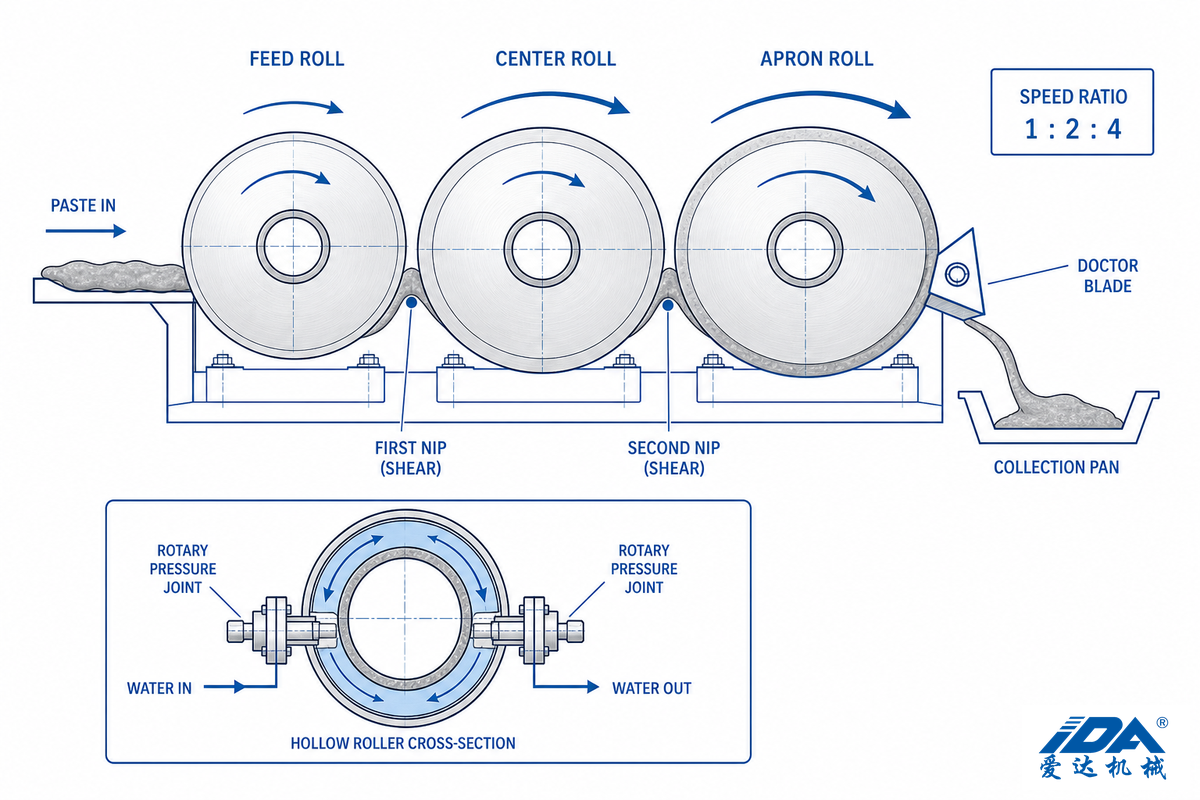
Un molino de laboratorio de tres rodillos es una máquina de dispersión de mesa que desaglomera material similar a la pasta haciéndolo pasar a través de dos puntas formadas por tres rodillos montados horizontalmente 'el rodillo de alimentación, el rodillo central y el rodillo de plataforma ', cada uno de los cuales gira más rápido que el uno anterior, con la pasta terminada raspada del rodillo del delantal en una bandeja recolectora.
El material ingresa entre los rodillos de alimentación y centrales, luego se corta nuevamente entre los rodillos centrales y de plataforma antes de ese paso final de raspado. Publicado investigación en mecánica de dispersión confirma que esta dispersión laminar del flujo de corte es un mecanismo distinto del rectificado por impacto y fricción utilizado en los molinos de bolas o de los mecanismos acústicos/de cavitación en los homogeneizadores ultrasónicos. El enfoque de tres rodillos favorece específicamente las pastas de alta viscosidad en lugar de las de flujo libre. líquidos o polvos secos, distinción que también se basa en investigación de molinos a escala de laboratorio sobre la predicción de resultados del tamaño de partículas a partir de datos de molinos.
Dentro de la carcasa, tres rodillos colocados horizontalmente que giran en direcciones opuestas y en cascada, velocidades desiguales generan el corte: esta fricción de velocidad produce el efecto de molienda que descompone los aglomerados a medida que la pasta pasa a través de cada línea de contacto por turno. La presión del rodillo hidráulico entre los rodillos central y trasero establece el espacio de trabajo -tenso y la salida se vuelve más fina, la afloja y el rendimiento aumenta a costa de la finura. Cada rodillo es hueco, y en unidades de laboratorio con capacidad de enfriamiento, un sistema de enfriamiento enfriado por agua dirige el agua de enfriamiento a través de juntas de presión giratorias en los extremos del rodillo, extrayendo el calor por fricción de la pasta antes de que pueda degradar una formulación sensible al calor. El material se transfiere a través de la superficie horizontal de tres rodillos de un estrecho al siguiente hasta llegar al rodillo final.
El material se raspa de ese rodillo final mediante una cuchilla raspadora fija después de cada pasada, y el ciclo se puede repetir -gnorar o realizar muchas veces -ñan hasta que el lote esté lo suficientemente fino como para pasar al siguiente paso del proceso. Obtener una reducción del tamaño real en una pasta difícil de dispersar requiere fricción para lograr una desaglomeración completa en múltiples pasadas; ejecutar el mismo lote durante tres a cinco pasadas tiende a obtener tamaños de partículas pequeños y consistentes en lugar de esperar que una pasada termine el trabajo. Lo que sale del otro lado son dispersiones de partículas finas, no una pasta que solo parece mixta.
El mecanismo subyacente sigue siendo el mismo ya sea que un proveedor lo llame modelo de laboratorio de molino de tres rodillos, molino de 3 rodillos, molino de tres rodillos de laboratorio o, menos precisamente, máquina de molino de tres rodillos; la arquitectura de triple rodillo no cambia con la etiqueta. Algunos compradores todavía buscan por marca un molino de tres rodillos Ross (Ross Mixers es uno de los fabricantes originales de la categoría y todavía se vende con ese nombre), pero las piezas de trabajo (tres rodillos colocados, un sistema de enfriamiento hueco y una rasqueta) son funcionalmente iguales entre marcas, razón por la cual comparar el diámetro del rodillo, el material y la precisión del espacio importa más que la insignia de la carcasa. En el lado de la salida, este diseño se utiliza para mezclar, homogeneizar y producir lotes finamente dispersos de adhesivo, tinta, pasta pigmentaria y muchos otros materiales viscosos y sustancias viscosas que de otro modo atraparían el aire o permanecerían grumosos bajo equipos de corte inferior. El material procesado sale visualmente suave y funcionalmente uniforme, lote tras lote. Los proveedores empaquetan ese mismo mecanismo en modelos de mesa, de mesa y de piso, y variantes de motor a prueba de explosiones para tiradas con alto contenido de solventes a mano. Algunos proveedores también ofrecen un diseño de molino de cinco rodillos para alimentación más gruesa y de mayor rendimiento, pero agrega costo y complejidad mecánica que la mayoría de los bancos de laboratorio no necesitan. Esa gama es también la razón por la que se utilizan tres molinos de rodillos, tanto a escala de laboratorio como de producción, en la producción de tintas de impresión, recubrimientos y cremas cosméticas en volumen real. producción, no sólo en una prueba de laboratorio única.
El diseño de “tres rodillos” se encuentra en un punto óptimo en una familia más amplia de molinos de rodillos. Diseños de un solo rodillo (1 rodillo) que presionan el material contra una barra fija y trabajan para trabajos menos exigentes a menor costo.
Un diseño de cinco rodillos (5 rodillos) agrega dos piezas de rodadura más, lo que le permite manejar material de alimentación más grueso con mayor rendimiento, pero es mecánicamente más complejo, más difícil de operar y más costoso de comprar y mantener. Tres rodillos es donde realmente aterriza la mayor parte del trabajo de dispersión de laboratorio y producción: suficientes etapas de corte para alcanzar una finura de un solo dígito micrón, sin la complejidad operativa de una línea de cinco rodillos.
Una distinción que vale la pena hacer justo antes de comprar: un molino de dos rodillos de laboratorio no es un molino de tres rodillos más pequeño. Los molinos de dos rodillos utilizan un solo estrecho y están construidos principalmente para compuestos de caucho y plástico, donde el objetivo es mezclar y masticar una masa sólida o semisólida 'sin cortar una pasta líquida hasta obtener una finura micrónica objetivo. Si su material es una pasta, gel o suspensión en lugar de un compuesto de caucho, un molino de tres rodillos es casi siempre la categoría correcta, no una unidad de dos rodillos.
Molino de tres rodillos de laboratorio versus molino de bolas de laboratorio, molino de cuentas y molino de arena
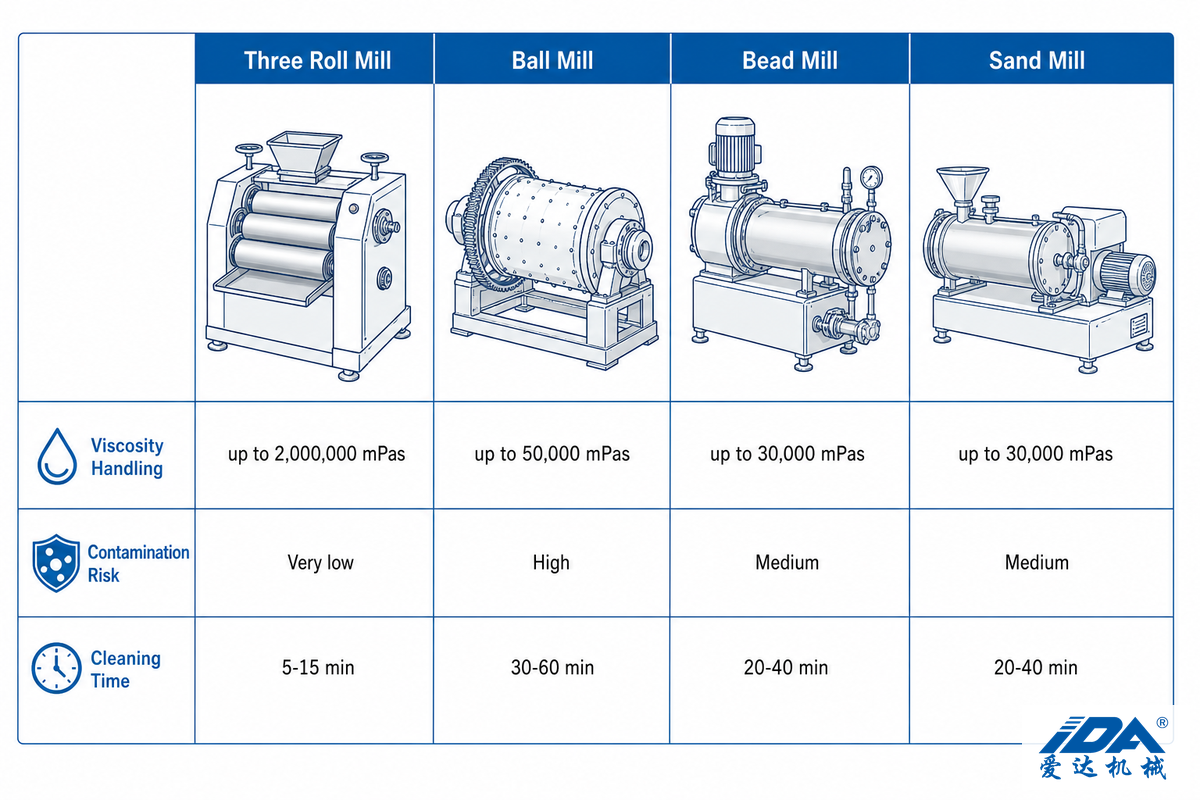
La mayoría de los fabricantes de equipos que venden un molino de tres rodillos de laboratorio también venden un molino de bolas de laboratorio, un molino de cuentas de laboratorio y un molino de arena de laboratorio - y la elección correcta depende de la viscosidad de su material y de la finura objetivo, no de qué máquina es más barata o cuál empuja un representante de ventas. Debido a que ninguno de los tres proveedores de molinos de rodillos que revisamos publica un número cruzado de viscosidad explícito entre estas familias, la siguiente comparación se basa en los rangos de especificaciones publicados en estos tipos de equipos, cotejados investigación independiente sobre fresado a escala de laboratorio sobre la predicción del tamaño de partículas, en lugar de la afirmación de un solo proveedor.
| Equipo | Rango de viscosidad típico | Riesgo de contaminación | Limpieza entre lotes |
|---|---|---|---|
| Molino de tres rodillos | High-viscosity pastes, up to 2,000,000 mPa·s | Very low (no media; ceramic option eliminates metal pickup) | Fast — wipe rollers, no media to separate |
| Bead / sand mill | Low-to-mid viscosity, continuous flow | Medium (bead wear over time) | Slower — beads must be flushed and recovered |
| Molino de bolas | Dry powders or low-viscosity slurries | Higher (grinding-media wear) | Slowest — media unload/reload cycle |
When Each Family Actually Wins
- If your paste is already thick enough to resist pouring and needs sub-10-micron fineness with zero media contamination → choose a three roll mill.
- If your material is a pumpable, lower-viscosity slurry that needs continuous processing at volume → choose a bead or sand mill.
- If you’re grinding a dry powder or a coarse feed down to a moderate particle size → choose a ball mill.
This is a product-fit question worth asking before you compare specific vendors, because the same manufacturer’s lab three roll mill, lab bead mill, and lab molino de cestas are usually built for different jobs, not different price points on the same job. IDA’s own horizontal sand mill series and basket mill line exist specifically because a three roll mill is the wrong tool for lower-viscosity, higher-volume dispersion work.
Qué aplicaciones realmente necesitan molienda de tres rodillos a escala de laboratorio
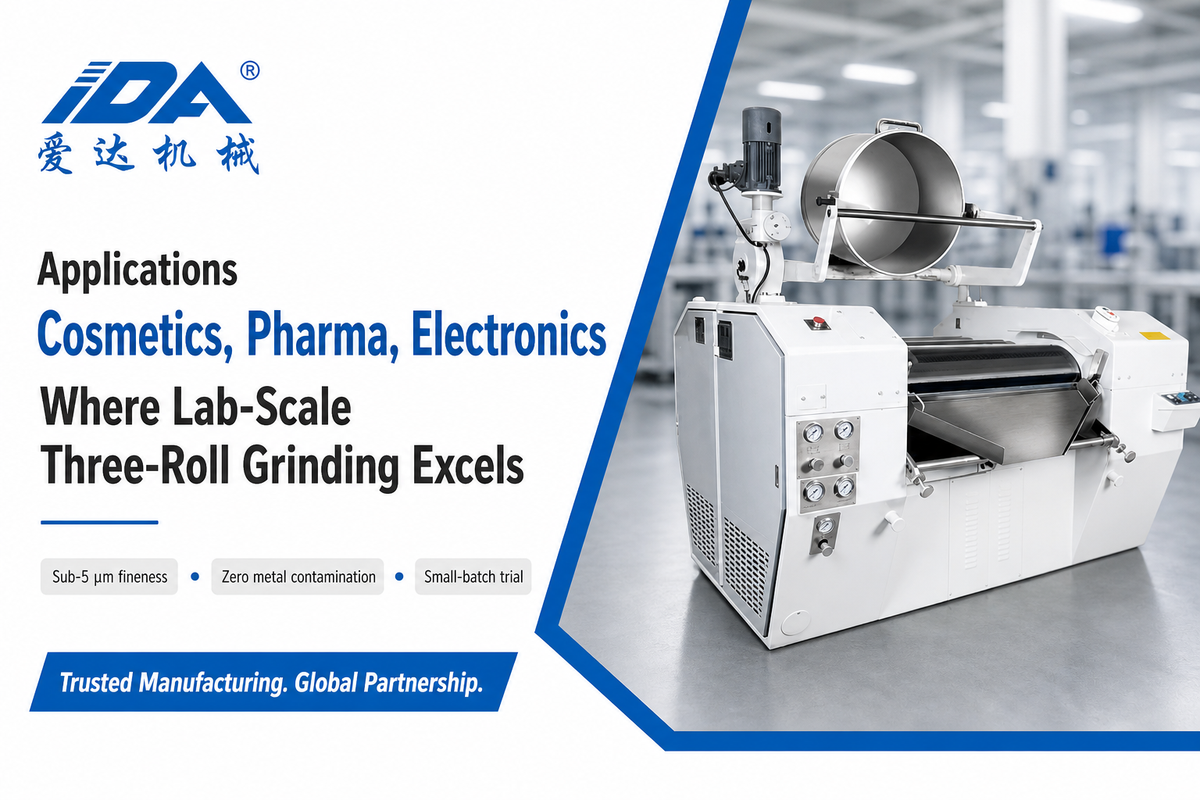
Lab-scale three roll mills earn their place on an R&D bench in a specific set of applications: electronic thick film inks and conductive pastes, high-performance ceramics, dental cosmetics, cosmetic and pharmaceutical creams and ointments, epoxy and sealant formulations, and coating or pigment dispersions where a formulator needs to validate a recipe before committing to a production run.
What these viscous materials share is a need for high shear force to obtain a small, uniform particle size in a small-batch trial rather than a full production run – a real engineered-graphene patent filing describes exactly this kind of lab-scale three-roll homogenization for advanced nanomaterial R&D. (If pigment or paint dispersion is your primary use case, IDA’s dedicated pigment three roll mill guide and general three roll mill selection guide go deeper on those specifics than this article does.)
Avoid assuming one setting of gap and speed applies equally to all these applications. According to vendor guide lines for lab dispersing equipment, common operating failures are inconsistent dispersion quality, excess heat generation and abnormal vibration-and their advice for grinding and dispersion operations routinely states roller gap and speed are material specific, not a generic setting. An electronic paste that requires tight particle size control won’t necessarily share its gap setting with a cosmetic cream that tolerates a wider particle size distribution, even on the same machine. Re-qualifying the gap and speed each time with the specific material-instead of assuming last week’s numbers will work this week-is the takeaway for your practice.
Especificaciones ES50 decodificadas, material del rodillo y precisión del espacio
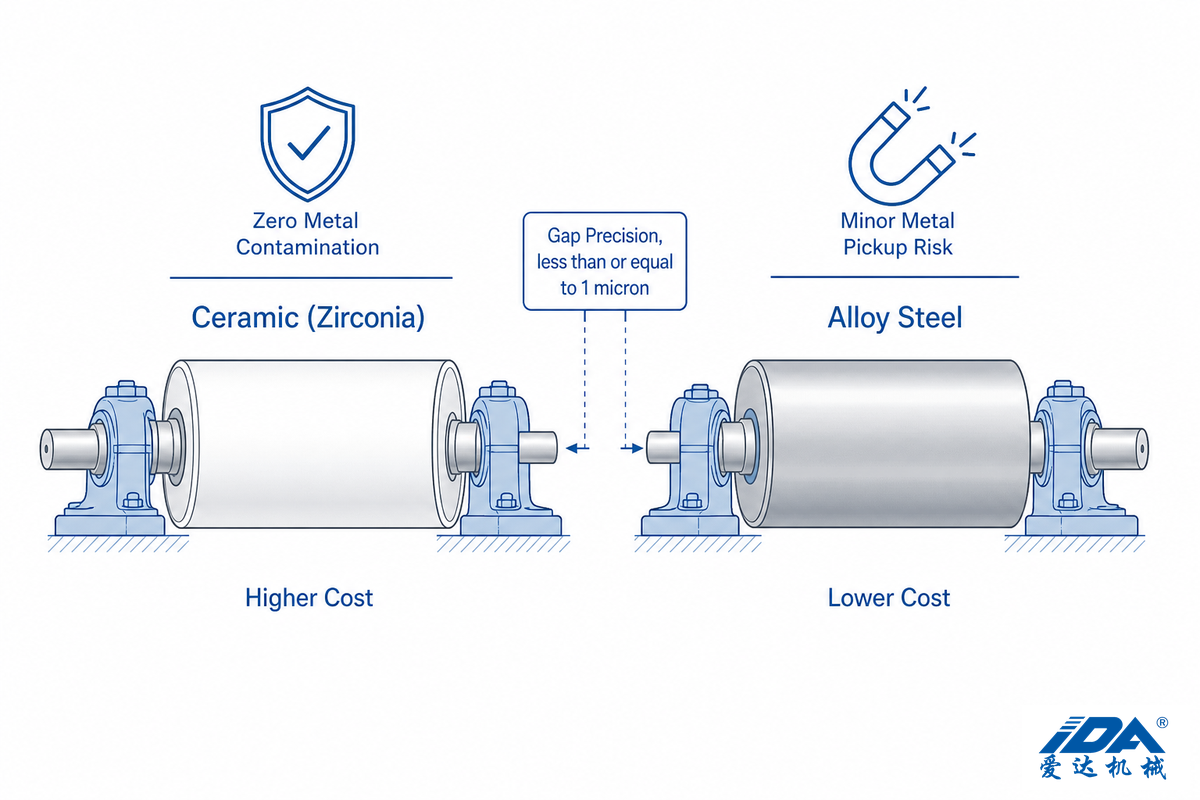
At its most basic level, reading a lab three roll mill specification sheet comes down to understanding these four numbers: Roller Diameter, Roller Material, Fineness, and Gap Precision. With 50mm roller diameter, the ES50 sits in the lab machine tier; comparable lab three roll mills from other vendors provide 65-80mm diameters at similar price points-which means that 50-80mm range is likely where a market’s “lab tier” range exists, before jumping up to 120mm+ for pilot and production machines.
Roller material dictates contamination risk. The 50mm lab three roll mill ES50’s ceramic (commonly zirconia) rollers ensure that no metal particles from roller wear enter your product – critical for pharmaceuticals, cosmetics, or electronic pastes where a Mill Test Certificate or ICP-MS contamination analysis needs to come back clean. Alloy-steel rollers cost less and carry a minimal but present risk of metal pickup over the roller life; that’s why most lab model vendors, including IDA, default to ceramic rollers and offer steel at a reduced price rather than the reverse.
The lab 50mm mill’s ≤1 µm gap precision is what ensures repeatable 1-20 µm fineness targets. A useful visual comparison for scale: typically on a lab unit, all three rollers rotate at a set ratio (i.e. 1:2:4 on one manufacturer, or up to 1:5:10 on another). On a 1:2:4 machine running at 20 RPM for the feed roll, the other rollers are rotating at 40 RPM and 80 RPM respectively. This widening speed gap between rollers creates the shear action needed, and reducing roller gap while increasing roller speed ratio can both improve fineness, but decrease throughput. Since the three machines reviewed had three different fixed speed ratios, your unit’s spec sheet value for this parameter is your working figure-not some assumed general industry standard.
📐 Nota de ingeniería
Because your three roll mill’s two nips are in-running rotating machine parts, these points are precisely what OSHA’s standard 29 CFR 1910.212 addresses when it requires machinery guarding to protect against “ingoing nip points” and “forming rolls or calenders.” A safety guard or interlock is essential at the feed nip, and an accessible e-stop should be present; even on a small 50mm benchtop model, the lack of a clearly designated, integrated safety guard/interlock at the feed nip, or a prominently located, functional e-stop should be a critical “red flag” on your list, not a post-purchase consideration.
| Parámetro | ES50 Lab Model | ES80 Pilot Model | ES120 Production Model |
|---|---|---|---|
| Tier | Lab / R&D | Piloto | Small production |
| Diámetro del rodillo | 50 mm | 80 mm | 120 mm |
| Material del rodillo | Cerámica (estándar) | Cerámica disponible | Ceramic/steel options |
| Finura | 1-20 µm | 1-20 µm | 1-20 µm |
| Viscosidad máxima | 2,000,000 mPa·s | 2,000,000 mPa·s | 2,000,000 mPa·s |
| Precisión de brecha | ≤1 µm | ≤1 µm | ≤1 µm |
| Control de velocidad | VFD | VFD | VFD |
| Enfriamiento | None (standard) | Refrigeración por agua | Refrigeración por agua |
| Ideal para | R&D, formulation development | Small-batch pilot production | Cosmetics, ink, pigment paste batches |
One standard you’ll encounter regarding fineness testing is ASTM D1210, for measuring “fineness of grind” with a Hegman gauge. Worth being precise on what it actually proves: it certifies the fineness of your milled output; it doesn’t attest to your mill’s roller material, gap tolerances, or quality of manufacture. ISO 8781-2 and ISO/TS 22107, a pair of ISO standards, document other, similar, dispersion-characteristics tests, useful if your lab follows a non-US standard regime.
Realidad presupuestaria, por qué la escala de laboratorio cuesta una fracción de una fábrica de producción
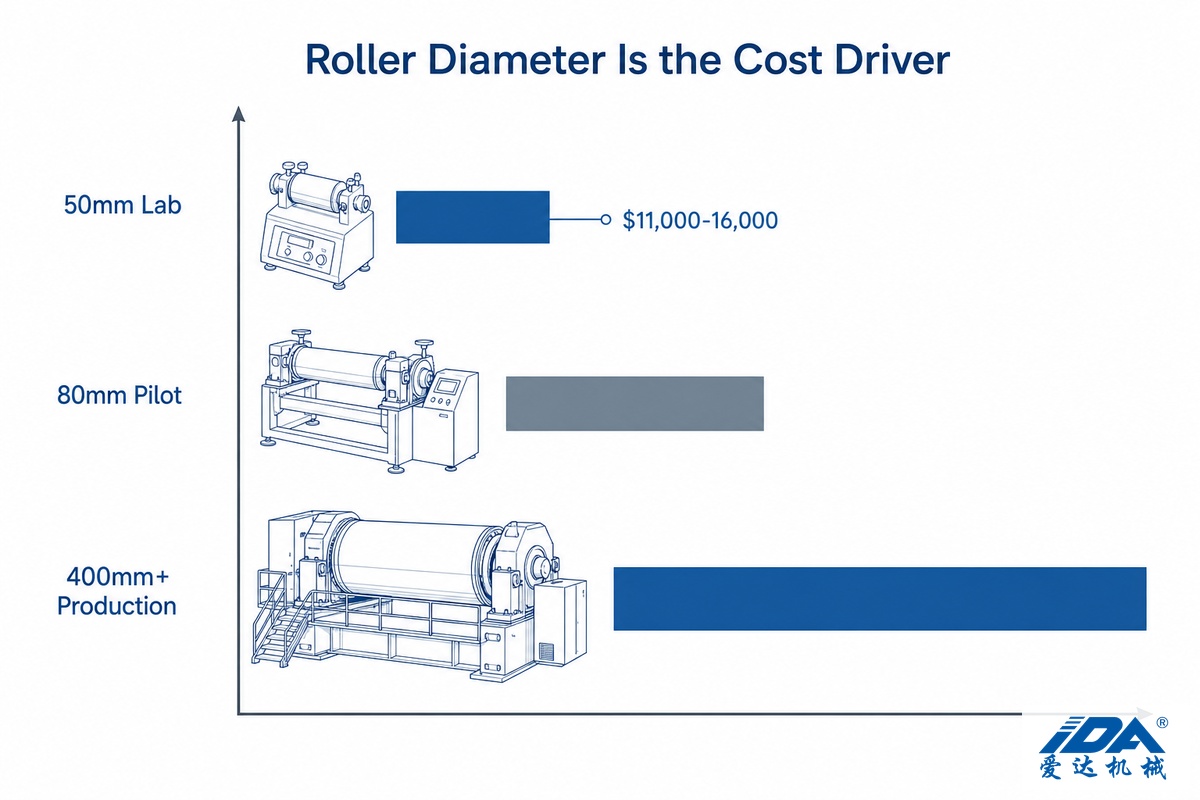
La regla de los 50 mm
Based on the two lab-scale listings priced for this article, roll diameter-not brand or level of automation-looks like the dominant cost factor, a pattern that also holds directionally as machines scale toward production size.
Two three-roll lab-mills priced for this article – one 65-mm stainless-steel unit, another 80-mm ceramic-roller unit – both list at $11,000-16,000 USD, putting three-roll lab mills firmly in the five-figures USD band irrespective of the roller composition. For a 400-mm+ production mill, multiply that price by a factor of 10 or so-not because the fundamental machine operation changes, but because large rollers mandate larger frames, bigger motors, and tighter tolerances throughout the machine.
Many university and corporate R&D operations can fund this five-figure purchase without a special capital request, drawing instead on a standard capital-equipment grant. For illustration, published equipment-procurement thresholds at U.S. research universities below which an agency isn’t required to issue a competitive request range from $5,000 (USAF) to $10,000 (ONR) at many institutions. The question, then, is less “can we buy a three roll mill,” but “under which departmental budget line or equipment grant category should we submit this request?”
Budget Framing Checklist
- Check your own institution or department’s threshold before proceeding with a full capital equipment request.
- When comparing multiple three roll mills, clearly separate roller and frame cost from optional components like water-cooling, PLCs, or automated recipe storage.
- If this purchase represents only the first step, inquire about the total cost to scale up from 50 mm to 80 mm to 120 mm (ES50-80-120 line, or comparable, as applicable) at a minimum.
De laboratorio a piloto y a producción: ¿se ampliarán realmente los resultados?
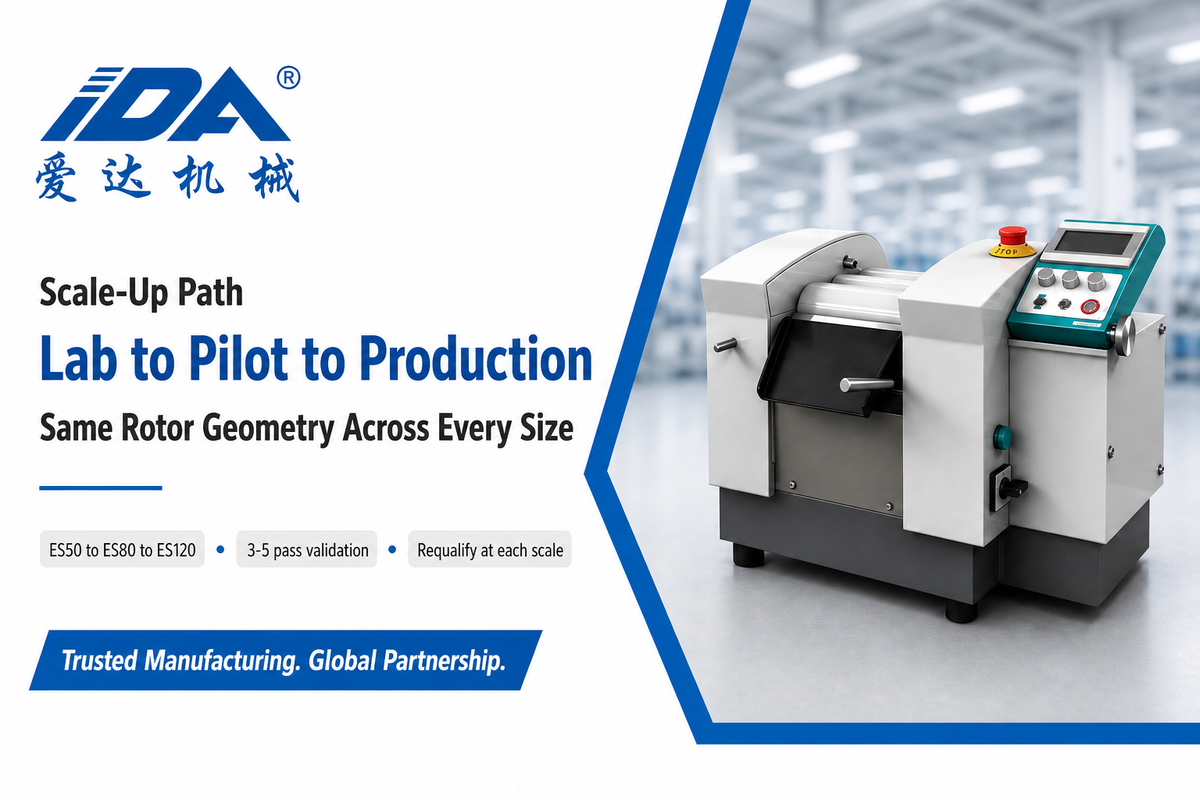
Yes, in most cases – if the lab and production machines share the same roller geometry and speed-ratio design, results from a 50 mm lab three roll mill transfer to larger machines with only minor requalification. What changes at scale is throughput, heat management, and batch-to-batch consistency, not the fundamental dispersion chemistry.
La prueba de transferencia de laboratorio a piloto a producción
If a 50 mm lab test doesn’t automatically translate to a larger production machine (120 or 400 mm, or higher), figure out which factors actually carry over and which don’t.
IDA’s ES50-to-ES80-to-ES120, or equivalent, product line preserves same rotor geometries and roller ratios across the range; that’s precisely why roller setting, speed ratios, and materials tested at 50 mm are a valid reference point when scaled up. Indeed, a US patent for silicone rubber compounding explicitly mentions a three-roll mill’s “sample size flexibility” and “ease of scale-up.”
What doesn’t automatically carry over, however, is throughput, thermal behavior, and batch-to-batch uniformity at volume. Literature on scaling-up from the pharma and process engineering realms is fairly united on the idea that translating a result from lab-scale to pilot-scale to full production is an engineering effort, not a linear extrapolation-since larger rollers disperse heat differently, batch homogeneity becomes more difficult to maintain at volume, and the accumulation of mechanical tolerances becomes a more significant factor at a larger scale. In practice this usually translates to accounting for a brief requalification at each larger scale-a gap check, temperature validation, and sample-consistency check-rather than assuming your 50 mm recipe ports will somehow continue unchanged at larger sizes.
“Most operators run three to five passes on a lab three roll mill – the first pass breaks large agglomerates, and each subsequent pass refines the distribution further. Checking with a grind gauge after each pass is how you know when to tighten the gap again.”
Pruebe antes de comprar, reduciendo el riesgo de equipos incorrectos
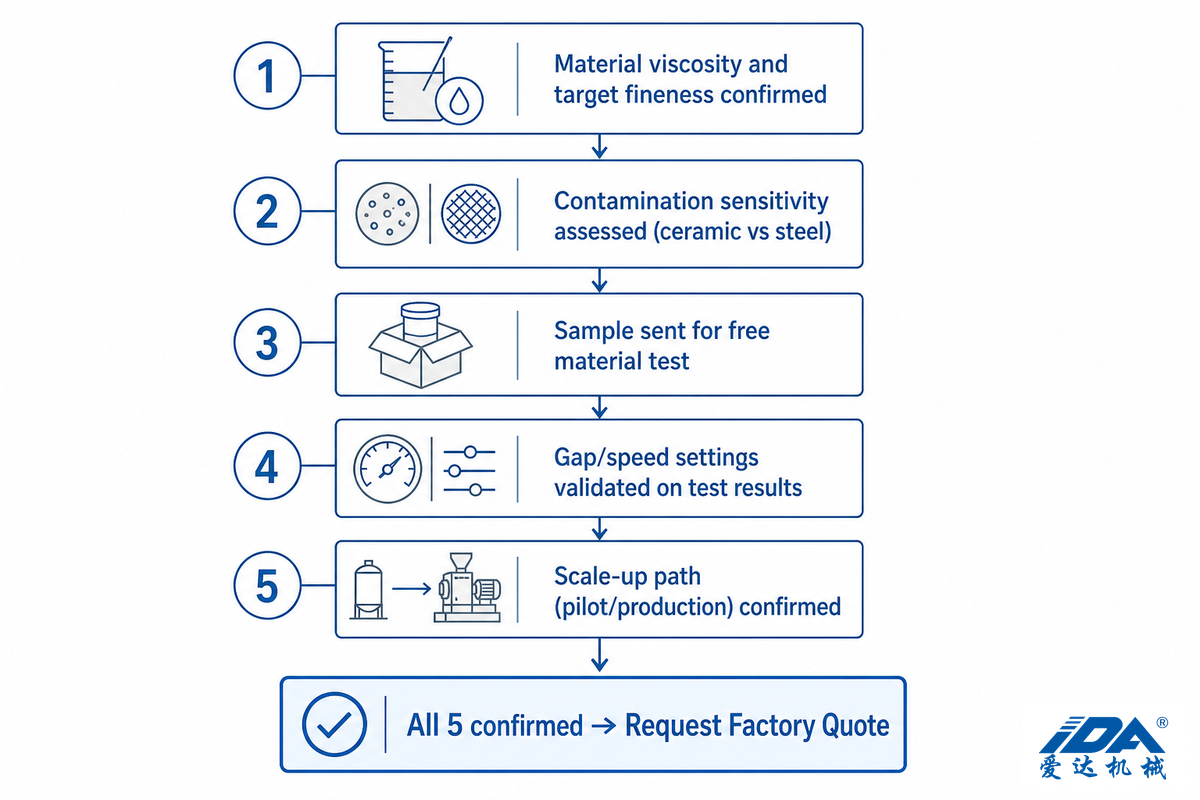
El control de ajuste de 5 puntos antes de comprar un molino de tres rodillos de laboratorio
Five checks confirm a lab three roll mill actually fits your material before you commit budget to it, following the same lab-scale validation logic used in published particle-size-prediction research: verify fit at bench scale before assuming it elsewhere.
- Confirm your material’s viscosity falls inside the mill’s rated range.
- Confirm target fineness is achievable in a reasonable pass count.
- Confirm roller material matches your contamination tolerance.
- Confirm gap precision matches your tightest spec requirement.
- Confirm cooling is available if your material is heat-sensitive.
Running this checklist against a spec sheet gets you most of the way – but the only way to fully close the gap is to test your actual material.
Per IDA’s published service description, its Jiangyin lab operates a documented six-step material testing process: book an appointment with the applications team, ship raw material and target specifications, the team runs grinding trials across multiple configurations, particle size is measured and documented, a detailed report with recommended specs is produced, and processed samples are shipped back for evaluation – typically within a 5-7 business day turnaround.
This kind of pre-purchase sample testing isn’t something every equipment category offers, and for a lab-scale purchase in the five-figure-USD range, it converts an educated guess into a verified fit before money changes hands.
Perspectivas de la industria, por qué está aumentando la demanda a escala de laboratorio
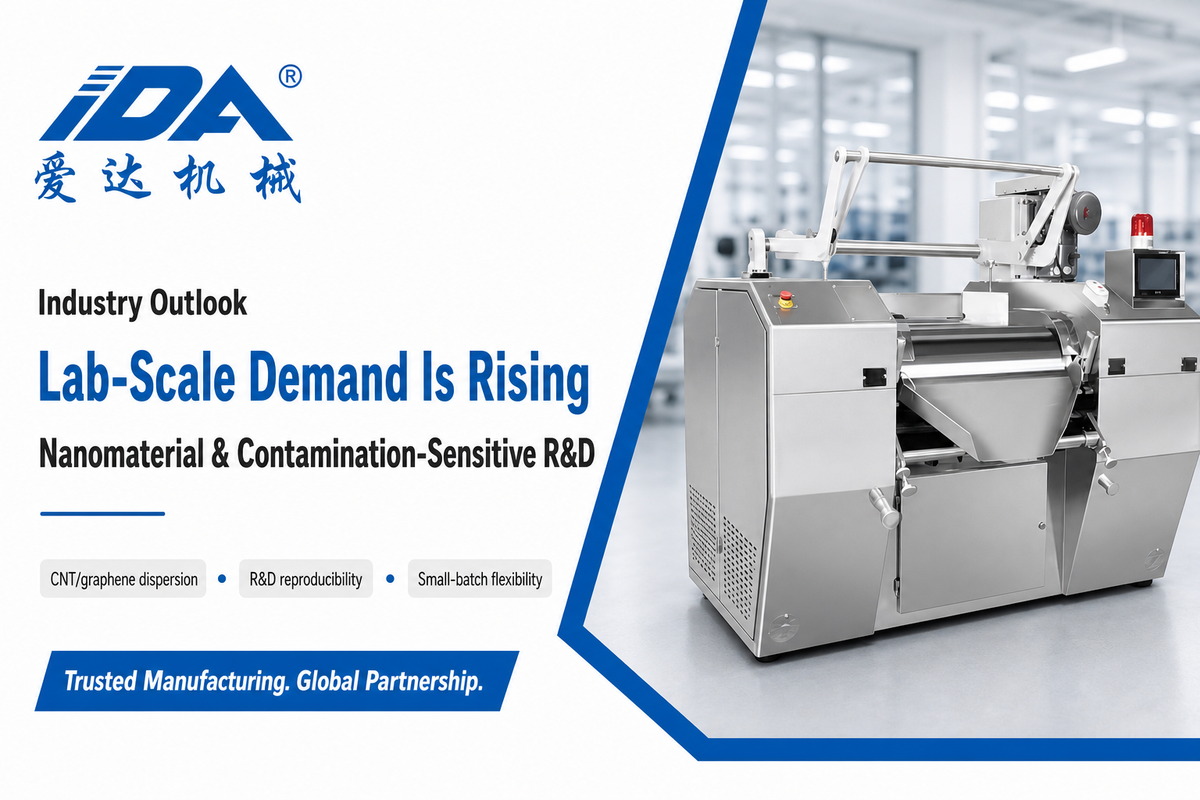
What actually drives lab-tier three-roll demand isn’t a market-size number – it’s that formulation work in electronic paste, battery-slurry R&D, and cosmetics/pharma development (the kind of work reflected in recent materials-R&D patent filings using three-roll dispersion) keeps generating a need to validate a recipe at small scale before committing production capacity to it. That’s a demand-side story about R&D activity, not a supply-side story about the mills themselves, and it shows up indirectly: equipment manufacturers building out dedicated lab-to-production model lines (IDA’s ES50/ES80/ES120 among them, and comparable modular lab-scale platforms from other equipment makers) are themselves evidence that vendors see enough R&D-stage demand to justify a dedicated lab tier rather than just scaling down a production machine on request.
On the compliance side, electrical safety requirements are a concrete, dated reason to check paperwork before you buy: IEC 60204-1, the standard IDA and other manufacturers cite for electrical safety on this class of machine, has an active revision history – the 2016 edition received Amendment 1 in 2021, consolidated into BS EN 60204-1:2018+A1:2025. When your institution’s procurement process requires current-edition compliance documentation, ask which edition and amendment level a quote is certified against, not just whether it’s “IEC compliant.”
Broader lab-equipment and dispersion-machine market forecasts exist (some citing CAGRs in the mid-single digits through the early 2030s), but they describe the category in general rather than lab three-roll mills specifically – treat those figures as directional market context, not a precise growth rate for this exact equipment type.
Preguntas frecuentes
P: ¿Puede operar un molino de tres rodillos de laboratorio manualmente o se requiere automatización?
Ver respuesta
Both options exist at the lab tier. Entry-level machines feature manual hand-wheel adjustment to set the roller gap, which works fine for occasional or exploratory runs. Mid-range to higher-end models add variable-speed drives (VFD) and, on some units, PLC control with stored programs for gap settings – useful if you run the same formulation repeatedly and want reproducible results without re-dialing the gap by hand each time.
P: ¿Cómo se limpian de forma segura los rodillos entre los lotes de formulación?
Ver respuesta
For regular operation and switching between materials, most users run a clean cycle (reversing the roller direction if the machine supports it) while running a solvent – often alcohol or another organic solvent – across the rollers with the guards in place, then let the machine air-dry thoroughly before the next batch. If your machine uses steel roller surfaces, take precautions against raw product residue contacting any exposed metal. Always follow proper lockout-tagout procedure and let rollers come to a full stop before opening any guard.
P: ¿Puede un molino de laboratorio de tres rodillos procesar materiales sensibles a la temperatura?
Ver respuesta
Yes, but check the product specs carefully – a good number of lab three roll mills ship with hollow rollers that aren’t equipped with a cooling hookup as standard equipment unless requested, and they won’t have an internal cooling path unless a coolant supply line is provided and connected. When you’re working with pharmaceuticals or heat-labile binders, remember that shear action creates significant heat; factor in integrated water cooling before you order, rather than discovering you need it after the first hot, degraded sample.
P: ¿Cuál es la diferencia entre un molino de tres rodillos de laboratorio y un molino de dos rodillos de laboratorio?
Ver respuesta
They aren’t the same job at a different scale – they process fundamentally different materials. A two-roll mill is a single-nip compounding device mainly used to create blends of rubbers or plastics. A three-roll mill uses two nips across three rollers to shear material and break down particle size, dispersing pigments or actives in pastes and slurries down to a target fineness.
P: ¿Pueden los resultados de una fábrica de laboratorio de 50 mm realmente predecir el rendimiento a escala de producción?
Ver respuesta
Partially, and it depends which variables you mean. Geometry-dependent parameters – roller gap setting, speed ratio, and roller-material choice – transfer well to a larger machine sharing the same rotor design. Batch-to-batch consistency, thermal behavior, and overall production throughput won’t scale linearly without additional adjustment and validation. Published pharmaceutical and process scale-up literature treats lab-to-pilot-to-production as a genuine engineering step requiring its own verification phase for gap, temperature, and product consistency – your lab-scale data is a strong starting point, not a guarantee of production performance.
P: ¿Qué materiales no deberían pasar por un molino de tres rodillos?
Ver respuesta
Free-flowing, low-viscosity liquids – a bead mill or disperser fits those better. Very abrasive or gritty feed can also scratch or wear the rollers, especially alloy steel ones.
Nuestra perspectiva
This guide was prepared with reference to IDA’s ES50/ES80/ES120 lab-to-production specifications and Laboratory Testing Center Service description, and was further reviewed and validated against the published specs of other lab three roll mill manufacturers, published literature in the field of dispersion mechanics, U.S. Patent & Trademark Office filings and O.S.H.A. and I.E.C. machine safety specifications. Review of technical details by Jiangyin IDA Equipment Co., Ltd. technical team.
Is it hard to find a lab three roll mill to process your material?
Whether you’re comparing a lab three roll mill price across vendors, browsing a lab three roll mill for sale listing, or sourcing lab three roll mill parts for a unit you already run, the fit-check and cost logic above still apply before you commit.
Request a Factory Quote →
Book a Free Lab Test
Discover the full specs of IDA’s Three Roll Mill Series (ES50 Lab model) from lab to production.
Referencias y fuentes
- Stress mechanisms acting during the dispersing in highly viscous media — ScienceDirect (Chemical Engineering Research and Design)
- Predicting Product Particle Size Distribution Using Laboratory-Scale Mill Data — Colorado School of Mines repository
- 29 CFR 1910.212, Requisitos generales para todas las máquinas — U.S. Occupational Safety and Health Administration
- ASTM D1210-05(2022): Fineness of Dispersion of Pigment-Vehicle Systems — ASTM International
- ISO 8781-2:1990, Pigments and Extenders, Dispersion Characteristics — International Organization for Standardization
- US20110112406A1, Silicone Rubber Compositions Comprising Bismuth Oxide — USPTO / Google Patents
- WO2019199659A1, Applications of Engineered Graphene — WIPO / Google Patents
- Pharmaceutical Process Scale-Up — M. Levin (Informa Healthcare)
- Equipment and Instrumentation Grants — Cornell Research Services
- Research Equipment: Procurement, Management, Transfer and Disposition — Rice University
- Changes in Edition 6.0 of IEC 60204-1 — Siemens
Artículos relacionados
- Guía de fresado de tres rodillos: principio de funcionamiento, selección y uso — the general selection framework for all three roll mill scales
- Selector de material de rodillos — interactive tool for choosing ceramic vs. alloy-steel rollers by contamination sensitivity
- Convertidor de unidades de viscosidad — convert cPs, Pa·s, and Poise with three-roll-mill suitability markers
- Dispersor de alta velocidad — pre-mixing and wetting equipment for lower-viscosity formulations
- Acerca del equipo IDA — company background and the Jiangyin Laboratory Testing Center