Get in Touch with IDA


A three roll mill for pigment grinding is a machine that uses shear between three contra-rotating rollers to break pigment paste into a uniform, smooth, evenly dispersed batch. Pigment dispersion quality-not simply initial pigment particle size-is the deciding factor for paint, ink and coatings makers aiming for specific color, gloss, and stability. Last updated July 2026.
Quick Specs
| Roller diameter | 50 mm (lab) to 400 mm+ (industrial) |
| Fineness | 1–20 µm (typ. ≤5 µm in 3-5 passes) |
| Gap precision | ≤1 µm |
| Max viscosity | up to 2,000,000 mPa·s |
| Speed ratio | 1:2:4 or 1:3:9 (feed:center:apron roll) |
| Roller material | alloy steel / SiC / zirconia ceramic |
What Is a Three Roll Mill and Why Pigment Producers Use It
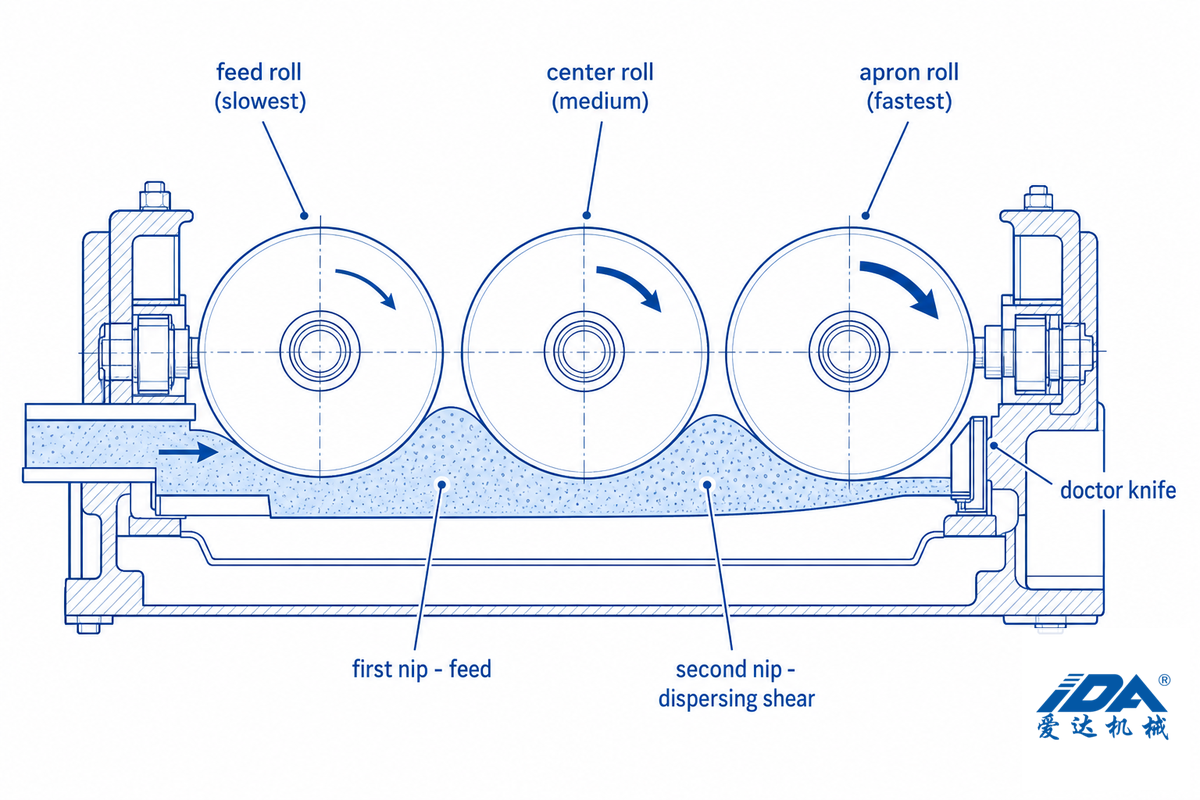
A three roll mill (also known as a 3 roll mill, triple roll mill, triple roll machine, three roller mill, or triple roller mill-and, in the pharmaceutical/cosmetics industry, an ointment mill) disperses pigment into a liquid base by pulling paste through a pair of narrowing gaps among three horizontally-aligned rollers turning at different speeds: feed slowest, center medium, apron fastest.
Feed rollers pull the paste into the system first, where the real grinding and dispersing effect takes over. This grinding and dispersing occurs as material passes through each pair of adjacent rollers in succession, with relative speeds typically rising-feed, center and apron at ratios like 1:2:4 or 1:3:9; higher ratios generate more high shear force across the roller gap to achieve finer grinding of agglomerates. According to the technical description on Wikipedia, this grinding process involves material passing between the surfaces of rollers turning at different speeds, and PCI Magazine’s coverage of new-generation three roll mills helps to clarify that the first nip primarily controls feeding into the second nip, which is the one where significant shear dispersion actually happens.
When pigment manufacturers need a three roll mill, they reach for one because of its capability to process high viscosity materials-up to 2,000,000 mPa·s paste-with near-zero contribution of grinding media to the batch. For pigments and colorants where just one stray particle can affect visual appearance or a quality test, this is critically important. Coverage isn’t limited to paint and pigments, either: this same grinding equipment processes thick film inks, colorants for plastics, sealants and other paste materials across a broad spectrum of process industries. Bench and floor models — lab-scale versus production-scale — work on the same principle, differing mainly in the roller diameters used.
How Fine Does Pigment Dispersion Actually Need to Be?
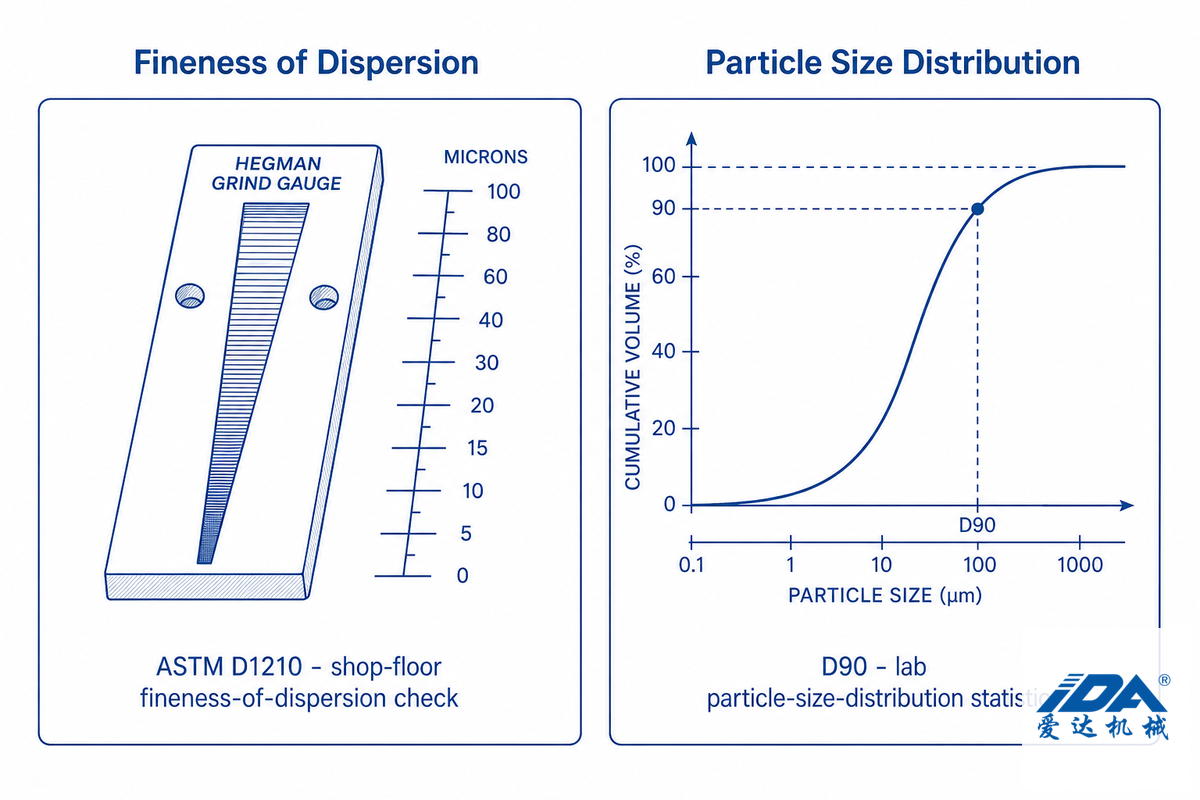
Target fineness depends on end use: architectural paint tolerates coarser dispersion than automotive coatings or electronic paste, and a shop-floor grind gauge — not a lab particle-size analyzer — usually sets the coarsest acceptable reading for a given paint or coating line.
With titanium dioxide (TiO2) in particular, the original particles (approx 150-300 nm median volume size for optimal light scattering, as described in this PMC (National Library of Medicine) study) are too small to need further grinding; the task for the paint maker and a three roll mill’s grinding effect is to de-agglomerate the larger clumps of particles and bring them back to this fundamental particle size to regain optimum light scattering (otherwise, the pigment can appear dull or chalky). So when someone specifies a requirement for fine particle size, it’s often important to clarify: fine compared to the underlying particle itself, or fine as in de-agglomerated to a more uniform size?
Two different pieces of equipment are conflated in conversations between buyers and the distinction is important: the shop-floor check that most paint plants carry out is an ASTM D1210 Hegman-type grind gauge that reads the coarsest visible scratch in a grooved wedge and tests for breakage of agglomerates – it’s a pass/fail fineness-of-dispersion check not a particle-size-distribution measurement. A D90 value (size below which 90% of particles fall) is a separate, more precise PSD statistic derived using laser diffraction that should be used when a much tighter tolerance actually requires a lab measurement, as with some electronic pastes. IDA’s own architectural-paint case study later targets a D90 <15 µm paint-specific quality spec – interpreted as a client’s target quality spec not a grind-gauge specification.
Hegman / Grind Gauge (ASTM D1210)
Shop-floor pass/fail check. Grooved wedge gauge, read in microns at the point streaks first appear. Confirms agglomerates are broken up. Fast, cheap, done every batch.
D90 / Laser Diffraction PSD
Lab statistic: 90% of particles fall below this size. Used when a tighter spec genuinely needs verification (electronic paste, some automotive coatings). Slower, needs lab equipment.
The D90 Fineness Ladder, Three Roll Mill vs Ball Mill vs Bead Mill for Pigment
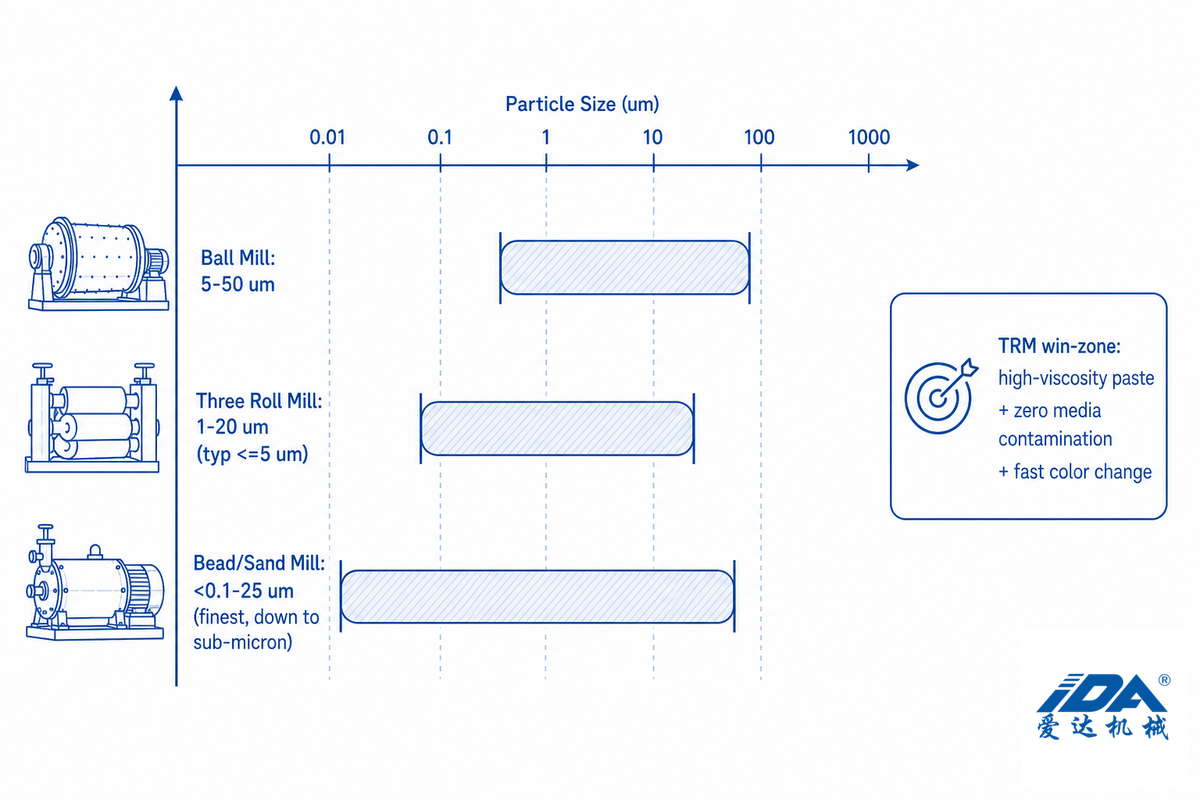
The 3-roll mill excels for a high-viscosity paste where zero media contamination and rapid color changeover are critical – not as a blanket “finest possible” solution. Where sub-micron or nanoscale pigment targeting is required (as with some electronic and photovoltaic paste) the bottom end of a bead or stirred-media mill reaches finer than the practical limit for a 3-roll mill (roughly 1µm). Whichever mill type wins for a given job, the same ASTM D1210 grind gauge is the practical way to confirm the output actually hit spec.
| Parameter | Three Roll Mill | Ball Mill | Bead / Sand Mill |
|---|---|---|---|
| Fineness range | 1–20 µm (≤5 µm typical) | 5–50 µm | down to <100 nm (turbo-nano) |
| Viscosity handling | up to 2,000,000 mPa·s | up to 50,000 mPa·s | up to 30,000 mPa·s |
| Contamination risk | very low (no media) | high (media wear) | medium (bead wear) |
| Color-changeover time | 5–15 min | 30–60 min | 20–40 min |
| Limitations | lower continuous throughput; needs operator skill | cannot handle high viscosity; slow; high contamination | clogs at high viscosity; bead separation issues |
Alloy-SiC-Zirconia Contamination Tiers: Choosing Roller Material for Pigment
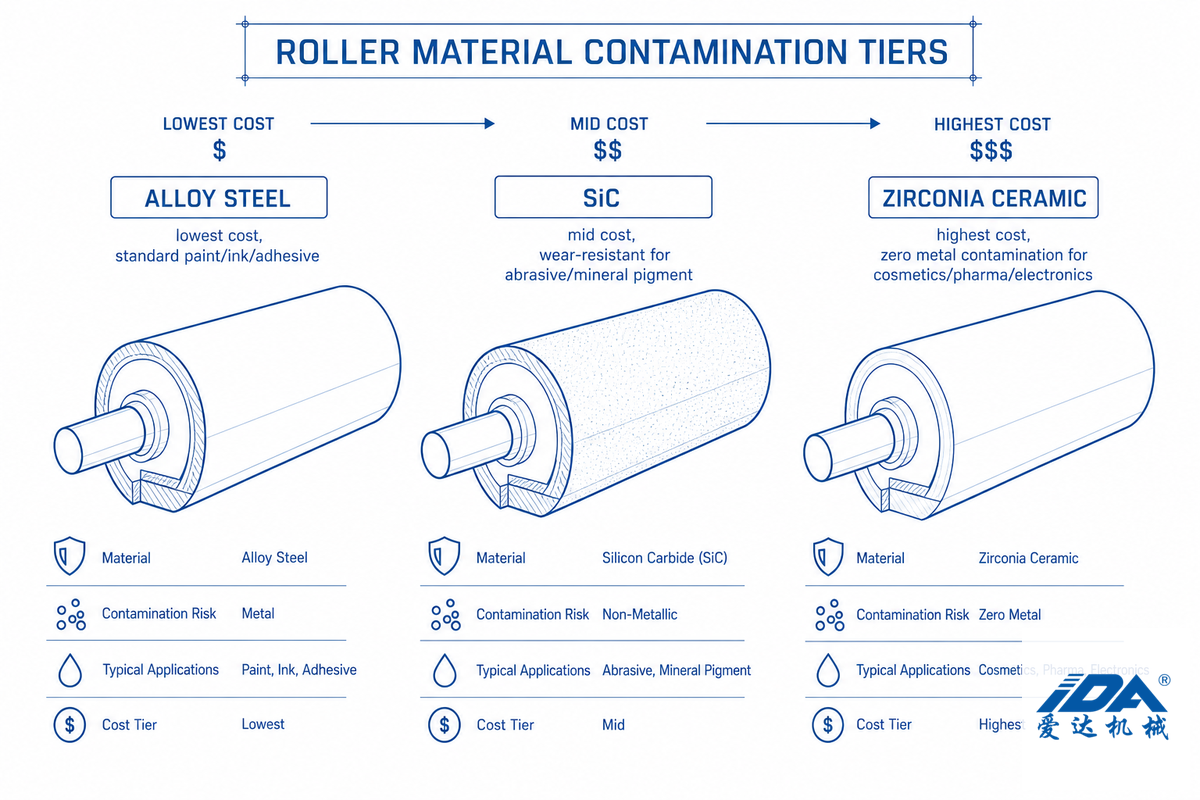
Roller material determines cost and the level of contamination allowable. Alloy steel is typically a chilled alloy casting selected for hardness and resistance to wear – the most cost-effective choice, suitable for pigments for paint, inks and adhesives where contact with the trace metals isn’t critical. SiC, for example, is more expensive but provides significantly greater wear resistance for the more abrasive inorganic pigments, such as iron oxide. Higher performance ceramics like zirconia eliminate all contact metals for such high-value applications as cosmetic, pharmaceutical and electronic paste pigments. IDA’s roller material selector tool helps to match your requirements with available options.
One detail to specify on order (not left to default): the scraper knife that removes the paste from the apron roll. Standard steel is usually acceptable for pigment work, but for solvent based inks a non-sparking feeding copper knife (sometimes brass) must be fitted to minimize fire risk. This detail can seem minor on paper, but is important in this context.
Keeping contamination out of the paste involve more than the choice of roller material; the mill design is critical too. For instance, a dispersion-equipment patent covering methods of retaining milling media in pigment particle dispersions demonstrates equipment designs using internal screens or a controllable gap to prevent milling media escape, a design challenge independent of roller material.
18–25→<15µm
D90 fineness
2hr→45min
Batch cycle time
8 months
Full ROI
The 3-Metric Ball-Mill-to-TRM Conversion Ledger
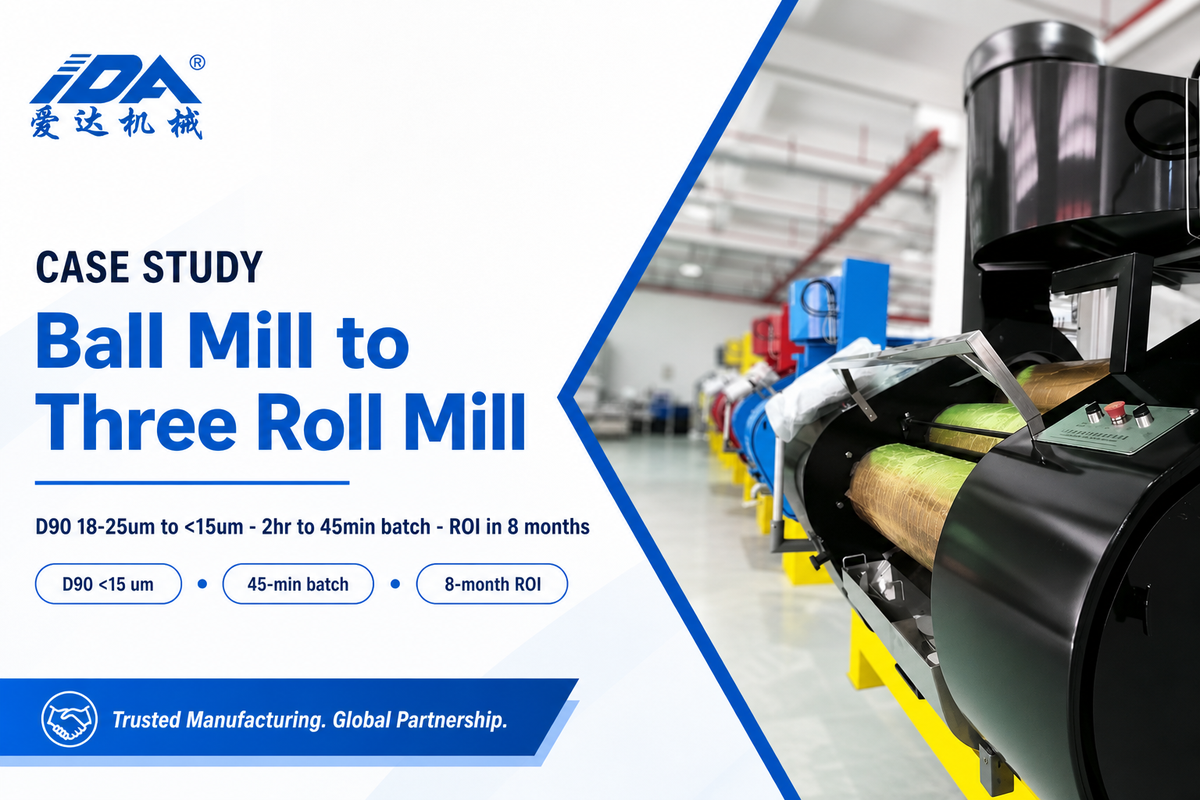
A South American paint producer grinding titanium dioxide pigment for architectural paints switched to IDA’s IS Series industrial three roll mill from a tired ball mill. Pre-switch on the ball mill: D90 fineness fluctuated widely between 18-25 µm, batch cycle time was approximately 2 hours, grinding media contamination was a consistent problem and color changeover was time-consuming. Post-switch on the IS Series: D90 remained consistently under 15 µm, the batch cycle time dropped to 45 minutes, media contamination went away and color changeover was reduced to 15 minutes. The plant achieved full return on investment within 8 months, and the production staff even noted improved batch-to-batch color consistency and reduced customer complaints.
This “before” photo is hardly an anomaly. Industry commentary on pigment dispersion equipment upgrades notes that batch cycle times frequently stretch to 4-8 hours while the typical goal remains 2-3 hours. The root cause is typically undersized or worn dispersion equipment-exactly what the plant’s ball mill had demonstrated prior to the switch, making it hardly a cherry-picked example.
The Ball-Mill Retirement Trigger List
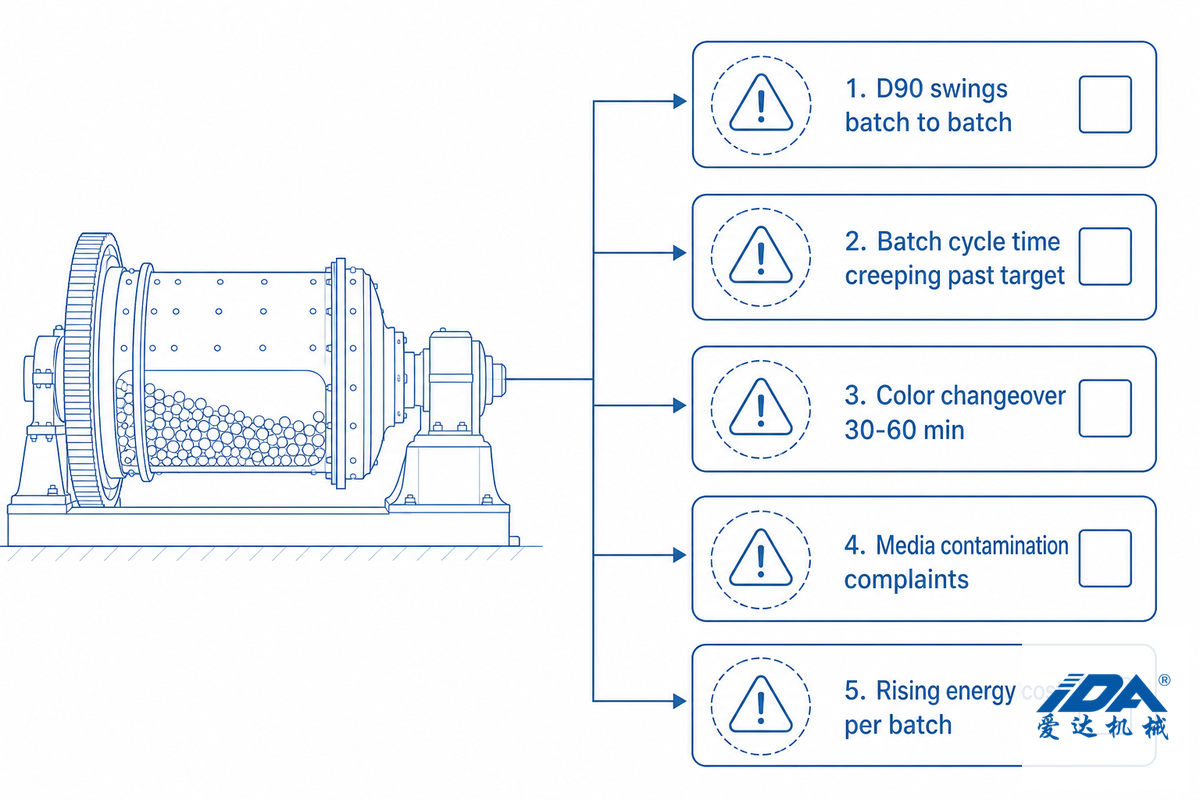
Five signals generally occur in unison to indicate that it’s time to replace the pigment-dispersing ball mill line:
- 1. D90 fineness swings between batches instead of staying within a tight range (the 18-25 µm swing above was a real occurrence, not hypothetical)
- 2. Batch cycle time has crept past its target-industry data showing typical cycles running 4-8 hours against a 2-3 hour goal confirms this pattern isn’t exceptional.
- 3. Color changeover between batches frequently takes 30-60 minutes, eating into available time and reducing throughput on multi-color production lines.
- 4. Grinding media contamination has led to customer complaints or internal rejects.
- 5. Energy consumption per batch keeps rising relative to output-ball mills sit at the lowest end of the energy-efficiency range for pigment dispersion.
Common Pigment Dispersion Mistakes
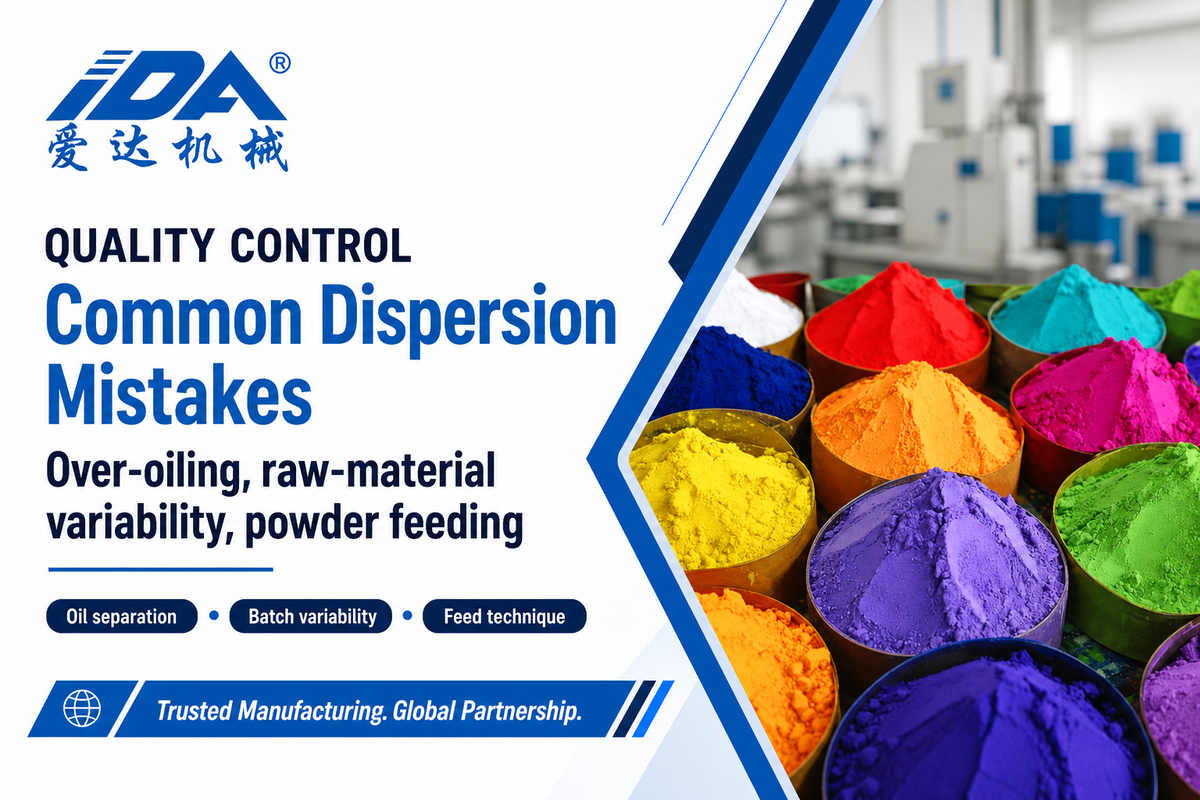
Industry professionals commonly note the practice of over-oiling a pigment paste (i.e., adding more vehicle than is strictly needed to create the batch) as a source of later pigment and oil separation and oxidation after the paint has been packaged. This is a more common problem with medium to high viscosity, oil-rich formulations than it’s with lower-viscosity formulations. Iron oxides such as umbers have intrinsic variability in the raw materials, which needs to be accounted for through process adjustments rather than just formula adjustments — a small-batch operator running the same umber recipe twice can see a visibly different mass tone the second time, purely from raw-material lot variation, with no change to the process itself. Finally, an operational pitfall noted by many is feeding dry pigment powder directly into the roller nip rather than pre-wetting it first; on a lab-scale 3 roll milling machine this shows up within the first pass as visible streaking, since the dry powder resists being drawn cleanly into the gap and rides along the roller surface instead of dispersing. This is exactly the kind of batch-to-batch quality check covered in the American Coatings Association’s guidance on pigment dispersion testing.
“Most operators run 3-5 passes. Pass one breaks large agglomerates. Each subsequent pass refines distribution. Check quality with a grind gauge after each pass to hit your target exactly.”
— IDA Process Optimization Team
Integration & Utility Requirements for Adding a Three Roll Mill to a Pigment Line
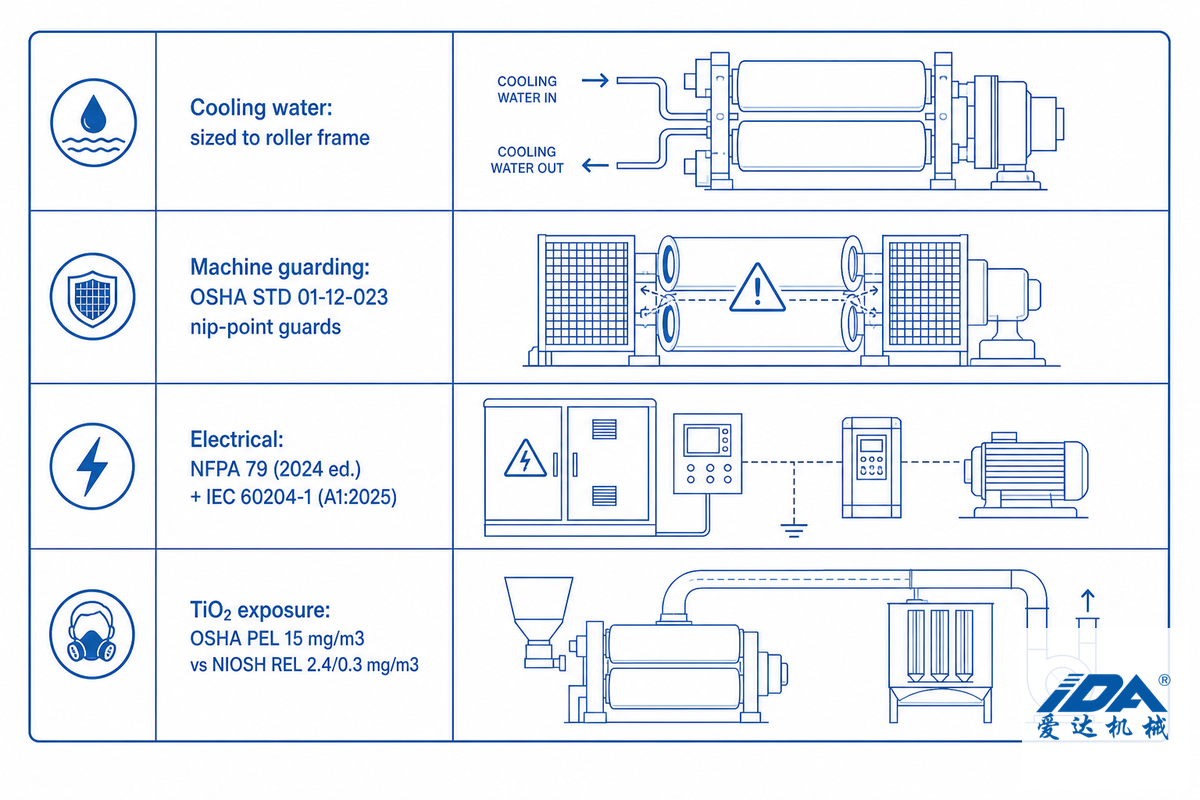
Beyond the mill itself, three installation issues make or break the process: for larger production models (ES80 and higher), there’s a water-cooled hollow-roller cooling system that must be sized before install, not after — confirm the flow rate using IDA’s cooling water calculator. And a hydraulic three roll mill or any PLC-automated model requires three-phase power sized to the roller frame — check this against your expected throughput early in the planning stage. Understand that three-roll milling is a distinct step from upstream mixing, emulsification, or slurry pre-mix tanks: the process disperses a paste, it doesn’t create the paste from scratch.
Safety compliance for three-roll mills is a regulatory matter unto itself, separate from generic machine standards. In the United States, for instance, OSHA’s directive on guarding of three-roller printing ink mills specifically mandates nip-point guards during the mill wash-up operation, under 29 CFR 1910.212(a)(1). With regard to electrical, be certain the machine conforms to the current editions of standards–a new edition of NFPA 79 was released in January 2024 and the IEC 60204-1 standard includes an update through A1:2025. If the machine certificate is to an older edition, be sure to verify it against local regulations.
With substances like titanium dioxide (TiO2) as example pigment types, two different exposure number figures exist, and they can’t be interchanged: OSHA’s legal exposure limit (PEL) is 15 mg/m³ as total airborne dust concentration; in contrast, NIOSH’s science-based recommended exposure limit for fine and ultrafine TiO2 (including engineered nanoscale forms) is far more stringent, 2.4 mg/m³ and 0.3 mg/m³ respectively. It’s best to use OSHA’s number as the legal floor rather than target and to employ other worker controls such as local exhaust ventilation at the feed point or closed powder handling equipment.
RFQ checklist — copy these into your quote request (and use the same list to compare three roll mill manufacturers side by side):
| Parameter | Recommended range | Why it matters | How to verify |
|---|---|---|---|
| Roller diameter | 50mm (lab) – 400mm+ (industrial) | drives frame size, motor size, and cost | match to your target daily batch volume |
| Roller material | alloy steel / SiC / zirconia | sets the contamination ceiling for your pigment | request ICP-MS contamination test data on zirconia claims |
| Max viscosity rating | up to 2,000,000 mPa·s | under-rated mills stall or overheat on stiff paste | test with your actual paste, not water-based proxy |
| Gap precision | ≤1 µm | determines the finest achievable D90/grind-gauge reading | ask for a documented gap-repeatability spec, not just a nominal number |
| Cooling & automation | water-cooled + PLC recipe storage for production scale | protects heat-sensitive pigments/vehicles and repeats settings batch to batch | confirm chilled-water flow requirement against your utility capacity |
Key Takeaway
A three roll mill earns its place in a pigment line on high-viscosity paste, zero-media-contamination requirements, and fast color changeover, not as a universal “finest possible” claim. Match the roller material to your contamination tolerance, confirm current-edition machine and exposure-limit compliance before installation, and use a free lab test on your own pigment before committing to a model.
Frequently Asked Questions
Q: What is a three roll mill?
A three roll mill disperses pigments into a liquid vehicle using shear force between three rollers rotating at different speeds, breaking up agglomerates into a smooth, uniform paste.
Feed, center, and apron rollers turn at a fixed ratio, commonly 1:2:4 or 1:3:9, pulling paste through two narrowing gaps. The higher the ratio, the more shear the paste experiences, which is what breaks down pigment agglomerates. Because there’s no grinding media involved, the process runs with near-zero contamination — a key reason pigment, ink, and cosmetics producers reach for this equipment over bead or ball mills for high-viscosity work.
Q: How do I choose the right three roll mill for pigment grinding?
The best three roll mill for pigment grinding isn’t one model — match four factors: your batch volume, your paste’s viscosity, your target fineness, and how sensitive your pigment is to contamination.
Batch volume points you toward a size class first: a 50mm lab three roll mill suits R&D and small-batch testing, 80–120mm pilot or small-production models suit growing volumes, and industrial or hydraulic models suit continuous production runs. Any of these size classes can handle paste up to 2,000,000 mPa·s, so viscosity mainly affects motor sizing rather than which class you pick. Fineness target and contamination sensitivity then decide the roller material: for contamination-sensitive pigments used in cosmetics, pharma, or electronic paste, specify zirconia ceramic rollers, while standard paint, ink, or adhesive pigment work is well served by the cheaper alloy-steel default. Because catalog specs alone can’t fully predict how your specific pigment chemistry behaves, IDA offers a free test with a sample of your own material — send batch size, target viscosity, and the pigment itself, and you’ll get back a recommended model, roller material, and operating parameters before you commit to a purchase.
Q: What roller material should I use for pigment vs cosmetics/electronics dispersion?
Alloy steel for standard paint/ink/adhesive pigment, SiC for abrasive mineral pigments needing wear resistance, zirconia ceramic for cosmetics, pharma, and electronic paste where zero metal contamination is required.
Alloy steel is the cheapest and most common choice for industrial pigment work where trace metal contact is acceptable. SiC costs slightly more and holds up better against abrasive pigments like iron oxide. Zirconia ceramic costs the most but eliminates metal contamination entirely, which is why it’s the standard for cosmetics, pharmaceutical, and electronic-paste applications with strict contamination specs.
Q: How much does a three roll mill for pigment grinding cost, and is the price different for used equipment?
Three roll mill for pigment grinding price depends mainly on roller diameter, roller material, and automation level — not a single fixed number you can look up in a catalog.
Larger roller diameters need bigger frames, motors, and finer machining, which raises cost. Roller material moves price from alloy steel (lowest) through SiC to zirconia ceramic (highest, for zero-contamination needs). Automation level matters too: manual hand-wheel models are cheapest, motorized gap control costs more, and hydraulic PLC-automated models with recipe memory sit at the top of the range. A used three roll mill for pigment grinding can look cheaper up front, but check roller wear and gap-repeatability before buying secondhand — worn rollers quietly give up the fineness you’re paying for. IDA sells factory-direct with no distributor markup on new equipment.
Q: Can I test my pigment before purchasing a mill?
Yes — IDA offers free testing of your own pigment sample at its Jiangyin lab, with a recommended model, roller material, and full results back in 5-7 business days.
Send a sample and your target specifications; IDA’s applications team runs the material on the appropriate mill model, measures particle size distribution, and returns both the processed sample and a report recommending model, roller material, and operating parameters. This removes the guesswork that comes from buying off a spec sheet alone.
Q: Three roll mill vs bead mill, which is better for pigment dispersion?
A three roll mill wins for high-viscosity paste needing zero media contamination; a bead mill wins for continuous throughput or genuinely sub-micron and nano-scale fineness targets instead.
Three roll mills handle paste up to 2,000,000 mPa·s in batch mode with no grinding media to contaminate the product. Bead/sand mills run continuously and reach finer targets (down to sub-100nm on turbo-nano configurations) but introduce some bead-wear contamination risk and struggle with viscous materials above roughly 30,000 mPa·s. Many producers run both: a bead mill for high-volume base grinds, a three roll mill for final dispersion of high-viscosity, contamination-sensitive pastes.
About This Analysis
This guide draws on IDA’s own architectural-paint conversion case (D90 fineness, batch cycle time, and ROI figures cited above), our roller-material engineering data, and published NIOSH/OSHA exposure and machine-guarding standards for three-roller mills. It doesn’t draw on data from other three-roll-mill manufacturers. Reviewed by the Jiangyin IDA Equipment Co., Ltd. technical team.
References & Sources
- Occupational Exposure to Titanium DioxideNIOSH / CDC
- Guarding of Three-Roller Printing Ink Mills, STD 01-12-023OSHA
- ASTM D1210, Fineness of Dispersion of Pigment-Vehicle Systems by Hegman-Type GaugeASTM International
- NFPA 79 Standard DevelopmentNational Fire Protection Association
- Three Roll MillWikipedia
- New-Generation Three Roll Mills Meet Today’s ChallengesPCI Magazine
- Pigment Dispersion II, TestingAmerican Coatings Association
- Transcriptomic profile of TiO2 particle overloadPMC / National Library of Medicine
Related Articles
- Three Roll Mill Guide: Working Principle, Selection & Usethe fundamentals, if you’re starting from zero
- Three Roll Mill for Pharmaceutical Ointmentsthe zero-contamination pharma/cosmetics angle
- Basket Mill: How It Works, Uses & Mill Selectiona shorter-changeover alternative for smaller production runs
- Three Roll Mill Machines, Lab to Industrial Scalefull product line and specifications