Get in Touch with IDA

Chemical equipment decision guide
Reviewed August 2026 | For Process Engineers, Plant Managers, Quality and Technical Buyers
A corrosion resistant reactor is a reactor whose complete construction has been reviewed against a stated chemical service, not merely selected by one alloy name. That review includes production, cleaning, startup, shutdown, and foreseeable upset conditions. Selection starts with fluid chemistry and exposure, then moves through failure mechanisms, construction details, inspection, and supplier evidence.
This guide owns that narrow decision. Readers who need reactor types, heat transfer, kinetics, or general configuration principles should first use IDA’s chemical reactor types and design fundamentals. Here, the task is to turn corrosive duty into a defensible shortlist and a quote-ready specification.
Scope boundary: this guide covers agitated vessels for chemical-process duty. It focuses on material selection, construction boundaries, and supplier evidence for corrosive service.
Engineering boundary: the worksheets in this article organize evidence. They do not approve a material, set an inspection interval, replace a process hazard review, or supersede the applicable pressure-vessel code. Final decisions require verified service data and qualified reviews by materials, mechanical, and process-safety specialists.
Key takeaway
Material selection becomes reviewable only when every candidate is tied to the same service envelope, construction boundary, evidence request, and unresolved-unknown list.
1. Corrosion Resistance Is a Service Match, Not a Material Label
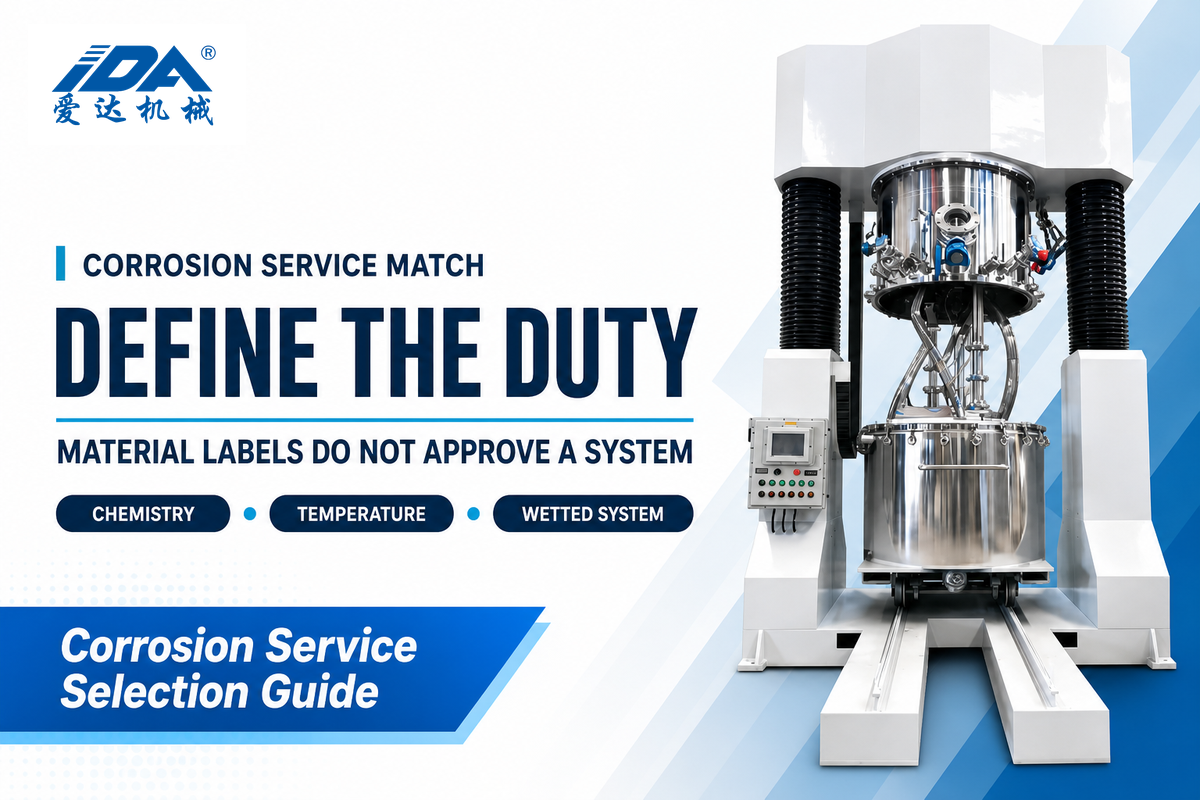
Short answer: no reactor material is resistant to every corrosive environment. A defensible selection links the material and construction to the actual chemicals, concentrations, temperature, pressure, flow, impurities, cleaning cycle, contamination limit, and abnormal conditions. [1]
That distinction changes the first buyer question. “Is Hastelloy corrosion resistant?” is too broad. “Which grade, fabrication route, and wetted-system design remain acceptable in this defined fluid sequence?” can be investigated. AMPP frames material choice around the environment, process parameters, component compatibility, operating life, maintenance, and inspection. Georgia Tech also notes that changes in process parameters can increase corrosion susceptibility. [2] An enquiry based on nickel alloys and titanium materials from TiAlloy should therefore include the specified grade, product form and service conditions, with reactor suitability confirmed by the responsible designer.
A public chemical compatibility chart is useful for screening. It isn’t a purchase approval because charts may omit mixtures, trace contaminants, weld condition, flow, heat-transfer surfaces, and transient exposure. UK regulator guidance notes that mixed-chemical data may not exist and that test-to-plant translation can be distorted by trace impurities, dissolved gases, velocity, and turbulence. [3]
A material label can start a shortlist, but it cannot approve a duty. An unknown exposure or wetted component keeps the selection provisional.
Within chemical processing, reactor materials and materials of construction cover more than the reactor walls. They include structural materials, cladding, linings, weld metal, internals, seals, and connected process equipment. Corrosion protection must address the system that contains the chemical reactions, not only the vessel name.
Labels such as “highly corrosive” or “harsh conditions” are still incomplete. Corrosion-resistant materials need evidence for their resistance to chlorides and other corrosive materials in the actual reactor system. That evidence may come from traceable operating history, qualified tests, or both.
2. Build a 6-Field Corrosion Service Passport Before Comparing Materials
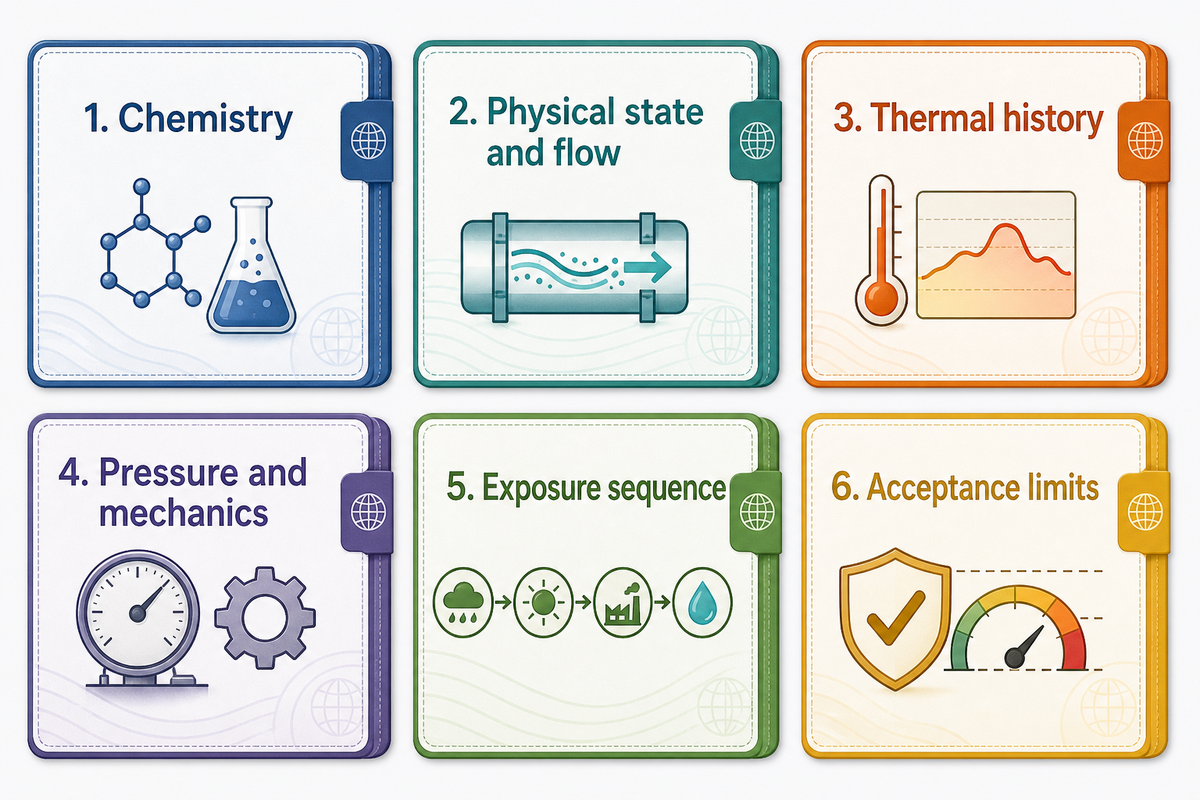
The 6-Field Corrosion Service Passport is an intake structure, not six sufficient variables. Each field is a category containing the details a corrosion specialist or equipment supplier needs. Unknown values stay visible. A blank marked “unknown, test required” is safer than a copied chart rating.
Fictional entries below demonstrate formatting only. No recommendations on recipe, corrosion limits, or example materials apply.
| Field | Fictional entry format | Questions that keep the field honest |
|---|---|---|
| 1. Chemistry | 18% by weight organic acid; 2,000 ppm chloride; dissolved oxygen unknown | List every feed, intermediate, by-product, impurity, catalyst, inhibitor, gas, and water source. |
| 2. Physical state and flow | Liquid with 8% by weight suspended solids; 1.5 m/s local design velocity | Record phases, viscosity, aeration, particle size, settling, impingement, turbulence, and dead zones. |
| 3. Thermal history | 25–145 °C batch; 3 °C/min heat-up; 20 °C wash | Include minimum, maximum, ramp rate, hot spots, cooling steps, and thermal cycling. |
| 4. Pressure and mechanics | Full vacuum to 0.6 MPa; 12 starts/week | State pressure, vacuum, cycling, agitator load, vibration, nozzle loads, and solids abrasion. |
| 5. Exposure sequence | Reaction lasting 6 hours; alkaline clean lasting 0.75 hours; weekly chloride-bearing rinse | Separate production, hold, drain, clean, sanitize, startup, shutdown, and foreseeable upset exposure. |
| 6. Acceptance limits | No visible lining defect; product iron below project limit; inspection method pending | Define contamination, corrosion allowance, service life, repair policy, code scope, and required test evidence. |
Worked Example A — more complete fictional handoff: A request records a 1,500 L working volume, 18% organic acid, 2,000 ppm chloride, 8% suspended solids, a 1.5 m/s local-flow target, 0.6 MPa maximum pressure, a reaction stage lasting 6 hours, a cleaning stage lasting 0.75 hours, 120 rpm agitation, and a 3 bar jacket limit.
Worked Example B — incomplete fictional handoff: A second request records a 3,000 L working volume, 12% unspecified acid, 500 ppm chloride, 4% solids, 0.8 m/s local flow, 4 bar design pressure, a reaction stage lasting 8 hours, a cleaning stage lasting 1.5 hours, 90 rpm agitation, and a proposed inspection baseline of 24 months—but omits impurities, upset chemistry, weld condition, and acceptance evidence.
Boundary: These numbers demonstrate record structure only. Neither worked example represents IDA product capability, a safe operating limit, an inspection recommendation, or a material approval. Example B remains unsuitable for selection until its unknowns are resolved.
Passport discipline prevents a common failure in coatings, adhesives, pharmaceuticals, and fine chemicals: a mild-looking production fluid hides a more aggressive cleaning step. A formulation may also change viscosity and mixing duty. When that happens, the material review must stay connected to high-viscosity mixing requirements rather than treating chemistry and agitation as separate purchases.
3. When Chlorides and Temperature Shrink the 316L Stainless Steel Margin
316L stainless steel continues to be a practical candidate for many duties, but “stainless” is not a complete material-selection process. Chlorides may promote pitting, crevice attack, or stress-corrosion cracking depending on temperature, deposits, dead pockets, tensile stress, and weld condition.
A peer-reviewed chloride-deposit study reported stress-corrosion cracking on 316L at 30 °C and on 304L at 20 °C under its specific non-rinsing test conditions. Duplex grades in the same study showed cracking only at 70 °C. Those values describe that test, not universal safe limits. Their value is the warning: “low temperature” by itself doesn’t close the review. [4]
The USGS provides a useful scale boundary: fresh groundwater along the Atlantic coast is typically below about 20 mg/L chloride, the EPA secondary guideline is 250 mg/L (approximately 250 ppm in dilute water), and seawater is about 19,000 mg/L (approximately 19,000 ppm). Those water values illustrate scale only; they are not reactor material limits. Temperature, mixtures, deposits, and impurities still control alloy behavior. [5]
Acid labels need the same discipline. Nitric acid differs from hydrochloric and sulfuric acids, and each can present different oxidizing, reducing, impurity, and concentration conditions. High-temperature exposure and high pressures add mechanical and fabrication questions, while a claim that an alloy is inert can hide localized attack. [3]
| Observed condition | Credible concern | Next verification step |
|---|---|---|
| Chloride-bearing deposits or evaporative zones | Pitting or chloride stress-corrosion cracking | Define deposit chemistry, wet/dry cycle, temperature, stress state, and test method. |
| Gasket shadow, lap, threaded feature, or poor drainage | Crevice corrosion | Review geometry, oxygen differential, cleaning access, and alternate joint design. |
| Attack concentrated near a weld or heat-affected zone | Fabrication- or stress-related susceptibility | Request weld procedure, filler, post-weld thermal processing where applicable, surface condition, and welded-coupon evidence. |
| Localized attack at a high-flow inlet | Erosion-corrosion or protective-film removal | Model local velocity, impingement, gas entrainment, and solids loading. |
Escalation doesn’t automatically mean “buy a higher alloy.” It means 316L no longer earns approval from a material name alone. Next steps may include a duplex or nickel-alloy review, a construction change, a geometry correction, a cleaning change, or condition-specific coupon testing.
4. Four-Material Decision Scorecard for Corrosive Reactor Service
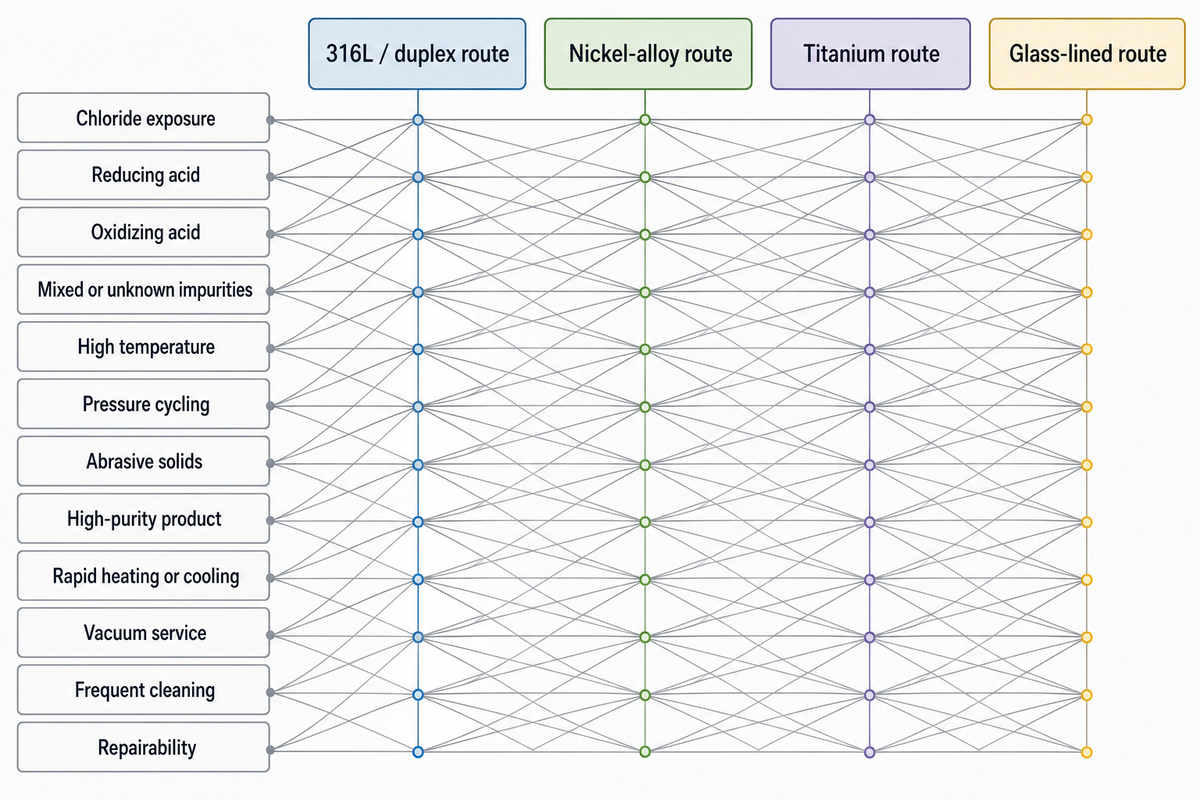
The Four-Material Decision Scorecard isn’t a ranking list from worst to best. Each entry asks whether 316L or duplex stainless steel, a nickel alloy, titanium, or glass-lined construction merits further review for a given service condition. “Candidate” simply means “investigate.” “Hold” means the available evidence is insufficient to include that route in a shortlist.
Glass-lined steel is an architecture, not a solid alloy. Its glass barrier, steel substrate, nozzles, accessories, repair method, impact sensitivity, and thermal response must be reviewed together. MTI and Chemical Engineering both describe maintenance and handling constraints that sit outside a simple compatibility rating. [6][7]
Published numbers may serve as helpful screens but shouldn’t substitute for design limits. This Boundary Register shows precisely how each number was obtained and what it means.
| Source-scoped signal | Published value | Allowed use |
|---|---|---|
| 304L chloride-deposit test | Cracking observed at 20 °C | Describe only the cited non-rinsing test conditions. |
| 316L chloride-deposit test | Cracking observed at 30 °C | Challenge a low-temperature assumption, not set a service limit. |
| Duplex grades in the same test | Cracking observed at 70 °C | Keep the result inside the study’s material and exposure set. |
| USGS chloride comparison | Below about 20 mg/L freshwater; 250 mg/L (approximately 250 ppm or 0.025%); about 19,000 mg/L seawater (approximately 19,000 ppm or 1.9%) | Show scale; do not infer a reactor pass or fail. The ppm and percentage figures are direct dilute-water unit conversions. |
| HSE plant-design allowance example | 2 mm where severe corrosion is not expected; 4 mm where more severe corrosion is anticipated | Illustrate how a guidance value remains material- and context-bound; obtain project calculations. |
| ASME product scope | Pressure vessels above 15 psi gauge (15 psig) | Prompt a code-scope review; never imply certification. |
| HSE barrier-lining discussion | Multiple layers near 3 mm | Distinguish a built-up barrier from thin paint-like coatings. |
| MTI glass-lined summary | 500 °F (260 °C) standard, 650 °F (345 °C) special, -94 °F (-70 °C) lower boundary; 100 psi to 150 psi described as normal | Use only as association-published context; obtain design-specific limits. |
| 2007 Chemical Engineering article | 260 °C, 130 psi to 150 psi gauge (9.14–10.55 kg/cm²), about 6,000 V spark test | Treat as dated, vendor-authored field practice; follow the proposed supplier’s procedure. |
| Material-selection condition | 316L / duplex route | Nickel-alloy route | Titanium route | Glass-lined route | Evidence still required |
|---|---|---|---|---|---|
| Chloride exposure | Review grade, temperature, deposits, stress | Candidate by exact alloy and environment | Review oxidizing state and crevice conditions | Candidate if chemistry and lining integrity fit | Chloride range, temperature, wet/dry cycle, welded test |
| Reducing acid | Often specialist review | Candidate by grade and concentration | Hold until exact chemistry is checked | Candidate with exclusions reviewed | Acid, concentration, aeration, impurities, temperature |
| Oxidizing acid | Review passive-film stability | Review exact alloy; no family-level pass | Potential candidate in selected services | Review glass exclusions and thermal duty | Oxidation potential, contaminants, full temperature range |
| Mixed or unknown impurities | Hold | Hold | Hold | Hold | Representative sample, analysis, exposure sequence, test plan |
| High temperature | Review corrosion and strength together | Candidate by grade and stress state | Review creep, oxidation, and chemistry | Review supplier thermal limit and gradients | Metal and wall temperature, hot spots, ramp rate |
| Pressure cycling | Review fatigue, corrosion allowance, welds | Review fatigue and fabrication route | Review fatigue, welds, and design code | Review substrate, lining strain, and nozzles | Cycle count, pressure range, code calculation, inspection plan |
| Abrasive solids | Review impingement and wear allowance | Review hardness and local velocity | Review erosion at inlets and agitator | High caution for impact or abrasion damage | Particle size, wt%, hardness, velocity, settling zones |
| High-purity product | Review metal-ion limit and finish | Review alloy-element contamination | Candidate if product and oxide behavior fit | Candidate if glass release and damage controls fit | Product impurity limits, surface finish, cleaning validation |
| Rapid heating or cooling | Review thermal stress and weld details | Review thermal stress and expansion | Review thermal gradient and fabrication | High caution for thermal shock | Ramp rate, jacket zones, wall gradient, control interlocks |
| Vacuum service | Review external-pressure design | Review external-pressure design | Review buckling and fabrication | Review vessel and lining architecture together | Full-vacuum case, jacket pressure, temperature, stiffening |
| Frequent cleaning | Include cleaning chemistry and crevices | Include cleaning chemistry and weld state | Include cleaning agents and galvanic joints | Review cleaning method, impact, and defect checks | Cleaning fluid, time, temperature, frequency, inspection hold point |
| Repairability | Review weld repair and post-repair evidence | Review filler, procedure, heat treatment | Specialist repair route | Review field repair versus reglassing limits | Repair procedure, acceptance test, access, downtime plan |
NIST’s Corrosion Data Program shows why a family name isn’t enough. Its alloy-performance reasoning accounts for oxidizing capacity, temperature, velocity, galvanic coupling, and active-passive behavior. Those factors can reverse a casual “higher alloy is always safer” assumption, so titanium and nickel-alloy candidates still need condition-specific evidence. [8]
Type 316 stainless steel, duplex stainless steel, and super duplex grades are distinct candidates. Nickel-based alloys may use nickel and molybdenum in different proportions; the phrase “Hastelloy reactors” still leaves the grade, product form, weld, and design unknown. Hastelloy and titanium also carry different contamination, fabrication, tensile strength, and mechanical strength questions. A claim of superior corrosion resistance is evidence to check, never a reason to skip the service passport.
5. Use a Corrosion Boundary Trace, Not a Review of the Shell Alone
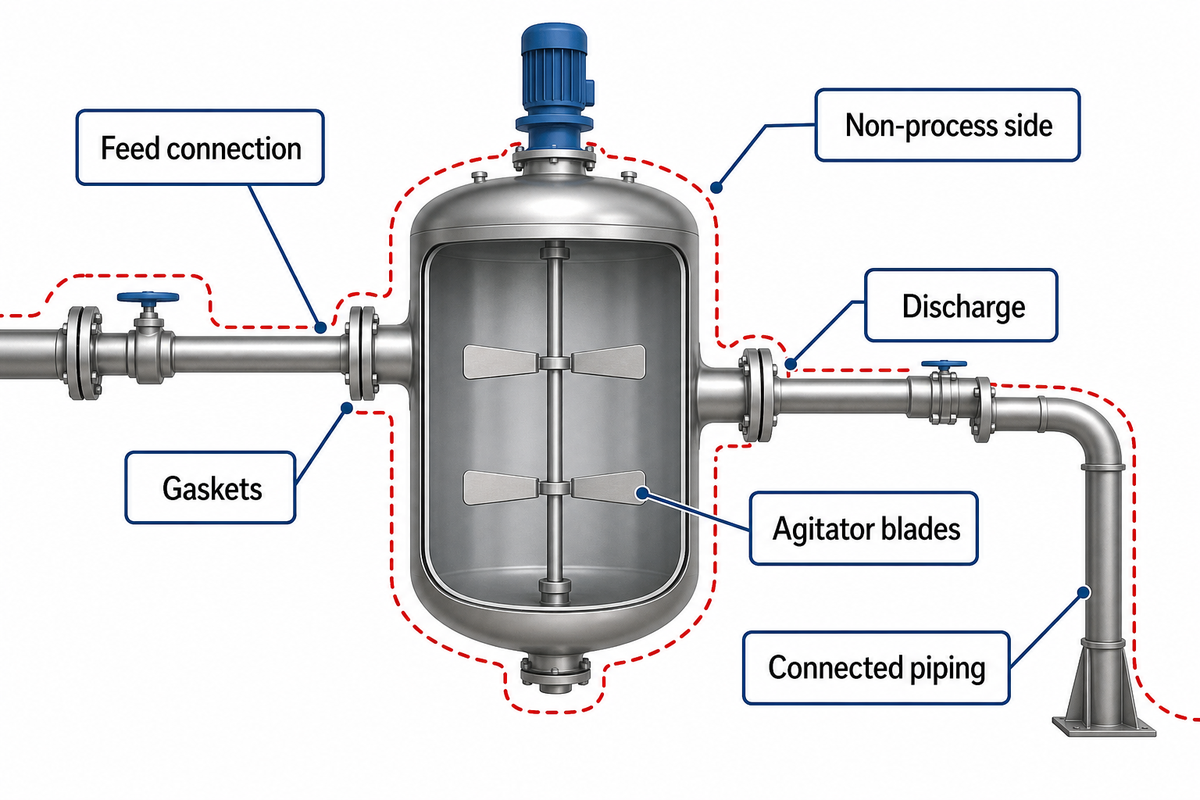
Shell construction can pass while another component sets the real limit. A Corrosion Boundary Trace follows exposure from the feed connection to the discharge and then around the non-process side. It includes agitator blades, shaft, baffles, spargers, dip pipes, thermowells, sampling points, nozzles, gaskets, seals, valves, and connected piping. This component-level check follows the system approach in HSE materials-selection guidance.
Boundary tracing also considers jacket medium, insulation, coating, supports, anchor bolts, outside crevices, and washdown atmosphere. HSE recognizes that external atmospheric corrosion causes many loss-of-containment incidents and can be a larger problem than internal corrosion. Insulation that allows moisture ingress is an additional exposure area. [3]
Do
- Assign a material and evidence item to each component family.
- Trace both process-side and external exposure.
- Review welds, interfaces, crevices, and repair zones.
- State which boundary remains unverified.
Don’t
- Approve the system from the shell grade.
- Assume a lining automatically protects every internal component.
- Ignore cleaning, jacket, insulation, or washdown chemistry.
- Hide unknown gasket or seal compounds.
For high-viscosity duty, shaft load, seal choice, heat transfer, and local velocity interact with corrosion. A separate triple-shaft mixing configuration may solve a mixing problem, but it also changes the wetted-component list and mechanical review. Coatings buyers can compare that boundary with IDA’s overview of mixing equipment for coatings.
6. Start With a 9-Mode Corrosion Response Grid
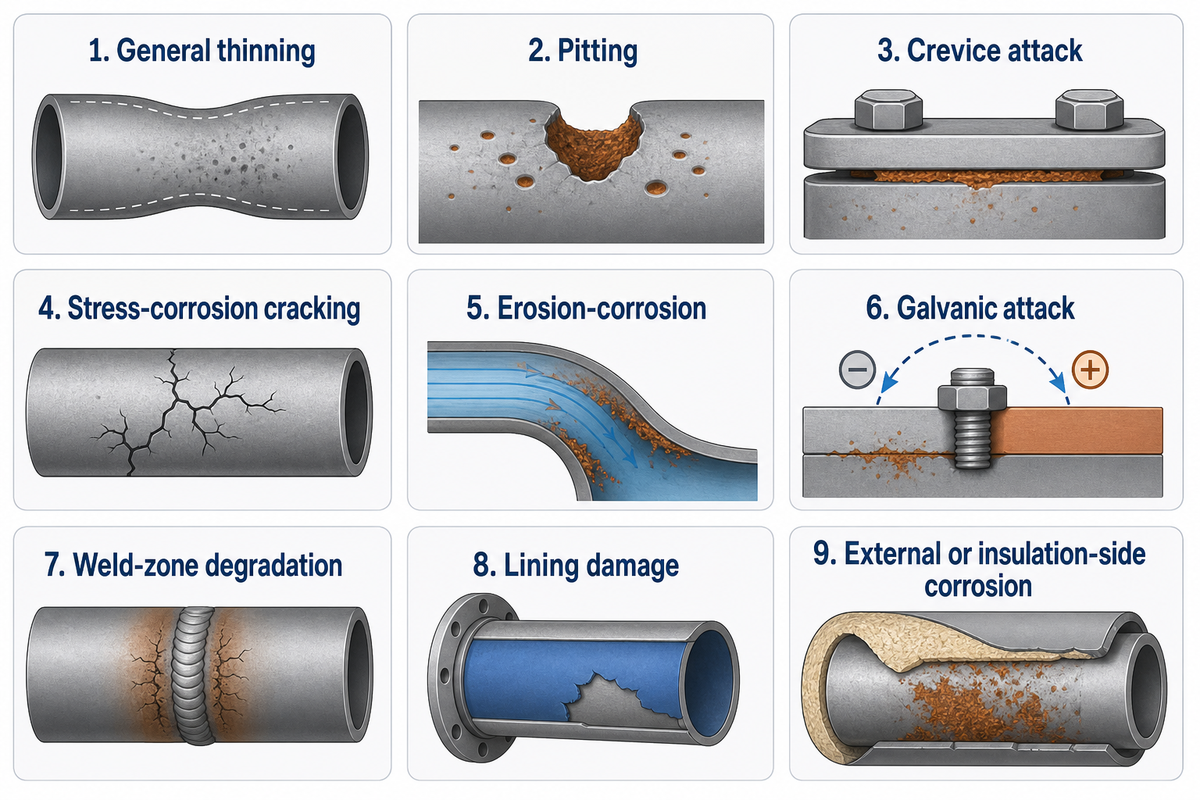
The 9-Mode Corrosion Response Grid connects a credible mechanism to a location, an observable clue, a confirmation method, and an escalation boundary. It’s a starter map. It doesn’t set inspection frequency. OSHA’s nonmandatory process-safety appendix ties inspection methods and intervals to equipment history, applicable codes, corrosion-rate knowledge, and owner procedures. [9]
| Mode | Likely location | Possible clue | Confirmation path | Response boundary |
|---|---|---|---|---|
| 1. General thinning | Broad wall area | Trend in measured thickness | Mapped thickness data and corrosion-rate review | Escalate when allowance or trend basis is uncertain. |
| 2. Pitting | Deposits, liquid line, stagnant zones | Small cavities or unexpected leak | Clean, inspect, size, and identify chemistry | Do not average pits into a general wall-loss value. |
| 3. Crevice attack | Gaskets, laps, deposits, threaded details | Localized attack hidden at interface | Open the interface and inspect geometry | Review joint design before return to service. |
| 4. Stress-corrosion cracking | Welds, stressed zones, hot chloride deposits | Fine branching cracks or abrupt failure | Qualified surface or volumetric examination and mechanism review | Hold service until fitness and cause are resolved. |
| 5. Erosion-corrosion | Inlets, impeller zone, bends, baffles | Directional wear or local thinning | Velocity, solids, geometry, and thickness mapping | Correct flow or geometry, not only material. |
| 6. Galvanic attack | Dissimilar-metal joints | Attack concentrated near one material | Verify alloys, area ratio, electrolyte, and isolation | Review the pair and joint design together. |
| 7. Weld-zone degradation | Weld metal and heat-affected zone | Preferential attack or cracking | Trace procedure, filler, post-weld thermal processing, finish, and examination | Base-metal certificate alone is insufficient. |
| 8. Lining damage | Nozzles, impact zones, thermal-gradient areas | Chip, crack, blister, electrical discontinuity | Supplier-approved visual and defect testing | Keep substrate exposure and repair limits explicit. |
| 9. External or insulation-side corrosion | Supports, anchors, insulation, jacket exterior | Coating breakdown, staining, damp insulation | External inspection, insulation removal plan, thickness data | Include external findings in containment decisions. |
The CSB investigation of the NDK pressure vessel shows the importance of the response boundary. Investigators correlated the catastrophic 2009 rupture with stress-corrosion cracking, design and material-selection issues, the assumption of an internal protective barrier, and the absence of recommended internal inspection. This doesn’t mean every reactor has the same mechanism. It demonstrates that a believed protective barrier can’t substitute for mechanism-specific evidence. [10]
Materials degradation may not become apparent until a local feature is vulnerable to SCC, a lining has begun to degrade, or measured corrosion rates have fluctuated. Shutdown thresholds and escalation pathways therefore belong alongside each mechanism. This connection underpins long-term dependability and can assist owner-operators in maintaining safety and efficiency without confusing a calendar interval with equipment condition.
7. What Evidence Should a Reactor Supplier Provide?
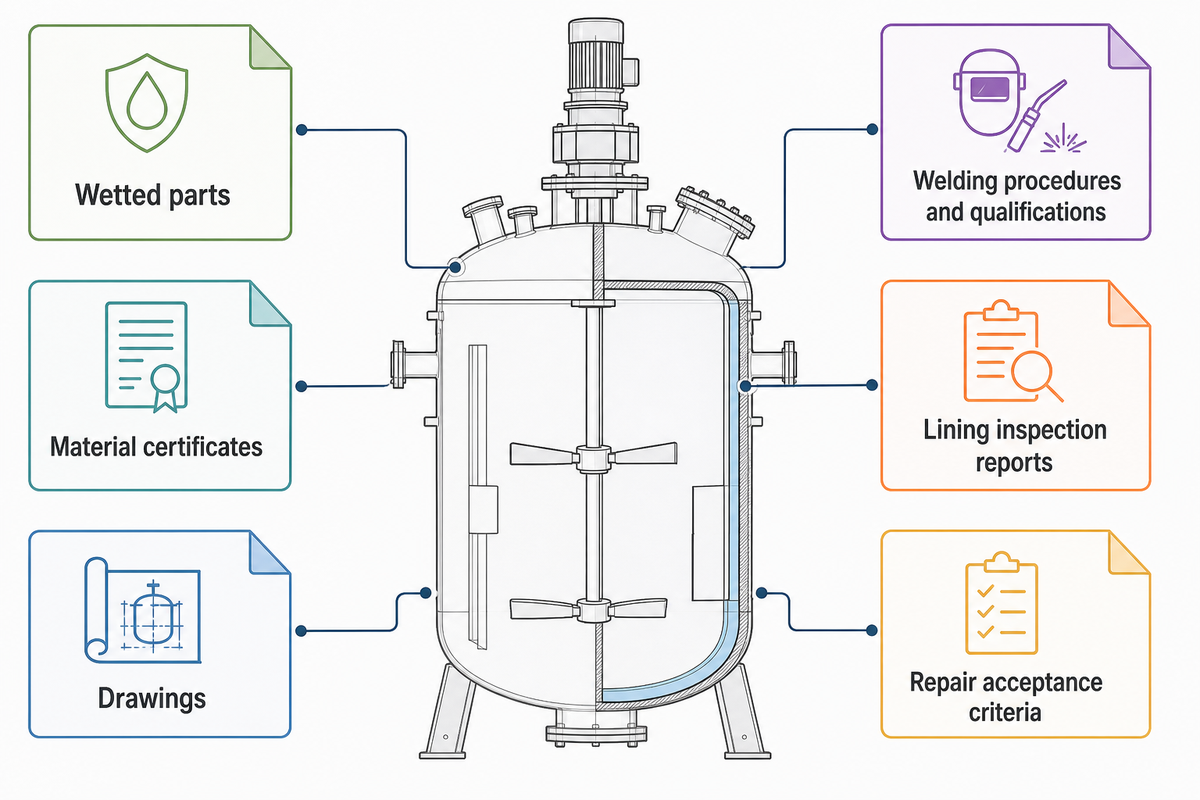
A vendor recommendation becomes reviewable when its assumptions, materials, manufacturing processes, inspections, tests, and exclusions are identified. Request the list of wetted parts, material certificates, drawings, welding procedures and qualifications where applicable, filler identification, post-weld thermal-processing certificates where applicable, surface-finish specifications, lining inspection reports, pressure-test scope, and repair acceptance criteria.
ASME lists the 2025 edition of BPVC Section VIII Division 1 as covering the design, fabrication, inspection, testing, and certification of pressure vessels above 15 psig. That statement helps a buyer ask which code and edition apply. It doesn’t establish project applicability or prove that a particular IDA vessel carries a certification. [11]
Responsibility remains divided. Suppliers provide agreed equipment evidence. Designers confirm the design basis. Installers verify field materials and procedures. Owners and operators maintain process information, change control, inspection history, and operating limits. OSHA’s published Appendix C guidance specifically includes field verification of gaskets, packing, bolts, valves, and welding consumables. A material certificate for the shell can’t close those separate links. [9]
IDA’s public company page can supply first-party context about the organization, but it isn’t independent corrosion evidence. Buyers can review about IDA Equipment and then request the exact project documents that support the proposed construction.
8. Turn the Shortlist Into a Corrosion Duty Sheet
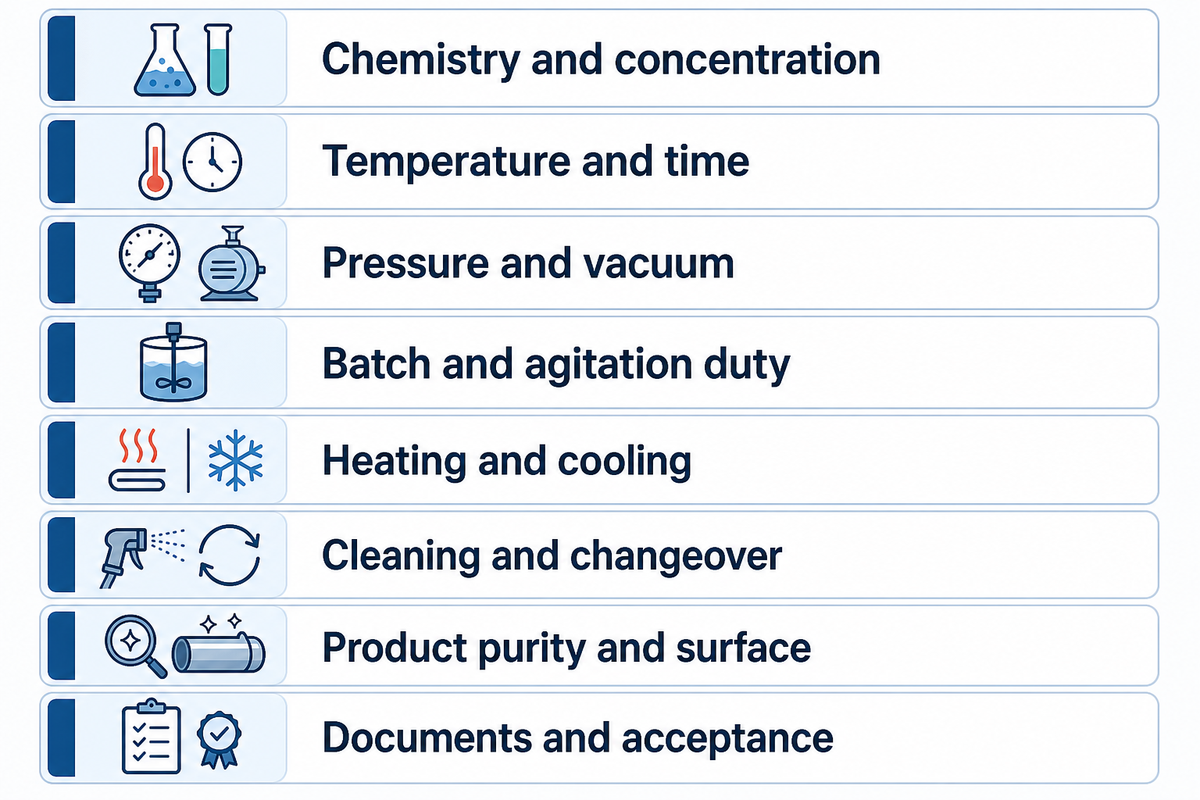
A one-line inquiry for a “corrosion-proof reactor” forces every supplier to guess a different scope. The Corrosion Duty Sheet converts the passport and scorecard into comparable inputs. Copy the table into the technical portion of the request for quotation and mark missing values instead of inserting defaults.
RFQ checklist: copy these fields into your quote request
| Parameter | Project entry | Why it matters | How to verify |
|---|---|---|---|
| Chemistry and concentration | Enter wt%, ppm, pH, phases, gases, impurities | Defines the exposure rather than the product name | Current recipe, SDS, sample analysis, upset review |
| Temperature and time | Enter °C range, ramp rate, hold time, cycle frequency | Changes corrosion, stress, and lining duty | Batch record, control narrative, heat balance |
| Pressure and vacuum | Enter MPa or bar for normal, design, and upset cases | Defines mechanical and code review | Approved design basis and relief study |
| Batch and agitation duty | Enter L or m³, viscosity in mPa·s, solids wt%, speed range | Changes shaft, seal, heat transfer, and local flow | Process calculation and mixing review |
| Heating and cooling | State utility, jacket zones, inlet °C, ramp target | Controls wall gradients and cycle stress | Utility data and thermal calculation |
| Cleaning and changeover | List every cleaner, wt%, °C, time, frequency | Cleaning can be the limiting exposure | Validated cleaning procedure and residue limits |
| Product purity and surface | Enter contamination limits and finish requirement | Separates corrosion survival from product acceptance | Product specification, finish record, cleaning validation |
| Documents and acceptance | List code edition, certificates, inspections, tests, hold points | Makes proposals and exclusions comparable | Document register and signed acceptance plan |
Duty-sheet records should travel with a list of unresolved questions. If a mixture lacks reliable public compatibility data, request a condition-specific testing plan. If the proposed construction uses cladding or lining, ask which components carry the barrier, how holidays or defects are detected, and what repair evidence returns the unit to service.
9. Why Comparable Reactor Quotes Start With Scope
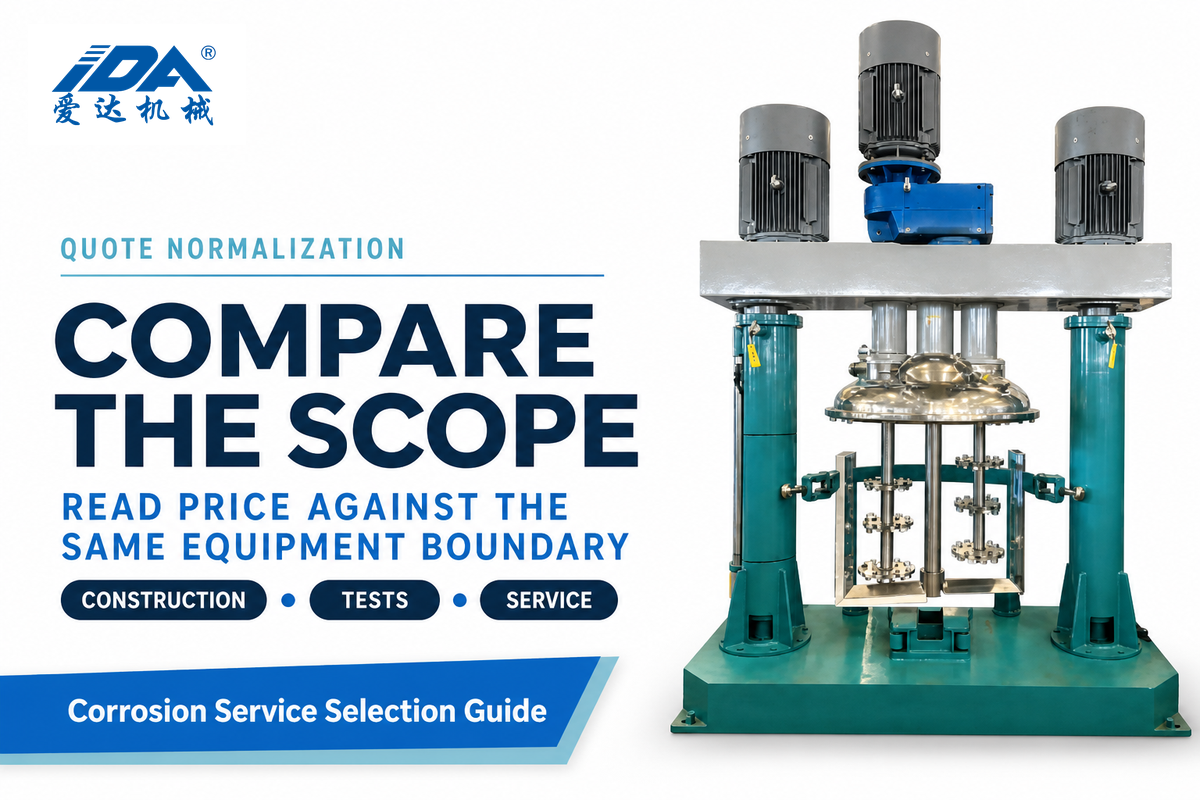
Two corrosion-resistant reactor quotes can differ because they price different equipment boundaries. Capacity, full-vacuum design, pressure rating, solid alloy versus cladding or lining, agitator complexity, heat-transfer area, seals, surface finish, nondestructive examination, documentation, acceptance testing, spare parts, and field service all change the proposal.
Normalize the duty sheet before comparing proposals so every price is read against the same service, construction boundary, and evidence request.
| Scope item | Offer A | Offer B | Buyer action |
|---|---|---|---|
| Wetted construction | Record exact alloy, lining, cladding, internals | Record exact alloy, lining, cladding, internals | Reconcile every exclusion and interface. |
| Mechanical duty | Record pressure, vacuum, cycles, agitation | Record pressure, vacuum, cycles, agitation | Return non-equivalent design cases for revision. |
| Inspection and tests | List included methods and acceptance criteria | List included methods and acceptance criteria | Price missing evidence as an open risk. |
| Service and repair | List warranty, spares, field support, repair route | List warranty, spares, field support, repair route | Separate purchase scope from lifecycle assumptions. |
Comparable scope isn’t total cost of ownership. NIST’s manufacturing equipment guide treats long-term cost-effectiveness across financing, installation, use, maintenance, downtime, warranty, expected life, and disposal. Public research for this article didn’t find decision-grade lifecycle data comparing the four reactor routes. Keep those cells as supplier and owner inputs instead of publishing a false payback number. [12]
10. From Material Shortlist to an IDA Reactor Configuration
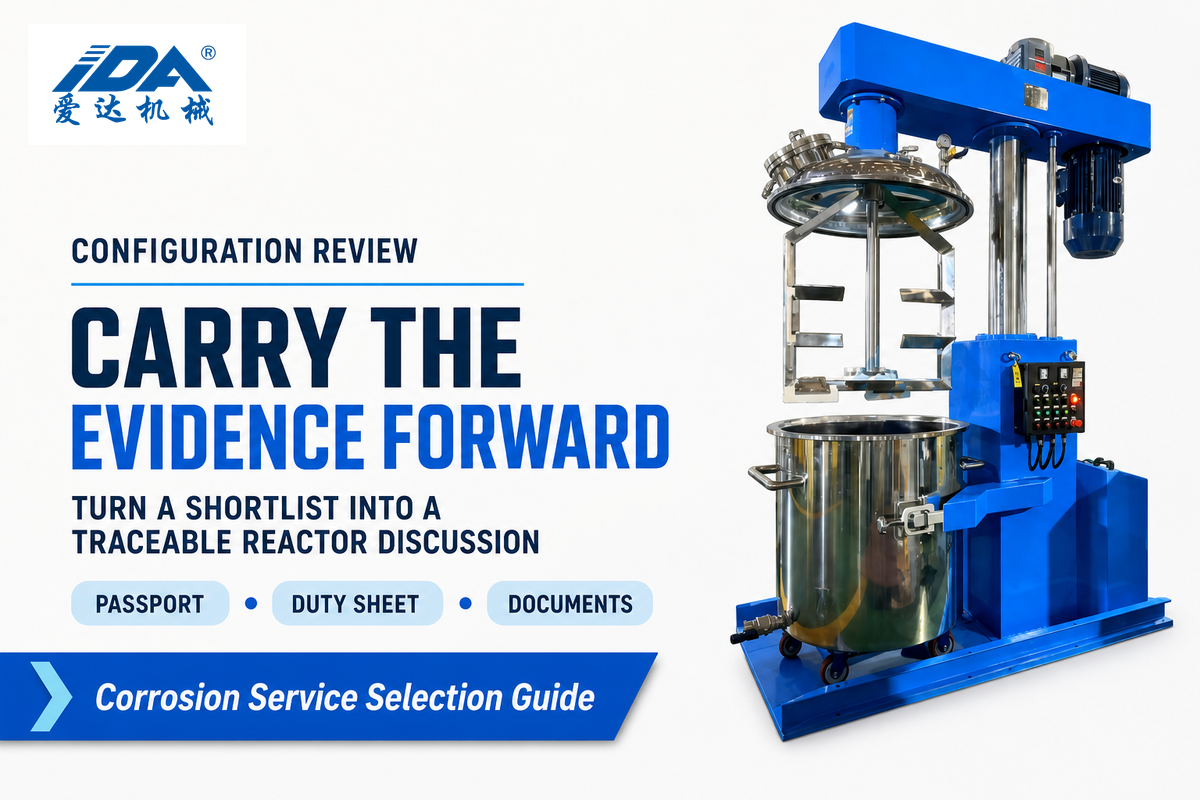
A completed passport and duty sheet give IDA a defined basis for discussing chemical reactor configuration options. IDA can identify which inputs remain missing, which construction routes warrant review, and which drawings, certificates, inspections, or tests belong in the proposal. Its product page is first-party scope information, not independent proof that one material fits a particular corrosive service.
Send the service passport, Corrosion Boundary Trace, duty sheet, and required document register together. Ask the proposal to state assumptions and exclusions in writing. That keeps the commercial handoff tied to the same engineering boundary used in the shortlist and creates a traceable basis for later inspection and long-term reliability review.
Request a corrosion-service reactor review
FAQ: Corrosion Resistant Reactor Questions
What materials are used in corrosion resistant reactors?
Common routes include stainless steel, nickel alloys, titanium, zirconium, glass-lined steel, cladding, and polymer-lined construction, selected against the complete documented chemical and mechanical service conditions.
Selection depends on every wetted chemical, concentration, temperature, pressure, impurity, cleaning step, flow condition, mechanical load, and contamination limit. Construction matters as much as the material name. Solid-alloy, clad, glass-lined, and polymer-lined vessels have different interfaces, damage modes, inspection methods, and repair boundaries. The shortest honest answer is a condition-bound shortlist, not a universal material ranking.
Why is Hastelloy preferred over stainless steel in some corrosive applications?
A selected nickel alloy may retain a larger corrosion margin than common stainless grades in a defined service, but only condition-specific evidence can establish that advantage.
“Hastelloy” is still a family label, not a universal upgrade. Grade, reducing or oxidizing chemistry, concentration, temperature, chloride level, impurities, weld condition, stress, and fabrication route matter. Comparison should use condition-specific evidence and include repair, inspection, contamination, and mechanical requirements before a nickel alloy enters the request for quotation. A supplier should also state the exact grade, product form, filler metal, post-weld thermal processing where applicable, and construction boundary. Higher purchase cost alone neither proves nor disproves suitability.
How are corrosion resistant reactors maintained?
Maintenance follows credible damage mechanisms, construction details, operating history, and the owner’s mechanical-integrity program, with inspection focused on the relevant wetted boundaries, interfaces, and repair history.
Metallic vessels may need attention around welds, crevices, nozzles, deposits, and high-flow zones. Glass-lined equipment needs controlled handling and appropriate lining-defect inspection. Seals, gaskets, probes, jackets, supports, coatings, and insulation require their own review. Operators should record chemistry excursions, cleaning changes, repairs, examination methods, measured locations, and acceptance decisions so later findings have a baseline. Inspection frequency cannot be taken from this article; it depends on applicable rules, condition, corrosion-rate knowledge, operating history, and qualified owner procedures. An unexpected change in damage pattern should trigger reassessment rather than an automatic return to the previous interval.
Is glass-lined construction always better for acid service?
No. Glass-lined construction has broad chemical utility, but it also has chemical exclusions and distinct damage modes that must be checked against the exact duty.
Review impact, abrasion, thermal shock, static discharge, cleaning, defect detection, and repair access. Supplier-specific limits belong to the exact design.
What information should I send with a corrosion-resistant reactor inquiry?
Send chemistry, operating ranges, exposure sequence, mechanical duty, purity limits, construction boundaries, required documents, acceptance tests, and a clear list of unresolved process conditions and assumptions.
Include all fluids and impurities, concentrations, phases, dissolved gases, temperature and pressure ranges, flow or mixing duty, solids, heating and cooling, cleaning, startup, shutdown, upset conditions, product contamination limits, utilities, code basis, required certificates, inspection methods, and repair expectations. Mark unknowns clearly. Ask the supplier to list every assumption, exclusion, proposed verification method, repair boundary, and item that remains the owner’s responsibility.
Summary: The Decision Sequence
Define the service first. Screen credible mechanisms second. Compare construction routes without pretending that a table is approval. Trace internal and external corrosion boundaries, assign evidence to each component, and make the supplier state assumptions. Then compare like-for-like quote scope while keeping lifecycle economics separate. Treat ASME’s cited 15 psig boundary as a code-review trigger, not a material or certification approval.
That sequence won’t produce a universal winning material. It will produce something more useful: a shortlist that a qualified team can challenge, test, document, and carry into a reactor configuration review.
References & Sources
- Materials Selection and Design for Corrosion Control AMPP.
- Corrosion Testing Georgia Institute of Technology.
- Corrosion and Selection of Materials UK Health and Safety Executive.
- DOI record for the Low-Temperature Stress Corrosion Cracking study Crossref scholarly metadata.
- Chloride Contrast in Freshwater and Seawater U.S. Geological Survey.
- Glass Lined Equipment Repair and Maintenance Materials Technology Institute.
- Maintenance and Repair of Glass-Lined Equipment Chemical Engineering.
- Corrosion Data Program U.S. National Institute of Standards and Technology.
- 29 CFR 1910.119 Appendix C, Process Safety Management Compliance Guidelines and Recommendations U.S. Government Publishing Office.
- NDK Pressure Vessel Investigation Findings U.S. Chemical Safety Board.
- BPVC Section VIII Division 1, 2025 ASME.
- Manufacturers: Pre-Purchase Guide for Equipment NIST Manufacturing Extension Partnership.
Related Articles
- Chemical Reactor Guide: reactor types, operation, heat transfer, and general selection.
- High-Viscosity Mixer Selection: connects rheology and agitation duty to equipment design.
- Industrial Mixing Equipment for Coatings: compares process roles in coatings production.
- IDA Equipment Blog: browse additional mixing and processing guides.
Method note: case values remain scoped to their cited source. Fictional duty-sheet entries illustrate record structure only. Product-page statements are first-party scope information. Every named framework is a structured comparison aid for readers, not a standard or engineering approval.