Get in Touch with IDA

How Twin Shaft Mixer Works: A Complete Engineering Guide

Contents
show
The twin shaft mixer stands as an essential equipment solution for achieving both efficiency and consistent performance across industrial mixing processes. Delivering exceptional power and operational flexibility, these systems are deployed across construction, chemical manufacturing, pharmaceuticals, food processing, and agricultural operations. Understanding the specific mechanisms behind their performance — through component design, counter-rotating shaft dynamics, and intelligent control systems — is what separates informed selection from guesswork. This guide provides a thorough investigation into the engineering concepts that define the twin shaft mixer: how it is built, how it operates, why it outperforms alternatives, and how to select the right configuration for your application.
2
Parallel Counter-Rotating Shafts
7
Core System Components
↓
Reduced Mixing Time vs. Single-Shaft
I 4.0
Industry 4.0 Integration Ready
Introduction to Twin Shaft Mixers
What Is a Twin Shaft Mixer?
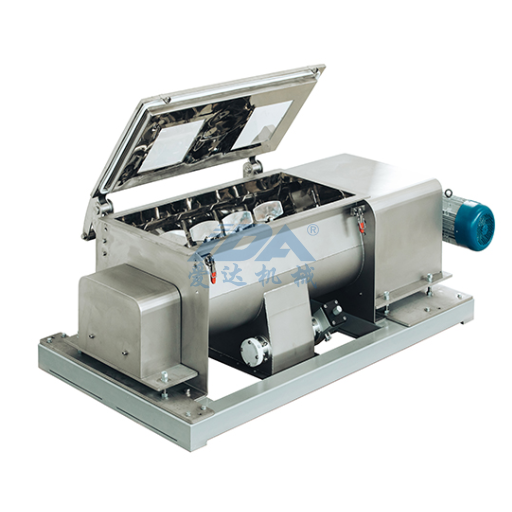
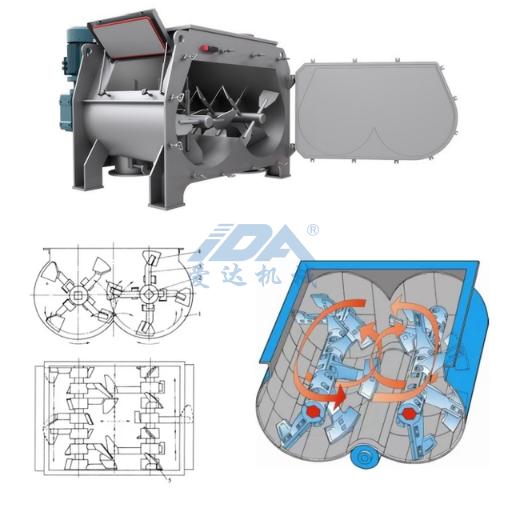
The design of a twin shaft mixer serves industrial purposes by enabling efficient mixing of materials during the blending process. The system features two parallel shafts which operate together to mix materials through their attached mixing paddles and arm components. Twin shaft mixers prove most effective for industrial applications which need to process heavy and abrasive materials that include concrete and grout and composite materials in construction and chemical processing and agricultural work. The system creates high shear forces together with strong mixing chamber turbulence which produces uniform material distribution in shorter time periods when compared to single-shaft systems. Modern systems use automated control systems together with materials that resist wear and energy-saving drive components to establish the twin shaft mixer as vital equipment for demanding industrial operations.
The Twin Shaft Mixer System: Core Components
Importance of Mixing Technology Across Industries
Mixing technology functions as an essential factor which determines both product quality and operational efficiency for all industries that utilize it. The construction field depends on twin shaft mixers to create high-performance concrete which maintains consistent properties that ensure structural integrity. Pharmaceutical manufacturing requires exact mixing methods to produce uniform active ingredient distribution which meets both regulatory and patient safety standards. Food processing companies use mixing technology to maintain standard flavor and texture and quality throughout their production of bulk food products.
Industry Insight
Industries increasingly prefer automated mixing systems with integrated sensor technology because these systems simultaneously improve output, decrease material wastage, and reduce environmental footprint. Businesses that implement advanced mixing solutions can produce superior products while decreasing production expenses — demonstrating that mixing technology is not a supporting function, but a primary driver of industrial progress and operational competitiveness.
Working Principle of Twin Shaft Mixers
How Twin Shaft Mixers Operate
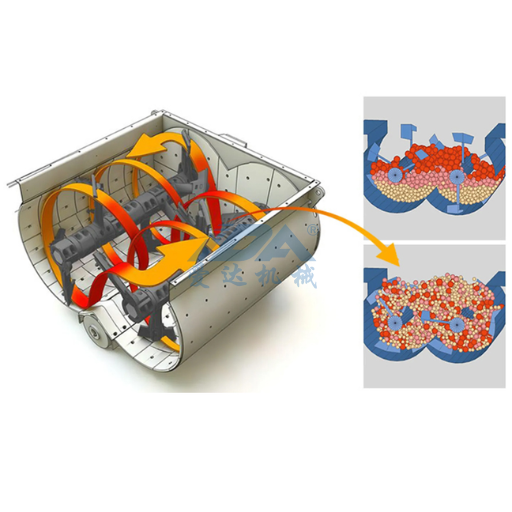
Twin shaft mixers function by operating two parallel, horizontal shafts equipped with paddles or blades that rotate in opposite directions. The paddles generate a fluidized zone inside the mixing chamber which enables complete material homogenization through continuous lifting and folding and blending processes. This proves essential for producing the consistent mixtures that construction, food, and chemical industries require. Automated controls have improved system performance through digital sensor advancements which enable current systems to monitor their speed and operational status while users can modify settings based on material characteristics. The changes lead to higher product quality which decreases mixing times and reduces energy consumption throughout different operational states.
Principle 01
Counter-Rotating Shaft Action
The two shafts rotate in opposite directions, creating a mixing dynamic that enables complete blending of difficult or heterogeneous materials. Counter-rotation continuously breaks particle aggregates and prevents clumping — especially valuable in pharmaceutical and advanced composite production where high precision is required. This design also reduces mixing time and minimizes energy consumption compared to single-direction alternatives.
Principle 02
Paddle Fluidization Zone
Arranged in a ‘W’ shaft configuration, the paddles move particles from the center of the mixer trough toward both sides and continuously return them to the center. This overlapping motion generates a fluidized zone — distributing air around particles and suspending them to enable uniform distribution of granules and powders regardless of density differences. The combined lifting and axial movement completes mixing cycles faster than any single-shaft configuration.
Principle 03
Paddle Mixer Gentle Blending
In applications requiring controlled shear — food processing, pharmaceuticals, delicate granular materials — the paddle design enables multi-directional material movement without excessive shear force. Paddles lift and fold material rather than aggressively shearing it, protecting sensitive ingredients. Programmable settings, automated batch controls, and real-time monitoring further enhance precision, making this mechanism well suited to variable batch requirements and sensitive formulation types.
Advantages of Using Twin Shaft Mixers
Common Applications of Twin Shaft Mixers

Concrete Mixing
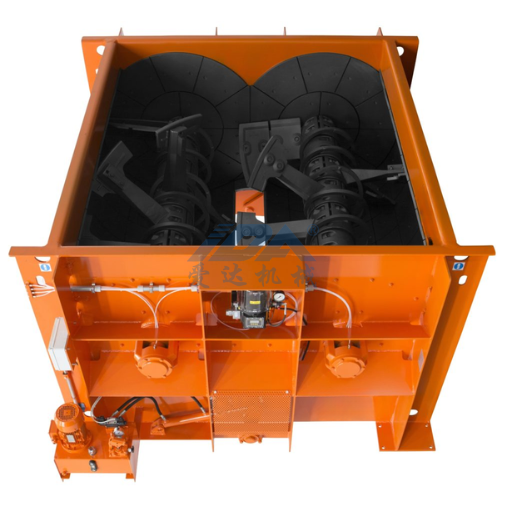
Twin shaft mixers are the most reliable equipment for producing concrete, achieving uniform material mixtures throughout every production cycle. The twin-shaft system enables superior aggregate distribution and complete blending of cement, water, and additives at all production stages — reducing mixing time and energy consumption while delivering concrete with measurably superior strength.
- Ready-mix concrete plants and batching systems
- Precast concrete element manufacturing
- Large-scale civil and infrastructure construction
Powder & Shear Mixing
Powder and shear mixing is essential to both pharmaceutical and food production processes because it enables manufacturers to achieve uniform particle distribution while eliminating all clumps during their production runs. The applications require high-performance mixers which deliver uniform material distribution together with consistent results across different production runs and accurate control of particle dimensions. Machine learning algorithms now study how particle size distribution, moisture content, and mixing speed interact — driving the development of increasingly energy-efficient systems.
- Pharmaceutical powder blending and granulation
- Fine chemical and specialty compound preparation
- Advanced composite material processing
Food, Chemicals & Cosmetics
The food industry requires accurate mixing techniques to produce products that have identical taste and texture characteristics when they reach their full production capacity. The chemical industry utilizes mixing technology to create consistent chemical compounds which enable faster reactions and safer handling of dangerous substances. Both industries now use automated systems together with machine learning technology to achieve better resource management and to meet their legal obligations.
- Bakery, confectionery, and dairy production
- Chemical compound synthesis and blending
- Cosmetic and personal care formulation
Agricultural & Specialty Applications
Agricultural processing relies on twin shaft mixers to blend forage, animal feed, fertilizers, and soil amendments with uniform ingredient distribution. Specialty applications extend to renewable energy operations — including biomass feedstock preparation — where standardized mixing directly improves energy system efficiency. The flexibility of twin shaft mixer design makes these systems readily adaptable to both established and emerging processing requirements.
- Animal feed and forage blending
- Fertilizer and soil amendment preparation
- Biomass feedstock and renewable energy applications
Choosing the Right Twin Shaft Mixer for Your Needs

Factors to Consider When Selecting a Mixer
Key Selection Criteria
- 1
Material Type & Characteristics
Assess viscosity, density, and abrasiveness. These properties determine the required mixer capacity, shaft specifications, paddle geometry, and liner material — all of which directly affect performance and service life. - 2
Production Volume & Cycle Time
Analyze required batch sizes and processing frequency to determine the appropriate mixer size and configuration. Matching capacity to efficiency objectives prevents both production bottlenecks and unnecessary capital investment. - 3
Component Quality & Durability
Evaluate the quality of mixing blades, gearboxes, bearings, and liner materials. Industries handling abrasive or corrosive materials require components rated for those specific service conditions to prevent accelerated wear and unplanned downtime. - 4
Energy Efficiency & Maintenance Needs
Evaluate both ongoing energy costs and maintenance schedules. Energy-efficient drive systems and accessible maintenance points reduce total cost of ownership — which often exceeds the initial purchase price over the equipment’s full service life. - 5
Automation & Industry 4.0 Features
Current buyers consistently prioritize automated controls, sensor integration, and Industry 4.0 connectivity. These features enable real-time process observation, operation optimization, and predictive maintenance — reducing downtime and increasing productivity across the production cycle.
Understanding Your Mixing Requirements
Your mixing requirements necessitate a complete evaluation of material viscosity and required mixing speed and batch size and needed automation level together with the current operational parameters and your upcoming production expansion. The growing search interest for “how to choose the right industrial mixer” and “mixer capacity for manufacturing” demonstrates an increasing need for customized industrial solutions. The understanding of these parameters together with the alignment to current technology capabilities enables you to achieve optimal performance and extended system reliability for your production objectives.
Consulting Experts for Optimal Solutions
The combination of expert advice and modern data analysis tools significantly improves equipment selection outcomes. Engineers and application specialists bring in-depth knowledge of material behavior and proven configurations that specification sheets alone cannot replicate. The search trends together with current industry data create a wider view which shows emerging solutions and market preferences. The organization uses these resources to build decision-making processes which produce dependable results and support upcoming production needs.
Frequently Asked Questions
Reference Sources
Source 01
Twin-Shaft Mixers’ Mechanical Behavior Numerical Simulations of the Mix and Phases
Explores the mechanical behavior and performance optimization of twin-shaft mixers through numerical simulation methods and phase analysis.
Source 02
Justification of the Design of the Two-Shaft Mixer of Forages
Discusses the engineering design principles and functional performance of twin-shaft mixers applied to forage processing in agricultural settings.
Source 03
Mechanical Design of Mixing Equipment
Provides a comprehensive examination of the mechanical design and working principles for industrial mixing equipment, including twin-shaft configurations.