Get in Touch with IDA


By Karry · Updated October 2026
How is toothpaste made in a factory? Manufacturers weigh ingredients, prepare a liquid base, disperse powders, create a paste through controlled mixing, remove air that’s trapped in the paste, and fill and seal tubes. The most difficult part of manufacturing is getting all of those stages to work in conjunction with one another. A paste must mix evenly and uniformly throughout in order to flow through a transfer line and leave a clean, smooth ribbon on a toothbrush.
This industrial toothpaste manufacturing guide follows the paste from its origin at raw ingredients to when it’s finished being packaged. It explains why white abrasive paste and clear gel can need different mixing actions, and how to connect a batch size to a filler’s actual output. The sequence of processes should follow the approved formulation; quantities mentioned are for a hypothetical scenario for planning purposes.
Factory process at a glance
- Water, humectants and dispersed binders form the starting base.
- Powder wetting, shear and air removal shape the product as well as its composition.
- Batch release and package checks follow their own test methods; a smooth appearance alone is insufficient.
How Is Toothpaste Made? Seven Factory Steps
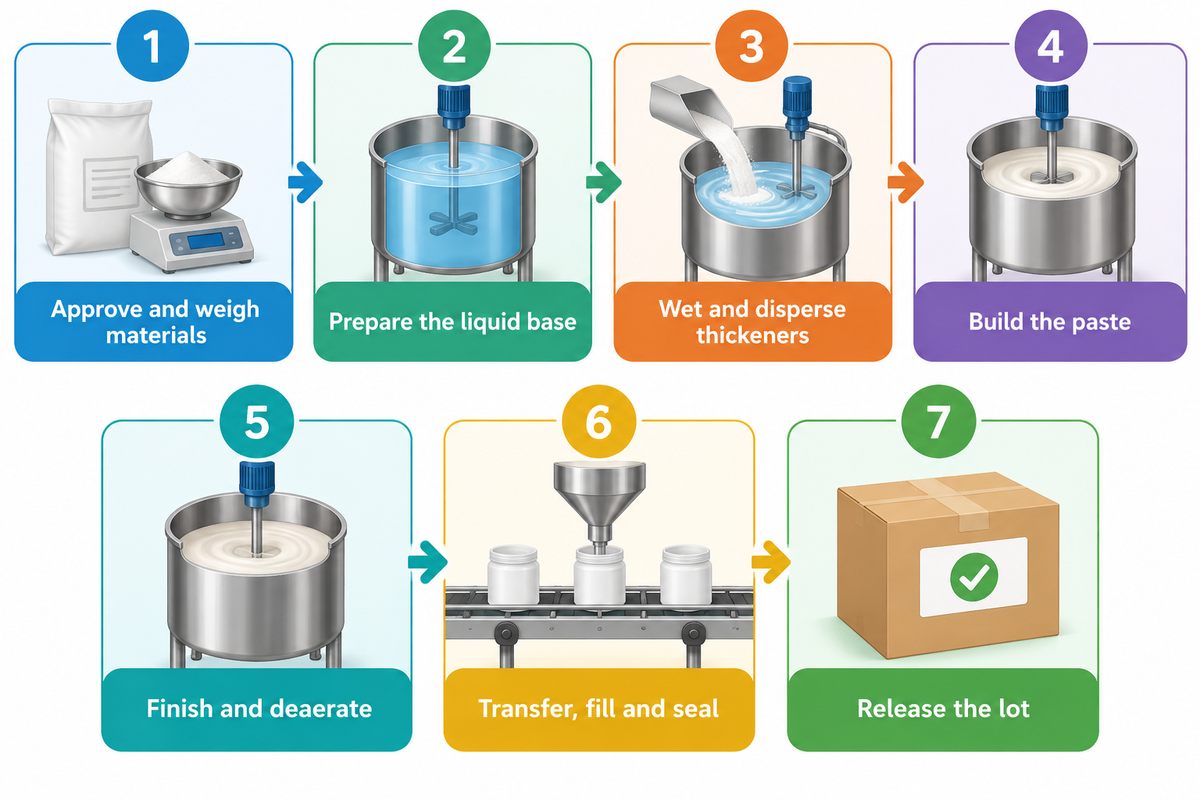
The industrial toothpaste production also combines the functions of measured ingredient addition, mixing, deaeration and packaging. A practical seven-step process separates material preparation from the release of finished product. Some factories use separate premix vessels; others combine duties in a vacuum mixer. The selected arrangement must reproduce the formula’s required order of addition and quality attributes.
- Approve and weigh materials. Verify ingredient identity, release status and correct amounts against the batch record.
- Prepare the liquid base. Charge the specified water and humectant, allowing space for later powder additions.
- Wet and disperse thickeners. Introduce the binder by its validated route so the outside does not form a gel skin around dry powder.
- Build the paste. Incorporate abrasives and the remaining ingredients while controlling mixing action and temperature.
- Finish and deaerate. Add sensitive or foam-forming ingredients at the specified stage and remove entrained gas.
- Transfer, fill and seal. Supply the toothpaste tube filler with a stable product and check the dose and closure.
- Release the lot. Review analytical results, packaging checks and batch documentation before distribution.
This step-by-step production process is also concerned with water preparation, cleaning, and the storage of materials, as well as quality assurance. Those operations involved in toothpaste manufacture need time and equipment outside the main vessel. The FDA’s July 2025 toothpaste manufacturer warning letter provides an example of why Process Validation and incoming material controls are separated from equipment installation.
Combining functions in a single vessel can reduce the number of transfers in a line. The vessel, however, remains occupied between loading, finishing, emptying and cleaning. A faster filling machine can’t compensate for that lost time.
What Ingredients Are Used to Make Toothpaste?
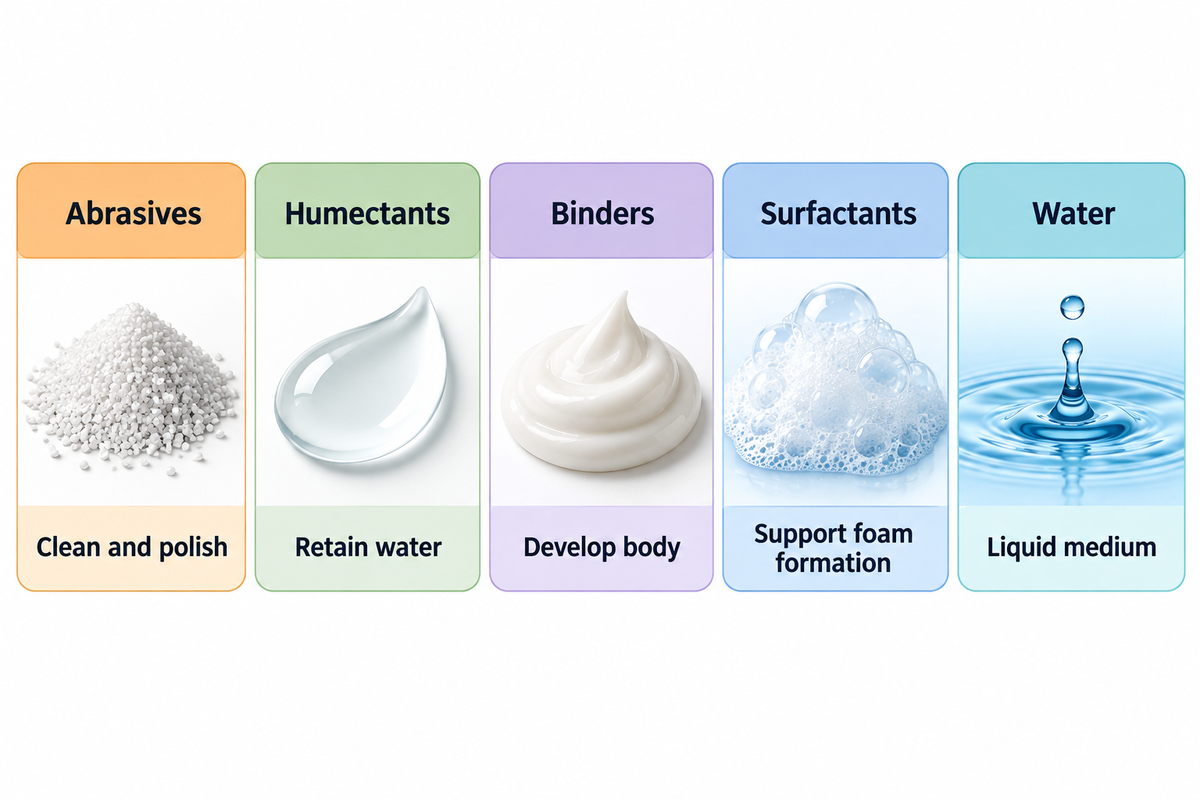
Modern toothpaste usually combines an abrasive, water, humectants, a binder, flavoring and a surfactant. Anticaries products contain an appropriate active ingredient. These ingredients perform different functions. A formulation should be made of a list of ingredients which are compatible with each other.
The American Dental Association’s toothpaste overview focuses on the function of various ingredients. Abrasives help in the removal of plaque and food particles from teeth; fluoride supports cavity prevention. The table groups ingredients used in toothpaste formulations by manufacturing function, rather than prescribing a formula.
| Family | Examples | Function | Process question |
|---|---|---|---|
| Abrasives | Hydrated silica; calcium carbonate | Help clean and polish tooth surfaces | Can the mixer wet the powder and circulate the loaded paste? |
| Water | Water meeting the formula’s quality requirements | Liquid medium | How are identity, quality and added quantity controlled? |
| Humectants | Sorbitol; glycerin | Help retain water and maintain texture | Are incoming-material tests and viscosity effects addressed? |
| Alternative humectant | Propylene glycol, where specified | Moisture-management component | Is it compatible with the intended formulation and market? |
| Binders | Cellulose gum; carrageenan | Develop body and suspend solids | What prewetting and hydration sequence prevents lumps? |
| Surfactants | Sodium lauryl sulfate | Support dispersion and foam formation | When can it be added without excessive aeration? |
| Anticaries actives | Sodium fluoride; stannous fluoride; sodium monofluorophosphate | Provide the specified anticaries function | Does the complete formula preserve available fluoride? |
| Sweeteners | Saccharin and other permitted sweeteners | Adjust toothpaste taste | Is the sweetener uniformly dissolved or dispersed? |
| Flavor system | Mint oils or other flavoring | Give the intended sensory profile | Does the late-stage process preserve the selected flavor? |
| Appearance modifiers | Titanium dioxide or a permitted dye, where specified | Control opacity or color | Are color dispersion and market requirements satisfied? |
| Preservation system | A preservative selected for the complete formula, where needed | Contribute to microbiological control | Has the final formulation passed its preservation assessment? |
Binders and humectants are compounds that help toothpaste maintain its intended body and moisture. Sweeteners like saccharin adjust taste, while abrasive choices can include dicalcium phosphate as well as silica. These ingredients are used to satisfy different physical and sensory requirements; changing one can affect several others.
Abrasive cleaning contributes to keeping teeth clean when brushing your teeth, but “more abrasive” is not a complete dental hygiene product specification. Perry Romanowski’s Formulation Explanation puts the question of ingredient selection more appropriately, in our context.
“The key to a good abrasive ingredient is the size, shape, brittleness, and hardness of the particles.”
Ingredients like calcium carbonate interact with other components of the formulation. A 2021 study of six calcium-containing dentifrices noted that the total and bioavailable fluoride could differ substantially. That lab study concerned particular products and test conditions. For formulation development, it makes the choice of fluoride, abrasive, and analytical method a joint decision.
Fluoride helps prevent tooth decay and can even remineralize early enamel lesions. That action concerns tooth enamel at an early stage of mineral loss; it does not mean an established cavity repairs itself. The manufacturing question is whether the finished formula preserves the active ingredient’s intended function. A dentist is meant to address an individual’s dental care needs.
Whitening toothpaste, tartar-control products and sensitivity products add further requirements. A toothpaste that aims to whiten teeth or address gum disease needs claim-specific substantiation; ingredients such as potassium nitrate or strontium chloride should be considered within the applicable product category and market rules.
The Mixing Sequence: Turn Powders Into a Uniform Paste
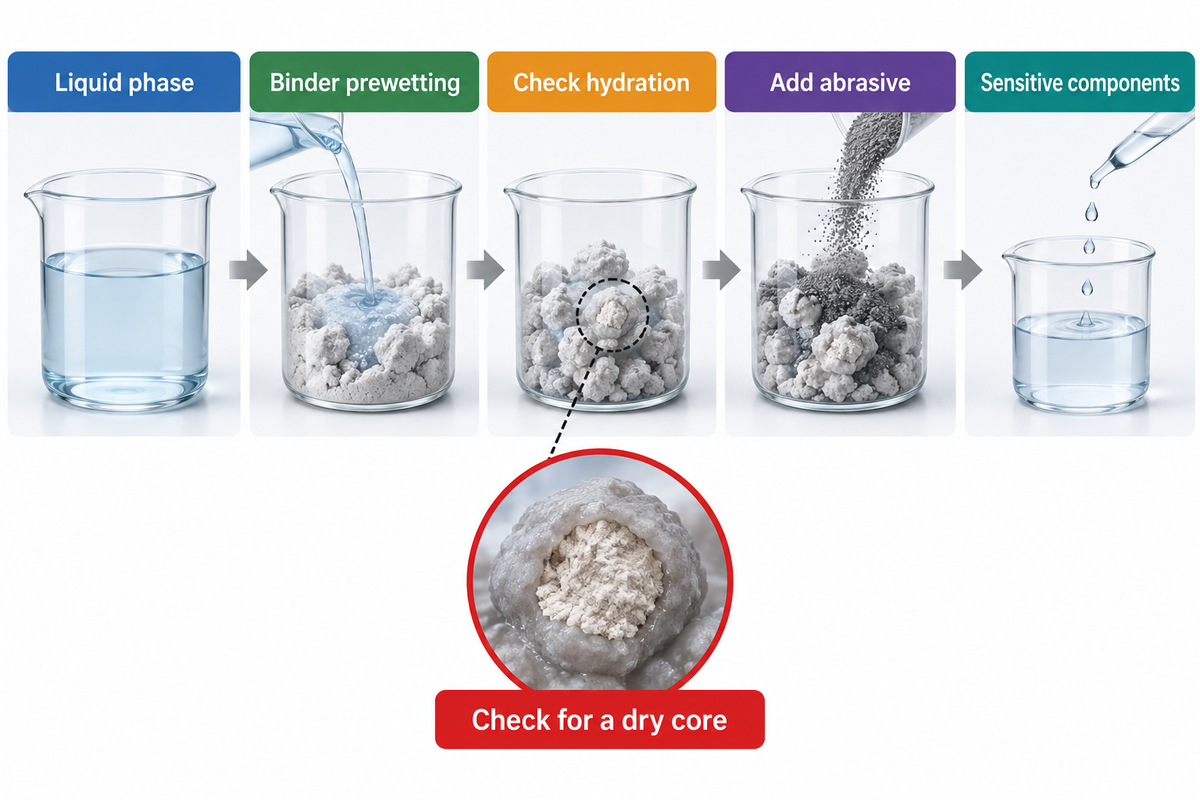
The mixing process initially gives powders access to a compatible liquid before the paste becomes too viscous to circulate; a binder that hydrates around a dry core can leave persistent lumps. Once abrasives increase the solids loading of a formulation, a mixer needs enough bulk movement to repeatedly bring the material through its mixing region.
Powder-to-Paste Wetting Checkpoints
Review the proposed sequence: create the liquid phase, choose the binder’s prewetting route, check hydration, add abrasive, and add other sensitive components. Each rung has an observable endpoint. Bulk circulation helps evenly distribute the abrasives, while local mixing breaks down suitable agglomerates. Check gum dispersions for a dry core before the paste becomes too hard to circulate.
Silverson’s application guidance describes prewetting some rheology modifiers in glycerin or another suitable nonaqueous ingredient. ROSS describes a different sample route using discrete polymer and gum dispersions. A gum that disperses well in one base may act differently in a changed humectant/salt system or a different solids concentration.
The 2022 RSC Advances carbomer-mixing study adds a useful boundary: the mixing method can change the hydrated polymer itself. Instead of assuming that all solid and liquid combinations are solved with a longer time, it’s prudent to assess the components and their response.
What makes toothpaste foamy?
A surfactant like sodium lauryl sulfate helps toothpaste foam when mixed with water and agitated during brushing. During manufacturing, the same behavior can complicate mixing and filling. In the examples of suppliers cited, detergent enters later under slower agitation. Foam volume is a different measurement from cleaning performance or active-ingredient content.
A formula that looks nice and foamy during a bench demonstration may become troublesome in a receiving hopper. Before increasing mixer speed to scrub out a visible lump, check if it’s undispersed powder, an incompatible component, or a structure that has already hydrated incorrectly.
Why Vacuum Mixing Changes Density and Filling
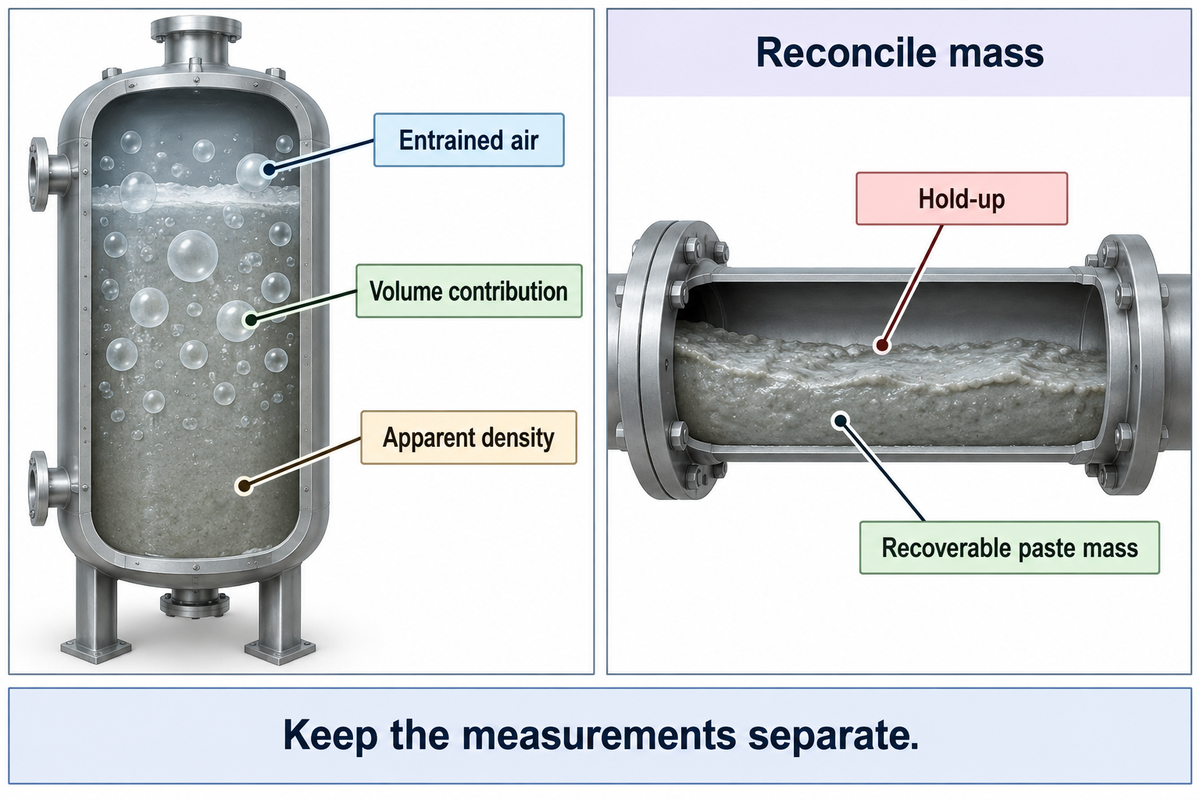
Vacuum mixing removes entrained air from toothpaste. Air carried by powders, drawn into a surface vortex or stabilized by surfactant occupies volume without contributing useful paste mass. Removing it can change apparent density and dispensing behavior. Hygienic manufacture and microbiological release depend on their own controls and tests.
For a fixed-volume dose, mass is density multiplied by volume. A volumetric filler can function with an air fraction. A variable air fraction changes mass at a nominal volume displacement. A gravimetric system instead measures mass, although product supply, valve behavior and control settings still affect its operation.
The public scope of USP-NF General Chapter 755, Minimum Fill describes using mass and preparation density for volume-labeled products to reduce the influence of entrained air. This is a good measurement principle, but its applicability must be established for the product and market. It is not a universal toothpaste filler accuracy specification.
Air-to-Fill Loss Map
| Observation | Possible process connection | Useful check |
|---|---|---|
| Powder floats | Poor wetting or entrained gas | Addition route and wet-out endpoint |
| Foam rises | Surfactant agitation or air entry | Speed and timing of detergent addition |
| Batch volume changes | Changing air fraction or temperature | Density measured by a defined method |
| Mass varies at a fixed dose | Density or metering variation | Separate density checks from dose checks |
| Paste spits at the nozzle | Air or intermittent product supply | Feed continuity and discharge behavior |
| Hopper level falls unevenly | Transfer supply does not match demand | Mass transferred per unit time |
| Paste remains in the line | Hold-up reduces recoverable batch mass | Reconcile charged and transferred mass |
| Seal area is contaminated | Cutoff or fill position needs attention | Nozzle withdrawal and tube presentation |
| Average fill passes but rejects rise | Variation is hidden by the average | Distribution of individual net contents |
These are diagnostic possibilities, not unique diagnoses. Hold-up is a mass loss from recovery; entrained air is a volume contribution. Capacity calculations become misleading when hold-up loss and entrained air are combined. IDA’s guide to foaming during liquid filling covers related concerns.
Which Mixer Fits White Paste, Gel and Sensitive Ingredients?
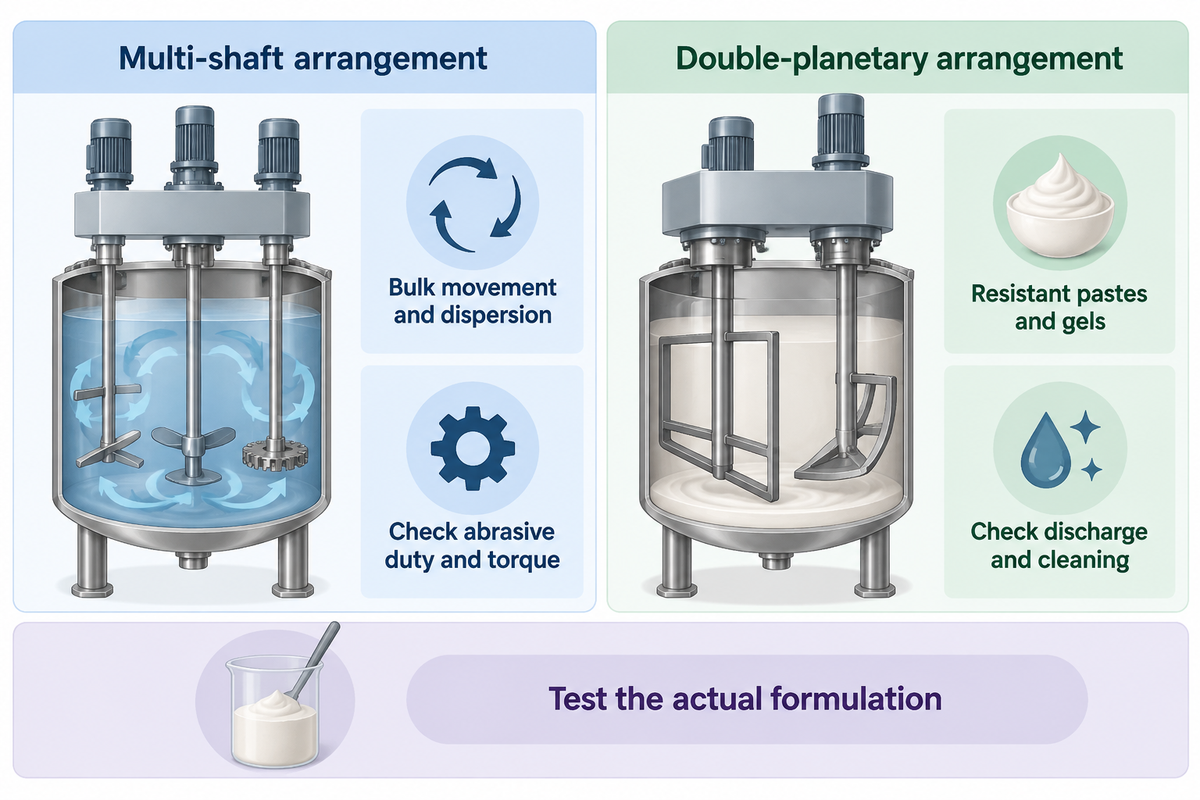
A high-shear unit can prepare a suitable premix, while a multi-shaft or planetary arrangement can handle the finished, more resistant paste. Selection relies on the formulation’s viscosity profile, abrasive loading, shear requirements and ability to circulate. White paste and transparent gel may share ingredients but place different demands on equipment.
Silverson states that high-speed rotor/stator units may not be suitable for some viscous abrasive duties and provides suitable production stages. ROSS mentions use of multi-shaft and double-planetary units for finished abrasive products at the 70,000-100,000 cP range. That’s a supplier example, not a rating or general operating window.
In the RSC study, the methods were compared using 1.22 wt% aqueous Carbopol 980 NF dispersions, sampled after 1 and 3 minutes. High-shear mixing caused more degradation of the polymer than the magnetohydrodynamic approach. These were polymer dispersions, not finished toothpaste; the result does not supply a three-minute toothpaste cycle or establish that one technology suits every gum.
Multi-shaft arrangement
- Combines bulk movement with a dispersing or homogenizing duty.
- Allows separate control of different agitators.
- Requires checks of abrasive duty, torque and vessel turnover.
Double-planetary arrangement
- Provides another route for resistant pastes and gels.
- Can combine thorough movement with a gentler mixing objective.
- Requires checks of discharge, cleaning and the complete mixing cycle.
For a discussion on equipment, begin with IDA’s triple-shaft mixer configuration or double-planetary mixer range. Provide the viscosity test method and temperature, alongside the value; viscosity without its test conditions gives too broad a range of interpretation.
It’s better to use a representative trial that covers the whole sequence than to compare motor power alone. Include the heaviest abrasive loading, final viscosity, transfer route, and cleanout requirement in that trial.
How Tubes Are Filled, Striped and Sealed
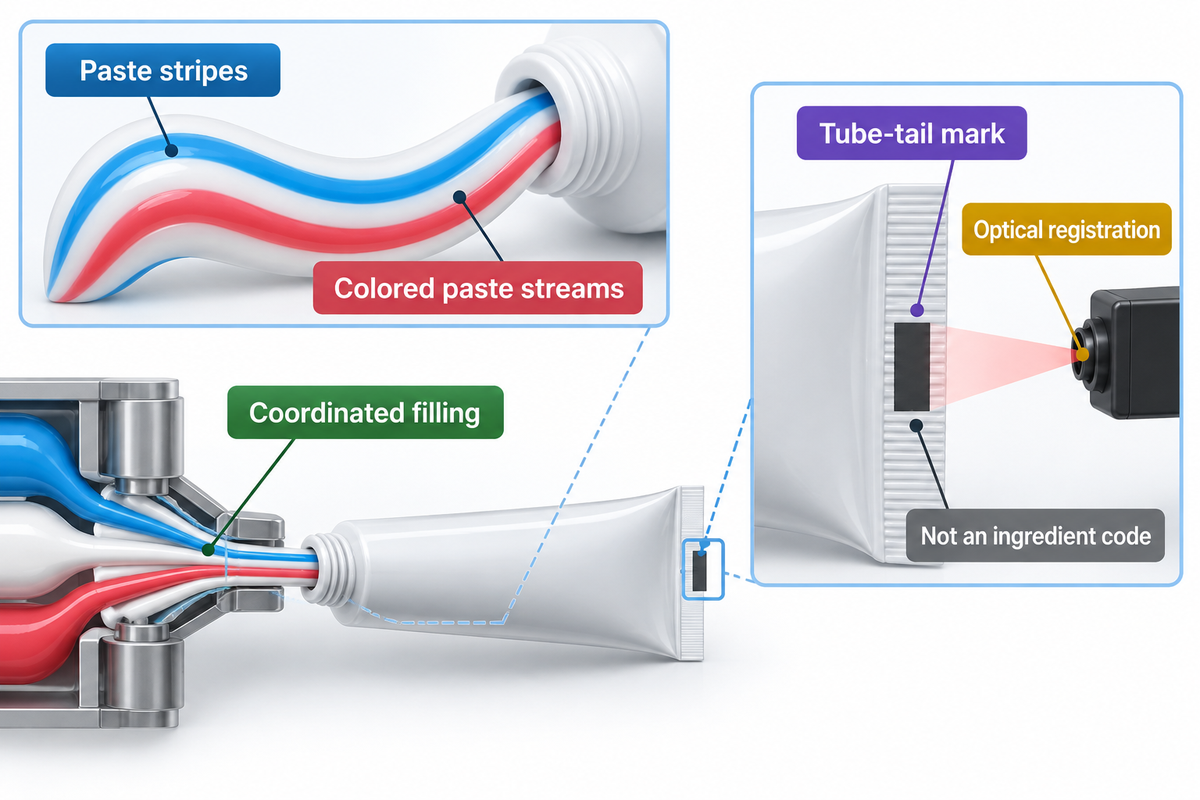
A tube filler meters toothpaste into the tube and closes it using a method suited to the package. Product supply and cut-off must be stable during the run. Striped paste needs a coordinated filling arrangement, while a printed registration mark helps the machine position the package.
Seal and tube wall structure belong in the filling trial. A 2015 Packaging Digest case about Theodent’s packaging describes a resin-and-barrier construction and a distinctive dispensing opening. It’s a historical example of a package; elements of the case shouldn’t be used for a different brand.
How do the lines stay in toothpaste?
Striped toothpaste employs a filling configuration that keeps different colored paste streams in the intended pattern. The actual dosing head, paste rheology and package design determine the route. Stability of the stripes therefore needs testing through filling, storage and extrusion; a simple filler shouldn’t be assumed to create the pattern.
Printed blocks near the sealed end of the tube are a separate feature. Colgate’s explanation of tube color marks identifies them as aids for optical sensors during tube manufacture. They do not reveal whether the toothpaste contains natural, synthetic or animal-derived ingredients.
During filling trials, test the net contents, check the orientation of the tube and the integrity of the seal, and see if paste is left in the closure area. A tube that appears shiny and smooth may still have a poor seal. Inspect the dosing principles in IDA’s Piston and Gravity Filler Guide and determine the behavior of the actual paste and the material of the tube for the trial inquiry.
Quality Checks Before a Batch Leaves the Line
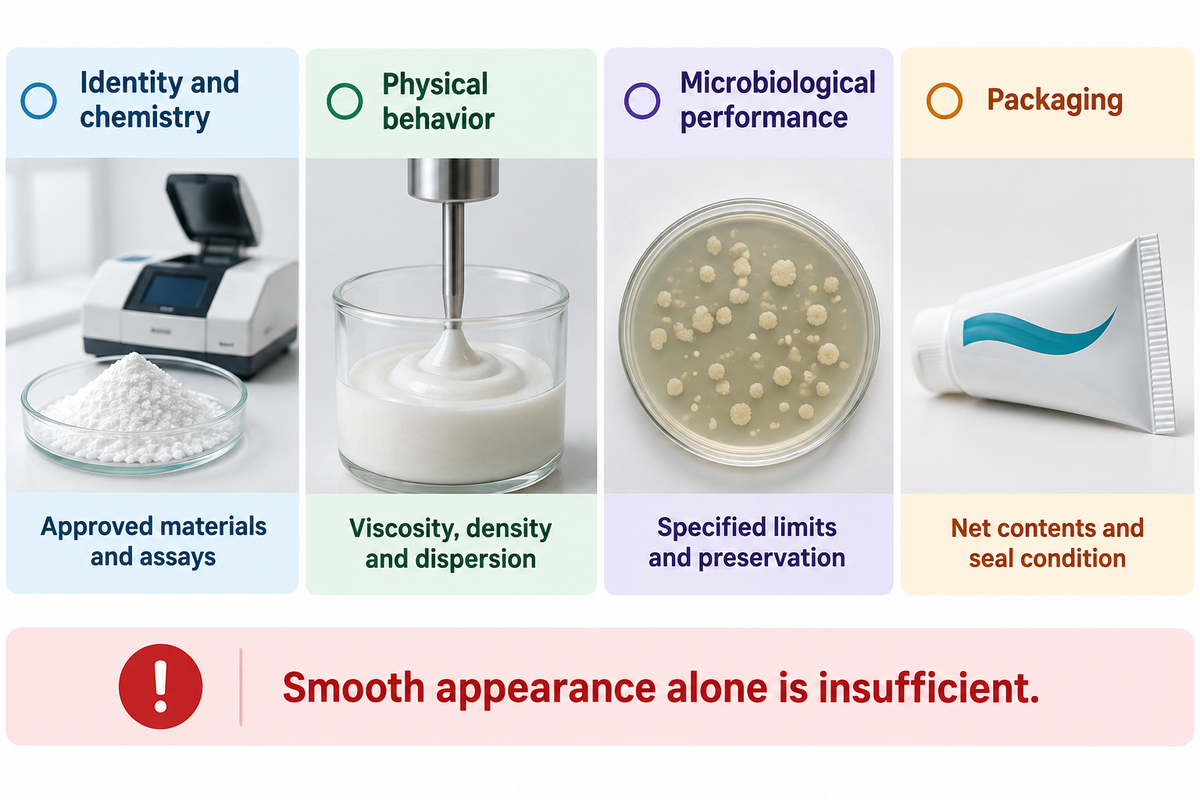
For each batch of effective toothpaste, raw-material identity, formulation chemistry, physical consistency, microbiological quality and packaging must be checked. Each of these checks answers a different question. Uniform color does not establish active content, and a correct average fill does not establish that every tube meets the applicable net-content requirements. Release requires the complete product specification.
For U.S. OTC anticaries products, FDA Monograph M021 addresses permitted active ingredients, labeling and testing conditions for products generally recognized as safe and effective under its scope. The product’s formula and claims determine the regulatory route. Describing a facility as registered does not satisfy the product’s requirements.
In its July 2025 enforcement case, FDA identified inadequate controls for high-risk components including glycerin and sorbitol solution, as well as inadequate process validation. Equipment installation and operation qualification did not demonstrate control of the critical process limits. This supports the argument to include in the project scope product validation and incoming material testing.
- Identity and chemistry: verify approved materials, active-ingredient assays and formula compatibility using suitable methods.
- Physical behavior: measure viscosity under defined conditions, density, dispersion and the ability to form the intended ribbon.
- Microbiological performance: apply the product’s specified limits and preservation assessment.
- Packaging: assess net contents, leakage, seal condition, printing and performance through the required stability period.
The 2021 fluoride study also shows why a total assay and an available-fluoride assessment are different measurements. A claim that a formula prevents tooth decay needs the appropriate evidence for that finished product; adding an ingredient associated with oral health does not settle the question.
A genuine update is FDA’s July 28, 2026 request for scientific data on a pH-cycling test model. The agency was considering evidence for a possible non-animal testing procedure under M021. The request for data represents an agency initiative to collect scientific data; it does not, by itself, revise how the agency evaluates data or allows the release of a product.
Match Batch Output to Filling Capacity and Cost
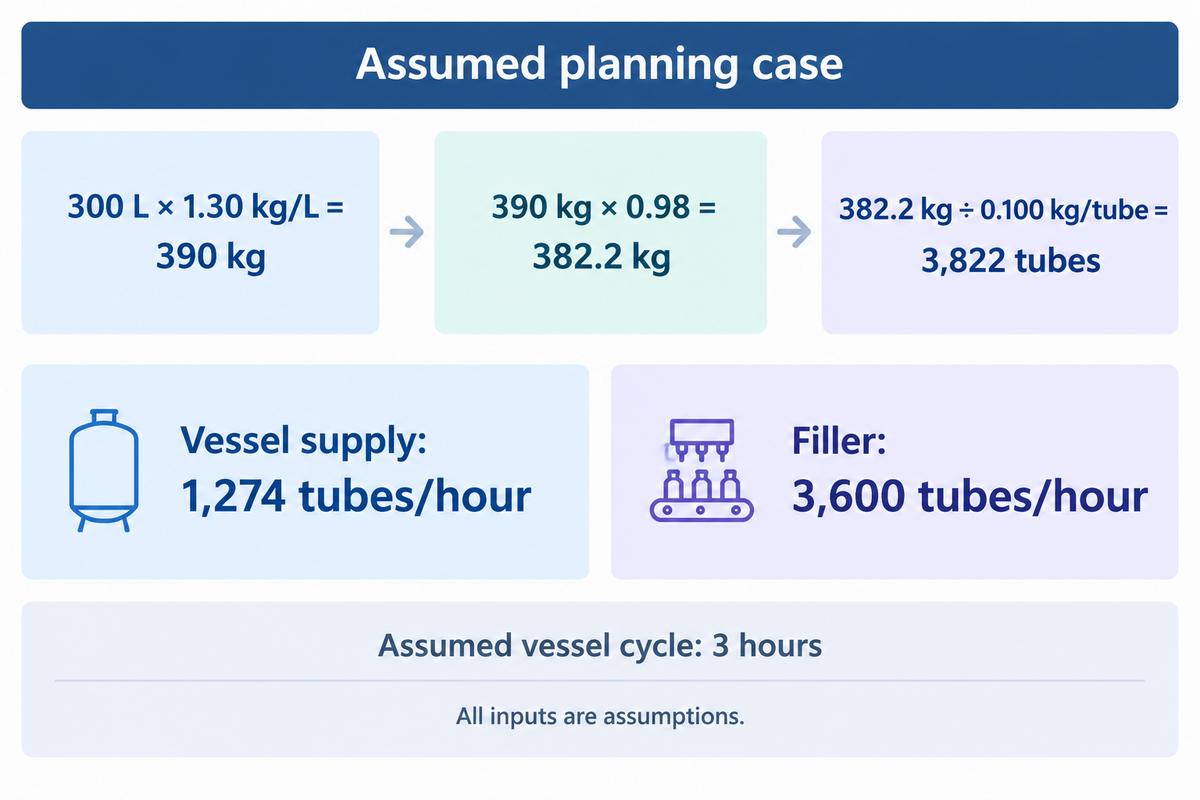
Useful line capacity is determined by recoverable paste mass and the complete batch cycle. The rate at which this paste can be packed, under assumed running conditions, determines line speed. The lower of the two speeds governs line capacity. Cleaning, changeovers, stoppages and rejected tubes reduce saleable output beyond this ideal calculation.
Worked planning case: all inputs are assumptions
Assume a 300 L working charge, a measured paste density of 1.30 kg/L, 2% transfer hold-up, 100 g net contents per tube and a filler running at 60 tubes/min.
Charged mass: 300 L × 1.30 kg/L = 390 kg.
Recoverable mass: 390 kg × 0.98 = 382.2 kg.
Theoretical tube count: 382.2 kg ÷ 0.100 kg/tube = 3,822 tubes.
Uninterrupted filling time: 3,822 ÷ 60 = 63.7 minutes.
If the complete mixing-vessel cycle is assumed to be 3 hours, its average supply is 1,274 tubes/hour. The filler’s instantaneous rate is 3,600 tubes/hour. That gap directs attention to batch supply, holding capacity and scheduling before buying a faster filler.
A first-stage mixing time should never be substituted for the complete cycle. INOXPA’s published process includes roughly 45 minutes for initial water/sorbitol mixing and additional mixing stages afterward. A 2024 contract-toothpaste-filler study also reports an overall improvement in equipment efficiency from 41.66% to 58.61% as a result of set-up improvements. That’s a 16.95-percentage-point change in that case, not a guaranteed gain for another line.
How much does it cost to manufacture one tube of toothpaste?
For the assumed batch above, a $600 processing allocation divided by 3,822 tubes gives about $0.157 per tube for that allocation alone. Full unit cost also includes ingredients, the tube and cap, labor, utilities, cleaning, quality testing, depreciation and losses wherever those were excluded from the allocation.
The purchase price of the equipment answers a different question. When comparing equipment offers, break down the water system, premix tanks, and transfer equipment, and then consider the mixer, filler, sealer and testing and secondary packing. A 100 mL tube can’t be assumed to be the same as a 100 g fill, and a density conversion must be considered.
Distributing toothpaste adds carton, storage and transport costs, and packages the tubes for the final destination. Packaging and labeling costs for the final destination must also be added to the budget for a project aimed at global distribution. When comparing machinery, these costs must be ignored.
For the small toothpaste manufacturing project, the batch-and-fill mass balance is more useful than the unqualified online “complete line” cost. IDA’s filling equipment overview is a starting point to define the transfer and packaging duties that should be part of the cost quote.
What Should You Check When Changing Toothpaste Tube Packaging?
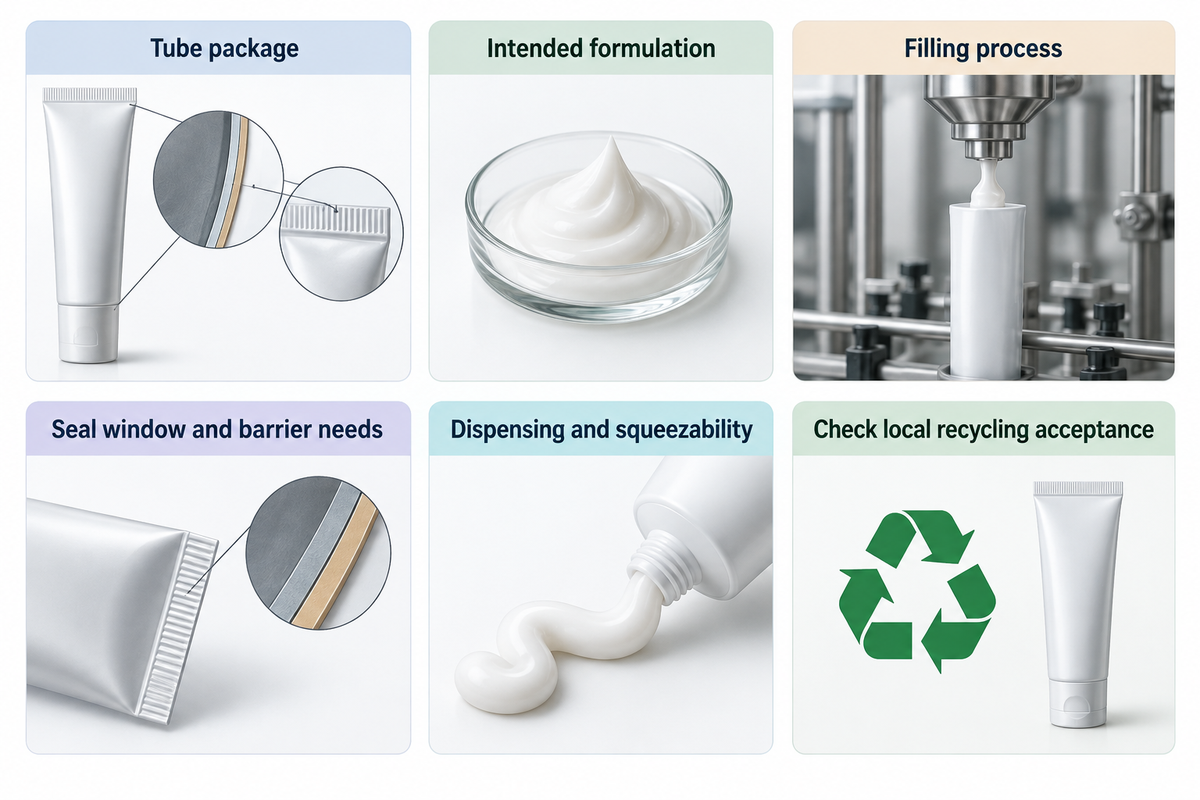
Check the seal window, barrier needs, dispensing opening, squeezability and finished appearance with the intended formulation when changing toothpaste tube packaging. The package, paste, and the filling process should be assessed together to ensure that the package will work for the filling process. Another consideration should be whether the package is recyclable, and whether the local recycling collection system is adequate.
In 2019, Colgate began a transition to recyclable tubes. The company says the tube is primarily HDPE, with a polypropylene cap. It advises consumers to check local recycling acceptance. The company has done some engineering work by using various grades and thicknesses of HDPE. For a manufacturing project, check that the selected construction runs and seals on the equipment it will be used on.
A 2024 toothpaste-squeezability study abstract describes both ends of the sensory problem: paste can be too difficult to squeeze or too runny to retain its shape on the brush. Test the intended formula in the intended pack, rather than assessing tube material alone.
Send IDA the formulation’s measured physical properties, batch target, package samples and required finished-product checks to discuss a matching process. The IDA equipment and testing background provides information on the company’s focus on processing. A representative material trial can define the processing equipment discussion.
Frequently Asked Questions
How is Colgate toothpaste manufactured?
Colgate uses product-specific mixing and packaging processes.
Colgate toothpaste follows formulation-specific preparation, mixing and packaging processes. Its different products do not share one publicly defined factory recipe. For equipment planning, identify the intended paste or gel, active ingredients, batch properties and tube construction first. A generic production diagram cannot reproduce a particular branded formula or its validated manufacturing controls.
What are toothpaste tubes made of?
Toothpaste tubes use several plastic or laminated constructions.
Toothpaste tubes can use different laminated or plastic constructions, with barrier layers selected for the product. Colgate describes its relevant recyclable tube as primarily HDPE and its cap as polypropylene. That description does not cover every brand or pack. Confirm the actual tube specification and local recycling acceptance for the selected packaging.
Is toothpaste made from animal bones?
Animal bones are not required to manufacture toothpaste.
Animal bones are not a required ingredient in toothpaste manufacture. Common abrasive names such as calcium carbonate or silica do not, by themselves, establish the origin of every ingredient in a finished product. For vegan, halal or other sourcing requirements, use the manufacturer’s ingredient-origin documentation and relevant certification rather than tube markings.
Does toothpaste have alcohol in it?
Alcohol content depends on the particular product.
The answer depends on the product’s ingredient list. “Alcohol” can describe chemically different materials, and an ingredient name should be checked in context. For a particular dental care product, use its current label and manufacturer’s explanation rather than assuming all pastes use the same solvent system.
What permissions and licenses are required by toothpaste manufacturing companies?
The destination market, product category and claims determine the requirements.
Requirements depend on the market, product category and claims. In the United States, an OTC anticaries toothpaste must meet its applicable drug requirements, including the relevant M021 conditions, labeling and manufacturing controls. A cleaning-only cosmetic product can follow a different route. Facility registration, product listing and an individual product’s lawful marketing status are separate matters. Establish the intended claims and destination market before finalizing the facility and validation plan.
Why is toothpaste usually mint flavored?
Mint is a flavor choice rather than an essential manufacturing ingredient.
Mint is a common flavoring choice that gives the intended taste and fresh sensation. It is not essential to producing toothpaste, and other flavors are available. The selected flavor must remain compatible with the complete formula and its manufacturing sequence.
What are the different colour stripes on the bottom of toothpaste tubes?
The blocks at the sealed end are optical production marks.
The colored blocks near a tube’s sealed end are production marks used by optical sensing equipment, as Colgate explains. They are different from colored stripes in the paste. A green, blue, red or black mark does not identify the product as natural, medicinal or synthetic and does not establish ingredient origin. Use the ingredient list and manufacturer’s sourcing information when checking composition, allergy concerns or certification requirements.
References & Sources
- American Dental Association: Toothpastes, updated February 2026
- Shen et al.: Bioavailable fluoride in calcium-containing dentifrices, 2021
- Houlleberghs et al.: Dispersing carbomers, mixing technology matters, 2022
- USP-NF 755: Minimum Fill, public scope
- FDA: Health and Natural Beauty USA warning letter, July 2025
- FDA: Request for pH-cycling test data, July 2026
- Boonphakdee et al.: Toothpaste tube filling-machine setup study, 2024
- Packaging Digest: Theodent tube-design case, December 2015
- Psychophysical and Rheological Investigation of Toothpaste Tube Squeezability, 2024 abstract
- Perry Romanowski: Cosmetic Formulation Basics, Toothpaste, 2012