Get in Touch with IDA

Triple Shaft Mixer vs. Double Planetary Mixer: A Selection Guide

Contents
show
In industrial mixing applications, appropriate equipment selection is paramount to the realization of efficiency, precision, and consistency. Among a multitude of mixers available, one mixer that stands out is the Triple Shaft Mixer, while the Double Planetary Mixer is the other. It thus underscores that each of these mixers accords its unfeigned contours and merits that set it apart from the other. It is of high consideration to appreciate these distinctions before making a selection. This guide aims at providing significant features, capabilities, and use cases of both mixers that may help in making the right decision as to which would best offer for your own particular application. This comparison guide will help you weigh and make the best choices for your particular patent-mix applications, whether those in food, pharmaceuticals, adhesives, or any other industry.
Key Takeaway
This guide aims at providing significant features, capabilities, and use cases of both mixers that may help in making the right decision as to which would best offer for your own particular application. This comparison guide will help you weigh and make the best choices for your particular patent-mix applications, whether those in food, pharmaceuticals, adhesives, or any other industry.
Understanding Mixer Technology
What is a Triple Shaft Mixer?
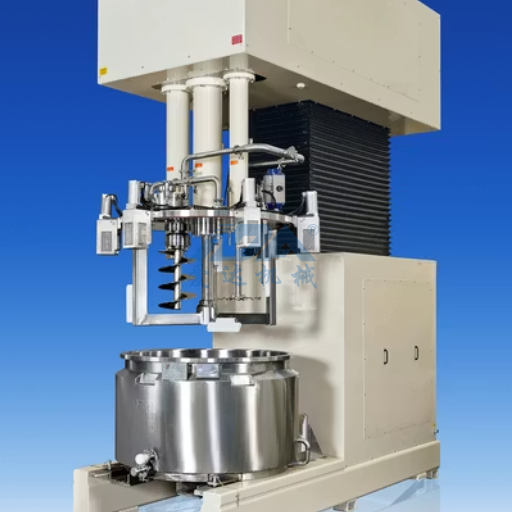
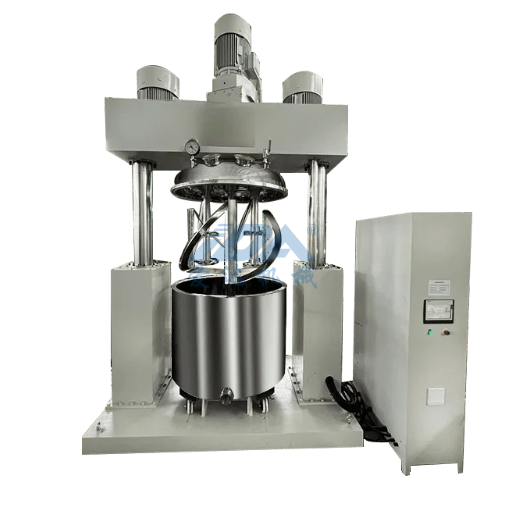
It is an advanced type of mixing equipment used in the blending process, which is driven by high meshing and comprehensive mixing systems. Primarily this machine finds useful applications in industries functioning in food production, pharmaceuticals, etc., where applying an equally uniform and consistent mix remains paramount. There features three distinct shafts that work as designated means and cast for furnishing the activity purpose significantly.
Usually, a triple-shaft mixer comprises three shafts consisting of a high-speed disperser, a slow-speed anchor agitator, and a high-shear rotor or emulsifier. The disperser spins very fast and grinds larger particles of the different components to dispense them homogeneously. The anchor agitator is at a lower speed, encouraging heating; it scrapes the sides and prevents material build up.
The advantages of the three-shaft mixer include the ability to work with a large range of viscosities, from low-viscosity fluids to highly viscous pastes and gels, with optimal outcomes. Its versatility and efficiency make it particularly suitable for applications that require exact control over consistency, surface texture, particle size, or any quality characteristic—and all this mixing is done in a single machine, turning small components into larger tasks of mixing.
What is a Double Planetary Mixer?
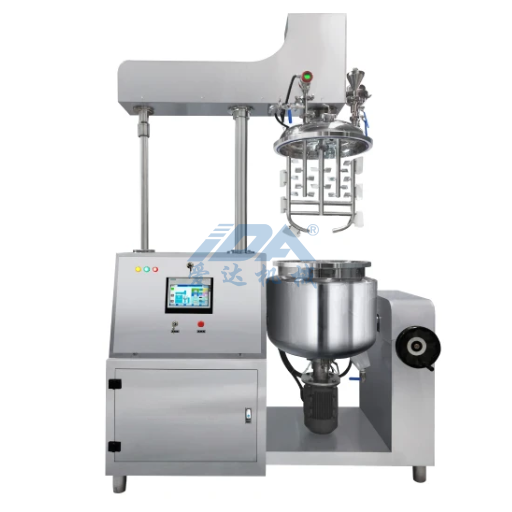
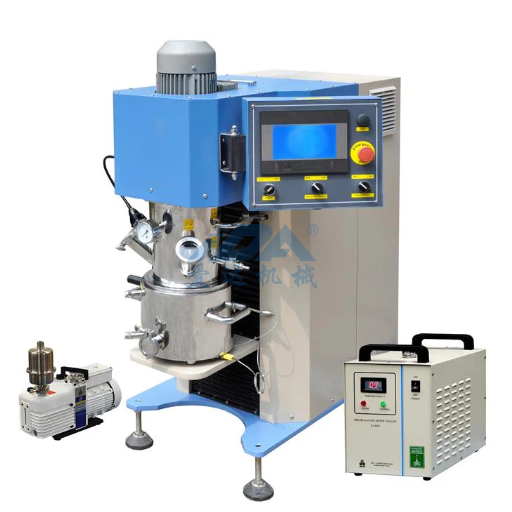
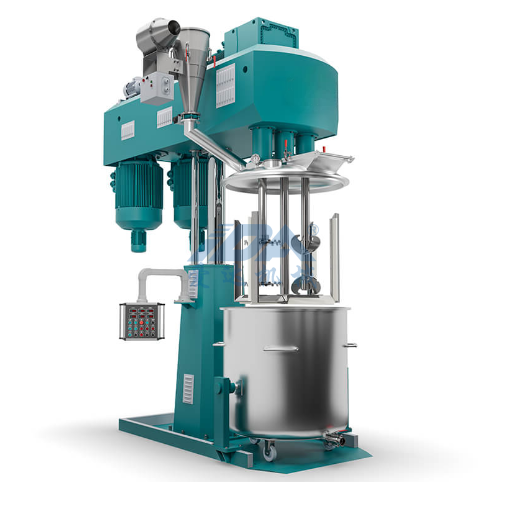
A double planetary mixer is an incredibly-efficient mixing device that handles high-viscosity materials with formulas that require thorough mixing. The unique design features two mixer blades that revolve each on its own axis and revolve around a common central axis, thus simulating the planetary movement. These two rotations ensure that materials are mixed thoroughly and consistently within the mixing vessel.
Ability to deal with materials of very high density and high viscosity that exist as a challenge in most mixing systems is primordial to the double planetary mixer. The blades knead and fold with all the efficacy needed to keep each component well blended for uniform consistency. Those blades will run without needs for additional scraping mechanisms. The blade motion will provide for the most minimum amount of material build-up on the wall of the mixing vessel.
Double planetary mixers are considered a versatile tool and find a wide variety of applications in the pharmaceuticals, chemicals, electronics, and food production industries. The precision and reliability of the mixer in achieving homogeneous batches of uniform quality are unarguable. Additionally, high vacuum capability is offered for the removal of air pockets essential for bubble-free products. It is in these mixed feelings of efficiency and gnosis that one may find the essential approach of the Double Planetary Mixer in digital control coupled capabilities for the work in which exactitude and efficiency matters.
Key Components of Shaft Mixers
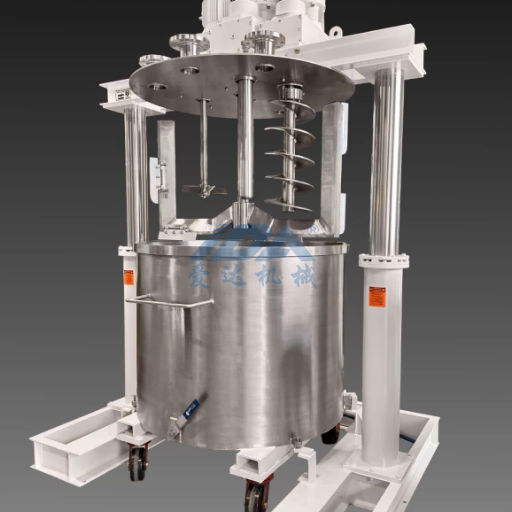
The core of every shaft mixer consists of a mixing shaft, impellers, and a motor. The mixing shaft is among the key components, transferring the operational force from the motor to the impellers. This shaft is usually made of something very sturdy, say stainless steel, in order that it may withstand fatigue under severely challenging situations.
The impellers create an interfacing boundary condition of circulating movement to allow self-mixing of the material from the top and bottom, as well as ensuring deep penetration into the vessel for uniform mixing. Depending on the material characteristics—closed or open-circuit system impellers—go through flow patterns, while improving material mixing. Caveat impassim, the shape of the impeller will decide upon the shape of the mixing effect. Flat-blade, paddle-like, and helical-type configurations are some of the style characteristic types considered for differing material into considerations in terms of the functionality and/or viscosities.
In the mixing operation, the motor supplies the torque necessary for the effective rotation of the shaft and impellers. A dependable motor, when used with an adjustable-speed drive, offers very accurate control over mixing speed. This avoids allowing the mixer to adjust its performance and function properly on a sliding scale between low-viscosity liquids and high-viscosity pastes.
Working Principles of Each Mixer

Mechanics of the Triple Shaft Mixer
The three shafts that propel forward the triple shaft mixer are driven independently, accommodating different sets of agitators and impellers corresponding to different functions. This usually includes a high-speed disperser, a low-speed anchor agitator, and an intermediate-speed rotor/stator or paddle mixer. Blending requirements are fulfilled by them to support a broader range of needs. Such requirements refer not only to blending but also to dispersion and emulsification of materials with differing viscosities.
The high-speed disperser functions to decrease solid materials and mix them evenly into the liquid-facing systems, for uniform mixing. It is noteworthy in fine particle dispersion or in powder additions to liquid solutions. On the other side, the slowness of the sweep anchor agitator conveys consistent movement of thicker viscosities, forever a partial effect until a settled phase is reached, preventing from splitting. In the process, it’s scraping the sight and the side of the mixer, thereby mixing, thoroughly combining all of the contents.
The medium-speed part of a call of the nature of, for example, a rotor and stator, receives the incoming stream and effectively cuts the product making it homogenized. This is in most situations of great advantage with emulsions or multiphase systems in bringing proper uniformity and stability. All three shafts in a system work towards a common goal of ensuring versatility in the product in order to allow the use of a triple shaft mixer to handle both low-viscosity and high-viscosity materials effectively, serving various mixing challenges.
Mechanics of the Double Planetary Mixer
The double planetary mixer works with the aid of two mixing blades which rotate on their individual axes while concurrently orbiting the vessel. With this dual action, it mixes everything completely and eliminates dead spots. This makes it excellent for both high-viscous materials and when one wants to control the level of mixing during the process. The blades travel on a defined trajectory, scraping the sides and the vessel bottom to ensure that all ingredients are homogenously incorporated.
One of the biggest benefits of double planetary mixers is the capability to mix material of varying viscosities without applying heat or a chilling system externally. The available tight clearances of the blades offer an effective shear and blend, even if the requirements constrain the design. With its performance, the mixer is thus workable with the processes such as mixing adhesives, sealants, and other heavy formulations with strict demands for uniformity.
Furthermore, the contained system of a double planetary mixer reduces after mixing contamination levels for the assurance of product integrity. This offers the mixing speed and processing time efficiency compromise because the machines are provided with better control, thus reducing the key objective of reducing energy consumption and reducing batch time. Double planetary mixers are therefore always a valid choice for industries needing pinpoint combinations and versatility.
Comparative Analysis of Mixing Processes
While offering good quality output, tripe shaft mixer and double planetary mixer are applications-matched in view of different mixing requirements. Triple shaft mixer has been designed for applications needing high shear operation and efficient dispersion operation. Multi-shaft configurations facilitate simultaneous blending, heating, and homogenizing, making the blender perfect for emulsions, viscous mixtures, and products that require a very precise control of their temperature and texture.
On the other hand, the double planetary mixer is perfect for those heavy mixtures, showing excellent kneading under moderate shear capabilities. It is particularly adept in mixing pastes, dough, or any materials of heavy consistency. Combined with its particular planetary motion, the mixing blades can achieve thorough integration of all components’ products consistently in the case of pretty sticky or gel-like substances.
Whereas coalescing over specific application imperatives, this choosing aspect is largely shaped by the application’s unique set of requirements. When a high shear with mighty grinding action is required on low-to-medium viscosities in a way that prohibits chances of phantom reservations, a triple shaft mixer will be a more judicious selection. On the other hand, the double planetary mixer is more fit for a highly viscous product not flowing rapidly, whose performance requires consistent kneading and folding without outrightly generating extra heating or shear. Thorough understanding of their unique characteristics will help in selecting the right mixer, improving the quality and performance of the desired end product.
Applications Across Industries

Adhesives and Sealants
In all sectors, these two facilitate a number of uses. Finally, we should take note of their role in creating a strong binder or a seal around the joint or gap, very much necessary for any quality part in an assembly. All in all, they are of every necessity, in their unique inherent properties being of service in creating bonds of high durability, for instance, by reinforcing adhesion, increasing workability, or offering some level of weather resistance.
Attaining a correct consistency and homogenous mix is crucial during the manufacture of adhesives and sealants. The double planetary mixers are traditionally relied upon because they can effectively adapt to the demands of high-viscosity materials needing thorough folding and kneading, thereby ensuring the even dispersion of fillers thereinto. Such fillers may include materials like silica and carbon black along with several other ingredients that are crucial in the formula of the components. Since double planetary mixers prevent the product from breakage during processing by giving homogeneity through simple convective mixing, they also disallow overheating during mixing and thus, the product easily maintains its integrity throughout production.
The triple shaft mixers are great for situations where processing time is less and batch sizes are big. These mixers lend themselves to intermix known benefits of dispersers at high speed with the functions of slow, thorough-stirred, less dissolved systems so that miscibility in liquid and powder and additive mixing can be attended to. This aspect of adaptability makes the triple shaft mixers most suitable in the manufacture of such products as glue or sealant that display inherent diversity in formulations along the efficiency and ultimate quality sought by diverse applications of industrial design.
Cosmetics and Personal Care
Cosmetics and personal care industry is highly dependent on advanced mixing technologies for creating top-end cosmetics that satisfy consumer demands. Triple shaft mixers enjoy particular appreciation in this sector on account of their capacity to handle the extremely varied mixtures that are needed for product manufacturing such as lotions, creams, and serums. While mixing, they unite raw materials with viscosity variation in a way that guarantees the final products ensure stability of an uncommon texture and an appearance that fits an unusual occasion.
Moreover, triple shaft mixers pad the sensitive actives additionally, such as vitamins, natural extracts. These mixers control speed very delicately and can be adjusted to give different levels of shear, which reduces the risk of thermal and mechanical breakdown at the time of mixing processes. This helps in retaining the efficiency of active materials so completed products have crossover therapeutic advantages for ultimate consumers.
Finally, the versatility of these triple-mixer units allows manufacturers to produce a wide variety of products under the same machine. These mixers produce a wide range of products, from light gels to heavy emulsions, with dynamic throughput minus any compromises in quality. The consistent, uniform textural quality is their hallmark. As a result, maladjustment or residual unmixed clumps could lead to a franchise in homogenization with these modern formulations while they are indispensable in cosmetic and personal care manufacturing.
Pharmaceutical Manufacturing
In evaluating the triple shaft mixer and the double planetary mixer, one would observe that well-devised design and competence contribute incredibly in shaping the distinction. The triple shaft mixer outperforms in processing an extensive range of viscosities and mixes ingredients earnestly through its combination of mixing blades and rotor with high shearing stress. Consequently, it is put into some applications where a uniform particle distribution over the rate and a defined texture are desired. For pharmaceutical purposes, this goes for cream, ointment, and gels. It only offers versatility to handle both rapid dispersion and slow setting in one appliance.
On the opposing end, a double planetary mixer is a piece that would be made for manufacturing with the most viscous materials or compounds to be mixed gently but thoroughly. The rotation on two axes permits effective mixing with air already in the materials and cemented throughout uniform materials. It is very advantageous to sensitive pharmaceuticals, where consistent results are desired with no impact as a result of heat or shear stress.
Efficiency and Performance Comparison
💡
Advantages of Triple Shaft Mixers
- ✓ Four distinctive mixing actions for high flexibility
- ✓ Optimal blending and particle size reduction
- ✓ Homogenous mixtures with minimal energy consumption
- ✓ Mitigation of dead spots and enhanced production speed
- ✓ Unbeatable adaptation and scalable operations
💡
Advantages of Double Planetary Mixers
- ✓ Proficient dispersal of highly viscous materials
- ✓ Thorough kneading of coarse or sticky ingredients
- ✓ Effective avoidance of air entrapment
- ✓ Exceptional durability and rugged construction
- ✓ Easy maintenance and cleaning protocols
Disadvantages and Limitations
⚠️ Important Note
Whereas double planetary and triaxial mixers do present advantages, there are a few corresponding disadvantages to study. The first and most recognizable limitation is the higher initial investment cost they command over basic mixers. These mixers are aimed at optimized technology and extremely hardy structure, justifying the cost only when compared against basic mixing alternatives. This may be a difficult constraint for smaller businesses operating on a debt string.
One large drawback is the complexity in that it is a mammoth affair needing a great deal of attention from both the operator and management staff. Triaxial mixers really request the kind of person who went through good training to operate them and to maintain them in excellent condition. Errors caused by inadequate training can arise whereby the operation is less productive or damaging to the mixer itself. Moreover, due to their complex design and moving parts, the mixer will demand higher maintenance as it ages.
Finally, their applications must be noted; not all tasks are suitable for such machines. These professional mixers are inefficient for simple- or low-viscosity mixing jobs because of the extra capability given to them over and above their basic requirement.
Choosing the Right Mixer for Your Needs
Factors to Consider When Selecting a Mixer
Of all the things, a mixer is one piece of equipment in need of your keen consideration for proper usage. The type of materials to be mixed is the most significant factor determining which mixer would best suit the intended purpose of creating a mixture as desired. The mixer has to be equipped with the right means, such as understanding the viscosity, average density, and other material properties. Failure to be so boned-up would mislead any mixer, since an under-applicable mixer poses the rest of the machinery to wear and damage, and will detract preeminently from the quality of your mixtures.
Capacity needs pose further demands. Evaluate batch volume in order to decide on a mixer conforming to that size. Under-sized mixers will grind down your output capacities, while over-sized machinery just excesses energy and space without accomplishing much of anything for you.
Final consideration goes to the issue of the Maintenance and Longevity. Mixers have to be straightforward in cleaning and keeping for such mechanism’s long life and operational efficient productivity. It is best to know the construction of the materials and whether the mixer is reliable to withstand rigors of operation. The machine’s most common material specification seen definitely includes stainless-steel, which is highly durable, resistant to corrosion, and is preferred in high-performance mixers, which are subject to various industrial clientele.
Cost Considerations and Budgeting
When considering industrial mixing costs, one must consider the budget vis-a-vis the operational needs and the buy-in requirements of the use/scope of the mixer. Mixers, however, vary in price depending on the size, type, and features. Smaller operations, for example, might find an affordable choice in compact mixers in purchase, whereas industrial-grade mixers (developed for heavy use) will automatically come with high price tags.
The expenses involved in buying a mixer do not only reflect the purchase price of the original asset. For one thing, there is the issue of maintenance, issues of energy consumption to be taken into account, and those times when all parts will have to be replaced. The trade-off is between the relatively higher purchase price of a stainless steel mixer, but one that is very durable with minimal maintenance costs that add up ensured saves in the long run. Warranty coverage is another in the record, as repairs and spare parts would come at some costs if the warranty’s services were unutilized over the span of use.
Creating a budget that takes into consideration both short-term and long-term costs can be very helpful in order to actually acquire a mixer that fits into the financial constraints and requirements. Based on an assessment of your needs and study of the market, you can then hopefully make a choice that will reconcile performance and price. Keep in mind the fact that the model you end up buying must meet set safety and quality requirements in order to facilitate a hassle-free and efficient operating setup.
Frequently Asked Questions (FAQ)
Q: What are the main differences between the Triple Shaft Mixer and Double Planetary Mixer?
A: The comparison is mainly focused on mixing effectiveness, shearing mechanism, and the correct range of viscosity. The triple-shaft mixer uses a blend of disperser shafts, scrapers, and high-speed dispersers to be effective at mixing slurries and high viscosity products of up to around two million cp. Double Planetary Mixers employ two planetary blades to yield very thorough kneading at low speeds, making them ideal for high-viscosity, shear-sensitive materials.
Q: Which mixer type offers a superior mixing time and production throughput?
A: Triple Shaft Mixers often come with heightened mixing time and production throughput due to their design of multi-shaft mixers and the circulatory action of the disperser shafts; these assist in cost-effective setups for large-scale concrete production and industrial slurry processing. Double planetary mixers take a slightly longer time to mix and are commonly seen in achieving homogeneous dispersion of viscous batches.
Q: How do discharge and the discharge process compare between the two?
A: Triple-wheel shaft mixing machines contain an efficient discharge position or valve for quick discharge, making them effective for high frequency cycles. Double-planetary mixers can have either bottom discharge or inclined vessel for discharge, requiring careful maneuvering for fragile spoils.
Q: What is the function of shear mixing and disperser shafts when choosing equipment?
A: The shear mixing in Triple Shaft Mixers is achieved by disperser shafts that spin at high speeds, generating strong shear forces. In Double Planetary Mixers, the reliance is more on kneading and compression between the blades and the vessel wall, allowing versatile mixing of high-viscosity products where caution must be taken regarding moderate shearing.
Q: Are twin shaft or twin shaft mixers similar to triple-shaft systems?
A: Twin-shaft systems usually indicate a durable design for concrete mixing and bulk materials handling. Triple-shaft mixers incorporate a third shaft—the “high-speed disperser”—which broadens the viscosity range and improves performance for special formulations. Twin-shaft systems are effective for rapid, high-volume mixing but offer less versatility for fine dispersion.
Q: How important are gearbox, cooling systems, and scale-up considerations?
A: Gearbox robustness and cooling systems are crucial. Double planetary mixers possess high torque at low speeds, demanding robust transmissions. For Triple Shaft mixers, the cooling system must overcome heat generated during high-speed dispersing. Scale-up must maintain mixing zone characteristics, keeping shear force and disperser-to-vessel ratios identical where possible.
Q: Which mixer is more cost-effective and versatile for production needs like precast concrete or specialty materials?
A: For precast products and high discharge demands, triple-shaft mixers are more cost-effective due to short cycles. For specialty materials and recipes needing gentle kneading (e.g., solder pastes), a double planetary mixer is preferred for higher-quality results despite potentially higher per-batch costs.
Q: How is quality of the product dependent on the mixing zone vessel wall interaction?
A: Triple shaft mixers use scrapers to engage the wall and avoid build-up. Double planetary mixers create compression between the blades and the wall for consolidating viscous materials and minimizing entrapped air. Factors like luminal surface adhesion are vital when choosing between the two.
Q: Can either mixer handle an extreme viscosity of 2 million cp for such products as solder paste or putties?
A: Both can handle high viscosities. Triple Shaft mixers use sturdier disperser shafts and high torque for heavy particulates. Double planetary mixers are exceptional at kneading ultra-high-viscosity masses reaching 2 million cp and beyond due to low-speed heavy mechanical compression and low heat generation.
References
-
Mixing
A detailed article on the mixing efficiency and blade interactions in double planetary mixers, available as a PDF from a professional mixer resource.
Access the PDF here -
Dimensional Analysis for Planetary Mixer: Mixing Time and Reynolds Numbers
Published on ScienceDirect, this research focuses on the mixing time and efficiency of planetary mixers, including dual-motion systems.
Read more here -
Digital Evaluation of Planetary Concrete Mixer Efficiency
This study evaluates the efficiency of planetary mixers using kinematic models, published on ScienceDirect.
Read more here -
Triple Shaft Mixer: Complete Guide to High Viscosity Mixing Solutions