Get in Touch with IDA

Three Roll Mill for Battery Slurry Processing

Contents
show
Efficient battery production depends greatly upon the handling of precise mixture and uniformly produced raw materials, thus making slurry processing a key process downstream in the manufacturing chain. The well-proven concept of a three roll mill appears superior when it comes to charge transfer and its control over the material uniformity of the resultant mixtures. It concentrates chiefly on the role of the three roll mill in improving the battery slurry formulations, and hence throws light on some unique merits of the three roll mill, essential features, operations, and final effects on potential advances in energy storage engineering. Whether you are manufacturing batteries or researching these battery materials, or have a mere casual curiosity as to the evolving technology of the time; this guide connects you to technology’s future for energy innovation through the three-roll mill.
Importance of Slurry Processing in Battery Manufacturing
Role of Slurry in Battery Production
Slurry’s crucial duty in battery manufacture is being the base upon which an electrode coating can be constructed. This mixture comprises active materials, conductive additives, binders, and solvents. Such combinations, during the pressing and drying processes, typically ensure the effective performance of the electrodes in the batteries. The uniform dispersion of these compounds within the slurry has a direct impact on the consistency in electrochemical performance and, therefore, the energy capacity, efficiency, and life of the battery.
Correct handling of slurry is such that it remains homogenous and no material separations occur. Consideration is given to slurry viscosity and particle distribution, which are most essential pointers for any quality coating of electrodes. A good blend will keep away glitched in the form of uneven coatings and flaking, which may eventually suppress the battery utilization. Many tried and tested methods; mixing, milling and deaeration, are put to use to optimize the said variables.
The here-worded significance of slurry in the fabrication of batteries extends in preparation of the slurry to crucial downstream events like coating, drying, and calendaring. A properly prepared slurry makes for durable electrodes that can survive the repeated charge/discharge-associated challenges and are essential to building a reliable means of storing energy. Indeed, the performance of batteries today, with respect to safety as well as efficiency, is mainly dependent upon the accuracy and quality that the slurry-processing stage guarantees.
Impact of Slurry Quality on Battery Performance
The slurry quality is, therefore, the main determinant of battery performance, safety, and life. Slurries are formulated to ensure that active material, conductive additives, and binders are uniformly distributed throughout the electrode. This uniformity is essential for consistent electrochemical performance as it prevents irregularities and favors balanced electrical output and useful life expectancy.
A good deal of information stands in support of the claim that high-quality slurry can give added strength to the electrodes. Therefore, the high strength of the electrodes is brought about by reducing the risk of tortile microcracks, delamination, or any kind of structural weakness during charging/discharging cycles. It is of help in enhancing battery life under various combined operating conditions, particularly high current and long-term continuause.
A defective slurry can threaten the safety and performance of the battery. Poor control of the slurry, whether by poor mixing, improper viscosity, or by agglomeration of materials, could lead to drastic reduction in capacity, overheating, or even battery failure. The precise control over slurry parameters, including composition and consistency, will therefore be a cornerstone for the achievement of high performance batteries that can distribute the requirements of modern energy storage.
Overview of Battery Slurry Types
Battery slurries are categorized based primarily on material electrodes used. These slurry typs are the cathode and anode slurries, both playing a crucial role in the performance and efficiency of lithium batteries.
Cathode Slurry
Cathode slurries usually contain the following active materials: Lithium Nickel Manganese Cobalt Oxide (NMC), Li Cobalt Oxide (LiCoO2), or Lithium Iron Phosphate (LiFePO4), depending on the chemical composition or the capacity of the slurry. Alongside, conductive carbon additives are also present, binders that would form layers over the current collectors and also the solvent, commonly N-Methyl-2-pyrrolidone (NMP). NMC cathodes are favored in high power applications due to their excellent energy density and cycle life. Studies suggest proper carbon black dispersion can increase slurry conductivity by up to 30%, tremendously improving battery life.
Anode Slurry
Regarding the anode slurries, they typically involve graphite as the active material along with conductive additives, binders, and solvents. With increased battery technology, silicon has been considered for the anode material, giving an approximate tenfold increase in energy density over graphite. However, such a high volume change accompanying silicon cycling makes the slurry constituent and formulation a tougher task to avoid material degradation.
Key Parameters and Data
Protocols to control slurry viscosity, solid content of slurry particles, homogeneity, and particle size distribution have been favored by modern science and technology education. Successful research suggests that within a slurry application, a 60-65 percent solid content would ensure better coating results through maximum energy density and state of conversion. Also, very close control of viscosities, i.e., ranging from 1,000 to 3,000 cP for cathode slurries, achieves well-coated current collectors during the production process.
Water-based Slurries and Other Innovations
The battery industry looks forward to interesting developments such as water-based slurries that eliminate the need for toxic solvents, representing a step towards safer and more environmentally friendly battery production. In addition, machine-learning and AI tools will be employed to supervise real-time optimization of the slurry-mixing profiles for higher consistency and quality.
The connotation of identity comes along with this statement. For the improvement of dismantling slurry properties, the manufacturers realize the enhancement of battery capacity, longevity, and safety in view of the greater demand for energy storage technologies.
The Role of Three Roll Mills in Slurry Mixing
Mechanics of Three Roll Mills
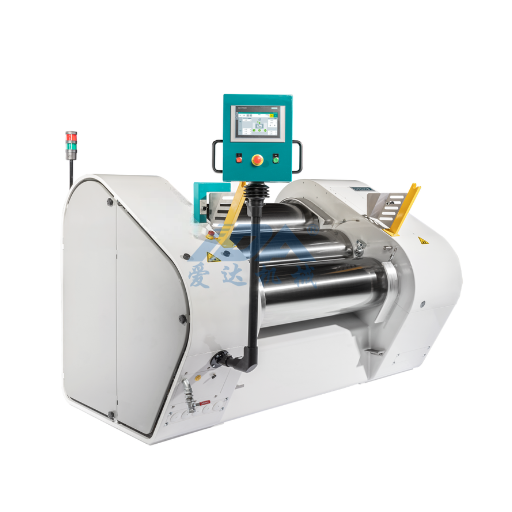
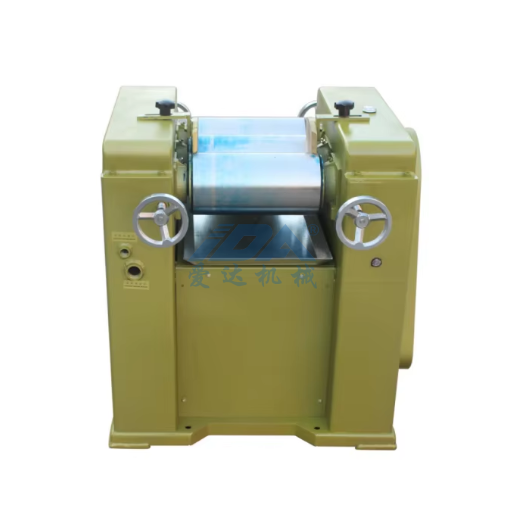
An input streaming system is facilitated by triple roll mills that involve three mutually arranged horizontal rollers’ manipulation at differing speeds of rotation. Such a combination generates a high shear force most essential for the disruption of particles and dissection into a slurry of particles. The intervening material passes between the rollers until the particles are ultimately reduced to an appropriate size and complete mixture homogeneity. In its absence, the consistent reduction of particle sizes thwarts the promiscuous advantages of their aggregates.
Fine control over the roller gaps and speeds permits target processing for the specific material requirements. Tinkering with the minute changes in these particular parameters will let manufacturers find their optimum handling behavior, such as viscosity or particle size distribution and likewise meeting the dispersion quality requirements. This control makes these machines especially useful into the battery industry. The uniformity of the actions in the production cycle is critical to the future performance and reliability of the product. Maximum productivity in waste reduction tasks during processing operations results in better utilization of processed materials.
In being energy-efficient and scalable, 3-roll mills are suited for use, from the laboratory to large-scale production. Agglomeration-free product dispersal ensures turmpet-voiced demand for 3-roll-mills into advanced energy storage technologies. Thus, their appropriation guarantees mileage of paving a way into leading the race to optimize slurry properties for pushing them into modern-day applications.
Advantages of Three Roll Mills Over Other Milling Methods
Three roll mills give an accurate and consistent product having all particles evenly spread. For these materials, tight tolerances and specific formulations are demanded, such as pharmaceuticals, cosmetics, and new materials, with three roll mills providing the necessary batch-tobatch consistency. On the other hand, most of the milling methods, such as ball milling or bead milling, require additional grinding the grinding media, all of which have a significant impact upon the final product. And, unlike ball milling, bead milling, or even ball mills, these require no grinding media, which simplifies the whole clean-up process.
Their versatility would be another great point to be discussed for three roll mills. These could be used in applications of any kind of viscosity, thus extending them for all needs; they can process anything from thick pastes to thin dispersions. This ultimately maximizes the probability of the manufacturers achieving the most desirable results in particle reductions and dispersions with the least passes, thereby fostering a better pace of production and saving time and money. Another thing that becomes better the more adaptable three roll mills get is the gap spacing of the roller, which makes the control of the product output for targeted production.
The three roll mills are also known for their energy efficiency and scalability. A lower energy input is present in the efficient mode as they offer reduced operational costs compared to other milling techniques. Due to their design, they can be used in tiny lab settings or for large-scale industries, providing scalable growth for a physics need. It is the resolution, versatility, and energy efficiency of the three-roll that includes the tool of choice in various industries.
Achieving Optimal Slurry Consistency
Obtaining optimum slurry consistency plays an indispensable (vital) role in ensuring smooth processing and high-quality output in a variety of industrial applications. This requires precise control of the solid-liquid ratio. Controlled ratios are the key to uniformity and help to avoid such problems as sedimentation, plugging, or extreme viscosity, all of which can thwart the flow of a machine and quality of the final product.
Mixing techniques indeed are foundational to have acceptable slurry consistencies. Consistent stirring or other ways of moving the slurry ensure that particles don’t settle. Other observations like pH levels, temperature, and particle size have-so the capability to maintain stability by preventing any unwanted reactions or alterations in the solid features of the slurry.
Good practice is being made great with the advances in up-to-date measuring tools and equipment in monitoring the consistency of a slurry; therefore, equipment measuring for variables further than viscosity can help with the baseline measurements for the slurry’s proper consistency, covering factors such as flow properties and any particle cooperation-tracking viscosity. There is an increasing need for regular maintenance as a result of the latter explanation, assuring that equated actions are undertaken if your tools become out of track. Industry actors will find it a safe guarantee to witness their slurry given the required consistency and suitability of its application.
Key Operational Parameters for Efficient Three Roll Mill Performance

Viscosity and Its Influence on Mixing
In the three-roll mill, viscosity plays a crucial role in establishing the efficiency and effectiveness of the mixing process. It is the property that sums up a fluid’s resistance to flow and how the same is distributed across the system. High viscosity materials typically represent resistance to motion, and this requires extra effort and more energy to ensure thorough mixing. In contrast, low-viscosity materials tend to flow easier and allow rapid distribution but may potentially interfere with the control over the end-product consistency.
The importance of viscosity also extends further to the processing parameters such as the shear forces. Higher-viscosity material demands the application of higher shear forces in processing in order to crush down particles and achieve homogenization and dispersion. This would lead to increased wear and tear on equipment and regular maintenance to maintain optimum performance. With careful monitoring of viscosity and proper adjustment thereof, an operator guarantees compatibility between the material and blending equipment while expanding efficiency further.
The effective control of viscosity not only ensures uniform products but also reduces any chances of defects in the end product. It is therefore advisable that operators monitor the levels of viscosity they are working with in order to get exactly what is needed for a given application or operating condition. Therefore, a consistent and quality-mixed product should be expected from the blending process, while downtime should be reduced and the life of the equipment should be maintained.
Adjusting Shear Rates for Desired Particle Size
Controlling and achieving the particle size always occur with keeping the shear rate in adjustment during all processing operations. It is quite the direct influence that the shear rate on how particles break down and disperse, building it quite a critical parameter in the formation of the mixture, blend, or emulsion. In some cases, increased shear rate may aid in the development of smaller particles owing to increased shear force and halting the consolidation of larger ones. Conversely, lower shear rates may promote a wider distribution of coarse particles but are maybe more fitting if maintaining the structural integrity is needed.
In the context of shear rates, the material’s viscosity level, the target particle size, and the specific application requirements must all be taken into consideration in deciding on the optimum level of shearing. Highly viscous materials usually necessitate more powerful shear forces to yield a uniform dispersion. Processors can explore between a range of available possibilities and carefully observe the effects observed in order to find a trade-off between efficiency and quality. It is important to avoid excessive shearing that would lead to overheating or damage of sensitive materials- or, even worse, unwanted side reactions.
It is shear rate control that will ensure consistency, prolong the equipment life in processing, and reduce operational inefficiency. Standard calibration and an equipment performance check would further enhance precision. Operators will find themselves in a position to achieve what they want in particle size and texture, thereby increasing the product’s general quality, through a thorough understanding of the effect of shear rate on material behavior.
Monitoring Mixing Time and Its Effects on Slurry Quality
Mixing time is extremely significant in defining slurry quality. If mixing occurs under proper conditions and for an insufficient amount of time, mixing will have distributed the individual particles unevenly, thereby creating structural and compositional inconsistencies. Non-uniform mixing may lead to differential particle sizes, lowering the actual yield. On the other hand, over-mixing is likely to damage the desired physical properties of the slurry solution, such as viscosity or stability.
Implementing the most suitable mixing times with care would underscore the cause of the expression, trying to optimize the slurry quality. Additionally, operators shall evaluate these parameters in order to ascertain the homogeneity of the slurry and the intended texture at precisely the point where mixing is most productive. Additional checks and balances should help in remaining consistent all the time for the efficient manufacture of the slurry.
The practice does exist in which the manufacturer is bearing the responsibility concerning the optimization measures of a process. Technical methods include the use of metering measurements for the purpose of monitoring the progress of mixing, whereby test solutions would perform positively if their performance on-line were monitored or gauged. This approach ensures the maintenance of a stable production process and a high-end product standard.
Common Challenges in Battery Slurry Production

Addressing Viscosity Changes
Viscosity changes in slurry are very detrimental to the uniformity and quality of the final product. These changes occur due to several reasons which might include an inconsistency in the raw material properties, improper mixing protocols, and variations in temperature and humidity during the production process of making a product. In the event of indiscriminate viscosity changes, the consequences will be uneven coating, lesser electrical performance, and defects during the operational phase of battery use.
Implementing stringent process controls is crucial in dealing with this issue. Regular monitoring of raw material characteristics such as particle size distribution and the composition of the solvent, would help maintain consistent input parameters. As viscosity can be an issue when carried out by manual methods, metering counters are necessary to measure viscosity along with actual real time monitors that observe the viscosity level during the mixing process. Any deviation from the norm should lead to immediate corrective actions. Also, actions will be required in order to control all ambient conditions for the internal environment of production, including making sure that temperatures would remain same while the entire humidification would not be too fluctuating, which could lead to upset.
The second important approach to enhancing the quality of mixing is optimizing mixing. This can be achieved by ensuring that the active and inert materials, binding and solvent are well dispensed, providing a homogeneous slurry and uniform viscosity. Parameters to be controlled include setting rotary mixer attributes, and sequences of speed, time, and alloy mixing to achieve further efficacy. Consistent training of operators paid in obedience to standard procedures implies that every aspect of mixing will provide better assurance and reliability. More final control over the slurry viscosity to improve product quality and production efficiency can be realized when all these points are rightly attended to.
Overcoming Issues with Particle Distribution
Ensuring the uniform distribution of particles is a critical factor in elevating battery slurry performance and consistency. One good way to resolve this issue is to use a three-roll mill to gain precise control over the particle size reduction and guarantee homogeneity in the slurry composition. This machine works by producing shear forces between three collimated rotating rollers which are high enough and enough to distribute particles uniformly through the slurry in a consistent fashion.
The three-roll mill exhibits its particular value in being able to work with differing viscosities and guarantee more uniform results. Thus by adjusting rolls’ pressure setting and gap, one may control the size of the particle for the required suspension viscosity and enhance the performative ground electrode characteristics. This precise, coherent standpoint minimizes agglomeration and maintains a uniform nature for the slurry to ensure higher efficiency and longer shelf life of the final battery products.
If not more, the three roll mill is well suited to basic research and high output production because of its capability of achieving repeatable and scalable results. The instrument is engineered based on a set of quality systems to ensure that every batch of slurry given to the mill conforms to the specifications required for battery-optimum performance. In a situation where ladies are trained adequately and SOP are adhered to, the three roll mill is thus a very powerful and systematic way to manage the normal particle distribution in battery slurry applications.
Solutions for Scale-Up and Consistency
As a method of scaling up, roll mixing facilitates unmatched levels of consistency in the battery slurry process. The controlled particle size distribution, which is vital for superior battery performance, is achieved as a part of its particular design and mode of action. Shearing and mixing by certain systems are carried out uniformly in the whole; hence, the given method does not only assure adequate consistency but also favors a high compatibility rate among the instantiations. On this strength and performance of the bruising procedure, echelle properties have been rated very highly and a longer battery life guaranteed.
In order to overcome the scale-up challenges, the three roller mill has adjustable parameters such as velocity of the rollers, the pressure between the rolls, and the space between the rolls. These parameters are adjusted fine enough to suit the processing needs while transitioning from pilot/lab scale to commercial production. This adaptability ensures that critical attributes of the slurry such as viscosity and homogeneity are maintained well within the dictionary boundaries. Without causing the vagaries of production, this is smart high-quality assurance across the board regardless of input level.
Further, based on its reliability and the ease of its use, the equipment is best suited for large-scale industrial production. In addition to the described ground operating procedures (SOPs) and training of the operators, the three-roll mill is found to be dependable in decent battery slurry application. Its methodical approach assures repeated success and enables manufacturers to meet strict quality requirements in contemporary energy storage technologies.
Emerging Trends and Innovations in Slurry Mixing Technology

Scalability for Battery Manufacturing
Developing scalable solutions for manufacturing batteries is vital to cope with a soaring demand around the world for energy storage systems. Implementation of advanced battery mixing technologies that can deal with a larger production immersion is one main area in focus with emphasis on a constant quality factor. Methods, for example, automation and real-time monitoring systems already included in slurry prep processes to ensure that uniformity and uniformly improve overall efficiency of the production. These latest innovations provide manufacturers with opportunities to prudently reduce human error and efficiently optimize the outcome at a larger scale.
It is worth mentioning that a novel way to build scalable production lines lies in the use of modular equipment. It allows the manufacturers to increase their production capacities relatively easily without radical new infrastructure. This way they provide flexibility that allows expansion in phases; investments in support grow with market needs. Besides, the machines designed to be scalable are capable to change in slurry formulations with relative ease. They need to maintain steady output while allowing for variety in battery chemistries.
Sustainability is gradually gaining importance as a concern in scalable battery manufacturing solutions. Reducing waste and energy consumption during the slurry mixing process has various benefits ranging from the environmental to the operational cost. Here we consider operational efficiency, implying resource usage wrested from almost liberal tolerations. Manufacturing industries, therefore, have not only kindled the idea of green manufacturing as a corporate body but shed lights on ways to realize the expectation. Such advancements contribute to the scalability and sustainability of materials for enhancing energy storage needs in the future.
Future Directions in Lithium Battery Slurry Processing
The advancement of slurry processing for lithium-ion batteries is focused on improving uniformity, reducing waste, and enhancing production efficiency. One important researcher orientation involves improving mixing techniques to provide better homogeneity within the slurry. Homogeneous particle distribution in the active materials, conductive agents, and binders in the slurry is a must for enhancing battery performance and extending its life.
Two more significant developments that can aid greater industrial viability rest substantially on the sustainable, economic selection of these materials. More sustainable and less expensive materials are currently being assessed by many researchers to reduce environmental impacts without negatively affecting or while actually improving electrochemical performances. The possible incorporation of water or bio-based materials would reduce emissions of toxic elements and translate into lower production costs, thereby aligning with the plan for greener manufacturing.
Automation and digitalization are important advancements for the upcoming slurry processing. Utilizing advanced sensors and machine learning algorithms upon production lines advance real-time process monitoring, process control, and defect detection. These innovations promote quality control and at the same time scale to meet the high demand across industries for energy storage solutions.
Frequently Asked Questions (FAQ)
Q: What is that wet grinding model for Battery Slurry Processing and how it gets itself into battery manufacture?
A: A Three Roll Mill for Battery Slurry Processing is high shear wet grinding equipment used to disperse and develop homogenization of electrode materials in electrode slurries. In the battery manufacturing process, especially lithium-ion battery manufacturing, it fits into slurry preparation to break down particle agglomerates and tune the rheological properties of the result slurry before the coating and drying on the electrode foil.
Q: How does a Three Roll Mill compare to planetary mixers or planetary mixing in electrode slurry mixing?
A: Three roll mills provide intense shear and wet grinding ideal for breaking down particles and achieving tight particle distribution, while planetary mixers and planetary mixers are more suited to batch mixing, deagglomeration, and ensuring uniform distribution of the binders and conductive additives. The great many of the battery manufacturers combine planetary mixers for initial batch mixing and Three Roll Mill for fine dispersion to optimize slurry flow and coating process performance.
Q: Can the desired viscosity of slurry and other rheological properties be improved using a Three Roll Mill?
A: Yes. The combination of the high shear mixing and the actual wet grinding in a Three Roll Mill for Battery Slurry Processing can break up agglomerates, give better wetting of the particles, refine the rheological properties of the neat slurry, and lead to uniform coating and better mixing control of the electrode slurry during the coating process.
Q: Are 3-roll mills useful in the battery electrode industry for both batch mixing and continuous mixing?
A: 3-roll mills can actually be a good idea if one wants the versatility of batch mixing and continuing mixing. For instance, it may sound quite impractical to have a 3-roll mill when batch mixing is the case – or even for that matter. If the 3-roll mill is placed after initial batch mixing in the slurry preparation process, it is absolutely brilliant for batch mixing, but it can also be reconfigured to be in place for inline very fine dispersion to provide implementations for continuous-batch mixing with over a minute to hour span, and to aim in general for very high throughput battery manufacturing purposes.
Q: What electrode materials and slurry materials are typically processed with a Three Roll Mill for battery electrode slurries?
A: Typical electrode materials for lithium-ion battery electrode are active materials like graphite, NMC, LFP, conductive carbons, and polymeric binders. It is often processing the solvent and additives included in the slurry materials used for mixing along with a Three Roll Mill for uniform dispersion of the components for a stable battery electrode slurry that is used for battery cell production.
Q: The Three Roll Mill, in what way does it make a difference in the coating and drying step of battery cell performance all together?
A: By preparing a finely dispersed low viscosity, wet produced slurry, a Three Roll Mill improves the flow of the slurry and improves uniformity in coating, which leads to uniform coating and drying, good electrode microstructures, enhancing battery performance in terms of better capacity retention, and cycle life; as an after-effect, the better performing battery is mainly intended for electric vehicle powertrain applications.
Q: Are there scale and maintenance considerations for battery manufacturers when adopting Three Roll Mills?
A: Yes. Throughput requirements (batch vs continuous mixing), compatibility with solvents and abrasive electrode materials, and integration into the battery manufacturing process line present considerations for those in scale. Maintenance considerations include regular cleaning to avoid cross-contamination, keeping track of roll wear from abrasive materials, and setting up preventive servicing to maintain consistent performance in wet grinding while keeping the electrode manufacturing workflow from getting stopped.
Q: How does use of a Three Roll Mill help optimize battery electrode manufacturing and give betterment of battery performance?
A: A Three Roll Mill provides an improved performance of the dispersion in slurry and particle size distribution. This results in better homogenization of slurry for the electrode, diluting the defects in the coating process and optimizing microstructure of the electrode in question. This consistency results in superior fluid paste for electrode, increased electrode production yield, that ultimately impacts battery performance and reliability for lithium-ion battery manufacturing in consumer markets and electric vehicles.
References
-
Optimizing Aqueous Processing of Nickel-Rich Cathode Material in Ultra-Thick Lithium-Ion Batteries
This research explores mechanical processing and its impact on battery materials, which may include slurry processing techniques.
Read more here -
The Aluminum-Air Battery
This study discusses the use of roller mills in battery design and processing, which could provide insights into slurry processing.
Read more here -
Lithium Battery Recycling in Australia
This paper examines processing technologies for batteries, which may include slurry handling and related methodologies.
Read more here - Professional Three Roll Mill Manufacturer