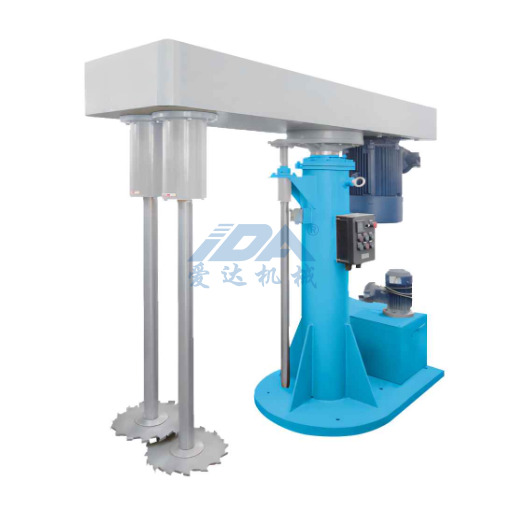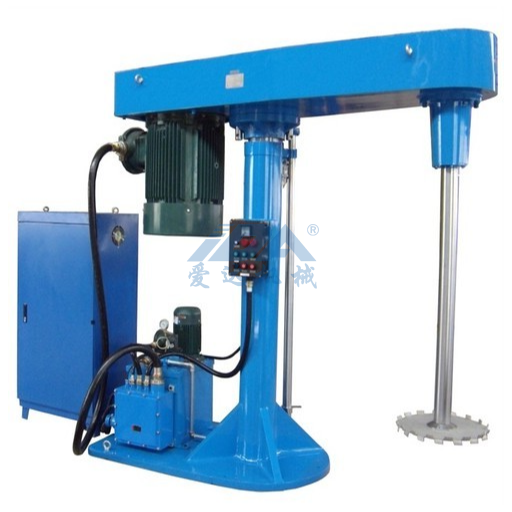
Get in Touch with IDA

What is a High Speed Disperser?

Contents
show
The high-speed homogenizer has become a popular must-have machine across several industries for mixing, homogenizing, and dispersing materials. Such a powerful machine is indispensable for a radical solution towards achieving universally uniform and consistent mixtures with better efficiency for paint production, adhesives, cosmetics, or any other chemical process. Now that you are aware of its operations, let’s find out what makes a high-speed disperser so high and the kind of recipes these are the most suitable for dealing with behemoth mixtures. I mean unique recipes! This blog delves deep into the very broad topic of high-speed dispersers, examining their functionality, advantages, and sector-based user groups. Finally, you will understand why high-speed dispersers are indispensable parts of contemporary production.
Understanding High-Speed Dispersers

Definition and Functionality of a High-Speed Disperser
High-speed dispersers are equipped to industrial mixing with the task of breaking down solid particles, dispersing them in a liquid so that their mixtures become uniform. This takes place several minutes later, working with a rapidly rotating blade that cranks out enough mechanical force for a faster yet still effective blending of materials. A more popular fraction of the user demographics is the coatings, paints, adhesives, and cosmetic industries.
The prime objective in the working of the high-speed disperser is to distribute all the constituents of the mixture uniformly, thereby eliminating all lumps and irregular textures at the same time. When stirred by shear from wherever high similarly to rapid agitation, it serves both purposes. The high-speed from high-shear motion breaks down the agglomerates, and so on-this machine leaves the ends so that it properly mixes the solids and liquids. Because they can perform inside the tank, a disperser is the ideal mixer with assurance of thorough mixing without any chances for losses or inconsistencies to occur.
High-speed dispersers are becoming eminently valuable because they are so fast, reliable, and adaptable to mixtures of various viscosities. The processes that need very smoothly dispersed mixtures appreciate them their performance! The high-speed dispersers are presently finding multiple facets of importance in various industries, likely manufactured goods, because they are effective at cost-effective passed with the alternatives and produce quite accurate, uniform results.
How a High-Speed Disperser Works
The high-speed disperser makes high-speed mixers work to disperse the shear forces in mixtures by using a third kind of very powerful attrition force. In this process, the high-speed disperser blade carries paste and powder to high-speed motion by a vortex action which is produced beneath the mixing floor. Featuring full-on power, a high-speed disperser can dissolve emulsified materials so they become uniform within the batch.
This action of providing bleach into the disperser liquid mechanism and then turning the blade on at high speed, causes turbulence that homogenizes the material or suspends all materials uniformly in the liquid. This way, all ingredients are fully mixed and there are no areas where clumping or separation is concerned. The perceived benefits of this approach lie in the refinement of the end-product mixture while maintaining the level of uniformity and quality.
High-speed dispersers are extremely adaptable and approach a variety primarily industrial applications, including the production of paints, coatings, adhesives, and pharmaceutics. These dispersers can blend across a range of viscosities and innumerable materials, thereby becoming indispensable tools in big industrial-size mixing equipment. With their high speeds, precision, and reliability, dispersers effectively boost efficiency while ensuring a high standard of outputs in efficient mixing.
Difference Between a Disperser and an Agitator
Fundamentally, the function, design, and application of these two different machines of disperser and agitator stand in stark contrast. Dispersers have been specifically designed to create an extremely fine particle distribution of solids within the liquid. Shearing and turbulence are effectively accomplished through the high-speed rotation that the disperser executes to ensure that the particles adhere uniformly and create a superbly smooth dispersion. Therefore, applications such as those that demand precision for factors such as the processing of paints, abstraction of protective lacquers, or the manufacture and wielding of pharmaceuticals often use dispersers.
Agitators, in stark contrast, are used to mix or blend liquids and preserve homogeneity in a solution. Whereas dispersers break down all solid particles to particles that are extremely fine; agitators orbit at relatively lesser velocities, thus creating motion within the blend. Agitators work well in procedures requiring the readjusting of solids, maintaining suspension and mixing liquids in moderately low-capacity articles.
The difference is in their final goal: an agitator is designed to gently mix solids and maintain circulation while a disintegrator is made for rough dispersion, i.e. fast breakdown of solids into smaller particles. The choice between them might be influenced by several factors concerning process descriptions, such as required homemogeneity, materials needed, and the required speed for producing the targeted product.
Components of a High-Speed Disperser
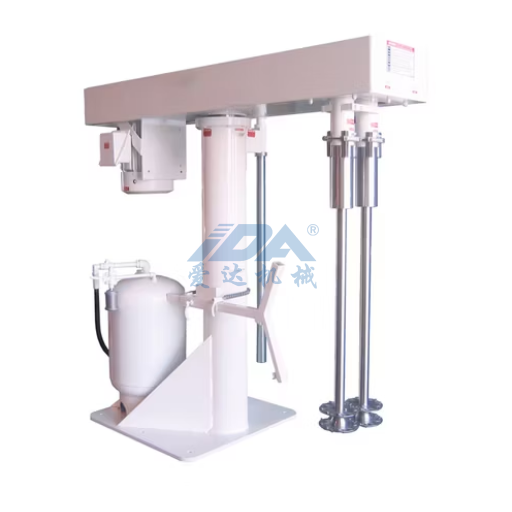
Main Parts of a High-Speed Disperser
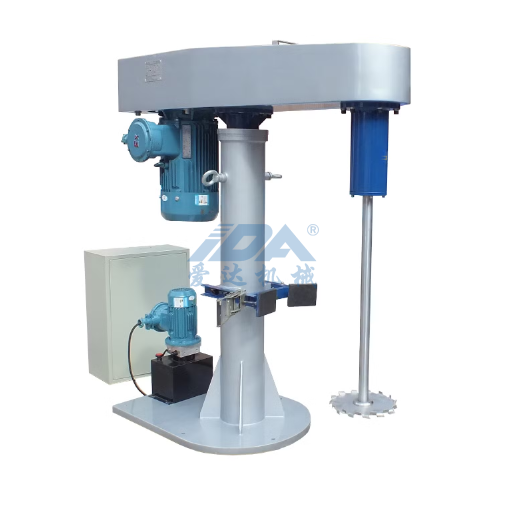
The high-speed disperser is about to comprise several critical parts. Each of these parts performs its own functions and is always available to ensure the combination has been done effectively and efficiently. The main components of the high-speed disperser are the motor, shaft, blade, and vessel. The mechanical and kinetic capabilities required for the dispersal of solids into liquids are provided by these units together.
The motor is the engine that drives the disperser, giving high RPM for the blade and the shaft. The strength and operation of the disperser depend on the motor. The shaft is a vertical rod that receives the energy from the driven motor’s gear and transfers it to the blade. The steadiness of the length and the direction of the shaft ensure that the process is vibration-free.
The impeller is the main mixing component of the disperser. This is usually either a saw-tooth or flat-blade type that generates the high velocity gradients required for breakdown of solid particles and their uniform dispersion. In contrast, the container holds the upholding material and supports circulation without any dead zones for a proper mix. Together, these are the essential workings of the high-speed disperser, a key piece of equipment in industries like paint, coating, and adhesive production.
Types of Blades Used in High-Speed Dispersion
Two primary types of blades are known to be utilized with high-speed dispersers-saw-tooth blades and plain blades. Of the two, the saw-tooth blade is heavily used in industrial applications since its smart edge provides an ideal shear force for breaking down particles, ensuring a homogeneous dispersion in minimal time. Its edges are serrated so that the material can be rapidly moved around, thereby resulting in a fine mix and dispersion in cases of paint or coating production.
Flat blades are more often used when a lower shear is needed for the process. These aid in liquid circulation and mix lower viscosity substances. They are not very good at breaking particles like the saw-tooth blade, but they are quite useful in keeping the even distribution of the constituent materials in the final mixture.
The choice of blade relies noticeably on the material viscosity, mixing purposes, and particular process requirements. High-viscosity materials prefer tocuzbi saw-tooth blades because they generate strong shearing forces, while flat blades become the proper medium for low-viscosity applications. It is vital to recognize these differences while choosing the proper blade and therein optimizing the performance of the disperser.
Variable Speed Options in High-Speed Dispersers
With a variable speed option, high-speed dispersers give the user greater flexibility and control when they are mixing. Employing the speed, the operator can apply a specific number to the disperser laid down by the material being applied for the perfect execution of the component properties. The capability of such adjustment cannot be underestimated in producing high-quality mixtures from lower viscosities amidst complex mixing requirements.
Different speed ranges are important for viewing materials requiring differing agitation or shear strength during multitier processing. For example, slow speed can ensure the absence of splashing at the time of wetting out with powder, whereas on subsequent stages after the medium steadies, higher speeds are needed for dispersion and homogenization. This adaptability has a laundry list of consequences-it trickles down to an increase in production and an appreciable reduction of material wastages.
Besides, for a safety and energy gain, adjustable speed drives are preferred. This will help prevent abrupt torque variations of the drive. When starting at low speeds, less damage to equipment results, extending their working life. Indeed, an agitator set to the right speed reduces energy wastage or loss, thus knocking on the head operational costs. Thus, in general, the variable speed options greatly improve the predecessor of high-speed disperses in myriads of industrial applications.
Applications of High-Speed Dispersers

Industries Utilizing High-Speed Dispersers
Because high-speed dispersers facilitate the task of mixing, blending, and dispersing materials efficiently, these machines will become the backbone of numerous industries. The paint and coatings industry is one such instance where dispersers are used to mix pigments, binders, and additives into equable and high-grade formulations. Their tremendous utility handling high-viscosity materials makes them ideal for achieving consistent textures and finishes on paint commodities.
Another major beneficiary of high-speed dispersers is the adhesives and sealants industry, where these machines are employed to homogeneously mix resins and fillers and other ingredients to ensure product performance. Moreover, the precision brought in by high-speed dispersers allows manufacturers to get the needed qualities in their adhesive like strength and high permanence.
Therefore, the prevalence of high-speed dispersion technologies across industries like pharmaceuticals and cosmetics emerges on a large scale for the processing of creams, lotions, gels, and other formulations. Not only is uniform dispersion an important phenomenon for the creation of dispersions in one or all particulate substances in the final product, service, application stability a visual attraction to make the business presentation great and good for marketing. Now their status in these industries screams “versatile” and “post-industrial” besides “importance for superior quality production”.
Specific Use Cases in Paint and Coatings
The main application of dispersion technology in the paint and coatings industry has been the achievement of uniform coloring and consistent finish of the product. Such dispersed colors result in uniform distribution of pigments within the paint material, thus giving brighter colors and greater opacity. The improper dispersion will cause the final coat to have different shades or streaks, thus taking away from the aesthetic attractiveness.
Another equally important use is preservation of the surface and imparting durability for the intended purpose. Dispersions allow the effective incorporation of additives that supply growth-related functionalities such as water resistance, UV resistance, or corrosion inhibition. These properties are greatly needed in paint coats placed in environments that are hard-pressed for endurance and performance.
In the coatings industry, paint and coating dispersion serves as a key element for optimizing the applied characteristics. Finely dispersed components ensure a well mixed, smooth structure for enhanced flow and easier application. This ensures a better user experience and reduces material wastes during application, thus enhancing sustainability and affordability for professionals and consumers alike.
High-Speed Dispersers in Pharmaceuticals and Chemicals
In the pharmaceutical and chemical industry, high-speed dispersers play a vital role, necessary for the desired uniform mixing and consistency in the production. These are meant to efficiently deal with challenges-either powder, liquid, and semi-solid dispersion down to the different shapes there in formulations. High-speed operation carries with it these dispersers, making it possible for a shear force that breaks down particles and allows them to properly disperse within the media. With the good dispersion, we will have a high quality of the product, which is critical to ensure regulatory-status compliance requirements.
In the pharmaceutical industry, the high-speed disperser stands as a critical instrument for the manufacture of suspensions, emulsions, and semisolids like creams and ointments. For pharmaceuticals, uniform particle distribution is of utmost importance as it can ensure correct dosing and stability. Considering an expectedly homogeneous distribution of forms, c.g. in liquid drug and injectable drug preparation, the high-speed disperser can proceed uniformly in the dispersion of active ingredients and eliminate any form of so-called inconsistency that would affect patient results.
The chemical industry also employs dispersers to produce adhesives, coatings, sealants, and various special chemicals. Dispersers are instrumental in the complete assimilation of additives, pigments, and other raw materials into the finished product, resulting in improved performance credentials such as viscosity, texture, and durability. In addition to quality, high-speed dispersers ensure speed in processing and production for manufacturing crammed with high-volume demands, at the same time lowering the fraction of waste generated during mixing operations.
Performance Factors of High-Speed Dispersers
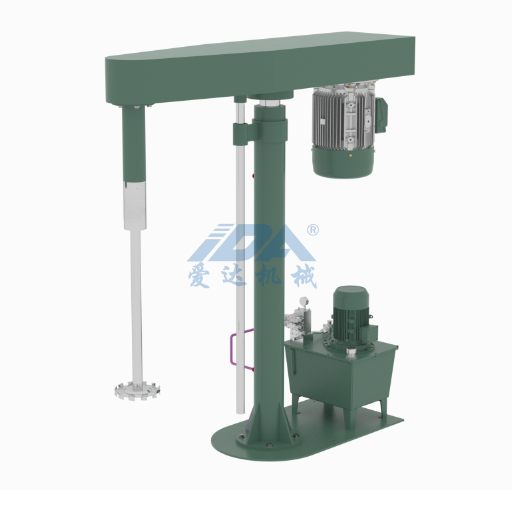
Key Performance Metrics for High-Speed Dispersion
High-shear dispersers rely on specific performance indicators to secure optimum mixing and consistent product quality. Shear rate, for instance, is one key aspect that either aids in the destruction of particles or mixes ingredients completely. Intensity of shear rate acts upon distribution of pigments, filler, and additives. Hence, the shear rate must be great in such a way as to effect good dispersion; and it affects the texture of the material taking full advantage of the aforementioned.
Another important metric in the motor power will dictate the disperse ahead for handling frequent viscosities in various volumes. Motor will have the power to run at speeds so that it may perform competently on low to high viscous materials to satisfy the needs of highly versatile production. Correct synchronization of the motor power with the material type can reduce processing time and prevent wear and tear on the equipment.
In stirring performance, the design of the blade and its speed undoubtedly are all-important. Size, design, and rotational speed alter the amount of turbulence necessary for dispersion and, thus, guarantee even particle distribution. The variable speed allows for precise control of stirring—one that adapts to a wide variety of materials having particular properties and formulations, resulting in effective and applicable results.
Factors Affecting Disperser Performance
There are quite a few factors that may affect the disperser performance. Each factor combines to influence the effectiveness and quality of the dispersion process. One important factor that determines performance is material viscosity. Generally, the higher the viscosity of the materials, the more energy and special disperser machine capabilities are needed to attain uniform particle distribution. Attempting to adjust the disperser speed and make sure it is compatible with the material properties, adjusts whenever the viscosity varies.
The design and shape of the blade are influential in determining disperser efficiency. When one selects the appropriate blade, it is to ensure optimum shear forces and turbulence as both prove a necessity and requirement in splitting agglomerates and achieving even distribution of particles. The blade should also be durable enough to endure the physical demands of the process on any abrasive or dense formulations.
Finally, turbulence/circumstantial parameters such as speed of rotation and mixing time come into play, affecting efficiency. To generate the desired flow pattern within the dispersion medium, an optimal speed is crucial. In practical circumstances, overmixing or undermixing is possible, introducing some variations in the product itself. Factors like temperature, and the presence of air bubbles should also be looked into as external factors, which might have an influence on the quality of the finished product. Attention to these factors leads to optimal disperser functioning across a broad array of applications.
Choosing the Right High-Speed Disperser for Your Needs
It is important to assess your application’s exact requirements while choosing a high-speed disperser. The kind of material that will be handled, the viscosity it has, and the kind of consistency that is to be achieved at the end of the process are of prime importance. The energy and speed of the disperser are to be commensurate with the task to be performed on particular materials without seriously impairing wear and, consequently, the performance of the disperser.
Next, consider the production capacity and depth of the dispersion. Dispersers come in various sizes that can handle anything from tiny laboratory samples to massive industrial production batches. Matching the machine to the working output will further explain its efficiency and effectively eliminate wasteful downtime. Put specific attention to the disperser blade design; remember, performance factors into the outcome of mix quality and uniformity.
Thus, one other element to be considered is the ease of operation, maintenance requirements, and longevity. A disperser that has easy-to-handle controls, with suitable maintenance procedures, may help save a significant amount of time and resources throughout the lifespan of the disperser. By ensuring that the specifications suit the needs perfectly, one can achieve applications-oriented and excellent quality at any time consistently.
Maintenance and Troubleshooting
Best Practices for Maintaining High-Speed Dispersers
For the effective longevity of high-speed dispersing, regular inspection and cleaning are quite essential. Some visits to check for wear and tear mainly in the blade (mechanical) and the frame holding the motor will make a lot of difference. Periodical thorough cleaning after every use is an excellent upkeep, stopping dried material from building up in places it did not belong, which would lead to inefficient performance and longevity. Ensure the dissipation is dried after cleaning to avoid corrosion or any damage.
Another very crucial thing concerning upkeeping that we cannot stay behind talking about is lubrication. Applying the right kind of lubricants on moving parts will lessen friction and allow the smooth operation of the equipment. The manufacturer should always be consulted for information on how often to lubricate and when to spare it so that both the complaints of over-lubrication and-under-lubrication are negated. One must necessarily use compatible lubricants with the material being dispensed.
Store and handling play a significant role in the durability of high-speed dispersers. They need to be housed in a clean and dry environment, free from dust and moisture when not in use. It is very important to maintain many of the associated small-scale maintenance problems head-on rather than address them in the form of larger costly repairs. Adhering to these best practices provides for good efficiency and performance when using high-speed dispersers.
Common Issues and How to Troubleshooting Them
Nonuniform Dispersion:Nonuniform dispersion is one of several typical problems cropping up due to improper blade height or incorrect blade speed, which are not precise for the particular material being processed. To overcome this, one must correct the blade position by bringing it to the center of the batch and adjust motor speed according to the viscosity and volume of the material. Making sure the material circulates properly and is the disperser size not too much for this job should then follow.
Too Much Vibration:The usual cause of vibration would be unbalance in the blades, poor installation, or deterioration of machine parts. Check the blades first and then the shaft and look for any possible damage or misalignment. If the blade bendage is decent, then it must be replaced forthwith to avoid catastrophic damage. It is important to tighten all connections and fittings appropriately while installing the machines to avoid vibration.
Overheating of Machinery:Overheating arises when machinery is operated for long periods, when machinery is insufficiently lubricated, or when motor problems exist. Do not run machines for longer units than deemed appropriate without taking much-needed rest. Check lubricant levels and ensure coolers, if present, are working properly. If overheating is a concern, it might pay off to hire somebody to look into the source of the problem in the motor and electrical system.
Upgrading Your High-Speed Disperser
Upgrading high-speed dispersers can instead greatly influence their competence vis-a-vis the capability to meet continually-changing schedules of production. An effective upgrade should aim at featuresother than the ability to manage extra power consumption and a more recent technique of control – one may focus concern as per their process requirements. Another criterion may as well include new mixing technologies for increased persistency and minimizing downtime.
The starting point is understanding the performance of the existing setup. Are there any factors that disallow you from meeting production requirements? Are the towing and mixing rates too slow in the current set of circumstances? Is the material not getting uniformly dispersed? These are a few chinks in the neck of high-speed dispersers that need to be fixed post-haste. Get a flow of the knowledge from trained Cantilever -type technicians and equipment manufacturers and better understand the selection wherein you may sit for upgrades.
Possible enhancements could include the application of energy-efficient motors, blade modification for improved mixing, and installation of automation controls for accuracy, ease of use, and simplification. Functions like variable-speed operation or digital monitoring could allow for greater systems flexibility and real-time feedback on system performance. Though they require an initial investment, the former can save money and increase production at good rates. Remodels should always be kept in compliance with safety and operations protocols.
Frequently Asked Questions (FAQ)
Q: How does High Speed Disperser work?
A: The High Speed Disperser, a major type of high shear disperser, is employed to destroy the continuity of solids, agglomerates, and droplets quickly in a liquid. High speed mixing of this kind uses the principle of energy transfer, with a disc-type blade mounted on a rotating shaft creating a slow-moving vortex directly from the blade into the high speed of the disc, enabling it to generate tip speed (peripheral velocity) and thus providing a good shear and high pumping for excellent dispersion.
Q: What is the distinction between a high-shear blade and a regular blade?
A: The principle of a high-shear disperser blade’s blade tip energy transfer relies on operation of high speeds and high shear, as opposed to a normal blade that operates at low speeds, hence the disperser drags material into the high-speed disc, where the shear forces and cavitation break particles apart very fast; faster than a normal blade or agitator.
Q: What is the tip speed and why is the tip speed of the disc important?
A: The tip speed corresponds to the speed or peripheral velocity towards the outer edge of the disc type blade and is critical in that the tip speed sets into play shear intensity; increased speeds, per se, cause increased shear, barriers to dispersion, and increased chances of perfect dispersion that may call for greater horsepower, plus careful tuning of speed/product rheology.
Q: What are typical operating blade speeds and ranges for high-shear dispersers?
A: Disperser blade speeds are generally measured in feet per minute for tip speed and revolutions per minute for shaft speed; shaft speeds for high-shear dispersers may operate at hundreds and even thousands of feet, depending on the shaft’s overall length and RPM—the blade speed of high-shear dispersers is typically above normal blade speed—half the normal blade speed comparisons are used in various contexts—not as a rule so anytime a disperser operates, it should be adjustable to match the conditions of the viscosity, sheer requirements, and the particular application of dispersion.
Q: When should a disperser be used rather than an agitator or mixer?
A: Use a disperser instead of an agitator where you need rapid break-up of particles, produce strong shear emulsions, obtain high production rates and short dispersion times with their inherently higher speed; a disperser treated as a type of mixer serves to rapidly break apart solids into liquid medium and it is used in place of agitators whenever high-shear disperser blades-creating- a fine particle distribution are desired.
Q: Which are the performative considerations that the blade diameter and other mixing-shaft options might have?
A: The blade diameter had a direct impact on the tip speed and the shear intensity of the mixer; hence, this implied that the big-diameter blades made higher peripheral velocity options at the same rpm; the additional mixing shafts tend to provide benefits by increasing circulation, also reducing dead zones, as is good news that optimal dispersion is achieved by combining localized high-shear with bulk mixing.
Q: What maintenance and replacement instructions should be followed for disperser blades?
A: Disperser blades should be replaced when worn, Standard: tk, bent, or their performance decreases. Many models of dispersers are available; follow the manufacturer’s recommendations on the inspection frequency for the blade; make sure the disperser speed can be adjusted according to the manufacturer’s recommendations regarding horsepower in order to prevent it from getting overloaded. This powerful tool is essential for making dispersal processes more productive by producing good and consistent results where the disperser-tool relies on sharp-edged disperser blades being properly balanced.
Q: How many factors affect dispersion times and product yields?
A: Dispersion times would be directly influenced by the circumference speed of the disc, the diameter of the blade, horsepower, rheology of the product, and the particular dispersion application applied; maintaining velocity and rheology of the product, mounting the right type and blade configuration of disc will ensure the material is sucked into and well dispersed by high-speed discs. Simply forming a swirling vortex could also be a high-speed dispersion in its own right.
References
-
Preparation of Coal-Water Slurry Using a High-Speed Mixer-Disperser
This academic paper discusses the effectiveness of high-speed dispersers in reducing particle size and enhancing slurry stability.
Read more here -
High Shear Mixer Standard Operating Procedure
A detailed document outlining the specifications and operation of high-speed dispersers, including power and output speed.
Read more here -
Ceramics Funmatsu Bunsan to Bunsanki (Journal Article)
This journal article explains the mechanics of high-speed dispersers, focusing on their use in shearing and dispersing powders.
Read more here - High Speed Disperser – Industrial Mixing Equipment from Leading China Manufacturer