Get in Touch with IDA


By Karry | Reviewed by the Jiangyin IDA Equipment Co., Ltd. technical team | (Updated November 2026)
Commercial plants manufacture sunscreens by heating separate oil and water phases, dispersing UV filters under vacuum homogenization, cooling below 40 °C before heat-sensitive additions, and running clinical release tests. At factory scale, the question of how is sunscreen made centers on breaking mineral particle clusters cleanly while protecting polymer emulsion structure. Sunscreen is a regulated topical formulation that provides UV protection by absorbing or scattering solar UV radiation across UVA and UVB wavelengths using approved mineral or chemical UV filters.
Bottom Line Up Front: Effective sun protection requires dispersing mineral aggregates below a 200 nm optical transparency threshold while selecting mixers by viscosity, switching from single-shaft dispersers or bead mills around 50,000 mPa·s to triple-shaft mixers, double planetary kneaders, or hydraulic three-roll mills for dense pastes.
Key Manufacturing Takeaways
- Raw “Non-Nano” Powders Still Clump: Horiba LA-960V2 diffraction measurements show commercial mineral sunscreen products displaying coarse bimodal peaks at 3.76 µm and up to 20 µm optically unless mechanical dispersion breaks secondary agglomerates.
- Thermal & Shear Order Protects SPF: Heating separate oil and water phases to 45–80 °C (over 83 °C for crystalline avobenzone dissolution) and keeping intense shear away from neutralized carbomer avoids up to 50% permanent polymer viscosity loss reported in NIH carbomer shear research (PMC8982170).
- Viscosity Sets the Machine Class: Thin UV slurries under 30,000 mPa·s run cleanly through horizontal agitated bead mills, while high-solids zinc oxide masterbatch pastes require hydraulic three-roll mills rated up to 2,000,000 mPa·s.
- Monograph & Clinical Testing Govern Launch Schedules: US OTC drug compliance adds FDA 21 CFR 201.327 SPF panel testing on 10+ human subjects alongside container-closure stability validation before commercial release.
Quick Specs: Mineral vs Chemical Sunscreen Manufacturing
| Manufacturing Parameter | Mineral Suspension Sunscreen (ZnO / TiO2) | Chemical UV Filter Emulsion |
|---|---|---|
| Active Filter State & Limit | Insoluble micronized inorganic solids (WO2008109182A1) | Oil- or water-soluble absorbers; bemotrizinol up to 6% (91 FR 35220) |
| Primary Heating Window | 45–80 °C (85 °C reported in Croda W/O SPF 30 batches) | Above 83 °C to fully solubilize crystalline avobenzone |
| Critical Structural Target | Dispersed mineral aggregate D90 <= 200 nm | Uniform emulsion droplets (0.20–0.34 µm with CP-HPH, MDPI Processes) |
| Pre-Mix / Grinding Step | High-speed disperser, bead mill (<=30,000 mPa·s), or three-roll paste mill | Heated oil-phase dissolution kettle with gentle anchor/turbine mixing |
| Release Standard | In vivo SPF (10+ subjects), >=370 nm critical wavelength, stability testing | In vivo SPF (10+ subjects), >=370 nm broad spectrum, HPLC filter assay |
How Is Sunscreen Made? The 5-Stage Industrial Manufacturing Workflow
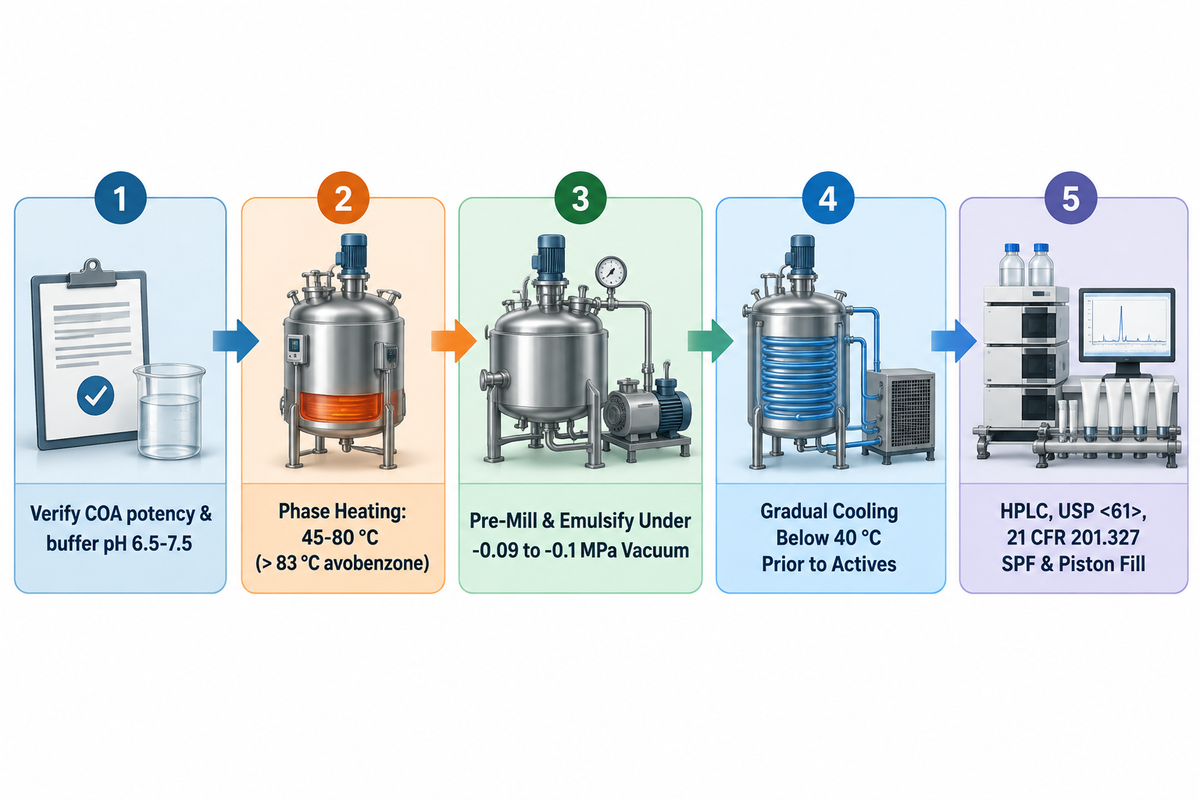
Prior to commercial distribution, industrial sunscreen manufacturing executes five sequential unit operations: heating water and oil phases separately at 45–80 °C, pre-dispersing inorganic powders or dissolving organic filters, homogenizing the combined emulsion under vacuum up to -0.09 MPa, cooling below 40 °C prior to heat-sensitive additions, and releasing lots after assay and clinical testing.
That five-step thermal and shear sequence prevents coarse grit, uneven active distribution, and trapped air bubbles across commercial lot sizes. Unlike small-batch homemade sunscreen mixed in open benchtop vessels, commercial sunscreen production isolates oxygen and dust inside jacketed stainless reactors. Dumping raw UV powders straight into a warm lotion kettle produces unmixed dry cores (“fisheyes”), non-uniform sun protection factor (SPF) distribution across drums, and premature emulsion cracking. Plant operators prevent those defects by verifying active-ingredient assay certificates first, pre-wetting thickeners or oxides under controlled vortex geometry, and holding cooling trajectories within tight crystal-nucleation limits so finished sunscreen creams exhibit smooth spreadability on skin. Per FDA Small Entity Sunscreen Guidance, every U.S. OTC drug lot across common sunscreen lotions, sprays, and mineral creams must follow validated current Good Manufacturing Practice controls from raw dispensing through packaging release.
45–80 °CSilverson phase heating range
-0.09 MPaIDA IZF vacuum degassing level
< 40 °CCool-down target before actives add
Viscosity shifts sharply during Stage 3 as oil-soluble waxes meet aqueous gums, so jacket water temperature and anchor scraper speed must track batch thickening dynamically. If the cooling jacket drops cold brine onto molten fatty alcohols too rapidly, wax micro-crystals nucleate prematurely and turn an otherwise glossy sunscreen cream grainy before it ever leaves the tank. It’s important to have a stable batch-specific gravity before the emulsifying vessel is filled. This is accomplished by maintaining a vacuum in the emulsifying vessel to break and remove entrained, stabilized micro-bubbles.
| Stage | Unit Operation | Documented Target Envelope | Primary Defect Prevented |
|---|---|---|---|
| 1A | Raw Material QC & Assay Check | Verify COA potency of UV filter actives & excipients | Under-dosed active SPF failures and lot rejects |
| 1B | Aqueous Hydrocolloid Pre-Hydration | Venturi induction into purified water; buffer O/W pH 6.5–7.5 | Unwetted polymer fisheyes and zinc ion pH drift |
| 2A | Separate Water & Oil Phase Heating | Heat jacketed phase tanks to 45–80 °C (Silverson benchmark) | Incomplete wax melting and thermal shock inversion |
| 2B | Crystalline Filter Solubilization | Hold oil phase above 83 °C for avobenzone dissolution (Croda) | Post-cooling organic filter recrystallization |
| 3A | Mineral Oxide Wetting & Pre-Milling | Disperser, bead mill (<=30,000 mPa·s), or three-roll paste mill | Coarse 3.76–20 µm white-cast pigment agglomerates |
| 3B | Vacuum Rotor-Stator Emulsification | Lab high-shear up to 15,000 rpm (MDPI Processes) or vacuum rotor-stator homogenization up to 3,000 RPM under -0.09 to -0.1 MPa vacuum (IDA IZF/QLF) | Wide oil-droplet span and entrained air micro-bubbles |
| 4 | Controlled Cooling & Post-Additions | Gradual anchor sweep cooling below 40 °C before heat-sensitive inputs | Wax grittiness and fragrance/preservative volatilization |
| 5A | Analytical & Clinical Release QC | Per-lot HPLC assay + USP <61> + 21 CFR 201.327 SPF validation | Sub-potent sunscreen products and FDA warning letters |
| 5B | Low-Shear Transfer & Piston Filling | Rotary lobe pump + bottom-up servo piston nozzle dive | Shear-thinned lotion and weight-drift air cavities |
What Are the Ingredients of Sunscreen?
Sunscreen formulations combine FDA-regulated active ingredients that block ultraviolet radiation with functional base excipients that form an even film on the skin. Inorganic mineral formulas rely on zinc oxide or titanium dioxide particles as physical blockers. Chemical formulas instead use soluble organic absorbers such as avobenzone, octocrylene, homosalate, octinoxate, and oxybenzone.
Industrial sunscreen formulations also add water-resistant film-forming polymers, rheology modifiers, chelating agents, and broad-spectrum antimicrobial preservatives. Purified water, emollient esters that increase spreadability, and O/W or W/O emulsifiers complete these base formulations.
What Is a Natural Sunscreen?
Natural sunscreen uses exclusively inorganic mineral actives, such as titanium dioxide and zinc oxide, as physical filters instead of synthetic petrochemical organic UV absorbers. These mineral filters act as a UV shield on the stratum corneum rather than relying on aromatic chemical rings to dissipate photon energy.
In factory sunscreen production, these mineral powders are dispersed into plant-derived emollient oils or biocompatible esters using wetting dispersants. That vehicle choice supports mild suitability for people with sensitive skin while delivering full UVA protection and UVB protection without stinging.
Mineral vs Chemical Sunscreen Manufacturing: Active UV Filters and Stabilizer Chemistry
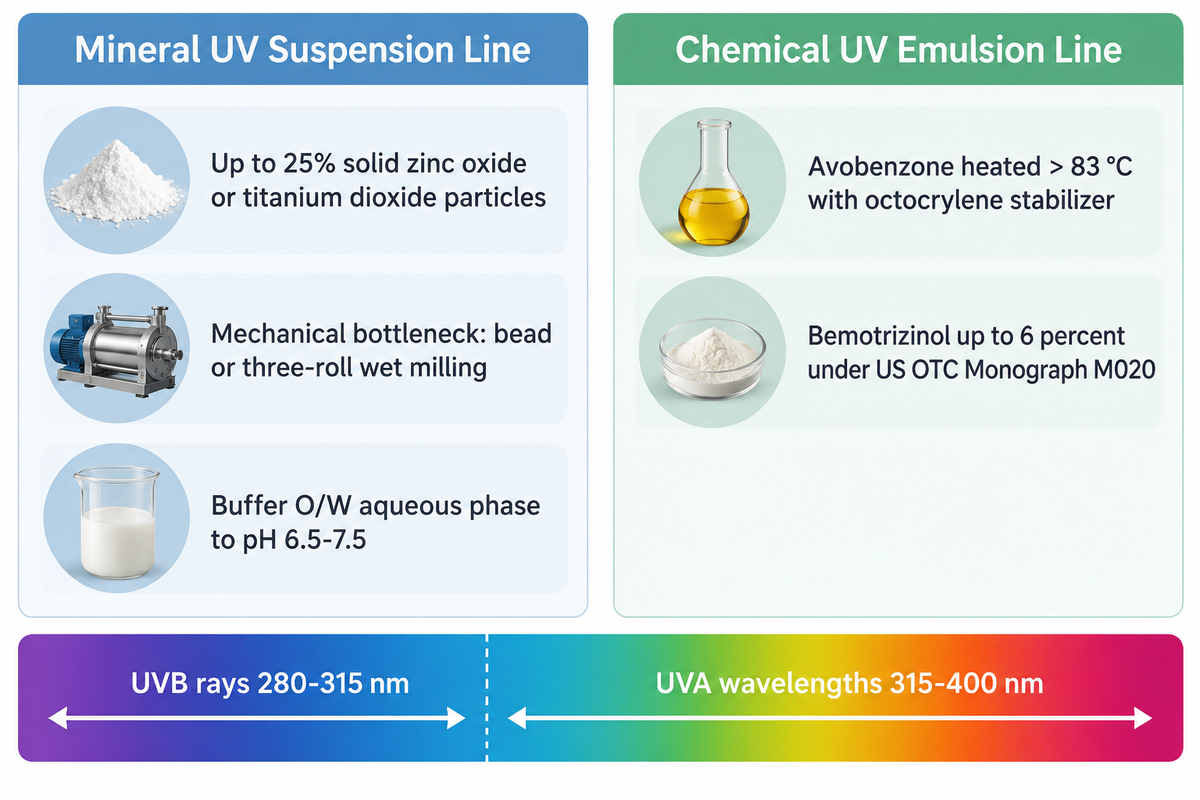
Mineral sunscreen relies on up to 25% solid zinc oxide or titanium dioxide particles suspended by mechanical milling, whereas chemical sunscreen dissolves crystalline organic absorbers into oil heated above 83 °C alongside photostabilizers. On June 10, 2026, Federal Register Final Order OTC000039 added bemotrizinol up to 6 percent for use in sunscreens under US OTC Monograph M020.
Different mechanisms separate how mineral and organic systems behave inside processing kettles. Organic absorbers such as avobenzone melt and dissolve completely into nonpolar emollient esters inside heated oil kettles. Similarly, liquid absorbers including octyl methoxycinnamate (widely labeled octinoxate on retail cartons), oxybenzone, and other benzophenones demand gentle agitation time. However, pure avobenzone degrades rapidly under solar UV rays unless paired with photostable triplets like octocrylene or encapsulated UV filters. Croda formulation guidelines document that crystalline avobenzone requires heating above 83 °C during oil-phase preparation so crystals do not precipitate after cooling. US rules also restrict combining avobenzone with uncoated titanium dioxide and zinc oxide due to photoreactive metal-chelation effects.
Mineral sunscreen batches invert that engineering bottleneck completely because solid mineral powders never dissolve in oil or water. Instead, surface-coated titanium dioxide and zinc oxide grades (described in patent application WO2008109182A1) reach high active loading only when surfactants wet every particle surface and mechanical energy breaks up loose inter-particle clumps. Cosmetics & Toiletries technical literature by Staniland and Hewitt shows that coating enhanced-UVA TiO2 with alumina and stearic acid blocks photocatalytic reduction of titanium ions (“photogreying”) in bright sunlight. In O/W mineral emulsions, Croda further advises buffering the water phase to pH 6.5–7.5 before emulsification so solubilized zinc ions do not destabilize ionic thickeners or drift emulsion viscosity.
Mineral UV Suspension Line
- Actives stay insoluble up to 25% loading
- Requires hydrophobic surface coating + wetting agents
- Mechanical bottleneck: bead or three-roll wet milling
- Buffer O/W aqueous phase to pH 6.5–7.5
Chemical UV Emulsion Line
- Absorbers dissolve fully above filter melting point
- Avobenzone heated > 83 °C with octocrylene stabilizer
- Process focus: polar/nonpolar ester solvency ratio
- Protect organic filters from high-pH amine shift
Across all commercial types of sunscreen, UV light exposure damages skin differently by spectrum, which explains why modern broad-spectrum formulations blend complementary actives. Shorter UVB rays (280–315 nm) strike the outer epidermis to trigger surface sunburn and direct DNA damage. Longer UVA wavelengths (315–400 nm) penetrate deeper layers of the dermis, where they break down structural collagen and accelerate visible tan darkening. A product that protects across both bands pairs strong UVB absorbers or TiO2, with long wave UVA blockers like zinc oxide, avobenzone, or bemotrizinol which was recently approved.
| Sunscreen Category | Primary Active UV Filters | Spectrum & Mechanism | Critical Process Demand |
|---|---|---|---|
| Mineral (Inorganic) | Zinc oxide, titanium dioxide (up to 25% each in US monograph) | 290–400 nm UVA/UVB; scatter UV and absorb UV photon energy | De-agglomerate powder clusters without shearing coatings off |
| Chemical (Organic) | Avobenzone, octocrylene, homosalate, octinoxate, bemotrizinol (up to 6%) | Chromophores absorb UV radiation and convert to heat | Hold oil phase above 83 °C for avobenzone; block crystallization |
| Hybrid (EU / Asia ODM) | Coated TiO2 or ZnO paired with photostable soluble absorbers | High SPF 50+ efficacy with lighter cosmetic feel | Prevent Fe/Ti catalyzed degradation and check regional filter rules |
Zinc Oxide and Titanium Dioxide Dispersion: Controlling Particle Size to Prevent White Cast
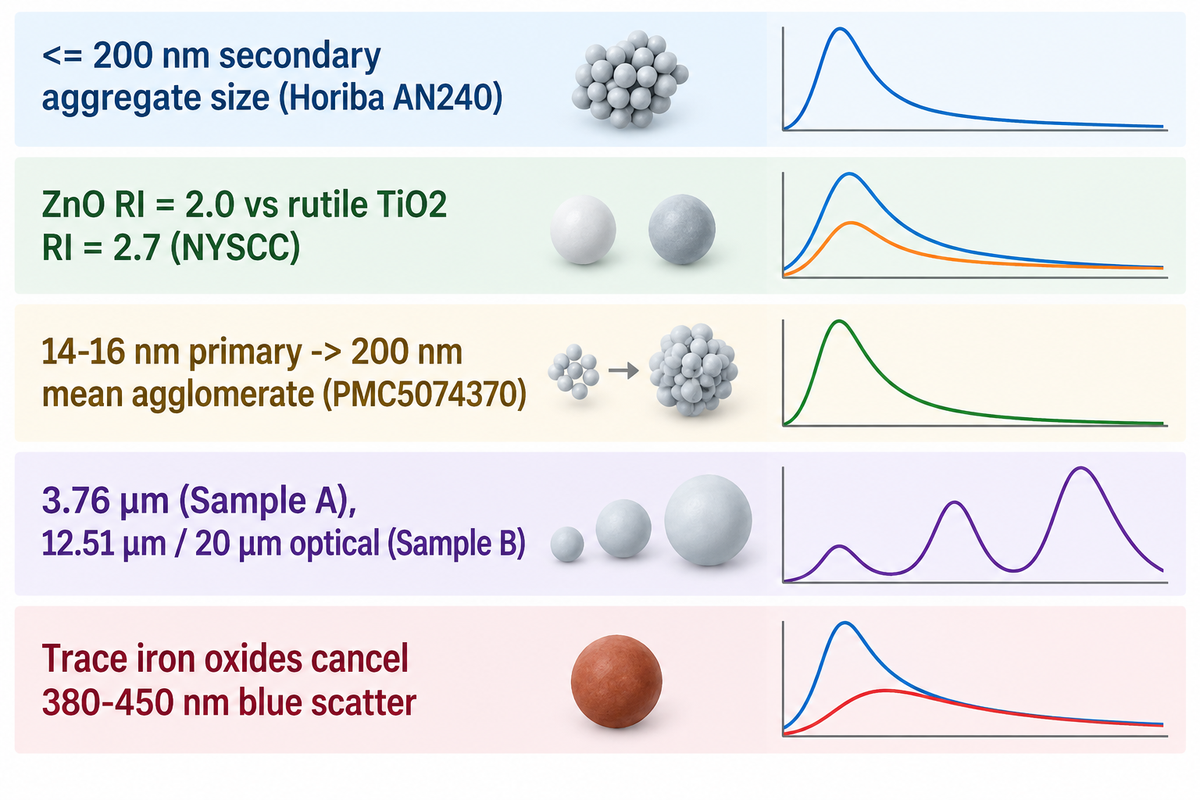
Preventing visible white cast requires milling zinc oxide and titanium dioxide below a 200 nm secondary aggregate ceiling, because coarse commercial aggregates measured at 0.76 to 12.51 µm strongly scatter visible light on skin. Below that sub-200 nm secondary particle size limit, mineral ZnO/TiO2 dispersions transmit visible wavelengths cleanly without whitening applied skin. Purchasing nanosized raw powders is of no value, because van der Waals forces cause the micrometer-sized clusters to re-form in inadequate mixers.
200 nm Optical Scatter Threshold
The sub-200 nm aggregate ceiling is the upper secondary particle size limit at which mineral ZnO/TiO2 dispersions transmit visible wavelengths cleanly without whitening applied skin.
Formulators often treat a supplier’s transmission electron microscopy (TEM) crystal diameter as finished-batch reality, yet Horiba Application Note AN240 proves light interacts with dispersed secondary aggregates rather than dry raw crystals. Horiba LA-960V2 laser diffraction testing confirms that ZnO particles of 200 nanometers or smaller appear virtually transparent, yet commercial “non-nano” mineral sunscreens still exhibited large bimodal coarse fractions. Sample A showed a fine peak at Dv50 = 90 nm alongside a 3.76 µm coarse peak, Sample B showed 80 nm plus 1.35 µm and 12.51 µm peaks (with 20 µm optical microscopy agglomerates), and Sample C showed 80 nm and 0.76 µm peaks. Peer-reviewed oxide dispersion research in NIH nanoparticle review PMC5074370 similarly observed that even silicone-coated 14–16 nm T-Lite SF rutile TiO2 crystals aggregated right up to that optical transparency boundary during emulsion processing.
Optical refractive index dictates why rutile TiO2 creates heavier, opaque chalkiness than zinc oxide when ground to the same particle size. Dr. Yun Shao, in technical guidance published by the New York Society of Cosmetic Chemists (NYSCC), notes the refractive index of rutile TiO2 is 2.7 compared to 2.0 for zinc oxide. That gap causes TiO2 to scatter roughly three times as much visible light per Mie scattering physics. Because residual 380–450 nm short-wavelength blue scatter can still leave a subtle cast on darker skin, formulators incorporate trace transparent iron oxides (fine red, yellow, and black pigment grades) alongside well-dispersed mineral slurries to neutralize gray or chalky undertones without thickening texture. However, unmilled pigment agglomerates can streak visibly across uneven skin pores during rub-in. Pairing fine iron oxides with cleanly dispersed zinc oxide slurries balances undertone and translucency across deeper skin tones.
| Mineral Dispersion Metric | Measured / Published Value | Process & Optical Consequence |
|---|---|---|
| Visual Transparency Threshold (ZnO) | <= 200 nm secondary aggregate size (Horiba AN240) | Particles at or below that ceiling appear virtually transparent on skin |
| Refractive Index Contrast | ZnO RI = 2.0 vs rutile TiO2 RI = 2.7 (NYSCC) | TiO2 scatters far more visible light; demands tighter PSD control |
| Coated TiO2 Mean Aggregate Size | 14–16 nm primary -> 200 nm mean agglomerate (PMC5074370) | Primary crystal data alone mispredicts real emulsion dispersion state |
| Commercial Bimodal Coarse Peaks | 3.76 µm (Sample A), 12.51 µm / 20 µm optical (Sample B) | Under-milled agglomerates scatter light and whiten medium to dark skin |
| Undertone Tint Compensation | Trace transparent iron oxides (NYSCC) | Cancels residual 380–450 nm bluing on deeper skin tones |
Note a key process boundary documented in Horiba AN240 and PMC5074370: single-vendor TEM primary particle specs (such as 14–16 nm TiO2 or 140 nm triethoxycaprylsilane-coated ZnO) never eliminate white cast alone. Downstream milling and surface-wetting agents must prevent soft agglomerates from reforming into 0.76–20 µm clusters inside the finished emulsion. Over-shearing coated powders at extreme dry-powder impact speeds can also strip hydrophobic silane shells, forcing re-agglomeration during shelf storage.
Oil-in-Water vs Water-in-Oil Sunscreen Emulsification: Shear, Temperature, and Vacuum Degassing
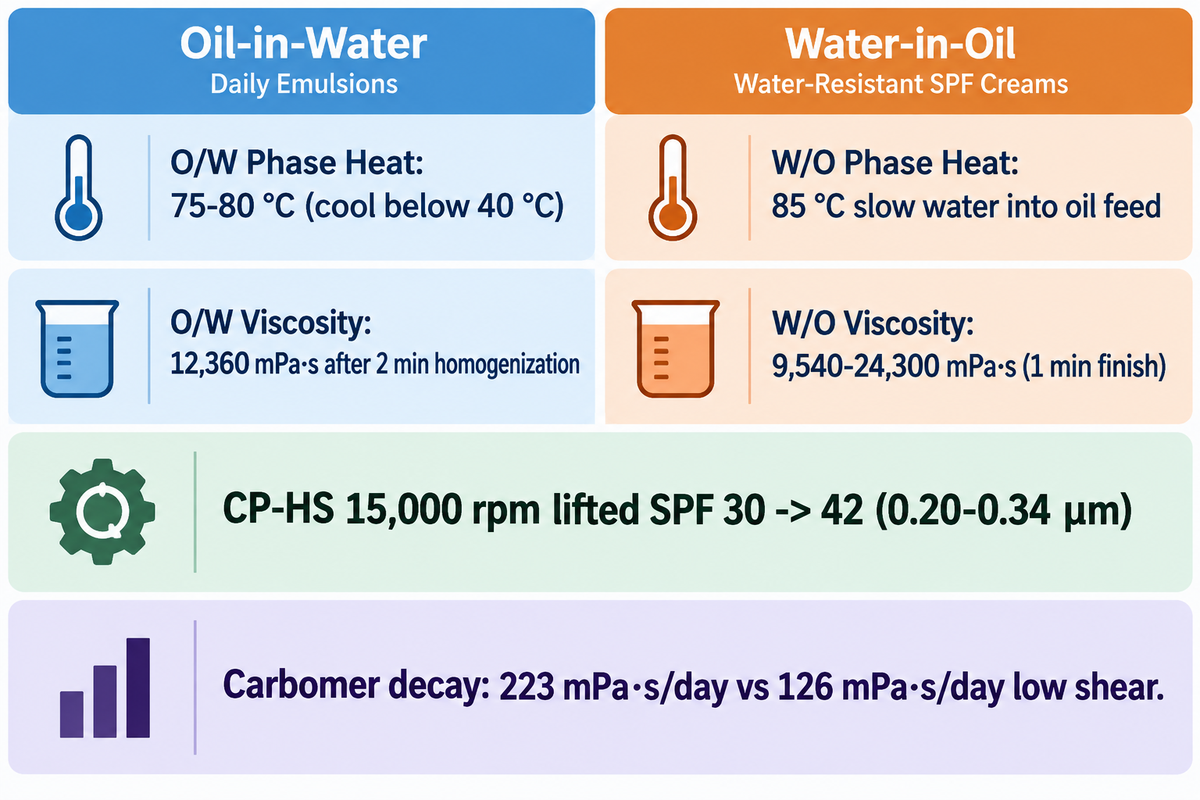
Complementary high-shear homogenization at 15,000 rpm for 15 minutes raised in vitro SPF from 30 to 42 in peer-reviewed MDPI Processes sunscreen trials, while O/W and W/O batches require distinct addition sequences, temperatures (75–80 °C vs 85 °C), and polymer shear timing. Choosing the wrong addition sequence or homogenizing after carbomer neutralization breaks emulsion viscosity permanently.
“Dispersions prepared with MHD technology proved more stable, with an average viscosity loss of 126 mPa s per day compared to 223 mPa s in the case of high shear mixing.”
Preserving those coated powders and hydrophobic silane shells inside the finished emulsion requires matching shear schedules across O/W daily lotions and W/O sport creams. In O/W sunscreen formulation, Croda’s published SPF 20 procedure heats separate aqueous and oil phases to 75–80 °C, combines phases for 2 minutes under controlled homogenization to yield 12,360 mPa·s viscosity at 5 rpm, and cools below 40 °C before adding heat-sensitive actives. When Carbopol 980 NF polyacrylic acid thickeners stabilize the water phase, NIH nuclear magnetic resonance studies (PMC8982170) prove that prolonged high-shear exposure cleaves polymer crosslinks and inflicts irreversible viscosity decay (223 mPa·s/day drift vs 126 mPa·s/day for low-shear hydration). Plants avoid this degradation by hydrating unneutralized carbomer early via Venturi powder induction or holding polymer addition until after main high-shear emulsification.
Water-in-oil sunscreens demand strict phase-addition rate control rather than open high-speed mixing during water introduction. In Croda’s W/O SPF 30 protocols published in Cosmetics & Toiletries, operators heat oil and aqueous phases to 85 °C and meter the water phase slowly into the continuous oil phase containing already-dispersed mineral powders. A brief 1-minute final homogenization pass then locks in 9,540–24,300 mPa·s stability. Dumping the water volume into the oil phase rapidly crosses the phase-inversion volume threshold, producing a coarse O/W emulsion that leaks oil within days of filling.
| Emulsification Control Factor | Oil-in-Water (O/W) Daily Sunscreen | Water-in-Oil (W/O) Water-Resistant SPF |
|---|---|---|
| Phase Addition Direction | Oil phase metered into agitated aqueous phase | Water phase metered slowly into continuous oil/mineral phase |
| Hot-Process Temperature | 75–80 °C (cool below 40 °C before preservatives) | 85 °C phase merge (cold-process W/O variants exist for select silicone emulsifiers) |
| Homogenization & Rheology Impact | 2 min emulsification (12,360 mPa·s); keep prolonged shear off neutralized carbomer | Slow anchor blend during water feed + 1 min finish homogenization (9,540–24,300 mPa·s) |
| Droplet Size & SPF Lift | CP-HS at 15,000 rpm lifted SPF 30 -> 42; CP-HPH narrowed PSD to 0.20–0.34 µm | Tight internal water droplets block channel syneresis during 40–80 min water immersion |
| Primary Plant Failure Risk | Carbomer chain scission collapsing cream viscosity (PMC8982170) | Sudden water dumping forcing catastrophic W/O -> O/W phase inversion |
Which Emulsion Type Is Best for Sunscreen: O/W or W/O?
O/W emulsions suit daily facial skincare sunscreens and lightweight lotions worn under makeup. W/O emulsions perform better for water-resistant sport sunscreens and high-mineral formulas for humid outdoor conditions. O/W carriers spread quickly and feel lighter as the external water evaporates quickly on rub-in.
W/O bases strengthen the protective properties of sunscreen by surrounding internal water droplets in an unbroken lipid film on the skin, helping formulas withstand 40-minute to 80-minute water immersion tests while stabilizing heavy zinc oxide suspensions that would otherwise settle rapidly. Production plants choose emulsion polarity based on label SPF, pleasant sensory texture targets, and regional water-resistance claims.
Industrial Sunscreen Mixing and Grinding Equipment: Vacuum Homogenizers, Bead Mills, and Three-Roll Mills
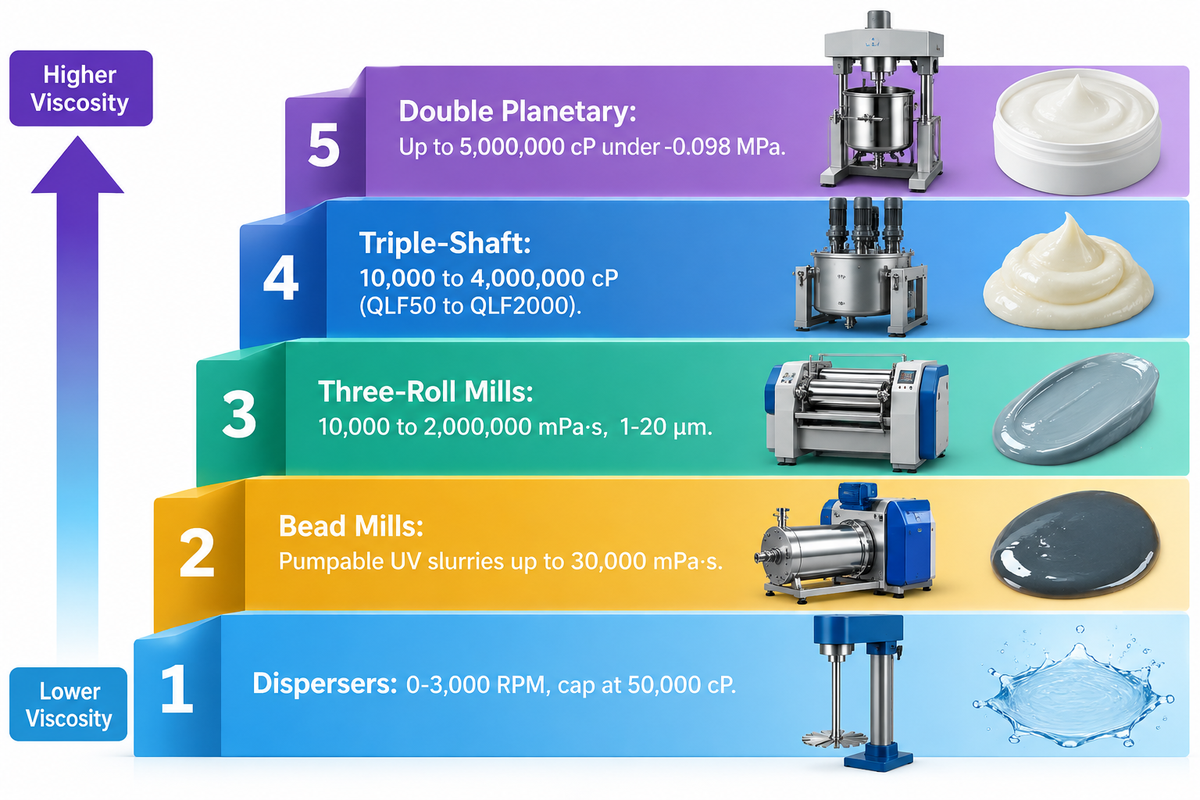
Single-shaft high-speed dispersers handle fluid sunscreen slurries up to 50,000 cP and horizontal bead mills choke above 30,000 mPa·s, whereas concentrated high-solids zinc oxide masterbatches and anhydrous sunscreen sticks require hydraulic three-roll mills (up to 2,000,000 mPa·s) or vacuum triple-shaft and double planetary mixers. The right equipment for slurry rheology prevents feed pump stalls and screen blowouts.
50,000 mPa·s Rheology Routing Gate
Around 50,000 mPa·s, single-shaft dispersers lose flow and high-torque planetary mixers or three-roll mills take over.
Many plants oversize a bead mill expecting one machine to handle every mineral dispersion, only to watch dense zinc oxide pastes starve positive-displacement feed pumps and blind bead-separator screens. Practicing cosmetic chemists on Chemists Corner note that moderate pigment loadings in light cosmetic esters run cleanly on a homogenizer or overhead disperser, whereas creating a concentrated 40% or more ZnO masterbatch paste requires a three-roll mill, closing roll gaps near ~20 µm when running thinner carriers, which sits inside IDA’s 1–20 µm fineness window. Published IDA Equipment specs quantify the handoff explicitly: recirculating horizontal bead mills for pumpable UV slurries excel up to 30,000 mPa·s, high-speed UV powder dispersers (0–3,000 RPM) cap at 50,000 cP without wall scrapers, and water-cooled ceramic precision three-roll paste mills for 40% ZnO masterbatch process 10,000 to 2,000,000 mPa·s down to 1–20 µm fineness.
Inside main batch kettles, combining slow anchor sweep scraping with high-speed dispersion and rotor-stator emulsification solves high-viscosity heat and dead-zone defects without moving viscous product between multiple open tanks. For thick sunscreen creams and pastes from 10,000 to 4,000,000 cP, coaxial triple-shaft vacuum emulsifying mixers for SPF creams (IDA Triple-Shaft Mixers in 50, 200, 500, 1,000 L standard vessels and QLF50 to QLF2000 custom units with anchor, disperser, and homogenizer) sweep wall film continuously while pulling agglomerates directly into the shear zone. Heavy wax sticks and balms pushing past 4,000,000 cP shift to high-vacuum planetary mixers for anhydrous mineral stick bases (IDA Double Planetary Mixers from XJB-5 at 1.5 kW to XJB-2000 at 90 kW, rated up to 5,000,000 cP under -0.098 MPa vacuum).
For bulk low-to-medium viscosity UV oxide slurries that do not require bead-chamber grinding, Chemical Engineering (Apr 2021) documented Advanced NanoTek converting slow ball-milling lines to Ross ultra-high shear rotor-stator mixers exceeding 11,000 ft/min tip speed. Operating across 60 kg, 216 kg, and 540 kg vessels, the upgrade more than doubled plant capacity while cutting electricity and labor. On high-purity tinted mineral bases where iron contamination ruins shade stability or violates trace-metal rules, zirconia ceramic three-roll rollers in IDA YS/ES80 trials reduced shade-change cleaning from 45 minutes in enclosed grinders down to under 15 minutes with zero metal contribution under ICP-MS testing. Formulators scaling cosmetic dispersion lines can compare chamber geometries in IDA’s guide to cosmetic wet grinding equipment alongside high-shear mineral dispersion patent application WO2008109182A1.
9-Row Sunscreen Format-to-Cell Spec Schedule
| Row | Sunscreen Format / Intermediate | Viscosity Regime | Primary Equipment Choice | Published Speed / Power / Fineness | Hard Operating Disqualifier |
|---|---|---|---|---|---|
| 1 | Watery UV Gel / Spray Premix | 1–5,000 mPa·s | Single-Shaft High-Speed Disperser + Venturi Inductor | 0–3,000 RPM, 0.5–500 kW VFD/PLC, 20–28 m/s blade tip speed | Single shaft fails batch wall turnover above 50,000 cP |
| 2 | Pumpable Mineral Oil Slurry | 500–30,000 mPa·s | Horizontal Agitated Bead Mill (ceramic media) | Continuous recirculation; sub-micron to <5 µm mineral grind | Clogs bead-separation screens above 30,000 mPa·s |
| 3 | Small-Batch Tinted UV Slurry | 1,000–30,000 mPa·s | Immersion Batch Basket Mill | Single-tank milling + rapid basket rinse | Lacks heat removal & flow past ~30,000 mPa·s |
| 4 | High-Shear Chemical Emulsion | 1,000–50,000 mPa·s | Inline Rotor-Stator Homogenizer | >11,000 ft/min ultra-high shear option; narrow droplet PSD | Cannot break dense high-solids ZnO paste agglomerates alone |
| 5 | O/W Daily Lotion (SPF 20–50) | 3,000–25,000 mPa·s | Vacuum Emulsifying Homogenizer Kettle (anchor + bottom rotor-stator) | 45–80 °C jacket heating; vacuum up to -0.098 MPa | Extended post-neutralization shear fractures Carbopol 980 |
| 6 | High-Solids Cream & W/O SPF | 10,000–4,000,000 cP | Vacuum Triple-Shaft Mixer (50, 200, 500, 1,000 L; QLF50–QLF2000) | 10–60 RPM PTFE scraper anchor + 0–1,500 disperser + 0–3,000 homogenizer | Overkill capital cost for watery <5,000 cP sprays |
| 7 | Concentrated ZnO Masterbatch Paste | 100,000–2,000,000 mPa·s | Three-Roll Mill (IDA VFD ES50/ES80/ES120 & Hydraulic YS Series) | 50/80/120 mm rolls (ceramic ES50/ES80), 1–20 µm fineness, <=1 µm gap | Thin <10,000 mPa·s fluids drip off wide-gap rolls |
| 8 | Anhydrous Balm / Mineral Stick Base | 500,000–5,000,000 cP | Vacuum Double Planetary Mixer (XJB-5 to XJB-2000) | 1.5–90 kW dispersion, -0.098 MPa vacuum, heated/cooled bowl | Slow cycle if processing watery thin dispersions |
| 9 | Finished Viscous Sunscreen Tubes | 8,000–50,000+ mPa·s | Positive-Displacement Piston Filler + Rotary Lobe Transfer Pump | Bottom-up nozzle dive; servo metering for non-Newtonian creams | Gravity fillers stall and trap voids above ~5,000 mPa·s |
Our schedule sets clear processing limits: single-shaft high-speed dispersers lose convective turnover above 50,000 cP, and bead mills choke separator screens past 30,000 mPa·s. Open three-roll mills lose feeding efficiency on thin liquids below 10,000 mPa·s unless the gap is held near 20 µm, the top of IDA’s 1–20 µm adjustable gap range.
Worked Process Sizing Example: Rotor-Stator Tip Speed and Batch Thermal Cooling Load
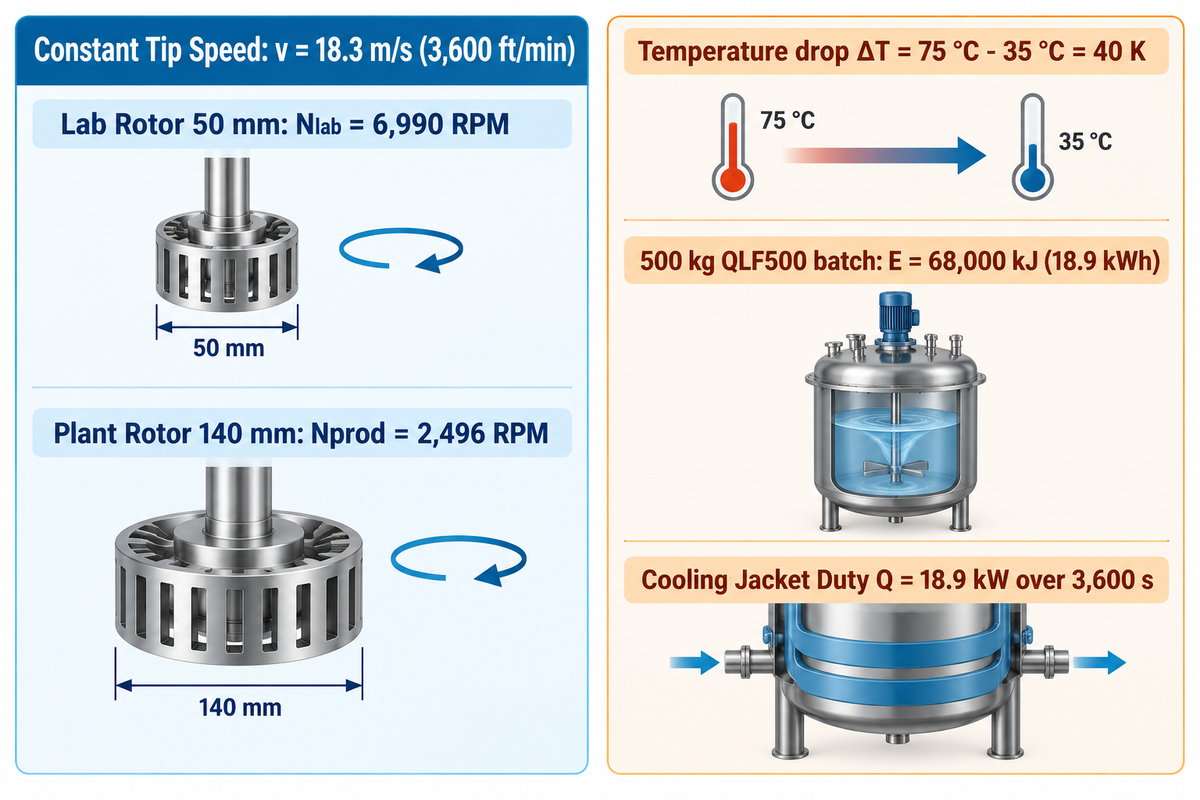
Holding a target 18.3 m/s rotor-stator peripheral tip speed across scale-up lowers required speed from 6,990 RPM on a 50 mm lab head to 2,496 RPM on a 140 mm production rotor. Cooling a 500 kg batch from 75 °C to 35 °C in 60 minutes requires 18.9 kW of sensible jacket heat removal.
Once engineers choose between high-speed rotor-stator heads, bead-mill separator screens, and three-roll gap tolerances, procurement teams scale lab trials to 500 L production kettles matching typical cGMP production batch qualification scales and IDA QLF500 500 L ratings. A common mistake is matching shaft RPM numerically instead of peripheral velocity. Keeping 3,000 RPM fixed moves a 50 mm benchtop rotor at just 7.85 m/s while driving a 140 mm plant rotor at 21.99 m/s, altering shear energy per pass nearly eightfold. Applying IDA Equipment’s published tip-speed equation (Tip Speed = π × D × RPM divided by 60 for m/s, within or slightly gentler than the 20–28 m/s pigment window) and a first-law heat balance eliminates trial-and-error commissioning.
Assumed inputs: Batch mass m = 500 kg (from an IDA QLF500 500 L standard capacity vessel at nominal 1.0 kg/L density). Target peripheral tip speed v = 18.3 m/s (3,600 ft/min, chosen just below IDA’s 20–28 m/s pigment-dispersion ceiling to protect polymer emulsions). Lab rotor diameter Dlab = 50 mm (0.050 m) and production rotor diameter Dprod = 140 mm (0.140 m). The hot-to-cool temperature drop is ΔT = 75 °C − 35 °C = 40 K within Silverson and Croda windows. Assumed steady-state emulsion specific heat capacity is Cp = 3.4 kJ/(kg·K) over a cooling duration t = 60 min (3,600 s).
Step 1 solves required shaft speed via N = (60 × v) / (π × D): for the 50 mm lab head, Nlab = (60 × 18.3) / (3.1416 × 0.050) = 6,990 RPM; for the 140 mm production rotor, Nprod = (60 × 18.3) / (3.1416 × 0.140) = 2,496 RPM. Step 2 solves steady-state sensible cooling load via Qsensible = (m × Cp × ΔT) / t = (500 × 3.4 × 40) / 3,600 = 18.89 kW ≈ 18.9 kW.
| Sizing Parameter | Formula & Substituted Inputs | Calculated Output | Engineering & Equipment Note |
|---|---|---|---|
| Lab Speed (50 mm Rotor) | N = (60 × 18.3) / (3.1416 × 0.050) | 6,990 RPM | Matches lab high-shear benchtop rotor-stator conditions |
| Plant Speed (140 mm Rotor) | N = (60 × 18.3) / (3.1416 × 0.140) | 2,496 RPM | Fits VFD-driven 0–3,000 RPM homogenizer heads cleanly |
| Batch Sensible Enthalpy Drop | E = 500 kg × 3.4 kJ/(kg·K) × 40 K | 68,000 kJ (18.9 kWh) | Total thermal energy removed across 75 °C -> 35 °C ramp |
| Sensible Cooling Jacket Duty | Q = 68,000 kJ / 3,600 s | 18.9 kW sensible load | Add mechanical power draw (~11–18.5 kW on QLF500) during shear runs |
This worked calculation sizes steady-state sensible heat extraction under assumed Cp = 3.4 kJ/(kg·K) across a 60 kg-to-540 kg industrial batch envelope matching published ZnO vessel upgrades. It is not a turnkey chiller specification because continuous impeller shaft dissipation, jacket fouling, wax crystallization latent heat, and non-Newtonian wall film viscosity increase true chiller duty, requiring verification on pilot material trials.
SPF Testing, Broad-Spectrum Validation, and FDA OTC Manufacturing Compliance
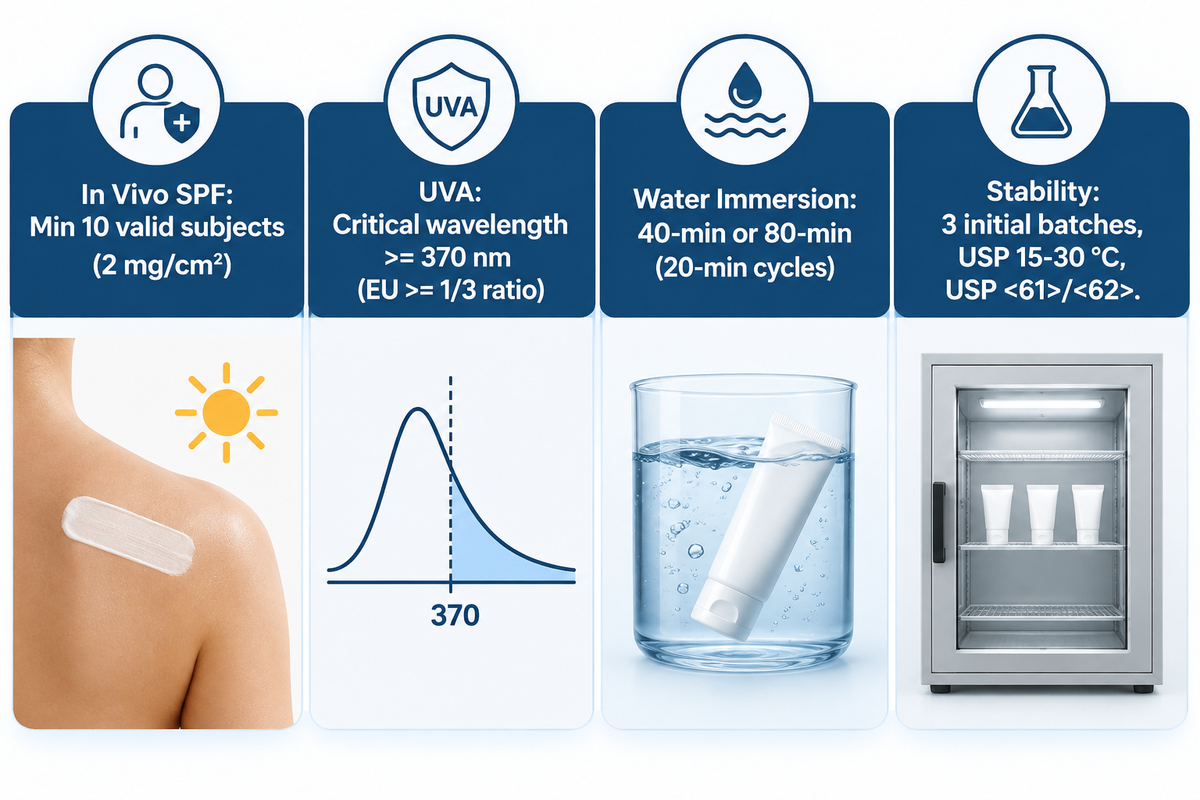
Each commercial sunscreen batch requires per-lot active chemical assay and microbial checks, as well as formula-level in vivo SPF testing on at least 10 human subjects (21 CFR 201.327(i)(3)), in vitro critical wavelength validation at or above 370 nm, and cGMP stability data in the smallest marketed container.
Brands new to sun protection frequently mistake benchtop UV transmittance spectrophotometer scans for legal sales clearance. In the United States, sunscreen products are regulated as OTC drugs rather than cosmetics, meaning adherence to safety and Monograph M020 limits governs every batch record. Under 21 CFR 201.327, laboratories measure sun protection factor (SPF) in vivo across a minimum of 10 valid subjects (maximum 3 rejected per test panel) dosed at 2 mg/cm² using a calibrated solar simulator and an FDA monograph standard control formula to confirm actual SPF versus target product label rating. Any compliant sunscreen with an SPF of at least 15 must pass in vitro critical wavelength testing at or above 370 nm to earn Broad Spectrum status. Only after clearing both clinical and optical tests can products claim broad-spectrum protection, and every compliant label must avoid outlawed “waterproof” or “sunblock” terms. For water-resistant SPF 30 or SPF 50 claims, panelists undergo two (40-minute claim) or four (80-minute claim) 20-minute immersion intervals prior to UV exposure.
Global compliance diverges across the Atlantic and Asia-Pacific, requiring multinational lines to test and calibrate labels per destination market. As Eurofins regulatory guidelines summarize, ISO 24444:2019 harmonizes clinical SPF testing across roughly 60 countries, whereas European regulations demand both that critical wavelength floor and a minimum UVA-PF/SPF ratio of at least 1/3 (requiring higher UVA filter ratios such as ~9:1 ZnO:TiO2 illustrated in Croda Solaveil Clarus dispersion formulations). For US cGMP shelf-life dating under FDA Inspection Technical Guide No. 41 (21 CFR 211.166), manufacturers place 3 initial commercial batches into controlled room temperature chambers (USP 15–30 °C) inside the smallest marketed container size because smaller bottles exhibit the highest surface-area-to-volume moisture and oxygen permeation rate.
| Validation Test | Regulatory Standard | Pass Criterion & Panel Basis | Testing Cadence & Scope |
|---|---|---|---|
| Clinical In Vivo SPF Testing | FDA 21 CFR 201.327(i) / ISO 24444:2019 | Minimum 10 valid subjects (2 mg/cm² dose) | Per new or modified formulation prior to market release |
| Broad-Spectrum In Vitro UVA | FDA 21 CFR 201.327(j) / ISO 24443 | Critical wavelength >= 370 nm (EU also requires UVA-PF/SPF >= 1/3) | Per formula qualification alongside clinical SPF panel |
| Water-Resistance Panel | FDA 21 CFR 201.327(i)(7) | Post-immersion SPF matches 40-min or 80-min claim | Per water-resistant SKU (two or four 20-min immersions) |
| OTC Stability & Assay Program | 21 CFR 211.166 (FDA ITG No. 41) / USP <61>/<62> | 3 initial batches in smallest container; 15–30 °C USP RT & HPLC active potency | Real-time & accelerated container-closure stability + per-lot HPLC |
Real-world consumer behavior still separates a higher SPF rating from outdoor outcomes: well-established clinical guidance instructs users to reapply sunscreen at regular reapplication intervals of every 2 hours because film rub-off, sebum, and sweat thin the active layer regardless of initial SPF 30 or SPF 50 potency. Maintaining clear batch traceability helps contract plants pass FDA audits smoothly.
What Does PA+++ and PA++++ Mean in Sunscreen Manufacturing?
PA+++ designates an in vivo or in vitro UVA protection factor (UVAPF) between 8 and 16, whereas PA++++ requires a UVAPF of 16 or higher for Asian regulatory markets. Each “plus” step classifies persistent pigment darkening (PPD) resistance across long-wave UVA exposure rather than UVB erythema alone.
To reach PA++++ ratings without turning creams chalky, Asian OEM lines balance dispersed mineral solids or combine photostable UVA absorbers calibrated under ISO 24443 in vitro UVA testing. Packaging compatibility tests then ensure bottle walls neither absorb organic absorbers nor degrade level of protection on shelf.
Sunscreen Packaging, Tube Filling, and Batch Cost, Lead Time, and MOQ Economics
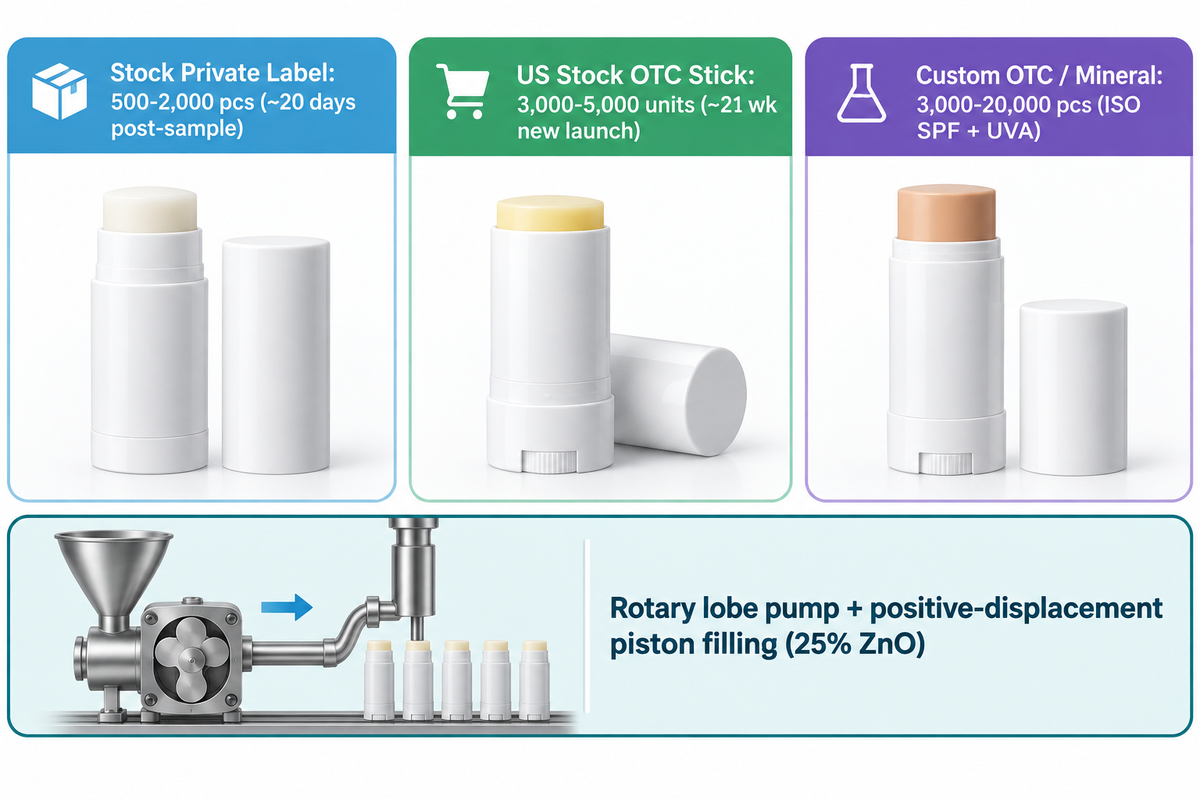
Contract sunscreen manufacturing carries published minimum order quantities of 5,000 to 10,000 units for US stock OTC formulas (Pure Velocity) or 3,000 to 20,000 units in China custom OEM runs (Skincraftlab), while per-unit transfer pricing, third-party ISO 24444/24443 testing fees, and launch lead times vary by specification and require a formal OEM quote.
First-time sunscreen launches slip schedules mostly during stability and packaging compatibility rather than kettle mixing. As FDA stability inspection rules highlight, drug products must be validated in their final container-closure system because active organic esters swell soft polyolefins and oxygen permeation accelerates discoloration. Across US and Asian OEM factories, total validation budgets and launch schedules vary by specification (request a quote), driven by active filter chemistry, panel subject count, water-resistance immersion cycles, and container-closure stability scope. A Korean skincare manufacturer specializing in stock-adapted textures or private-label catalog runs (starting around 500-piece stock label minimums at Skincraftlab) bypasses custom formulation queues by leveraging pre-qualified base dossiers.
During packaging, transferring vacuum-degassed sunscreen emulsion into retail laminate tubes, HDPE bottles, or airless pumps (or into bulk intermediate drums via industrial drum and pail filling equipment ) requires matching transfer-pump shear and nozzle mechanics to product yield stress. Passing finished lotion through high-RPM centrifugal pumps or open gravity hoppers re-introduces air pockets and breaks viscosity. Plants pair low-shear rotary lobe transfer pumps and positive-displacement filling machines with servo bottom-up dive nozzles using engineering controls from preventing foaming during filling so viscous 25% ZnO creams seal free of weight-drift cavities.
| Production Route & Benchmark Source | Published MOQ Range | Testing & Unit Cost Drivers | Schedule Drivers |
|---|---|---|---|
| Stock / Adapted Private Label (Skincraftlab, 2026) | 500 pcs (stock label) to 2,000 pcs (minor scent tweak) | Varies by specification (request a quote; leverages pre-tested base files) | Fastest route (~20 days post-sample); governed by artwork & stock readiness |
| Custom Sun-Care Stick OTC Launch (Skincraftlab benchmark, 2026) | 3,000–5,000 units per SKU (stick to custom bottle) | US monograph formula testing (USD 1,850–2,600 ISO 24444 SPF + USD 1,200–1,900 ISO 24443 UVA compliance) | Governed by component lead time (~21 wk new launch; 5–7 wk peak Apr–Aug booking) |
| Custom OTC / Mineral Development (Skincraftlab & OEM guide, 2026) | 3,000–20,000 pcs custom runs | Varies by specification (in vivo SPF + ISO 24443 UVA + water resistance + stability) | Extended by R&D iterations, clinical panel queues & stability holds |
Integration, Utility Requirements, and Sourcing Sunscreen Processing Equipment
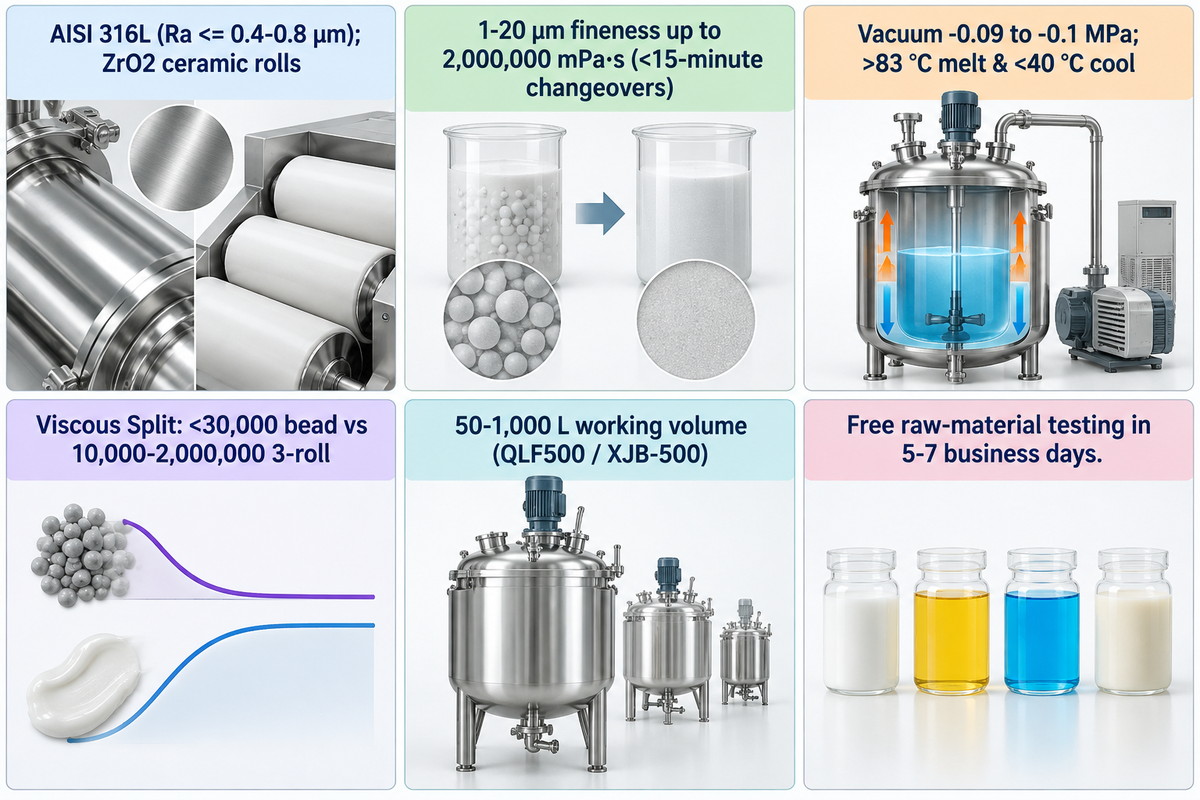
Sourcing sunscreen processing machinery starts with enforcing ISO 22716 hygienic metallurgy (AISI 316L stainless steel polished to Ra <= 0.8 µm, or electropolished to Ra <= 0.4 µm per InoxMIM sanitary standards and Ra <= 0.5 µm on IDA QLF-500V vessels), automated CIP/SIP spray heads, and chilled-water loops, while separating turnkey packaging lines from specialized wet-grinding and high-viscosity mixing equipment manufacturers.
Buyers frequently send one-line requests asking for a “500 L sunscreen mixer” without naming wetted steel grade, CIP nozzle drainage, viscosity ceiling, or dispersion D90. InoxMIM’s sanitary cosmetic plant standards call for AISI 316L product-contact surfaces at Ra <= 0.8 µm (or Ra <= 0.4 µm electropolished for ultra-clean duties), sanitary tri-clamp fittings free of dead pockets, FDA-grade EPDM or FKM seals, chilled-water circulation, and Venturi powder induction to prevent dry gum clumps during batching. As market context, Fortune Business Insights (November 2026) valued global mineral sunscreens at USD 4.85 billion in 2025, projecting USD 5.51 billion in 2026 to USD 15.35 billion by 2034 (13.67% CAGR), led by creams (38%) and North America (36%). That regional and dosage demand sustains factory investments in dedicated sub-micron mineral dispersion circuits capable of scaling tinted and sensitive-skin SPFs cleanly.
Transparent supplier scoping prevents costly procurement mismatches. Full-line turnkey cosmetic contractors deliver purified-water skids, vacuum kettles, cooling tunnels, and retail tube cartoning lines, whereas specialized wet grinding and high-viscosity mixing engineers solve the dispersion core. Jiangyin IDA Equipment Co., Ltd. (idaequipment.com) manufactures industrial wet grinding mills, three-roll paste mills, high-speed dispersers, triple-shaft mixers, and vacuum double planetary mixers, alongside bulk liquid drum fillers rated for 5–30 kg containers, and does not serve as a contract OTC sunscreen manufacturer or supply small retail squeeze-tube or bottle packaging lines. For plant buyers equipping the upstream compounding and mineral paste cells (supported by free raw-material testing in 5–7 business days via Jiangyin IDA Equipment laboratory material trials), IDA provides :
- For high-solids mineral pastes, ES50 / ES80 / ES120 VFD & YS Hydraulic Three-Roll Mills feature 50 mm (lab, uncooled ES50 ceramic), 80 mm (pilot, water-cooled ES80 with ceramic option), and 120 mm (small production, water-cooled ES120) rolls alongside PLC-controlled YS hydraulic models. These rollers achieve 1–20 µm fineness up to 2,000,000 mPa·s with <15-minute color changeovers between tinted pastes. In published European cosmetic foundation tests, zirconia ceramic IDS50/IDS80 rollers showed metal levels in ICP-MS checks well below EU limits.
- For multi-stage batching, Triple-Shaft Mixers (50, 200, 500, 1,000 L with anchor, disperser, homogenizer) covering QLF50 to QLF2000 builds and Double Planetary Mixers (XJB-5 at 1.5 kW to XJB-2000 at 90 kW) supply 316L electropolished vessels rated to -0.098 to -0.1 MPa vacuum across 10,000 to 5,000,000 cP mineral pastes.
- For fluid slurries, High-Speed Disperser (0.5–500 kW VFD/PLC, 0–3,000 RPM) units, horizontal agitated bead mills, and basket mills disperse low-to-medium viscosity UV fluid dispersions (including IZF -0.09 MPa vacuum models) up to 50,000 cP.
Copy the 6-parameter engineering checklist below directly into your equipment inquiry so vendors size motor torque, cooling capacity, and wetted metallurgy accurately without guessing.
RFQ Checklist: Copy These 6 Parameters Into Your Quote Request
| Parameter | Recommended Range | Why It Matters | How to Verify |
|---|---|---|---|
| 1. Formulation & Solids Load | O/W vs W/O; standard lotion suspension vs concentrated ZnO premix | Splits bead mills/homogenizers vs three-roll mills | Attach SDS & phase viscosity curve at 25–85 °C |
| 2. Target Dispersed Fineness | Aggregate D90 <= 200 nm (or 1–20 µm three-roll pre-grind) | Eliminates white cast and tactile grittiness | Horiba laser diffraction + grind gauge sample report |
| 3. Operating Viscosity Window | <30,000 mPa·s bead mill; 10,000–2,000,000 mPa·s three-roll | Prevents screen clogging and stalled feed pumps | Brookfield 5 rpm check + 5–7 day sample lab trial |
| 4. Wetted Steel & Contamination | AISI 316L (Ra <= 0.4–0.8 µm); ZrO2 ceramic rolls | Passes ISO 22716 CIP/SIP and ICP-MS metal caps | Material mill cert + profilometer finish test |
| 5. Vacuum & Thermal Duty | -0.09 to -0.1 MPa vacuum; jacket heat >83 °C, cool <40 °C | Deaerates bubbles & melts avobenzone cleanly | Chiller kW rating + 15–30 °C/min ramp log |
| 6. Batch Size & Acceptance Test | 50–1,000 L working volume (e.g., QLF500 / XJB-500) | Locks FAT acceptance prior to ocean shipment | Written 6-step lab trial & FAT protocol in PO |
Key takeaway
Industrial sunscreen quality depends on breaking mineral aggregates below the optical transparency ceiling and matching mixer class at the 50,000 mPa·s handoff, running pumpable slurries through rotor-stator or bead mills while routing concentrated ZnO pastes through zirconia ceramic three-roll mills or vacuum multi-shaft mixers before clinical SPF validation.
Frequently Asked Questions (FAQ)
Why Does Mineral Sunscreen Leave a White Cast or Feel Gritty?
Mineral sunscreens whiten or feel gritty when suspended zinc oxide or titanium dioxide agglomerates exceed the sub-micron optical transparency threshold, scattering visible light instead of staying clear.
Coarse aggregates measured up to 3.76-12.51 µm in commercial diffraction scans, or wax crystals formed during rapid jacket cooling, destroy uniform skin feel even when raw powder datasheets claim small primary crystals.
How Much Does It Cost to Manufacture Sunscreen Per Batch or Unit?
Published OEM sunscreen minimums run from 500 units for stock private-label items to 2,000 units for fragrance tweaks and 3,000 to 20,000 units for custom formulas or sunscreen sticks. Per-unit transfer pricing and third-party validation fees vary by specification (request a quote).
Total project budgets depend on active UV filter loading, packaging format (laminate tubes vs airless pumps), clinical ISO 24444 SPF panel size, water-resistance immersion cycles, and container-closure stability testing scope.
Do You Need to Test Every Sunscreen Batch for SPF Before Selling?
Brands must run in vivo clinical SPF testing on at least 10 valid subjects (21 CFR 201.327) and >=370 nm broad-spectrum checks on every new or modified formula, plus HPLC chemical assays on every production lot.
Repeating full human clinical panels on identical commercial batches is unnecessary unless active ingredient concentration, vehicle viscosity, or manufacturing processing changes.
Where Did Sunscreen Originate and How Has Industrial Manufacturing Changed?
Early UV salves evolved from simple botanical oils into vacuum-homogenized emulsions under FDA OTC Monograph M020, adding bemotrizinol up to 6% in June 2026.
Can You Manufacture Sunscreen Without Chemical UV Filters Like Oxybenzone?
Yes, factories make oxybenzone-free mineral sunscreens using surface-coated zinc oxide and titanium dioxide dispersed up to 25% each in biocompatible ester carriers under US and global monographs.
Because high mineral solids thicken oils above 50,000 mPa·s rapidly, plants pair hydrophobic coatings and polyhydroxystearic acid wetting agents with rotor-stator homogenization, horizontal bead milling, or hydraulic three-roll milling to avoid chalky aggregates while meeting SPF 30–50 and broad-spectrum targets cleanly.
Should Carbomer Thickeners Be Added Before or After High-Shear Homogenization?
Hydrate unneutralized carbomer early at gentle shear or adjust viscosity after main emulsification, because extended high shear fractures Carbopol 980 chains permanently.
What Equipment Is Used to Disperse Zinc Oxide Paste at Commercial Scale?
Equipment selection follows zinc oxide slurry viscosity directly: single-shaft high-speed dispersion mixers handle pumpable mineral suspensions below about 50,000 mPa·s, and zirconia horizontal bead mills below about 30,000 mPa·s.
Concentrated high-solids zinc oxide masterbatches and heavy anhydrous stick bases (100,000 to 2,000,000 mPa·s) require triple-shaft vacuum mixers (QLF series), XJB double planetary kneaders, or water-cooled ES80/ES120 three-roll mills to achieve 1–20 µm fineness, with zirconia ceramic ES50/ES80 or IDS50/IDS80 rollers minimizing metal contamination on ICP-MS checks.
References & Sources
- Labeling and Effectiveness Testing: Sunscreen Drug Products for Over-the-Counter Human Use (Small Entity Guidance, 21 CFR 201.327) — U.S. Food and Drug Administration (FDA)
- Amending Over-the-Counter Monograph M020: Sunscreen Drug Products (Final Order OTC000039, June 10, 2026, 91 FR 35220) — U.S. Federal Register / FDA
- Inspection Technical Guide No. 41: Expiration Dating and Stability Testing for Human Drug Products (21 CFR 211.166) — U.S. Food and Drug Administration (FDA)
- Dispersion and Surface Functionalization of Oxide Nanoparticles for Transparent Photocatalytic and UV-Protecting Coatings and Sunscreens (PMC5074370) — Science and Technology of Advanced Materials / National Institutes of Health (NIH)
- Structural Changes in Carbopol Hydrogels Under High Shear Mixing vs Magneto-Hydrodynamic Mixing (PMC8982170) — RSC Advances / National Institutes of Health (NIH)
- Dispersion of Micronized Zinc Oxide and Titanium Dioxide Sunscreen Formulations (WO2008109182A1) — Google Patents / WIPO
- The Influence of Complementary Processing Methods to Emulsification on Sunscreen Emulsion Properties (Processes 2025, 13(2), 520) — MDPI Processes
- Formulating Mineral Sunscreens for People of Color (Dr. Yun Shao Technical Article) — New York Society of Cosmetic Chemists (NYSCC)
Related Articles
Transparency & Technical Scope Note: Published mixing, three-roll milling, and dispersion equipment capacities in this guide reflect specification datasheets from Jiangyin IDA Equipment Co., Ltd. (idaequipment.com), peer-reviewed cosmetic engineering literature, and public US FDA OTC monograph rules as of November 2026. Assumed inputs in the 500 kg rotor-stator scale-up and cooling example illustrate heat-balance sizing methodology and must be confirmed against finished sunscreen rheology during pilot material trials.