Get in Touch with IDA


By Karry | Edited By Jiangyin IDA Equipment Co. Ltd. | (Updated November 2026)
Industrial chocolate milling is the two-stage fat-phase comminution production process in confectionery and cocoa processing that grinds roasted cacao nibs into smooth cocoa liquor (50 to 60 parts per 100 parts cacao fat under 21 CFR Part 163). It then refines crystalline sugar, milk solids, and cocoa solids into a homogeneous smooth paste with a typical volume-based d90 particle size of 15 to 25 microns. Selecting the right equipment across ball mills, agitated bead mills, roll refiners, and three-roll mills protects both mouthfeel smoothness and molten flow viscosity.
Bottom Line Up Front: Target a volume-weighted d90 between 15 and 25 microns (measured by ISO 13320 laser diffraction in a non-aqueous carrier) while limiting sub-5-micron ultrafine generation. Over-milling below a 15-micron d90 can trigger The Sub-5-Micron Yield-Stress Trap, where expanded specific surface area immobilizes free cocoa butter and spikes Casson yield stress. Match mill architecture to formulation fat and viscosity. Use two-roll and five-roll refiners or hydraulic three-roll paste mills (up to 2,000,000 mPa·s on IDA ES50, ES80, and ES120 models) for low-fat pastes, and deploy jacketed ball or bead mills for pumpable slurries.
Key Engineering Takeaways
- Stage 1 nib-to-liquor releases 50-60 parts per 100 parts native cocoa butter into the cocoa liquor from ruptured cellular walls of roasted cocoa beans. Stage 2 chocolate refining reduces the size of sugar and milk solids from 400 to 1,000 µm to a volume-based d90 of 15 to 25 µm, based on the level of fat present in the formulation.
- The human tongue perceives particles coarser than roughly 25 µm as gritty. However, generating excess sub-5 µm fines under The Sub-5-Micron Yield-Stress Trap multiplies specific surface area and raises Casson yield stress. Formulators balance this with free cocoa butter, soy lecithin (0.3 to 0.5 g/100 g), and PGPR (0.1 to 0.3 g/100 g).
- Agitated Ball & Bead mills must use a pumpable chocolate slurry viscosity. However, IDA Equipment ES50, ES80, and ES120 Water-cooled three-roll mills refine viscous cocoa masses and nut praline pastes up to 2,000,000 mPa·s without screen blinding.
- Jacketed thermal control keeps milk chocolate below the 50 to 55 °C amorphous lactose agglomeration ceiling and maintains exposed feed surfaces above the room’s ambient dew point. This prevents moisture condensation and sugar bridging, while warm-fat flushing handles routine batch changeovers and addresses carryover from a previous batch.
| Process Parameter | Stage 1: Cocoa Nib-to-Liquor Wet Milling | Stage 2: Chocolate & Compound Mass Refining | High-Viscosity Praline & Paste Three-Roll Milling |
|---|---|---|---|
| Primary Feedstock & Initial Size | Roasted, winnowed cacao nibs (cellular cotyledon fragments) | Granulated sugar (400 to 1,000 µm), milk powder, cocoa solids, and melted fat | Pre-mixed low-fat cocoa mass, gianduja, hazelnut paste, or compound filling |
| Continuous Fat Phase (g/100 g) | About 50 g/100 g native cocoa butter in roasted nibs (50 to 60 g/100 g in chocolate liquor per 21 CFR Part 163) | 25 to 27 g/100 g (roll refiner dough); 25 to 40 g/100 g molding and 33 to 36 g/100 g covering chocolate | Low-fat pastes and nut fillings up to 2,000,000 mPa·s on IDA ES50, ES80, and ES120 models |
| Target Fineness Metric | Laser diffraction d90 = 15 to 30 µm fine cocoa liquor | Laser diffraction d90 = 15 to 25 µm (18 to 20 µm roll refiners; 20 to 22 µm ball refiners) | 1 to 20 µm dispersion fineness (1 µm roller-gap setting accuracy on IDA ES-series) |
| Thermal Control Window | Above 32 to 36 °C cocoa butter melting range for pumpable liquor flow | Hold milk chocolate below 50 to 55 °C lactose plasticization ceiling; Casson viscometry at 40 °C | Internal water-cooled hollow alloy or ceramic rollers prevent shear overheating |
| Core Milling Equipment | Pin/disc/colloid pre-grinder + multi-stage agitated bead or ball mill | 2-roll + 5-roll refiner cascade, or jacketed vertical/horizontal ball mill | Hydraulic or mechanical three-roll mill preceded by planetary mixer |
What Is Chocolate Milling? Stage 1 Cocoa Liquor Grinding vs Stage 2 Chocolate Mass Refining

milling Industrial Chocolate involves two fat-phase processes in a commercial confectionery plant. Industrial chocolate milling comprises two distinct fat-phase operations in commercial confectionery plants: first, Stage 1 wet grinding of roasted cacao nibs to make a smooth cocoa liquor, and Stage 2 refining of crystalline sugar, milk powder, and cocoa solids down to a 15 to 25 micron volume-based d90.
Often, when specifying Industrial chocolate making, engineers mistakenly combine these two steps and pick a chocolate grinding machine to grind chocolate at the same time. When a ripe fruit pod harvested from Theobroma cacao is opened, Italian Food Tech’s industrial chocolate refining guide notes that each pod can contain up to 40 beans. After the process of fermentation, drying, roasting and winnowing, the beans produce cacao nibs. Under U.S. FDA 21 CFR Part 163 Standards of Identity for Cacao Products, cacao nibs are prepared by removing the shell from cured, cleaned, dried, and cracked cacao beans. For each 100 parts by weight of cacao nibs, total phosphoric acid is limited to not greater than 0.5 part by weight (expressed as P2O5). Under 21 CFR Part 163, chocolate liquor contains 50 to 60 parts per 100 parts cacao fat by weight. Sweet chocolate and milk chocolate follow separate standards of identity, while vegetable-fat compound coatings are sold under separate product descriptions.
During Stage 1 cocoa liquor grinding, the primary grinding process uses pre-grinding equipment (pin mills, knife mills, or colloid mills) to rupture nib cell walls above the 32 to 36 °C cocoa butter melting range. Frictional heat releases intracellular cocoa butter and melts the nibs. Solid nibs become a pumpable slurry that’s fed to multi-stage agitated mills or vertical ball mills. In Stage 2 chocolate grinding and refining, the process of making finished chocolate products shifts from cell-wall rupture to brittle crystal fracture. The right grinding technique ensures that 400 to 1,000 micron granulated sucrose, spray-dried or roller-dried milk powder, and non-fat cocoa solids are fractured within a continuous fat phase before conching and the tempering process. As described in the European Patent Application EP0997076A2 on continuous chocolate processing, molding chocolate and covering chocolate contain about 25 to 40 g/100 g and about 33 to 36 g/100 g fat, respectively. Hollow chocolate articles contain about 38 to 40 g/100 g fat and ice cream coating chocolate about 50 to 60 g/100 g.
| Engineering Dimension | Stage 1: Cocoa Nib-to-Liquor Milling | Stage 2: Compounded Chocolate Mass Refining |
|---|---|---|
| Dominant Breakage Mechanism | High-shear impact rupture of lipid-bearing plant cell walls followed by wet media attrition | Compressive roll-gap shear or agitated media collision fracturing brittle sucrose crystals and coating milk solids |
| Abrasive Wear Driver | Residual shell fragments and hard mineral contaminants accelerate wear during nib grinding | Hard crystalline sucrose corners and un-wetted sugar/milk agglomerates in low-fat zones |
| Moisture & Volatile Control | Vent steam and volatile acetic acid during open nib pre-milling and roasting | Control raw material moisture content and prevent ambient moisture ingress so sucrose cannot form syrup bridges |
| Downstream Unit Operation | Hydraulic cocoa butter pressing (yielding cocoa butter + cocoa press cake) or direct chocolate batching | Conching, final lecithin/PGPR standardization, tempering machine beta-V crystallization, and molding/enrobing |
Why Industrial Chocolate Milling Targets 15 to 25 Microns (and the Sub-5-Micron Yield-Stress Trap)
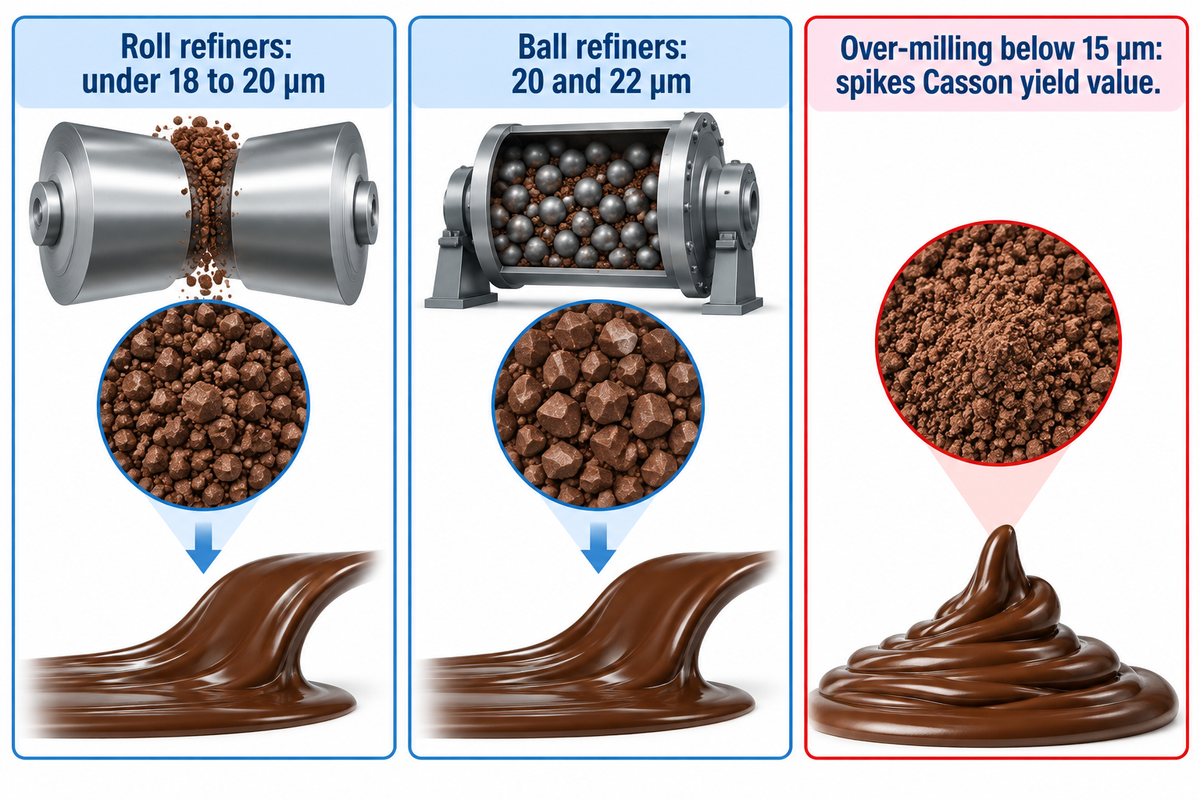
Industrial chocolate milling targets a 15 to 25 micron volume-based d90 to stay below the oral grittiness detection threshold, while avoiding The Sub-5-Micron Yield-Stress Trap, where excessive sub-5-micron fines multiply specific surface area, immobilize free cocoa butter, and sharply raise Casson yield stress.
Oral mechanoreceptors on the human tongue and palate are highly sensitive to coarse angular solids suspended in melting fat, directly governing taste and texture in commercial chocolate manufacturing. As noted in Italian Food Tech’s analysis of chocolate refining systems, granulometry should sit around 25 microns, where the tongue loses its ability to determine the grittiness of particles. Because tactile sensitivity varies across recipes and consumers, modern roll refiners finish chocolate mass under 18 to 20 µm. Ball refiners finish creams, spreads, glazes, chocolate substitutes, and hazelnut pastes between 20 and 22 µm to balance texture and flavor in finished tempered chocolate. Engineers must keep particle size metrics distinct. Specifically, d90 (or Dv90) is the 90th percentile of the cumulative volume distribution measured by ISO 13320 laser diffraction in a non-aqueous carrier such as sunflower oil or isopropanol. Meanwhile, P80 is the 80th percentile passing size used in comminution energy equations. A handheld micrometer or Hegman gauge measures only the coarsest surviving particles in a thin film rather than the full distribution.
Although driving the volume-based d90 of microns below 15 can help achieve a lower average fineness when refining chocolate, the resulting rheological penalty is significant, and it’s what we call the Sub-5-Micron Yield-Stress Trap. Over-milling chocolate mass below a 15-micron d90 expands specific surface area (SSA) and locks up free cocoa butter on particle surfaces, especially when single-stage ball milling produces a wide tail of sub-5-micron ultrafines. There are limits to how much chocolate or compound can be refined. In the 2026 MDPI Foods review on ball mill refining in confectionery manufacturing, it states that the industry standard for refined chocolate or compound is 20-25 µm d90. Further, it states that sub-micron and sub-5 µm fines can dramatically increase specific surface area and Casson yield stress. The Blommer Chocolate’s technical bulletin on molten chocolate behavior alludes to this in stating that excessively milling can increase yield stress of chocolate. Over-milling below 15 µm creates excessive surface area that immobilizes cocoa butter and spikes Casson yield value.
ICA / IOCCC Method 46 Casson Rheology Model (Measured at 40 °C):
sqrt(tau) = sqrt(sigma_CA) + sqrt(eta_CA * gamma_dot)
Where tau is shear stress (Pa) and gamma_dot is shear rate (s⁻¹). Here, sigma_CA is Casson yield stress (Pa, governed by specific surface area, sub-5 µm contacts, and emulsifier coverage), and eta_CA is Casson plastic viscosity (Pa·s, governed by fat volume fraction and packing span).
Crucially, yield stress is governed by the multi-factor coupling of fine-particle surface area, total fat content, and emulsifier dosage rather than a single universal sub-5 µm cutoff alone. In a 2024 NIH PubMed Central rheological study of chocolate suspensions (PMC11547402), experimental batches with Dv10 between 2.42 and 2.76 µm maintained low Casson yield stresses of 1.43 to 5.22 Pa when formulated with sufficient fat and emulsifiers. Yet as Afoakwa et al. demonstrate in the International Journal of Food Science & Technology, shifting the particle size distribution toward finer sizes at a fixed cocoa butter content raises both yield value and plastic viscosity at 40 °C. To counteract that rise, formulators dose soy lecithin at 0.3 to 0.5 g per 100 g to lower plastic viscosity by lubricating sugar surfaces. They pair it with polyglycerol polyricinoleate (PGPR) at 0.1 to 0.3 g per 100 g to lower Casson yield stress.
| PSD Regime (ISO 13320 Non-Aqueous d90) | Oral Sensory Texture & Flavor Release | Specific Surface Area & Rheology Impact | Formulation Fat & Target Chocolate Products |
|---|---|---|---|
| >25 µm (Under-Refined / Coarse) | Detectable sandy or gritty mouthfeel on the tongue | Low specific surface area; low yield stress but coarse particle sedimentation | Pre-refined chocolate mass (80 to 120 µm) or rustic inclusions prior to finishing |
| 20 to 25 µm (Standard Ball & Roll Refining Target) | Smooth texture below the 25 µm tongue grittiness threshold | Balanced specific surface area, Casson yield stress, and plastic viscosity | Molding chocolate (25 to 40 g/100 g fat), covering chocolate (33 to 36 g/100 g fat), spreads (20 to 22 µm) |
| 18 to 20 µm (Fine Roll Refiner Benchmark) | Velvety high-end smoothness for high-quality chocolate with rapid melt profile | Higher surface area; benefits from two-roll pre-refining to keep PSD span narrow | Roller-refined chocolate dough (25 to 27 g/100 g fat at refiner) and molded tablets |
| <15 µm d90 (Over-Milled / Excess Sub-5 µm Fines) | Pasty, slow-melting mouthfeel (“clay-like” drag) | Higher surface area can immobilize free cocoa butter and raise yield stress | Additional cocoa butter or PGPR may be needed according to fat content and emulsifier coverage |
What Is the Ideal Particle Size of Milled Chocolate in Microns?
Target particle size for milled chocolate depends on recipe and application, with industrial specifications commonly targeting a volume-based d90 of 15 to 25 microns. Modern roll refiners work under 18 to 20 microns, while ball refiners finish spreads and coatings at 20 to 22 microns. Quality control teams verify the full D10/D50/D90 span via non-aqueous ISO 13320 laser diffraction alongside line-side micrometer checks.
Comparing 5 Chocolate Milling Architectures: Roll Refiners, Ball Mills, Bead Mills, Three-Roll Mills, and Melangers

Viscosity-Regime Equipment Handoff Rule is relevant to mill selection. Two- and five-roll refiners process low-fat doughs (25 to 27 g/100 g fat), while ball and bead mills refine pumpable slurries. Water-cooled ES50/ES80/ES120 three-roll mills handle viscous pastes of up to 2,000,000 mPa·s, and stone melangers serve craft batches.
Closed-end vertical or horizontal chocolate ball mills and agitated bead mills significantly reduce batch grinding time and floor space compared to roll refiners and stone mills. However, closed chambers have less open evaporative surface area compared to five roll refiners and conches. Closed-end ball mills can’t strip volatile cocoa acids (like acetic acid) on their own, unless they’re coupled with an upstream conching process. Understanding how each machine transfers mechanical shear and impact energy helps avoid costly line mismatches.
- A Two-Roll + Five-Roll Refiner Cascade uses a two-roll pre-refiner to crush sugar from 400-1,000 µm down to 80-120 µm, and feeds a five-roll refiner consisting of hollow water-cooled cylinders (1 to 2.5 m working length). According to Italian Food Tech’s roller refining benchmarks, modern refiners work 1,200 kg/h of product to under 18-20 µm at an optimal 25-27 g/100 g fat content, discharging at around 25 °C into a conche.
- A Vertical Chocolate Ball Mill Machine in industry uses a jacketed vertical cylinder charged with 6.0 to 9.5 mm hardened steel balls agitated by a central shaft at up to 500 rpm (as in confectionery studies). Used as a ball mill for chocolate coatings, spreads, glazes, and hazelnut pastes at about 30 g/100 g or higher fat, this chocolate ball mill making machine reaches 20 to 22 µm and runs 24 hours a day with tanks and pumps.
- A Horizontal Agitated Bead Mill has a high-speed pin or disc rotor and 3.0 to 6.0 mm of high-density steel or yttria-stabilized zirconia media inside an annular jacket for fine grinding. It’s designed for Stage 1 cocoa liquor grinding and for continuous, Stage 2 compound refining, where high cooling surface-to-volume ratios are required. Readers can look into the horizontal bead mill for fine wet grinding for detailed information on rotor and seal mechanics.
- An industrial Hydraulic Three-Roll Paste Mill uses three, water-cooled alloy or ceramic rolls rotating at differential speeds (like 1:2:4 or 1:3:9) to shear viscous pastes. Regional chocolate makers producing low-fat fillings or nut pastes rely on roll shear when viscosity exceeds media-mill pumping limits, as detailed in our three-roll mill vs ball mill engineering comparison.
- A craft Granite Stone Melanger (Chocolate Stone Grinder) rotates two large granite millstone wheels over a bed of granite to grind the chocolate gradually in a single mill (grinding) pan. A tabletop chocolate grinder or chocolate stone mill refines nibs and sugar while mixing the mass to develop rich flavor profiles for handmade chocolate and bean to bar chocolate. For chocolatiers and boutique chocolate workshops, stone grinding may run continuously for up to 3 days to complete the work that an agitated ball mill can finish in 1 hour, while the output also reflects the capacity of the vessel.
18–22 µm
Typical Roll & Ball Refiner Fineness Below the 25 µm Grittiness Limit
1,200 kg/h
Modern Roll Refiner Throughput at 25 to 27 g/100 g Paste Fat
2,000,000 mPa·s
Viscosity Ceiling of IDA ES50 / ES80 / ES120 Three-Roll Mills
1 hr vs 3 Days
Ball Mill Batch Refining Cycle vs Traditional Stone Melanger
| Mill Architecture Type & Model | Process Category & Stage | Formulation Fat Regime | Viscosity Regime | Documented Fineness & PSD Behavior | Throughput / Cycle Benchmark | Explicit “Not Suitable For” Disqualifier |
|---|---|---|---|---|---|---|
| High-Speed Pin / Disc Pre-Grinder | Stage 1 Nib Pre-Milling | Roasted nibs (~50 g/100 g native fat; 50–60 g/100 g liquor) | Pumpable melted nib slurry | Coarse pre-liquefied cocoa liquor (>50 to 150 µm) | Model-dependent continuous pre-grind | Not suitable for final <25 µm chocolate refining without downstream fine mill |
| Toothed Rotor-Stator Colloid Mill | Stage 1 Nib & Nut Pre-Grinding | High-fat nib and roasted nut pastes | Pumpable pre-homogenized paste | Coarse pre-homogenized suspension (>50 to 150 µm) | Model-dependent inline pre-milling | Not suitable for reaching 15 to 25 µm finished chocolate smoothness |
| Two-Roll Pre-Refiner | Stage 2 Sugar/Mass Pre-Refining | 25 to 27 g/100 g fat paste (Italian Food Tech) | Plastic pre-refined chocolate paste | Reduces 400–1,000 µm sugar to 80–120 µm | Boosts final refining productivity by 10 to 20 parts per 100 | Not suitable as a standalone finisher; feeds 5-roll or ball refiners |
| Five-Roll Finishing Refiner | Stage 2 Low-Fat Mass Refining | 25 to 27 g/100 g optimal fat dough | Cohesive roll-adhering plastic dough | Under 18 to 20 µm; narrow PSD span | 1,200 kg/h (1 to 2.5 m roller length); 900 kg/h with high-shear stage | Not suitable for low-CAPEX small lines or high-fat liquid slurries that slip off rolls |
| Vertical Stirred Chocolate Ball Mill | Stage 1 & 2 Slurry Refining | About 30 g/100 g+ fat spreads/coatings (33–36 g/100 g covering) | Pumpable liquid chocolate slurry | 20 to 22 µm (Italian Food Tech); broader sub-5 µm tail if single-stage | 1 hour batch cycle or 24-hour continuous with tanks/pumps | Not suitable for non-pumpable low-fat doughs or un-conched dark masses needing acid evaporation |
| Horizontal Agitated Bead Mill | Stage 1 Liquor & Stage 2 Coatings | Pumpable liquor (50–60 g/100 g) and coatings (33–60 g/100 g) | Pumpable suspension through dynamic separator | d90 = 15 to 25 µm; narrow pass-mode PSD | Model-dependent continuous recirculation | Not suitable for un-wetted coarse crystals or stiff pastes that blind separator screens |
| Batch Immersion Basket Mill | Stage 2 Specialty Coatings & Colors | Fluid fat-based coatings and colored cocoa butter | Low- to medium-viscosity fluid suspension | d90 = 18 to 25 µm single-vessel batch | Batch vessel size dependent; rapid color changeover | Not suitable for stiff doughs or high-tonnage continuous commodity lines |
| Hydraulic Three-Roll Mill (IDA ES50/ES80/ES120) | Stage 2 Viscous Paste & Praline Refining | Low-fat cocoa pastes, gianduja, and nut pralines | Up to 2,000,000 mPa·s | 1 to 20 µm dispersion fineness (1 µm gap precision; no grinding beads) | 50 mm (lab), 80 mm (pilot), 120 mm (production); 3–5 typical passes | Not suitable for thin water-like slurries or unattended commodity coating lines |
| Granite Stone Melanger (Chocolate Stone Mill) | Craft Bean-to-Bar Batch Refining | Fluid craft chocolate and nut butter recipes | Open-pan granite wheel circulation | Craft batch refining with open aroma aeration | Up to 3 days per batch (vs 1 hour in ball mill) | Not suitable for large-scale production due to multi-day stone grinding cycle |
Note on Architectural Comparisons:
Exact hourly capacities (kg/h) and the minimum pumpable fat content as well as the number of passes for specific baskets, balls, beads, and rolls in the mill product line are dependent on the chamber volume, the motor power and the solid packing. Please confirm these parameters via pilot test on the target formulation.
What Is the Difference Between a Chocolate Ball Mill and a 5-Roll Refiner?
Five rolls of refiner compress and shear a low-fat chocolate dough (25 to 27 g/100 g fat, per Italian Food Tech) between five temperature-controlled cylinders (1 to 2.5 m length), and can process up to 1,200 kg/h at 18 to 20 microns. A chocolate ball mill circulates a higher fat liquid slurry (i.e. 30 g/100 g fat spreads and coatings, etc.) through agitated steel or zirconia media in a closed, jacketed system, to attain 20 to 22 microns.
When to Choose a Three-Roll Mill vs an Agitated Bead or Ball Mill for Cocoa Liquor and Nut Pastes

Choose an agitated bead mill or ball mill when cocoa liquor or compound coating flows as a pumpable slurry through media separators. Water-cooled three roll mills (such as IDA Equipment’s ES50, ES80, or ES120 series) may be used for refining viscous pastes of up to 2,000,000 mPa·s without grinding beads.
Horizontal agitated bead mills pump chocolate or nut slurry through an enclosed chamber where a rotor-gap or a slotted screen separator retains the grinding beads. In the case of vertical ball mills, the slurry is circulated through a vertically stirred ball bed. For chocolate and nut suspensions of high viscosity, media size (beads ranging between 3.0 to 6.0 mm in horizontal bead mills and balls ranging between 6.0 to 9.5 mm in vertical ball mills) and separator geometry of the mill, paste, and particle size are chosen together. When the viscosity of the paste increases excessively or high yield stress of roasted hazelnuts, pistachios, almonds, pralines, and fiber-rich fillings is observed, the paste can be pumped through a fine media separator, which increases the chamber pressure and temporarily blocks the exit screen. Detailed dynamics of the rotors and separators are given in our document on the agitator bead mill working principle.
For high-viscosity confectionery pastes above the typical 50,000 mPa·s pumping window of media mills, an industrial three-roll mill (ES50, ES80, and ES120) eliminates grinding beads, internal screens, and circulation pumps altogether. Published specifications for IDA Equipment’s Three-Roll Mill series span laboratory R&D through commercial production across 8 three-roll mill designs. The benchtop ES50 (50 mm ceramic rollers) handles lab formulation development. Meanwhile, the water-cooled ES80 (80 mm rollers) and industrial ES120 (120 mm rollers) refine high-viscosity pastes up to 2,000,000 mPa·s down to 1 to 20 µm fineness with 1 µm gap accuracy . While three-roll mills eliminate media-bead wear, metal rollers still experience normal surface wear over time, so ceramic rollers can be specified on models like the ES50 and ES80 for metal-sensitive products. Conversely, some plants run medium-viscosity colored cocoa butter, compound glazes, or flavored fillings that require rapid batch-to-batch color changeovers without dismantling external piping. For those batches, an immersion batch basket mill for fast recipe changeovers lowers a self-contained milling basket directly into a jacketed vessel.
| Selection Criterion | IDA ES50 / ES80 / ES120 Three-Roll Mill | Jacketed Horizontal Agitated Bead Mill | Jacketed Batch Immersion Basket Mill |
|---|---|---|---|
| Roller / Media Geometry | ES50 (50 mm), ES80 (80 mm water-cooled), ES120 (120 mm water-cooled) alloy or ceramic rolls | 3.0 to 6.0 mm zirconia or hardened steel beads in horizontal pin/disc chamber | Zirconia or hardened steel beads enclosed in an immersed milling basket |
| Viscosity Operating Range | Up to 2,000,000 mPa·s (heavy pastes, low-fat masses, stiff nut pralines) | Pumpable cocoa liquor and compound slurries within separator pressure limits | Pumpable batch coatings, colored cocoa butter, and fluid fillings |
| Fineness Metric & Control | 1 to 20 µm dispersion fineness (1 µm gap setting accuracy across 3 to 5 typical passes) | Laser diffraction d90 = 15 to 25 µm (controlled by pass count and specific energy kWh/t) | Laser diffraction d90 = 18 to 25 µm in single-tank batch circulation |
| Cleaning & Changeover | Exposed roll surfaces are accessible for warm-oil cleaning; product can remain around the feed, scraper, and apron areas | Dedicated line or warm fat/oil flush; media screen requires periodic inspection | Lift basket and rinse in warm cocoa butter/oil tank; no external pump piping |
Can You Use a Three-Roll Mill for Chocolate Liquor and Praline Fillings?
Yes. A water-cooled three-roll mill (such as the IDA ES50, ES80, or ES120) refines pre-ground cocoa liquor, hazelnut gianduja, pistachio pastes, and low-fat confectionery fillings to 1 to 20 microns dispersion fineness (typically in 3 to 5 passes verified with a grind gauge). Differential roller shear handles pastes up to 2,000,000 mPa·s without grinding beads.
Pre-Mixing, High-Speed Dispersion, and Staged Emulsifier Timing (Soy Lecithin & PGPR)

Efficient chocolate refining starts with the pre-wetting of dry sugar, cocoa solids, and milk powder in melted fat using a jacketed high-speed disperser (0-3,000 RPM) or planetary mixer, prior to fine milling. Processors also often split the emulsifier dosing, adding a small amount of soy lecithin during the pre-mixing to achieve pumpability, and adding the rest of the lecithin and PGPR at the end of the refining process.
Feeding un-wetted crystalline sucrose (400 to 1,000 µm) and spray-dried milk powder directly into a chocolate ball mill or bead mill creates dry powder agglomerates (“fisheyes”) that surge motor current and blind inlet pumps. As disclosed in EP0997076A2, high-shear liquefaction and dispersion (operating across shear rates of 200,000 to 1,000,000 s⁻¹ in high-shear stages) rapidly wets solid surfaces with melted cocoa butter or vegetable fat. In industrial chocolate production lines, plants prepare a homogeneous chocolate mixture before milling using an IDA high-speed sawtooth disperser (0 to 3,000 RPM, 0.5 kW to 500 kW VFD/PLC drives) for pumpable slurries . For heavy pastes destined for roll refining, plants use a jacketed double planetary mixer (XJB-5 at 1.5 kW up to XJB-2000 at 90 kW, alongside 50, 200, 500, and 1,000 L triple-shaft mixers across 6 standard mixer configurations).
Afoakwa et al. (IJFST) and Blommer Chocolate’s rheological studies show that soy lecithin (0.3 to 0.5 g per 100 g) and PGPR (0.1 to 0.3 g per 100 g) lower molten flow resistance. Amphiphilic molecules anchor to a sugar surface and extend their lipid tails into the fat phase. Recipes needing lower yield stress for thin-shell molding or enrobing therefore pair 0.3 to 0.5 g/100 g lecithin with 0.1 to 0.3 g/100 g PGPR. At the same time, experimental studies on milk chocolate ball milling show that adding a portion of lecithin at the start of milling keeps slurry viscosity stable across both spray-dried and roller-dried milk powders. As an illustrative split-dosing protocol for recirculating ball mill lines, operators can add an initial portion of the 0.3 to 0.5 g/100 g soy lecithin allowance (such as 0.06 to 0.15 g/100 g of batch weight) during pre-mixing. They then add the remaining 0.21 to 0.40 g/100 g soy lecithin plus 0.1 to 0.3 g/100 g PGPR near the end of refining after fresh crystal surfaces have fractured.
| Batch Preparation Stage (Illustrative Ball-Mill Protocol) | Equipment & Operating Window | Fat & Emulsifier Addition | Target Intermediate / Final State |
|---|---|---|---|
| Step 1: Melted Fat & Powder Pre-Wetting | Jacketed High-Speed Disperser (0–3,000 RPM, 0.5–500 kW) or XJB Planetary / Triple-Shaft Mixer (50–1,000 L) at 45–50 °C | Initial recipe cocoa butter / vegetable fat charge + dry sugar, cocoa powder, and milk solids | Lump-free pre-wetted suspension; powder agglomerates dispersed prior to mill feed |
| Step 2: Initial Viscosity Conditioning | Pre-mix vessel recirculation prior to mill feed | Initial portion of soy lecithin (e.g., 0.06 to 0.15 g/100 g of batch weight from the 0.3–0.5 g/100 g total) | Stabilizes initial slurry pumpability, especially in milk chocolate ball milling |
| Step 3: Main Comminution & Refining | Jacketed Ball Mill, Horizontal Bead Mill, or Two-Roll + Five-Roll / Three-Roll Mill | Main particle size reduction stage prior to final rheology trim | Particle size reduced from 400–1,000 µm (or 80–120 µm pre-refined) to target d90 = 15 to 25 µm |
| Step 4: Final Rheology Standardization | Final stage of ball-mill recirculation or liquid conching stage at 40–50 °C | Remaining soy lecithin (0.21 to 0.40 g/100 g to reach 0.3–0.5 g/100 g total) + PGPR (0.1–0.3 g/100 g) + remaining recipe fat | Coats freshly fractured sugar surfaces; standardizes ICA Method 46 Casson yield stress and plastic viscosity |
Do: Split Lecithin Dosing & Pair With PGPR
Add 0.06 to 0.15 g/100 g soy lecithin during pre-mixing for pumpability, then add the remaining 0.21 to 0.40 g/100 g lecithin and 0.1 to 0.3 g/100 g PGPR near the end of refining to coat newly fractured crystals.
Don’t: Overdose Soy Lecithin to Fix High Yield Stress
Instead of exceeding 0.5 g/100 g soy lecithin, blend 0.1 to 0.3 g/100 g PGPR when thin-wall molding or enrobing demands lower Casson yield stress at 40 °C.
Jacketed Temperature Control (40 to 55 °C), Moisture Dew-Point Limits, and Media Contamination
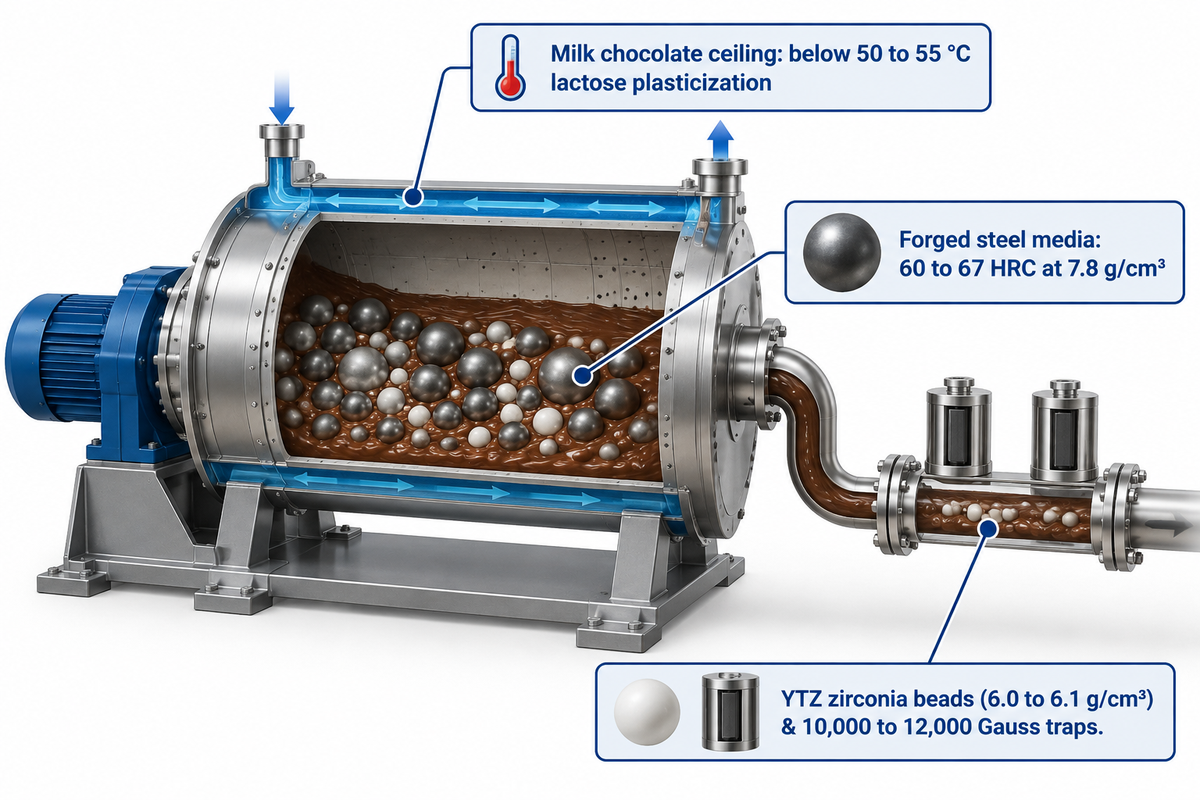
Jacketed cooling systems regulate the chocolate mass according to its formulation, accounting for milk chocolate’s susceptibility to amorphous lactose agglomeration around 50 to 55 °C and cocoa butter’s melting range of 32 to 36 °C. They must also keep exposed mill surfaces above the ambient room dew point so condensed moisture can’t enter the product.
Most of the electrical shaft power drawn by a chocolate ball mill or agitated bead mill converts into frictional heat inside the grinding chamber. As demonstrated in International Journal of Food Science & Technology research on milk chocolate refining, temperatures above 50 to 55 °C cause amorphous lactose in milk powder to plasticize and form gritty protein-sugar clusters. Spray-dried milk powder particles contain predominantly amorphous lactose and more encapsulated free-fat droplets than roller-dried milk powder. This makes spray-dried milk chocolate recipes highly sensitive to thermal agglomeration as temperatures approach 50 to 55 °C. At the same time, operators can’t pump overly cold chilled water into the mill jacket. Jacket water cold enough to chill the inner wall below the 32 to 36 °C cocoa butter melting range solidifies an insulating fat crust inside the chamber. Meanwhile, cooling uninsulated feed hoppers or covers below the room’s ambient HVAC dew point condenses atmospheric moisture. If condensed water droplets enter the chocolate mass, they dissolve sucrose into sticky syrup bridges that spike viscosity and cause sugar bloom upon drying. Sugar bloom is distinct from fat bloom, which occurs when cocoa butter crystallizes or stores outside stable beta-V tempering windows.
Equally critical is grinding media metallurgy and low-moisture food sanitation. Food-grade chocolate ball mills avoid soft austenitic 304 or 316 stainless steel balls, which deform under impact and shed non-magnetic wear debris. Instead, as documented in STR Industries’ grinding media properties guide, processors select through-hardened forged steel (60 to 67 HRC at 7.8 g/cm³) or martensitic 440C stainless steel (58 to 63 HRC at 7.75 g/cm³). Ceramic options include sintered alumina (3.6 to 3.9 g/cm³, near Mohs 9) and yttria-stabilized zirconia beads (YTZ, 6.0 to 6.1 g/cm³). Hardened steel balls reduce wear rate, and inline neodymium magnetic traps rated at 10,000 to 12,000 Gauss on the discharge line capture ferromagnetic steel wear particles. By contrast, YTZ zirconia beads eliminate iron wear altogether, but because ceramic fragments are non-magnetic and can’t be captured by magnetic traps, operators rely on intact separator screens and periodic bead inspection. In addition, because chocolate, cocoa liquor, and nut pastes are low-moisture ready-to-eat foods, introducing water into enclosed mills creates pathogen (Salmonella) and sugar-seizing hazards. Routine changeover between compatible chocolate batches uses warm cocoa butter or vegetable oil flushing and dry scraping. Where aqueous sanitation is required for allergen or microbial control, plants must execute validated cleaning and complete thermal drying before restarting.
| Formulation Stream | Thermal Ceiling / Operating Requirement | Jacket Cooling Water Control Principle | Primary Failure Mode if Violated |
|---|---|---|---|
| Milk & White Chocolate (Spray-Dried Milk Powder) | Hold strictly below 50 to 55 °C ceiling (typical operating band 42 to 48 °C) | Tempered water loop held above cocoa butter wall-solidification and room dew point | Amorphous lactose glass-transition plasticization, Maillard browning, and gritty clusters |
| Dark Chocolate & Compound Mass | Maintain molten flow above 40 °C viscometry baseline (typically 48 to 55 °C) | Tempered water loop matched to shaft heat load and ambient HVAC dew point | Chilled water freezes insulating cocoa-butter wall crust; moisture ingress causes sugar bridging and sugar bloom |
| Stage 1 Pure Cocoa Nib Liquor (50–60 g/100 g Fat) | Hold above 32 to 36 °C cocoa butter melting range (typically 55 to 65 °C) | Warm tempered water loop prevents fat solidification in pipes and screens | Over-cooling spikes liquor viscosity; improper downstream tempering causes fat bloom |
What Temperature Should Chocolate Be Milled At?
Milk chocolate must be milled under 50-55 °C to prevent agglomeration of lactose. Depending on recipe fat composition, plants commonly run 42 to 48 °C for milk and white chocolate, 48 to 55 °C for dark chocolate, and 55 to 65 °C for cocoa liquor. Tempered jacket water must stay warm enough to prevent cocoa butter freezing on inner walls while keeping exposed surfaces above the ambient room dew point.
Sizing Recirculation Passes, Media Diameter, and Specific Energy (kWh/Ton) With a Worked Example
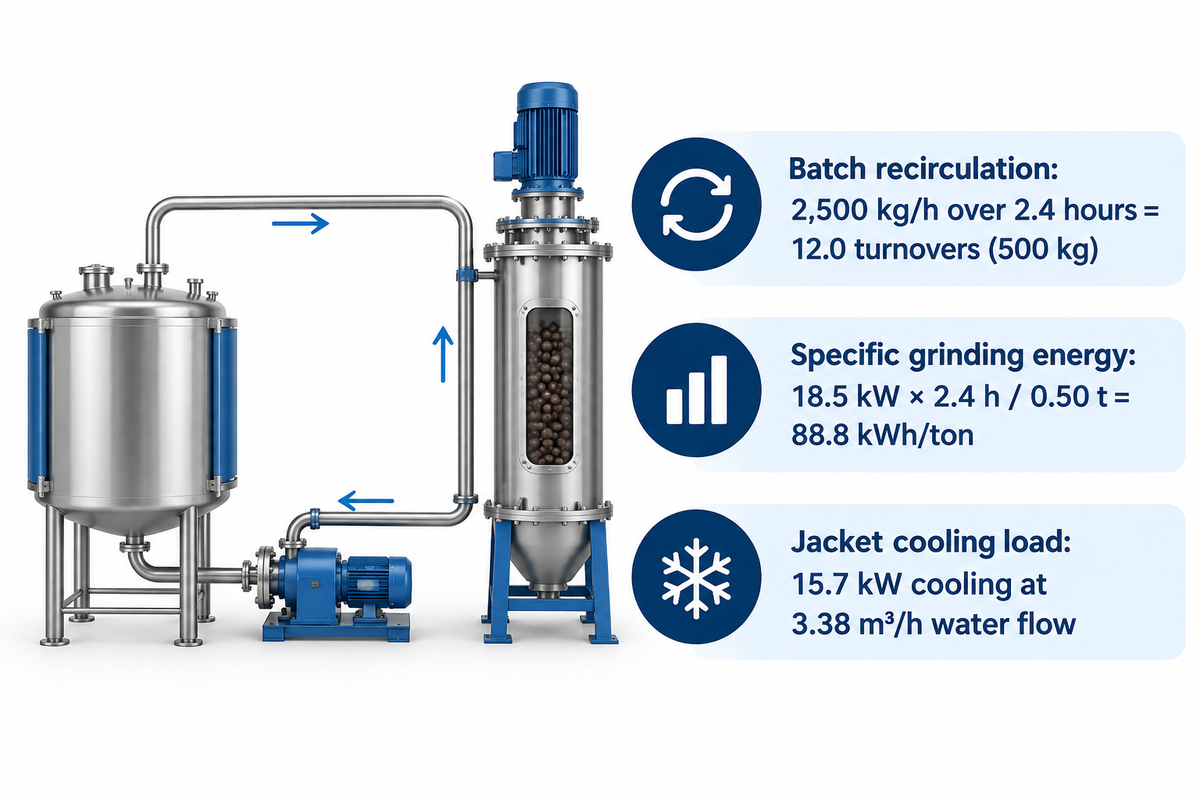
In the recirculating chocolate ball and bead milling, the specific grinding energy is equal to average motor shaft power in kilowatts, multiplied by the milling time in hours, and divided by the batch mass in metric tons. The grinding media density and the nominal tank turnover passes jointly govern the rate at which larger sugar crystals are fractured to a 15 to 25 micron d90.
Two physical variables control energy transfer in an agitated media mill: bead kinetic energy per collision and recirculation residence-time distribution. First, at agitator shaft speeds up to 500 rpm (targeting d90 = 20 to 22 µm in confectionery ball-milling studies per MDPI Foods), media density governs collision energy. High-density forged steel (7.8 g/cm³), 440C steel (7.75 g/cm³), or YTZ zirconia (6.0 to 6.1 g/cm³, carrying nearly twice the impact energy of 3.6 to 3.9 g/cm³ alumina per STR Industries) fractures coarse sugar crystals rapidly. Second, increasing the number of recirculation tank turnovers narrows the residence-time distribution so fewer coarse particles bypass the grinding zone, while proportionally increasing cumulative kilowatt-hours per ton. As documented in a 2025 NIH PubMed Central stirred-media comminution study (Elbendari et al., PMC11772577), conventional tumbling ball mills lose efficiency below 30 µm, whereas stirred media mills transfer energy via high-frequency attrition. In non-chocolate mineral and coal stirred-media benchmarks cited in PMC11772577 (9.5 L stirred mill), grinding a -24.4 µm feed to P80 = 5.9 µm consumed 309 kWh/t. Grinding further to ~1 µm at 500 rpm over 17 hours required approximately 1,225 kWh/t. Although chocolate has different rheology and breakage kinetics than mineral slurries, those benchmarks illustrate why pushing ultrafine comminution into the single-digit micron range steeply increases specific energy and cooling load.
Recirculating Chocolate Ball / Bead Mill Sizing Equations:
1. Nominal Tank Turnover Passes: N_pass = (Q_pump * t_hours) / M_batch
2. Specific Grinding Energy (kWh/t): E_spec = (P_avg_kW * t_hours) / (M_batch_kg / 1,000)
3. Jacket Thermal Rejection Load (kW): Q_cool_kW = f_heat * P_avg_kW
4. Tempered Cooling Water Flow (m³/h): V_water = (Q_cool_kW * 3,600) / (4,184 * Delta_T_water)
One way engineers use these equations in line design is shown in the calculation below for a 500 kg (0.50 metric ton) jacketed recirculating ball mill batch. Actual plant kilowatt-hours per ton and required turnovers vary with formulation and mill geometry and must be determined by pilot trials.
| Sizing Parameter (Illustrative Engineering Calculation) | Assumed Input / Formula | Calculated Output | Engineering & Procurement Implication |
|---|---|---|---|
| Batch Mass & Target Fineness Shift | M_batch = 500 kg (0.50 t); pre-refined feed -> target d90 = 20 µm | 0.50 metric ton batch | Pre-wetted in jacketed high-speed disperser or homogenizer tank prior to milling |
| Lobe Pump Recirculation & Cycle Time | Q_pump = 2,500 kg/h; batch milling time t = 2.4 hours | N_pass = (2,500 × 2.4) / 500 = 12.0 nominal tank turnovers | Individual particles pass through the mill different numbers of times; verify coarse-tail reduction via ISO 13320 d90 sampling |
| Average Agitator Shaft Power & Specific Energy | P_avg = 18.5 kW loaded draw (22 kW motor); E_spec = (18.5 × 2.4) / 0.50 t | 88.8 kWh/ton (44.4 kWh per batch) | Illustrative batch energy figure; measure actual kWh/t on a 5 to 25 kg pilot trial |
| Jacket Heat Rejection & Tempered Water Flow | Q_cool = 0.85 × 18.5 kW = 15.73 kW; water Delta_T = 4.0 °C | 15.7 kW cooling; 3.38 m³/h water flow | Size tempered-water heat exchanger with safety margin to hold product within thermal limits |
Mechanical reliability in continuous 24-hour milling lines also depends on avoiding axial and radial overload and coordinating jacket heating and cooling loops. In industrial ball mill maintenance practice, an Eng-Tips industrial ball mill thrust case documented axial thrust shearing bearing guide bolts three times in a year, with each shutdown requiring 48 hours of work. Starting a chocolate ball mill with congealed fat similarly overloads shaft bearings and seals. Installing VFD current interlocks and pre-warming the jacket before startup prevents cold-slurry torque spikes.
Hybrid Milling Lines: Combining Roll Refiners, Pre-Grinders, and Finishing Bead or Ball Mills
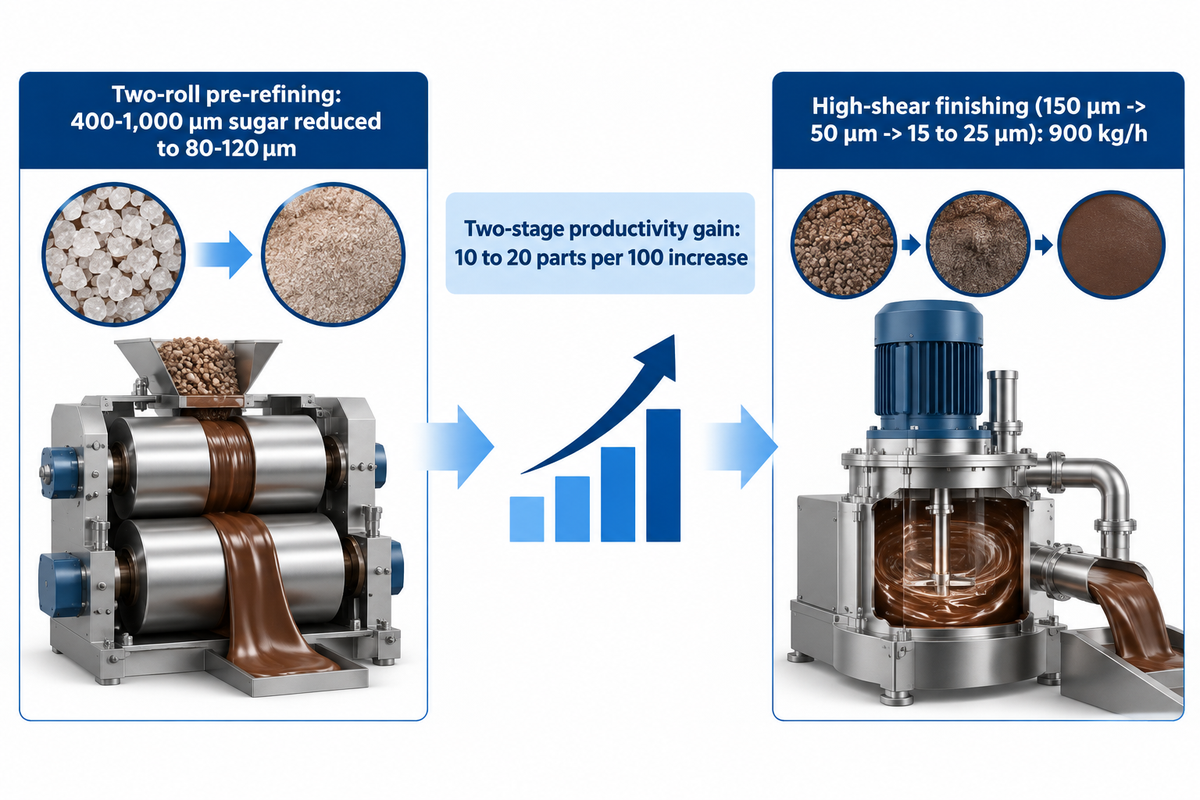
Two-stage or hybrid refining circuits separate coarse sugar breakage (400 to 1,000 microns down to 80 to 120 microns) from fine finishing (d90 = 18 to 22 microns). Italian Food Tech reports that pre-refining augments final refining by 10 to 20 parts per 100.
When a single batch ball mill is forced to crush coarse 400 to 1,000 µm granulated sugar all the way down to 18 to 22 µm, the chamber typically uses larger steel balls to generate sufficient impact force for initial crystal fracture. Once particles pass below 50 to 80 µm, large media balls are less selective and can generate excess sub-5 µm fines. As Italian Food Tech’s two-stage refining data confirms, pre-refining reduces sugar particle size from 400–1,000 µm to 80–120 µm and promotes fat absorption by solid ingredients. This two-stage approach improves production efficiency, yielding a 10 to 20 parts per 100 productivity increase and a more homogeneous paste. Similarly, EP0997076A2 shows that reducing chocolate mass from 150 µm to 50 µm before high-shear finishing (200,000 to 1,000,000 s⁻¹ to reach 15 to 25 µm) raises production rate by at least 50 parts per 100 (reaching 900 kg/h). In addition, the 2026 MDPI Foods confectionery ball-milling review highlights that hybrid roll pre-refining paired with a finishing ball mill refiner optimizes particle size distribution and molten rheology.
| Circuit Configuration | Coarse Pre-Grinding Stage | Fine Finishing Stage | Documented Process & PSD Effect | Best Production Application |
|---|---|---|---|---|
| Circuit A: Single-Stage Batch Recirculating Ball Mill | Jacketed High-Speed Disperser / Mixer pre-wetting | Single vertical ball mill (6.0–9.5 mm steel balls) | Simplest piping; wider PSD span if coarse sugar and fine finishing share one media size | Compact batch lines for compound coatings, spreads, and bakery fillings |
| Circuit B: Two-Stage Agitated Pre-Grind + Fine Bead/Ball Cascade | Pin/colloid pre-mill or coarse pre-refiner (150 µm -> 50 µm per EP0997076A2) | Horizontal agitated bead mill (3.0–6.0 mm YTZ or steel media -> 15–25 µm) | Matches media size to particle size stage; narrows sub-5 µm tail under identical recipe conditions | Continuous cocoa liquor wet milling and high-output coating lines |
| Circuit C: Hybrid Two-Roll Pre-Refiner + Ball or Three-Roll Finisher | Two-roll pre-refiner reducing 400–1,000 µm sugar to 80–120 µm (Italian Food Tech) | Finishing ball refiner (20–22 µm) or IDA ES120 Three-Roll Mill (1–20 µm for viscous pastes) | 10 to 20 parts per 100 productivity increase and homogeneous paste absorption (Italian Food Tech) | Chocolate tablets, spreads, hazelnut pralines, and low-fat confectionery fillings |
Single-Stage Batch Ball Milling
Offers compact footprint and simple piping for smaller to medium sized confectionery batches, although using a single media diameter for coarse breakage and fine finishing can increase the particle size distribution.
Two-Stage Hybrid Pre-Refining + Fine Finishing
Separates coarse crystal fracture (400–1,000 µm down to 80–120 µm) from fine ball, bead, or three-roll finishing (18–22 µm), delivering a 10 to 20 parts per 100 productivity gain and more uniform fat absorption.
2025 to 2026 Chocolate Milling Trends, Equipment Supplier Scope, and RFQ Checklist
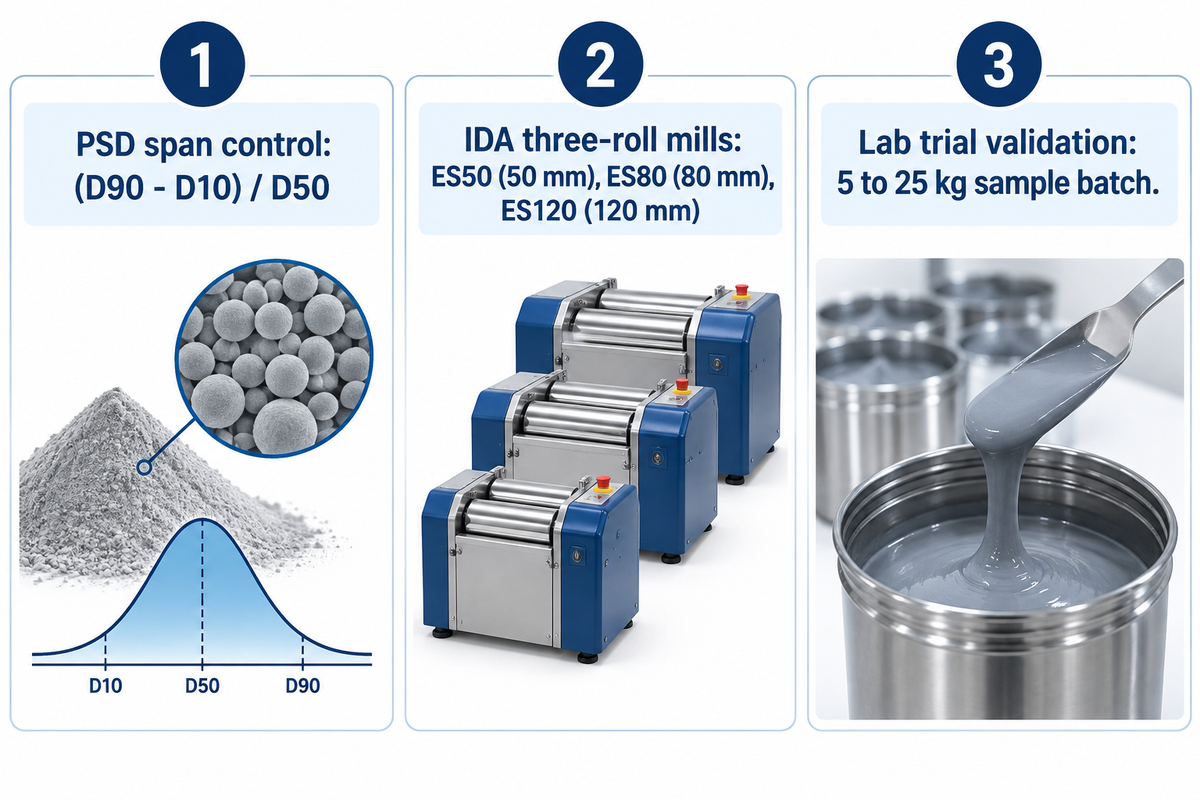
Recent pressures in 2025 to 2026 cocoa butter have promoted advancements in the chocolate industry with regard to narrow-PSD hybrid milling, high-density YTZ zirconia media, and staged emulsifier dosing. Equipment procurement has resulted in the need to differentiate between turnkey dry-roasting contractors and specialized wet bead mill and three-roll mill manufacturers.
Across the international food and confectionery industry, three engineering shifts define 2025–2026 chocolate production line upgrades. First, cocoa butter price volatility has made PSD span control ((D90 – D10) / D50, as defined in Horiba’s three-point D10/D50/D90 particle specification methodology) a top formulation priority: narrowing the sub-5 µm tail controls Casson yield stress without requiring excess cocoa butter. Second, specialty fillings, nut pastes, and compound coatings have increased the use of horizontal agitated bead mills and water-cooled three-roll mills. These lines apply wet dispersion principles from ultra-fine wet and dry grinding technology and high-efficiency nano bead mill engineering. Third, quality-assurance teams pair ferromagnetic 52100/440C steel or iron-free 6.0 to 6.1 g/cm³ YTZ zirconia media with dry warm-fat changeover protocols for low-moisture food hygiene.
When issuing requests for quotation (RFQs), procurement engineers should match supplier scope to the exact unit operation required. Full-line dry-processing chocolate plants typically provide upstream equipment from cocoa bean cleaners to five-roll dry refiners to dry conches and tempering machines. By contrast, Jiangyin IDA Equipment Co., Ltd. (idaequipment.com) states our manufacturing boundary transparently: IDA Equipment manufactures wet grinding, high-viscosity three-roll milling, and high-shear mixing equipment. We don’t manufacture cocoa bean roasters, winnowers, five-roll refiners, or dry conches. For cocoa liquor wet milling, praline and nut paste refining, compound coatings, and pre-milling slurry preparation, IDA Equipment manufactures :
- Benchtop ES50 (50 mm), pilot ES80 (80 mm, water-cooled), and production ES120 (120 mm, water-cooled) three-roll paste mills deliver 1 to 20 µm fineness (1 µm gap precision) up to 2,000,000 mPa·s for cocoa masses and nut pralines .
- Horizontal pin or disc agitated bead mills and batch immersion basket mills with tempered water jackets and zirconia or hardened alloy steel media for pumpable cocoa liquor and compound coatings (SPEC-DB: idaequipment.com).
- Industrial high-speed dispersers (0 to 3,000 RPM, 0.5 to 500 kW VFD/PLC drives), triple-shaft mixers (50 to 1,000 L), and XJB-5 (1.5 kW) to XJB-2000 (90 kW) double planetary mixers pre-wet sugar, milk solids, and cocoa powder into melted fat (SPEC-DB: idaequipment.com).
6-Parameter Copy-Ready Chocolate Milling RFQ Checklist
| # | RFQ Engineering Parameter | What to Specify in Your Inquiry Document |
|---|---|---|
| 1 | Formulation & Fat Mass Fraction | State exact stage (Stage 1 roasted nib liquor at 50–60 g/100 g cacao fat vs Stage 2 molding, covering, or praline paste), sugar crystal feed size (400–1,000 µm or 80–120 µm pre-refined), and milk powder type (spray- vs roller-dried). |
| 2 | Target PSD (D10 / D50 / D90) | Specify volume-based d90 (e.g., 18–22 µm) and sub-5 µm fines limits measured by ISO 13320 laser diffraction in a non-aqueous dispersion carrier (sunflower oil or isopropanol, never water). |
| 3 | Viscosity & Casson Targets at 40 °C | Provide operating dynamic viscosity window (pumpable slurry for bead/ball mills vs up to 2,000,000 mPa·s for ES50/ES80/ES120 three-roll mills) plus target ICA Method 46 Casson yield stress (Pa) and plastic viscosity (Pa·s). |
| 4 | Thermal & Dew-Point Control Loop | Specify maximum product temperature (below 50–55 °C for milk chocolate; above 32–36 °C cocoa butter melting range) and tempered jacket water control keeping exposed surfaces above ambient room dew point. |
| 5 | Wetted Metallurgy, Media & Hygiene | Require 304/316L food-contact surfaces, ferromagnetic AISI 52100 steel balls (60–67 HRC) or AISI 440C steel balls (58–63 HRC) with 10,000–12,000 Gauss magnetic traps, or 6.0–6.1 g/cm³ YTZ zirconia beads, plus warm-fat flush drainage. |
| 6 | 5–25 kg Lab Trial Acceptance | Require a representative 5 to 25 kg laboratory sample trial on your actual paste logging shaft kWh/t, pass count, temperature rise (°C), and before/after ISO 13320 D10/D50/D90 curves prior to commercial sign-off. |
Final Engineering Rule for Chocolate Milling Procurement
Never size a chocolate mill on tank volume or micrometer top-cut alone. Pair pre-dispersion wetting with the right viscosity architecture—agitated bead or ball mills for pumpable slurries, or water-cooled ES50/ES80/ES120 three-roll mills for high-viscosity pastes up to 2,000,000 mPa·s. Validate both d90 (18–22 µm) and sub-5 µm fines on a 5 to 25 kg sample batch before scaling up.
Frequently Asked Questions (FAQ)
Why does chocolate thicken when it is over-milled?
Over milling chocolate below a 15-micron volume-based d90 can generate an excess fraction of sub-5-micron ultrafine particles, depending on the width of the particle size distribution.
Newly created sugar and cocoa surfaces immobilize free liquid cocoa butter into adsorbed solvation shells. As a result, interparticle friction and Casson yield stress increase during molding or enrobing.
What is the difference between a chocolate melanger and an industrial ball mill?
A stone melanger rotates granite roller stones over a granite bed and may run for up to 3 days per batch, so the machine is suitable for small-scale craft bean-to-bar production.
A chocolate ball mill with an agitated shaft and hardened steel/zirconia media in a jacketed cylinder completes equivalent batch refining work in about 1 hour. However, daily output is dependent on the size of the vessel.
What minimum fat content is required for chocolate ball milling?
Recirculating vertical and horizontal chocolate ball mills and agitated bead mills require a pumpable slurry, which depends on the continuous fat content, solid packing span, temperature, and screen geometry.
Pure roasted cocoa nibs naturally contain 50 to 60 parts per 100 parts by weight of cacao fat under 21 CFR Part 163. Low-fat pastes that go beyond the limits of pumpability require a roll refiner or a hydraulic three-roll mill.
Can a colloid mill refine chocolate to 20 microns?
No, a toothed rotor-stator colloid mill cannot finish chocolate mass to a 20-micron d90 target.
Colloid and pin mills are only used for Stage 1 pre-grinders on nibs and coarse pastes.
Why can soy lecithin and PGPR be split-dosed during chocolate milling?
Adding the complete emulsifier allowance at the start of a milling process coats sugar crystals and modifies the breakage behavior of the media in an agitated mill.
Adding a small initial amount of soy lecithin during pre-mixing improves slurry pumpability. Adding the remaining amount of soy lecithin (0.3 to 0.5 g per 100 g total) and PGPR (0.1 to 0.3 g per 100 g) during refining reduces Casson yield stress and plastic viscosity.
Which Comes First in Chocolate Production: Milling or Conching?
In five-roll refiner systems, dry roll milling is followed by a several-hour long conching.
In ball mill systems, the mass is pre-conched or recirculated in a liquid conche.
How is metallic wear contamination controlled in industrial chocolate ball mills?
In industrial chocolate ball mills, a great deal of metallic wear is eliminated by using through-hardened ferromagnetic AISI 52100 steel balls (60 to 67 HRC) or martensitic AISI 440C stainless steel balls (58 to 63 HRC), instead of soft AISI 304 stainless steel. Processors can also specify iron-free yttria-stabilized zirconia ceramic beads (6.0 to 6.1 g/cm3).
During operation, users maintain fat-slurry lubrication and add 10,000 to 12,000 Gauss neodymium magnetic traps on the discharge to capture ferromagnetic wear. When running non-magnetic zirconia beads, plants rely on intact separator screens and periodic media inspection.
References & Sources
- National Institutes of Health / PubMed Central – Rheological Characterization and Particle Size Distribution Effects in Molten Chocolate Suspensions (PMC11547402).
- National Institutes of Health / PubMed Central – Ultra-Fine Stirred Media Milling Specific Energy Consumption and Operating Parameter Optimization (PMC11772577).
- U.S. Electronic Code of Federal Regulations 21 CFR Part 163: Cacao Products Standards of Identity (Cacao Nibs, Chocolate Liquor, and Sweet/Milk Chocolate)
- MDPI Foods (2026) Ball Mill Refining in Confectionery Manufacturing: Processing Parameters, Fat Structure, Emulsification, and Rheological Properties
- International Journal of Food Science & Technology (Afoakwa et al., Oxford Academic) – Particle Size – Distribution and Composition of Casson Yield Value and Plastic Viscosity in Molten Chocolate
- International Journal of Food Science & Technology (Oxford Academic) – Thermal Limits and Amorphous Lactose Agglomeration During Milk Chocolate Ball Milling
- Blommer Chocolate Company Technical Bulletin – Chocolate Behavior: What Influences Your Selection (Casson Viscosity, Yield Value, and Particle Fineness)
- Italian Food Tech – Refining Systems: A Delicate Operation (Pre-Refining, Five-Roll Refiners, and Ball Refiners)
- Italian Food Tech – How Chocolate Is Refined: Granulometry, Roller Length, and Fat Optimization
- European Patent Office / Google Patents – EP0997076A2: Continuous High-Shear Processing and Refining of Chocolate Mass
- Powder & Bulk Solids – Nano-Sizing via Wet or Dry Grinding: Media Selection and Sub-Micron Energy Mechanics
Related Articles
- Three-Roll Mill vs Ball Mill: Viscosity Crossover, Shear Mechanics, and Fineness Limits
- Horizontal Bead Mill Guide: Sub-Micron Wet Grinding Mechanics, Seals, and Cooling
- Grinding Media Selection Guide: Zirconia, Alumina, and Steel Media Trade-Offs
About This Confectionery & Wet Comminution Engineering Guide: Particle size distribution benchmarks (d10/d50/d90), ICA/IOCCC Method 46 Casson rheology equations, emulsifier dosing bands, and 21 CFR Part 163 standards in this article were cross-checked against peer-reviewed food-science literature, federal regulatory texts, and industrial refining documentation. Jiangyin IDA Equipment Co., Ltd. manufactures wet agitated bead mills, basket mills, ES50/ES80/ES120 water-cooled three-roll paste mills, high-speed dispersers, and jacketed planetary mixers (not cocoa bean roasters, winnowers, five-roll refiners, or dry conches). We provide this guide to help processors select the right wet milling or paste refining equipment. Reviewed by the Jiangyin IDA Equipment Co., Ltd. technical team.