Get in Touch with IDA

The direct answer to how is shampoo made is through sequential aqueous compounding: treated water is metered into a vessel, primary and secondary surfactants are diluted under controlled shear, conditioning agents and pearlizers are blended in, and salt or polymer modifiers adjust the viscosity before deaeration and filling.
While each liquid shampoo appears to be a simple cleanser in a bottle, industrial shampoo formulations behave as structured micellar fluids. Early soaps and shampoos relied on alkaline fats. Early soaps and shampoos relied on alkaline fats, whereas more recently developed hair care products balanced surface-active cleansers with polymers that leave the hair clean without causing damage to the hair. Shampoo uses surface-active cleansers and conditioning polymers, so its mixing hardware must match the formulation’s processing requirements.
Key points
- Commercial shampoos on the market combine an aqueous carrier phase with anionic, amphoteric, and nonionic surfactant blends to clean hair while maintaining healthy hair.
- Core phases in shampoo include water, primary detergents, foam boosters, and conditioning polymers that help with hair manageability and support marketing claims made on the label.
- Batch quality depends on matching vessel shear and thermal control to polymer hydration, surfactant dilution, electrolyte viscosity tuning, and deaeration before filling.
What Is Shampoo Made Of? Core Ingredient Phases
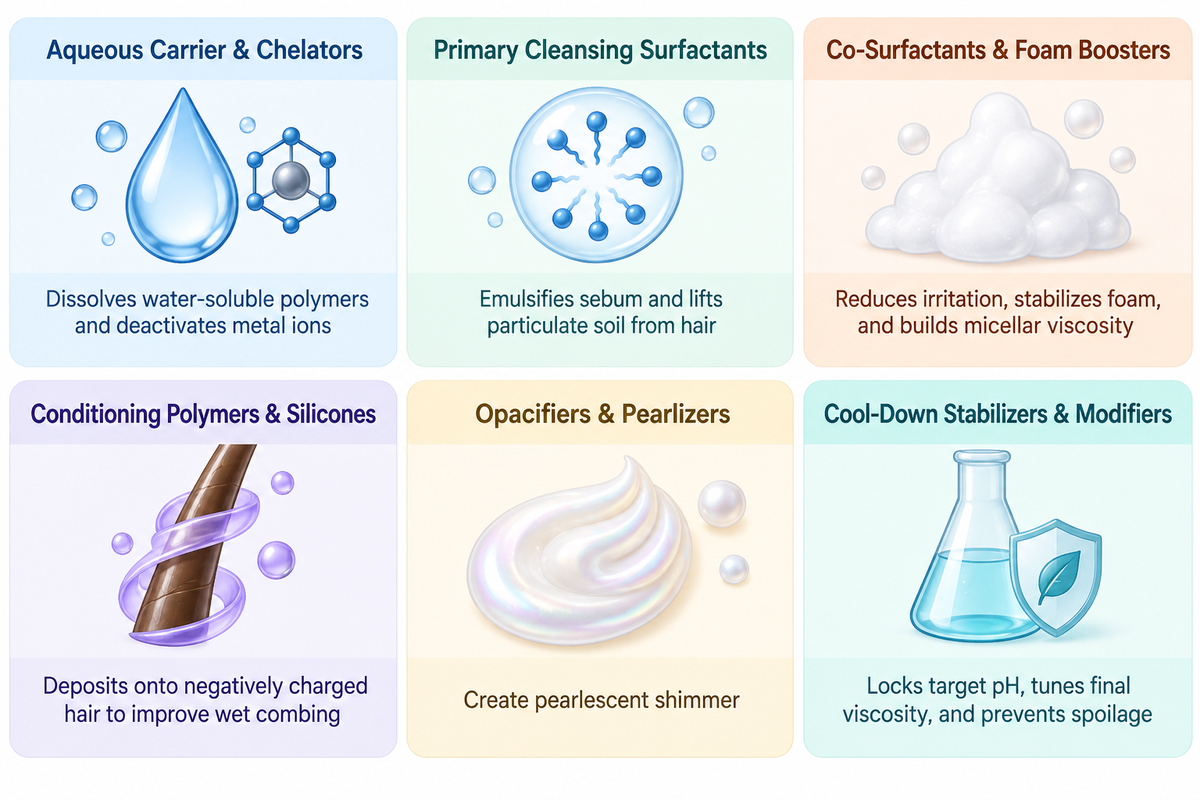
A modern shampoo is made of purified water, primary cleansing surfactants, foam boosters, conditioning agents, rheology modifiers, and a preservation system, are grouped into six formulation phases. In a peer-reviewed analysis of 123 commercial shampoos, measured pH values ranged from 3.5 to 9.0 across international brands.
Rather than treating shampoo ingredients as a flat shopping list, formulators take solubility, charge and thermal sensitivity into account when grouping raw materials. As mentioned in Silverson’s shampoo manufacturing report, shampoo is a mixture of surfactants, conditioning agents and functional additives in an aqueous medium, where the sequence in which ingredients are added controls hydration. Common ingredients in shampoos are selected to clean the hair and scalp gently, leaving a smooth hair feel. De-ionized water serves as the continuous medium. Deionized water serves as the continuous carrier, while chelating agents bind calcium and magnesium ions and can improve preservative stability in the presence of trace metals.
| Formulation Phase | Representative Ingredients | Primary Role in Hair Care |
|---|---|---|
| Aqueous Carrier & Chelators | Deionized water, disodium EDTA, sodium phytate | Dissolves water-soluble polymers and deactivates metal ions |
| Primary Cleansing Surfactants | Sodium lauryl sulfate, sodium laureth sulfate, olefin sulfonates | Emulsifies sebum and lifts particulate soil from hair |
| Co-Surfactants & Foam Boosters | Cocamidopropyl betaine, decyl glucoside, lauryl glucoside | Reduces irritation, stabilizes foam, and builds micellar viscosity |
| Conditioning Polymers & Silicones | Cationic guar, polyquaternium-10, dimethicone emulsions | Deposits onto negatively charged hair to improve wet combing |
| Opacifiers & Pearlizers | Glycol distearate and other pearlizing dispersions | Create pearlescent shimmer, while botanicals and oils serve separate conditioning or marketing roles. |
| Cool-Down Stabilizers & Modifiers | Citric acid, sodium chloride, fragrance, preservative blends | Locks target pH, tunes final viscosity, and prevents spoilage |
The cleansing core employs amphiphilic molecules to solubilize oil. The hydrophilic head acts to attract and bind water, and the lipophilic tail traps oil. Key ingredients include anionic cleansers, most often sodium lauryl sulfate or sodium laureth sulfate, coupled with amphoteric cocamidopropyl betaine used for hair cleansing. According to peer-reviewed hair formulation literature, permanent dyes and harsh alkaline washes can remove the 18-MEA lipid layer when consumers are washing their hair. To smooth the resulting roughness, conditioning shampoos incorporate silicone polymers (synthetic silicon-oxygen polymers that improve slip and combability) or cationic polymers that make the hair easier to comb and make your hair feel soft upon rinsing.
In Gavazzoni Dias et al.’s survey of 123 shampoos, only 38.21% of the 123 shampoos presented a pH of 5.5 or lower (while the majority measured above pH 5.5), and about 19.23% of antidandruff products fell at or below pH 5.5. A formulator creating a moisturizing shampoo to moisturize dry hair would choose a different surfactant ratio and humectant additive to moisturize the cuticle compared to the one creating a deep-cleansing salon wash.
How to make your own shampoo?
To make your own shampoo at home or in a pilot lab, disperse a thickener in warm purified water (around 40°C) and blend in pre-diluted liquid surfactants (around 25% to 30% active) with a broad-spectrum preservative to make shampoo safely.
When people learn how to make a basic shampoo recipe on a benchtop, their first shampoo trial avoids concentrated surfactant pastes because hand stirrers can’t break the intermediate gel phase. Even in a small homemade batch, an ingredient like aloe vera, natural oils, or herbal extracts added to shampoos requires a preservative because aqueous natural ingredients support rapid microbial growth.
How Is Shampoo Made Step by Step in a Factory?
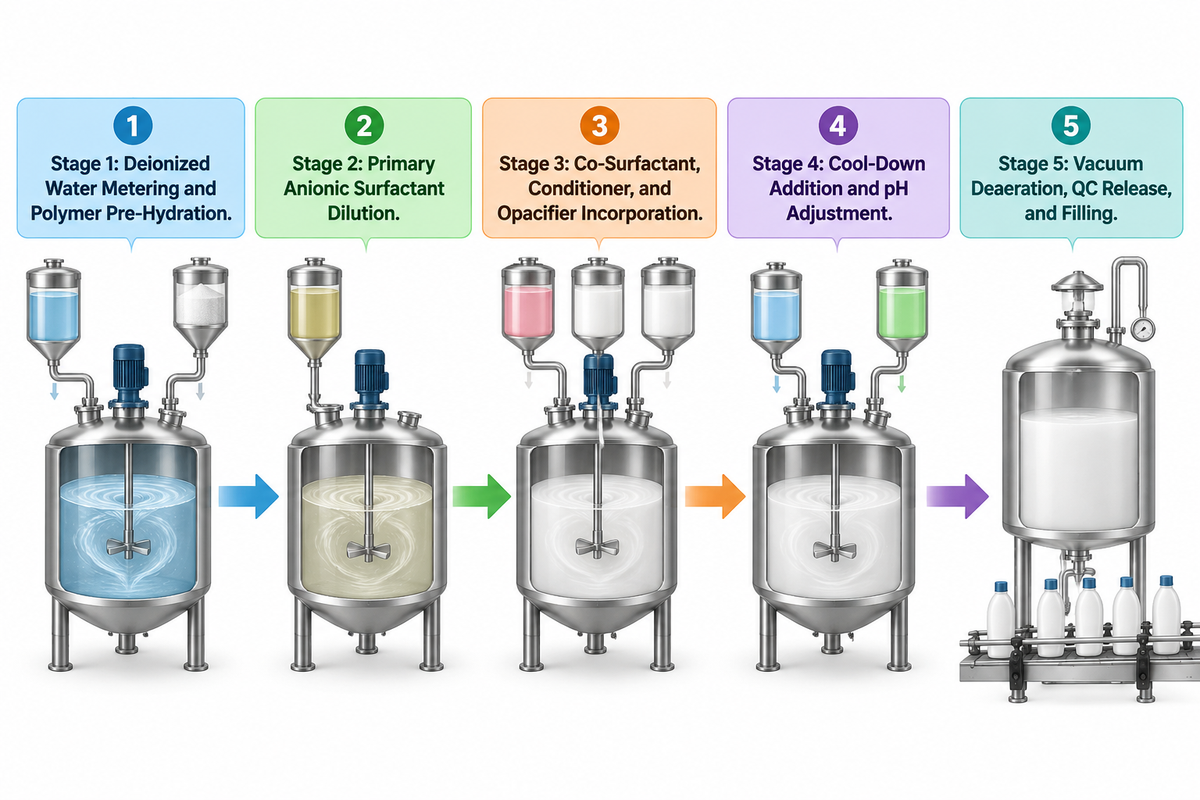
In an industrial plant, shampoo is made through five sequential unit operations: water purification and polymer hydration, primary surfactant dilution, co-surfactant and conditioner blending, cool-down pH and electrolyte adjustment, and deaerated filling. For high-active SLES dilution, batch water should be held at 40-50°C and not exceed 60°C.
The industrial shampoo manufacturing process is designed to hydrate solids and high-viscosity surfactant pastes before the batch builds its final thickness, whether the line produces separate shampoo and conditioner batches or 2-in-1 washes. Adding thickeners or electrolytes too early raises drag inside the tank and prevents uniform dispersion. High-shear batch mixers are suitable for batch sizes up to 300 US gallons, while larger lines pair jacketed vessels with recirculation loops.
- Stage 1: Deionized Water Metering and Polymer Pre-Hydration. Treated water is metered into the compounding vessel. Cationic polymers such as guar derivatives are educted into the vortex before surfactants are added so every polymer chain hydrates without clumping.
- Stage 2: Primary Anionic Surfactant Dilution. The main surfactant is charged first because viscosity-building additives slow down the dilution of surfactants. Closed inline rotor-stator mixers dilute high-active pastes below the liquid surface to prevent foam generation.
- Stage 3: Co-Surfactant, Conditioner, and Opacifier Incorporation. The batch is further processed by addition of secondary surfactants, silicone emulsions and pearlizing dispersions while moderate Anchor and Turbine agitation is carried out until the emulsion becomes homogenous.
- Stage 4: Cool-Down Addition and pH Adjustment. Once the batch cools to ambient temperature, heat sensitive preservative systems, fragrance oils and citric acid are added, and sodium or thickener salts are added to adjust the viscosity.
- Stage 5: Vacuum Deaeration, QC Release, and Filling. Prior to the final vacuum deaeration of the batch, air entrained during the preparation is stripped and laboratory samples are tested for viscosity and microbiological quality. In case tests are satisfactory, positive displacement meters fill bottles to the required level.
When shampoos are commercially made from 70% active sodium laureth sulfate paste, plant engineers must respect the liquid-crystalline gel boundary. Silverson and Chemger’s industrial SLES dilution guidance indicate that under these conditions, high active SLES can form a stiff viscous gel phase above roughly 27% active concentration; dilution water is held at 40-50°C and below 60°C to limit hydrolysis. For commercial SLES grades, phase boundary and temperature conditions are provided by the supplier in dilution guidelines, and the actual gel range shifts with ethoxylation distribution and co-surfactant ratios.
A SpecialChem shampoo compounding guide also mentions dispersing polymeric thickeners under gentle, submerged stirring, before adding high foaming detergents. Once air is whipped into a viscous surfactant base, bubbles remain suspended and cause weight variance on volumetric filling lines.
Sulfate vs Sulfate-Free Shampoo: Salt Curve and Thickening
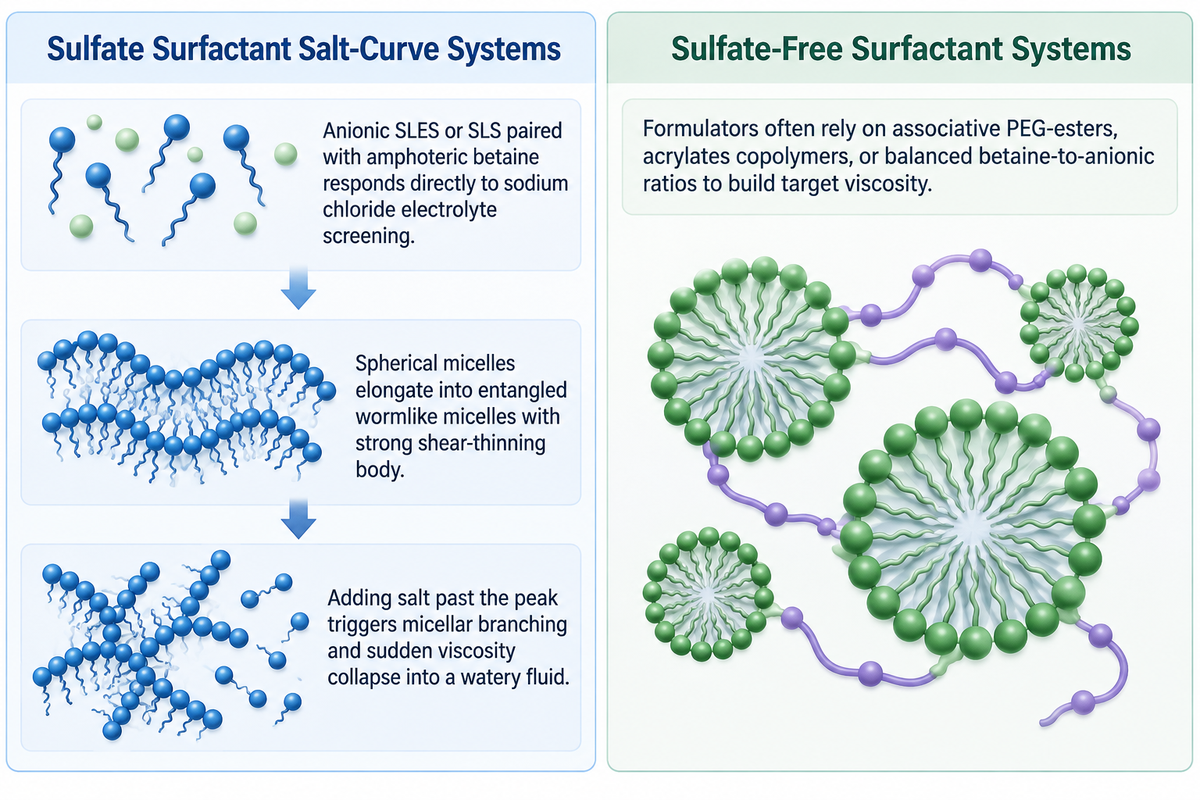
Sulfate shampoos thicken easily with sodium chloride because salt ions screen the repulsion between anionic surfactant heads and therefore allow the micelles to form a worm-like rod packed structure. Glucosides and amino-acid surfactants lack this behavior and require polymeric thickeners or specific ratios of betaine to anionic surfactant to build target viscosity without phase separation.
In a classic lauryl sulfate or sodium laureth sulfate base combined with cocamidopropyl betaine, titrating sodium chloride across a 0.2% to 2.0% laboratory salt curve builds a steep bell-shaped viscosity peak, while exceeding the peak collapses the micellar network. According to Rheology Lab’s shampoo salt-curve study, low-salt blends behave as thin Newtonian liquids until wormlike micelles entangle. Meanwhile, Patent US20230114939A1 describes structured sulfate-free shampoo examples, combining 3% to 35% isethionate or sarcosinate surfactants with 5% to 15% betaines at 0.6% or more sodium chloride, using cationic polymer charge densities above 0.6 meq/g and polymer-to-salt ratios from 1.2:1 to 2:1.
Sulfate Surfactant Salt-Curve Systems
- Anionic SLES or SLS paired with amphoteric betaine responds directly to sodium chloride electrolyte screening.
- Spherical micelles elongate into entangled wormlike micelles with strong shear-thinning body.
- Adding salt past the peak triggers micellar branching and sudden viscosity collapse into a watery fluid.
Sulfate-Free Surfactant Systems
- Sulfate-free systems may be built on taurates, isethionates, sarcosinates, olefin sulfonates, or nonionic alkyl polyglucosides, and they often use non-salt thickening strategies.
- Steric hindrance and headgroup packing prevent simple NaCl thickening in glucoside-heavy bases, although specific isethionate or sarcosinate blends with betaines can thicken at 0.6% or more NaCl.
- Formulators often rely on associative PEG-esters, acrylates copolymers, or balanced betaine-to-anionic ratios to build target viscosity.
As explained in Chemists Corner’s analysis of the shampoo salt curve overshooting the salt peak causes viscosity to drop sharply and can make a clear shampoo hazy in cold storage. The exact window for sodium chloride thickening depends on the anionic-to-amphoteric surfactant ratio and ternary co-surfactants, so every new shampoo formulation must be titrated across its own laboratory salt curve rather than follow a fixed salt percentage.
Formulators producing a shampoo without sulfates across different shampoo types such as color-safe liquid cleansers, sensitive hair types or solid shampoo bars, need to control the active surfactant matter. Documented practitioner trials on SoapMakingForum show a small reduction in total surfactant matter changed a sulfate-free isethionate/sarcosinate blend from a firm gel to a water thin liquid. Simultaneously, TRI Princeton hair research notes that a sulfate-free positioning doesn’t guarantee a product is always mild. In general, sulfate-free positioning does not automatically guarantee superior mildness, because the degree of irritation depends on the size of micelles, co-surfactant complexation, and surfactant residue left on the hair or skin or hair follicles after rinsing.
Cold Process vs Hot Process Mixing in Shampoo Production
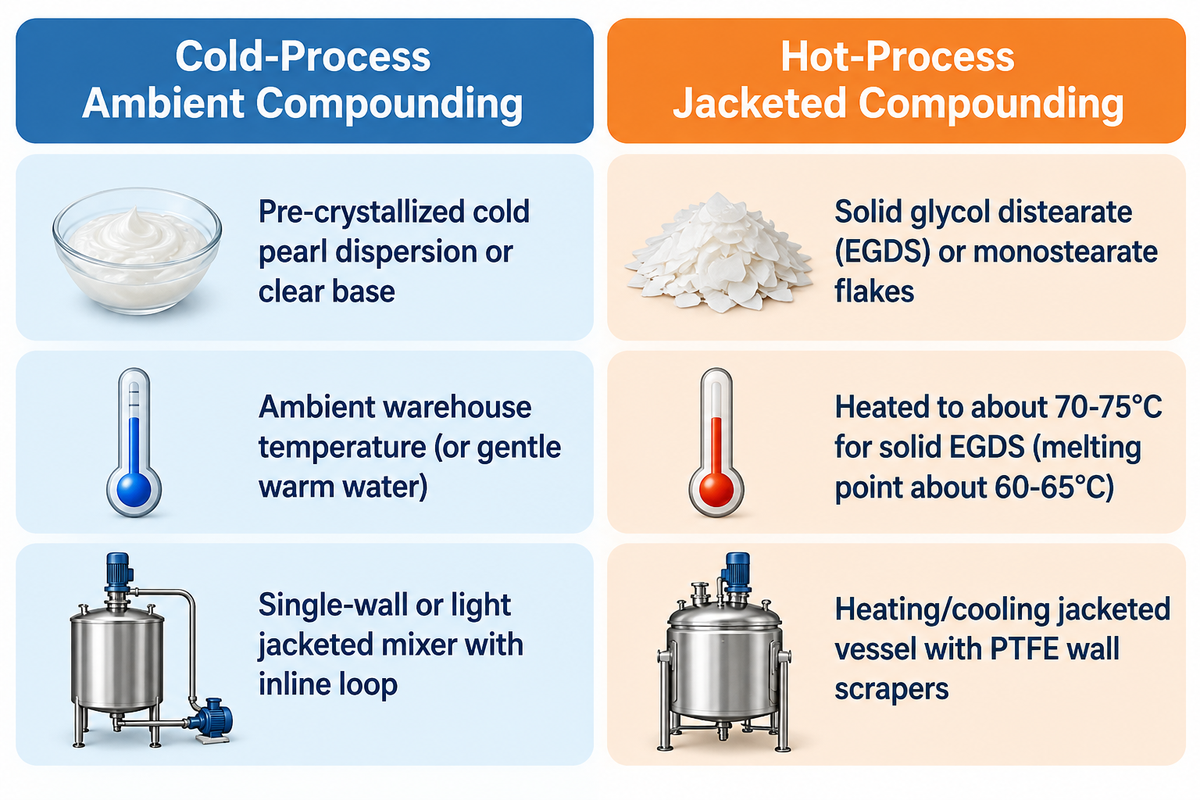
Cold-process mixing at ambient temperature is utilized when liquid surfactants and pre-crystallized pearlizing concentrates are supplied. Hot-process jacketed compounding is used when solid, waxy pearlizers such as ethylene glycol distearate, whose melting and blending windows vary by raw-material grade and carrier and are often around 60-65°C and 70-75°C, must be melted and recrystallized under controlled cooling.
Use the cold process mixing method for pumpable liquid surfactants and pre-crystallized pearlizing concentrates. Use cold-process mixing for pumpable liquid surfactants and pre-crystallized pearlizing concentrates; use hot-process compounding for solid waxy pearlizers that must be melted above 65°C and then recrystallized. Clear liquid shampoo, herbal shampoo and baby shampoos made with liquid surfactant blends can be compounded entirely at ambient temperature, unless the water is gently warmed to speed up polymer hydration. Traditional pearlescent conditioning shampoos made from solid waxy flakes require a complete thermal melt and recrystallization process.
| Process Parameter | Cold-Process Ambient Compounding | Hot-Process Jacketed Compounding |
|---|---|---|
| Pearlizer / Wax Feedstock | Pre-crystallized cold pearl dispersion or clear base | Solid glycol distearate (EGDS) or monostearate flakes |
| Peak Vessel Temperature | Ambient warehouse temperature (or gentle warm water) | Heated to about 70–75°C for solid EGDS (melting point about 60–65°C) |
| Cooling Requirement | None required before fragrance and preservative dosing | Controlled jacket cooling before dosing heat-sensitive volatiles |
| Vessel Hardware | Single-wall or light jacketed mixer with inline loop | Heating/cooling jacketed vessel with PTFE wall scrapers |
| Primary Process Risk | Slow polymer hydration or trapped air from cold viscosity | Irregular crystal platelet growth causing dullness or settling |
“If a composition has too high a solubilizing capacity the EGDS may not crystallize out, may require too low of an outlet temperature (<100° F.) to crystallize or may only crystallize slowly leading to crystals that are too large.”
According to UL Prospector’s technical guide on pearlescence in cosmetics, cold pearl concentrates supply pre-formed glycol distearate platelets suspended in amphoteric and nonionic surfactants so plants can blend pearlescent shampoos without steam heating. Hot-process mixing around 70–75°C is used when melting solid EGDS, whose melting point is about 60–65°C, while cold-pearl dispersion protocols depend on the raw material’s crystalline purity and surfactant carrier; grades therefore require crystal-stability re-testing before they’re swapped across processes.
Preventing Fish-Eyes, Air Bubbles, and Batch Defects
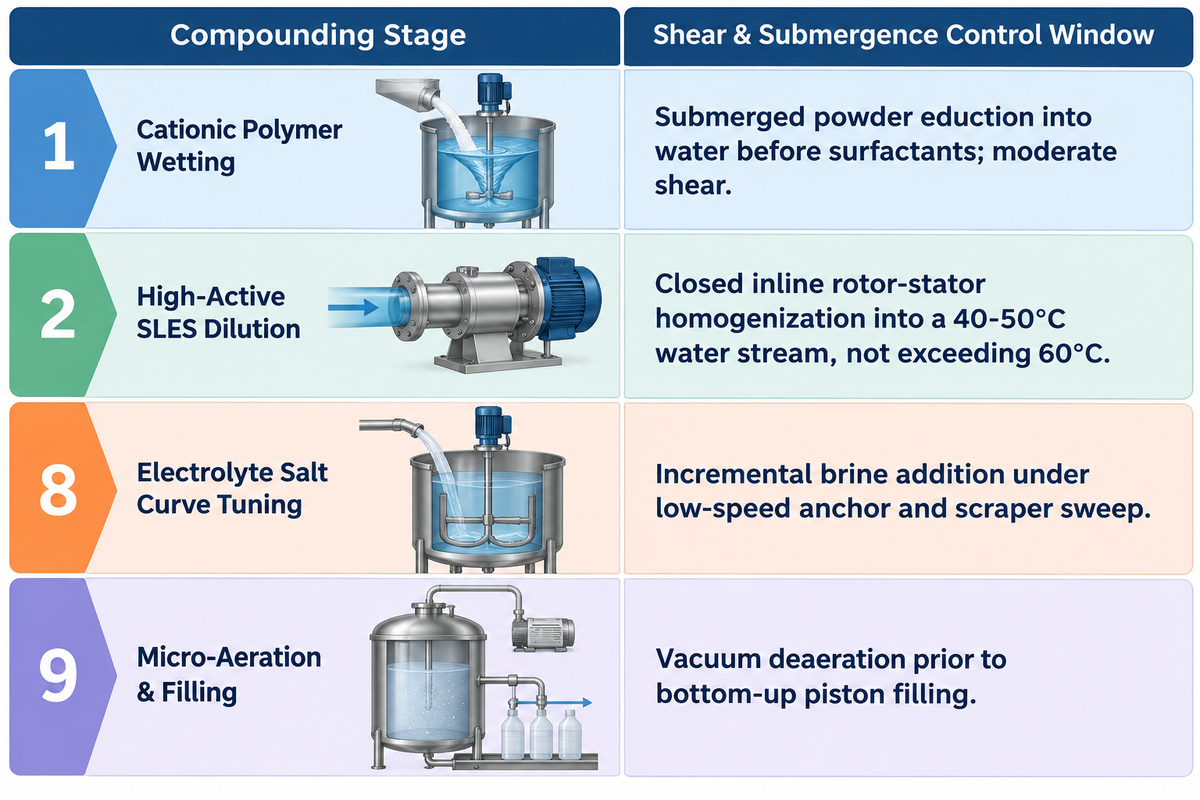
The three most expensive factory shampoo defects: SLES gel lumps (“fish-eyes”) formed when high-active paste crosses a gel boundary at about 27% active under low shear, micro-foam clouding from air entrainment in a vortex, and viscosity collapse when sodium chloride exceeds the 0.2% to 2.0% salt-curve peak, occur because of imbalances in mixer shear and dosing.
As noted alongside FDA cosmetic microbiological guidance, U.S. cosmetic law places responsibility on shampoo manufacturers to prevent microbial contamination and to ensure finished personal care products are not adulterated. If a surfactant solution contains an open-top impeller, and it spins too fast, it creates a surface vortex that pulls air into the micellar network. If shear is too low when charging cationic polymers or a high-active SLES paste, the outer layer of each droplet hydrates and thickens to a tough skin that protects the dried or concentrated core. Managing these opposing failure modes requires balancing mixer speed, recirculation flow, and vessel vacuum during each compounding step.
Micelle-to-Shear Phase Window
The Micelle-to-Shear Phase Window defines ten critical unit-operation transitions and quality control checkpoints across industrial shampoo production, and correlates each with its associated defect symptom, physical mechanism, and operating boundary.
| Compounding Stage / Defect | Physical or Chemical Mechanism | Shear & Submergence Window | Batch Verification Check |
|---|---|---|---|
| 1. Cationic Polymer Wetting | Guar or cellulose powder forms hydrated outer skin around dry core | Submerged powder eduction into water before surfactants; moderate shear | Visual drawdown on glass plate confirms uniform hydration within plant speck limits |
| 2. High-Active SLES Dilution | High-active SLES can cross a liquid-crystalline gel phase above roughly 27% active matter | Closed inline rotor-stator homogenization into a 40–50°C water stream, not exceeding 60°C | Uniform refractive index and absence of floating gel globules |
| 3. Co-Surfactant Addition | Betaine or glucoside builds premature mixed-micelle viscosity | Sub-surface dip-pipe charging with baffle-controlled anchor sweep | Homogeneous surfactant base without surface foam head |
| 4. Silicone Emulsification | Immiscible dimethicone coalesces and creams to top of bottle | High-shear rotor-stator pass or pre-emulsified micro-emulsion blend | Centrifuge stability test confirms emulsion uniformity without oil-ring separation |
| 5. Pearlizer Crystallization | Rapid quench or excess solvency produces amorphous lumps or haze | Heat above the pearlizer grade’s melting window, then apply slow scraper cooling matched to carrier solvency | Microscopic platelet check and elevated-temperature oven stability hold |
| 6. Fragrance Solubilization | Essential oils or fragrance exceed micellar solubilization limit | Pre-blend fragrance with nonionic solubilizer before cool-down dosing | Nephelometric turbidity check in clear shampoo products |
| 7. Citric Acid pH Titration | Localized acid pockets shock pH-sensitive anionic surfactants | Dose pre-diluted citric acid solution into active circulation zone | Calibrated pH electrode check on top, middle, and bottom samples |
| 8. Electrolyte Salt Curve Tuning | Over-salting collapses wormlike micelles into thin branched fluid | Incremental brine addition under low-speed anchor and scraper sweep | Rotational viscometer test at standardized spindle and temperature |
| 9. Micro-Aeration & Filling | Vortexing agitator traps micro-bubbles that skew volumetric fill weight | Vacuum deaeration prior to bottom-up piston filling | Pycnometer specific-gravity check matches deaerated lab standard |
| 10. Microbiological Release | Waterborne pseudomonads or fungi proliferate in unpreserved phase | Sanitized RO/DI water loop and cool-down preservative homogenization | Microbial plate count and pathogen absence per ISO 17516 framework |
Most plants combine physical quality checks with ISO 17516 alongside ISO 22716 Good Manufacturing Practices.
How often should you shampoo your hair?
Wash daily for oily scalps when using shampoo buffered with mild amphoterics; dry or chemically treated hair often benefits from washing every two to four days, depending on scalp sebum production, hair fiber porosity, and formula surfactant concentration.
From a formulation standpoint, whether an expensive shampoo or a mass-market wash is chosen, a clarifying shampoo is used periodically with higher anionic detergent levels to strip heavy styling buildup. By contrast, a gentle conditioning type of shampoo formulated with cocamidopropyl betaine, cationic polymers, and silicone emulsions cleans the hair while leaving a light protective film that supports frequent washing without excess friction or hair loss from breakage.
Choosing Mixing and Milling Equipment for Shampoo Lines
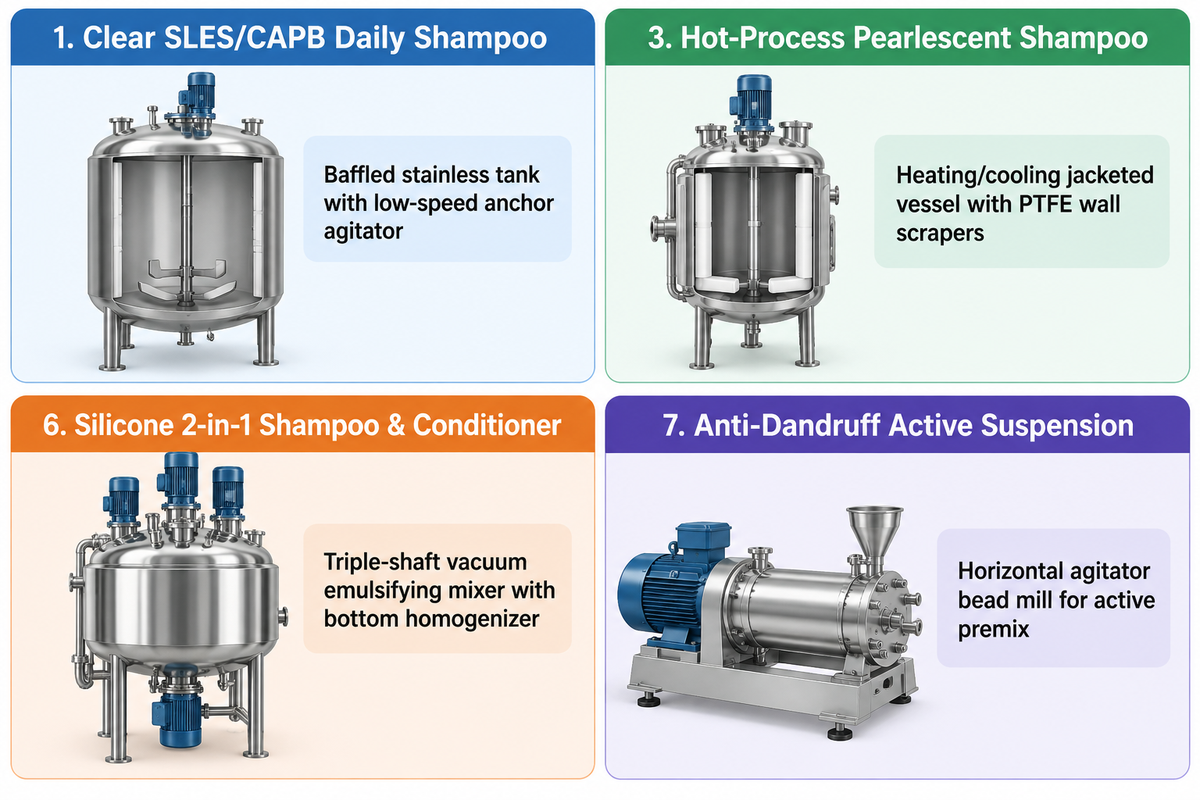
Selecting equipment for shampoo production begins with separating processes for soluble liquids from insoluble particles. Standard clear or pearlescent shampoos use a jacketed anchor and homogenizer vessel. Standard clear or pearlescent shampoos typically use a jacketed anchor-and-homogenizer vessel, while insoluble-solids formulations with anti-dandruff actives or pigments may require high-shear wet grinding or three-roll dispersion.
When increasing the scale of a shampoo production line, plant engineers look at four mechanical duties. These include the induction of powders, the dilution of very active surfactant components, bulk heating and wall scraping, and particle size reduction. For very viscous personal care batches requiring simultaneous high shear emulsification and the removal of dissolved gases, some manufacturers use multi-shaft vacuum mixing vessels to maintain the process within a closed, sealed, and sanitary system.
| Shampoo Formulation Type | Key Rheology & Phase Challenge | Primary Compounding Vessel | Auxiliary Inline / Milling Unit |
|---|---|---|---|
| 1. Clear SLES/CAPB Daily Shampoo | Preventing micro-bubble haze during salt-curve thickening | Baffled stainless tank with low-speed anchor agitator | Submerged inline rotor-stator mixer |
| 2. Typical High-Active SLES Bulk Dilution | Bypassing the unpumpable gel phase that can form above roughly 27% active matter | Warm-water holding vessel (40–50°C, not exceeding 60°C) with load cells | High-shear inline dilution skid with positive pump |
| 3. Hot-Process Pearlescent Shampoo | Melting solid pearlizer wax across its grade-specific thermal window and controlled recrystallization cooling | Heating/cooling jacketed vessel with PTFE wall scrapers | Bottom or inline homogenizer for pre-cool blend |
| 4. Cold-Pearl Conditioning Shampoo | Dispersing pre-crystallized pearl concentrate without shearing platelets | Ambient multi-shaft mixer with variable-frequency drive | Low-shear positive-displacement transfer pump |
| 5. Sulfate-Free Polymer-Thickened Gel | Hydrating cationic guar or acrylates without fish-eye lumps | Vacuum emulsifying mixer with sub-surface powder induction | Powder-liquid eductor hopper on recirculation loop |
| 6. Silicone 2-in-1 Shampoo & Conditioner | Reducing dimethicone droplet size for long-term suspension | Triple-shaft vacuum emulsifying mixer with bottom homogenizer | Multi-stage rotor-stator emulsion workhead |
| 7. Anti-Dandruff Active Suspension | Deagglomerating insoluble zinc pyrithione, sulfur, or selenium sulfide | Corrosion-resistant cGMP vacuum compounding vessel | Horizontal agitator bead mill for active premix |
| 8. Color-Depositing / Tinted Paste Shampoo | Wetting and grinding high-viscosity iron oxide or mica pigment pastes | Dual-planetary or coaxial high-viscosity mixer | Three-roll mill or basket mill for color concentrate |
| 9. Thick Cream / Scalp Scrub Shampoo | Moving high-yield-stress paste without dead zones or wall caking | Counter-rotating anchor and helical ribbon vacuum vessel | Twin-screw or lobe discharge pump to piston filler |
| 10. Batch-to-Recirculation Scale-Up | Scaling from batch mixers (up to 300 US gallons) to larger commercial tanks | Jacketed pilot or batch vacuum homogenizing mixer | Inline high-shear recirculation loop or benchtop bead mill |
In general, soluble surfactant systems use jacketed bulk agitation and inline homogenization, like triple-shaft compounding mixers. Soluble surfactant systems commonly use jacketed bulk agitation and inline homogenization, such as triple-shaft compounding mixers, while formulations containing suspended insoluble solids may require wet milling or fine wet dispersion. According to industrial cosmetic wet-grinding documentation, suspended anti-dandruff actives (such as zinc pyrithione or sulfur, which are controlled as OTC drug actives in the US and elsewhere) and pearlescent pigment concentrates require fine wet dispersion to prevent settlement in the bottle. For the solid-suspension premixes, plants incorporate wet bead mills and three-roll dispersion mills upstream of the main blending tank.
Since 2016, Jiangyin IDA Equipment has manufactured mixing, dispersing and wet-grinding systems for personal care and chemical plants. While high-shear batch mixers can mix batches up to 300 US gallons and larger systems use jacketed tanks with recirculation loops, specific pilot-to-production vessel sizes depend on each formula’s rheology. Prior to purchasing production-scale vessels, engineering teams can use the IDA material-trial and scale-up workflow to test their surfactant pastes, polymer systems, or other active suspensions and receive a measured recommendation on particle size and rheology.
Frequently Asked Questions
What differentiates shampoo from soap?
The primary difference between soap and shampoo lies in the cleansing ingredients found in shampoos: synthetic detergents, such as sodium laureth sulfate, cocamidopropyl betaine, and alkyl glucosides, remain soluble in hard water and can be buffered to a mildly acidic pH near 5.5. True soap consists of alkaline fatty-acid salts that react with calcium and magnesium ions to leave dull soap scum on hair cuticles.
Why do commercial shampoos use SLS or SLES?
SLS and SLES provide strong detergency and foam, while SLES/CAPB systems are commonly thickened with sodium chloride along a formulation-specific salt curve. SLS and SLES provide strong detergency and foam, while SLES/CAPB systems are commonly thickened with sodium chloride along a formulation-specific salt curve.
What do no-tear baby shampoos contain?
No-tear baby shampoos rely on mild amphoteric and nonionic surfactants, such as cocamidopropyl betaine, decyl glucoside, and ethoxylated sorbitan esters, rather than chemical numbing agents. These surfactants form larger, more stable micelles that minimize free monomer penetration into ocular tissues, and the formula is buffered closer to natural tear pH to prevent stinging.
What is dry shampoo made of?
Dry shampoo is an anhydrous powder or aerosol suspension made of oil-absorbing starches (rice, corn, or tapioca starch), clays, or silica paired with volatile propellants such as butane, isobutane, and propane that evaporate after spraying.
Does shampoo pH really affect hair health?
Yes, shampoo pH directly affects cuticle swelling, friction, and lipid retention on dyed or treated hair. In Gavazzoni Dias et al.’s peer-reviewed study of 123 commercial shampoos, the human hair shaft exhibited an acidic pH of 3.67 and the scalp measured 5.5, yet only 38.21% of retail shampoos tested at or below pH 5.5. Formulating shampoos in an acidic 4.5 to 5.5 window minimizes negative charge repulsion along the hair fiber, helps preserve the 18-MEA lipid layer, reduces frizz, and supports organic-acid preservative systems.
References & Sources
- NIH PubMed Central (PMC4158629): The Shampoo pH: Myth or Reality? (Gavazzoni Dias et al., 2014)
- Silverson Machines: Shampoo Manufacturing Process Application Report
- NIH PubMed Central (PMC4387693): Hair Cosmetics: An Overview (Gavazzoni Dias, 2015)
- Silverson Machines: Dilution of High Active Surfactants (SLES)
- Chemger: Sodium Lauryl Ether Sulfate (SLES) Dilution from 70% to 28% and Industrial Applications
- SpecialChem: Shampoo Formulation Technical Guide
- US Patent Application US20230114939A1: Sulfate-Free Shampoo Composition
- Rheology Lab: Ahead of the Salt Curve: Surfactant Rheology
- Chemists Corner: Why Does Salt Thicken Shampoos?
- SoapMakingForum: Liquid Syndet Shampoo Viscosity Trials
- TRI Princeton: Sulfate-Free Shampoo: A Beauty Trend or More?
- UL Prospector: Adding Pearlescence in Cosmetics
- US Patent US6165955A: Mild Cold Pearlizing Concentrates
- U.S. Food and Drug Administration (FDA): Microbiological Safety and Cosmetics
- International Organization for Standardization (ISO): ISO 17516 Cosmetics, Microbiology, Microbiological Limits
- NETZSCH Grinding & Dispersing: Wet Grinding Solutions for Pharma and Cosmetics