Get in Touch with IDA


June 2026 • Reviewed by the IDA Equipment technical team.
A basket mill is a wet media mill that disperses and grind in a single vessel: a perforated grinding basket holding beads is lowered into the batch tank, and a rotor inside circulates the millbase through the bead bed. Engineers in paint, ink, pigment, and coatings plants reach for a basket mill when they need fine particle reduction without the pumps, hoses, and slow cleanout of a closed bead mill. This guide explains how a basket mill work, what fineness it reaches, how to size grinding media, how it compares to bead, sand, and three roll mills, and when it’s the right tool – with sourced engineering data rather than vendor adjectives.
In one paragraph: A basket mill is a batch, single-vessel wet media mill used to disperse and grind pigments and solids into liquids – typically reaching a 1–50 µm median particle size (down to ~0.5 µm with fine media). Because the grinding basket, beads, and product stay in one tank with no external pump, basket mills typically change color in about 5-15 minutes – against the 30-60 minutes manufacturers cite for a horizontal bead mill – which is why they suit short runs and multi-product paint and ink lines.
Key takeaways
- Pick bead size from the feed particle size, not the target, a common assumption that runs backwards (90% of feed should be smaller than 10× the bead diameter).
- Staging media, coarse beads first, fine beads later, can roughly halve grind time (315 → 150 minutes to reach 80% < 2 µm in one published trial).
- A basket mill’s edge is changeover, not ultimate fineness: 5–15 min color changes and a 3–8 kg media charge vs 50–200 kg in a horizontal mill.
- For sub-micron, single-product, high-volume output, a continuous bead mill still wins.
Quick Specs: Basket Mill at a Glance
| Function | Combined dispersion + wet grinding in one vessel |
| Grinding media | 0.3–2.0 mm zirconia / ceramic / glass beads; micro-beads to ~0.05 mm for nano work |
| Typical fineness (d50) | 1–50 µm; ~0.5 µm with fine media and staged milling |
| Batch size | Lab ~0.75 L → production 5,000+ L |
| Viscosity window | ~500–50,000 cP (with adequate bottom flow) |
| Color/product change | 5–15 min (lift basket, rinse) |
| Best fit | Short runs, frequent color changes, d50 ≥ ~5 µm, multi-product lines |
What Is a Basket Mill?
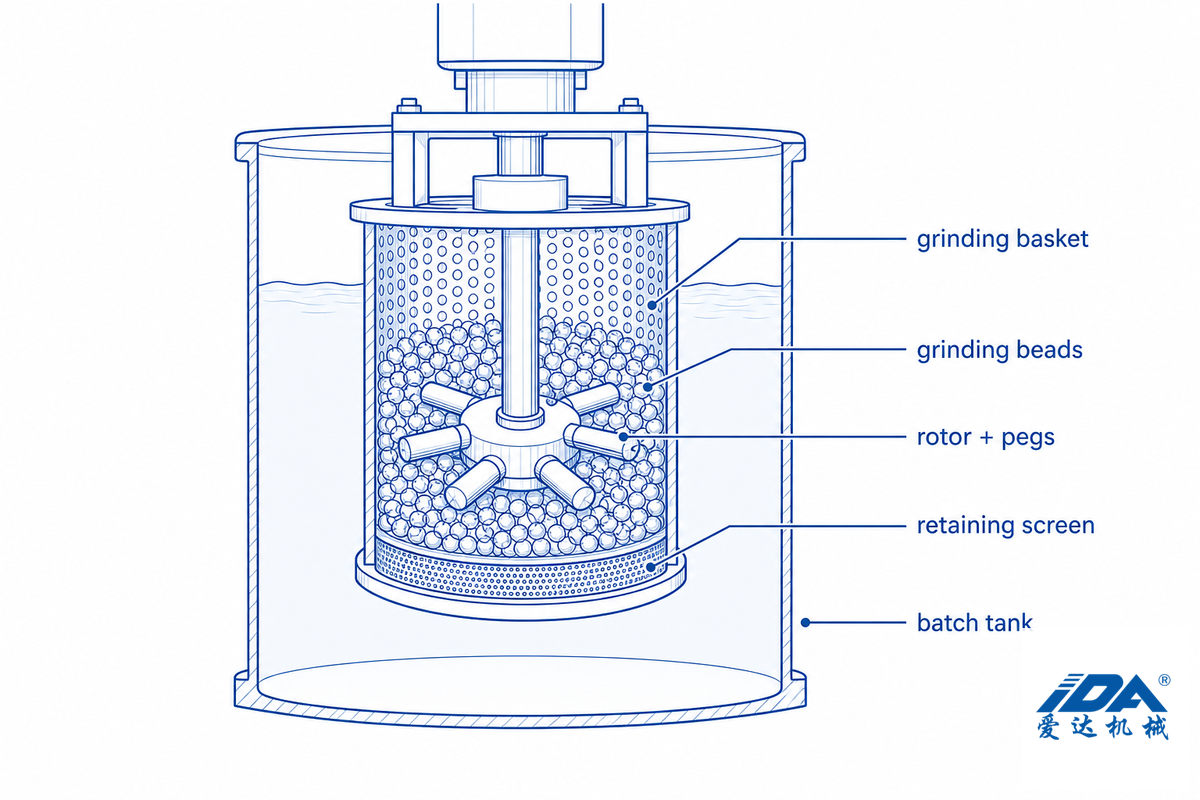
A basket mill is a type of wet media mill built around a perforated “basket” that holds grinding beads. The basket is lowered into a batch tank, and a rotor with pegs spins inside it. Product is pulled through the bead field, where collisions between beads, pegs, and solid particles break agglomerates and reduce particle size, then exits through retaining screens and recirculates.
Because everything – beads, product, and rotor – sits in one vessel, the basket mill combines dispersing and grinding in one pass, two steps that older lines ran on separate machines.
You’ll also see basket mills called immersion mills – the term the technology’s 1990s originator uses – or basket-type bead mills. A well-run basket mill yields a narrow particle size distribution, the hallmark of strong color development. Basket mills belong to the broad family of media mills, which carry the largest installed grinding power of any size-reduction machine class, according to a particle-science review hosted in the University of North Carolina digital repository.
💡 Why it matters
Combining disperse-and-grind in one tank is the whole point: fewer transfers, fewer pumps to clean, and a faster path from premix to finished dispersion. That single-vessel design is also the source of every trade-off in this guide.
Inside a Basket Mill: The Single-Vessel Recirculation Loop
How does a basket mill work?
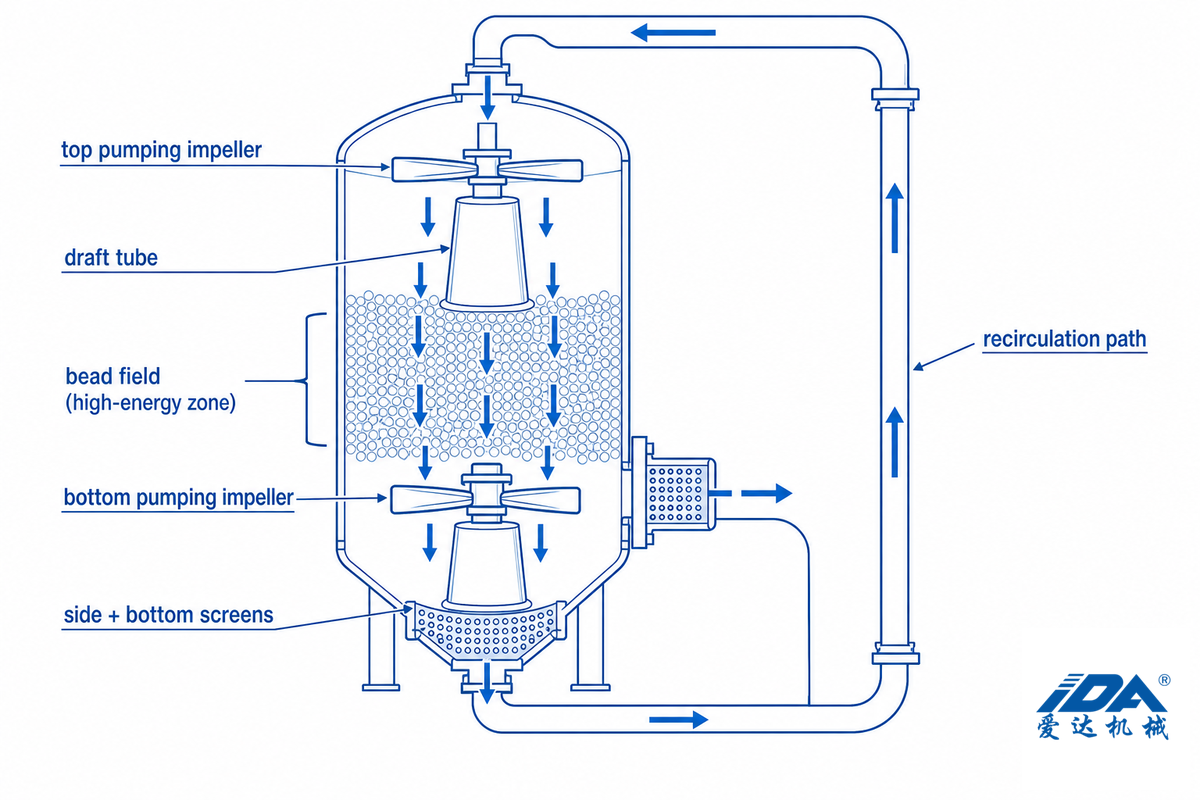
Inside, a basket mill processes material by flowing millbase through a stationary bed of grinding beads resting in a perforated, cylindrical basket. Impellers at the top and bottom of the basket draw the product down through the bead field with help from draft tubes and push it back out through side-and-bottom screens – in what we’re calling a Single-Vessel Recirculation Loop. That same batch circulates through the high-energy bead zone countless times until it reaches the target fineness.
Inside the basket is a rotating hub whose pegs face stationary pegs at the Chamber walls, thereby multiplying the number of shear zones each particle experiences. According to U.S. patent 2009/0212141 A1, which describes the concept, the grinding charge should be grinding beads of 0.1–3 mm in diameter with a built-in retainer so no additional device needs to be inserted to separate them from the product. The specific details – water-cooled submerged basket, top and bottom Pumping impellers to pull and push the product up and out the side and bottom screens, draft tubes, batch sizes range from 750 mL to 5,300 L, and retaining screens with a slot spacing slightly less than that of the smallest beads- are given in a Paint & Coatings Industry article.
📐 Engineering Note
For efficient media recovery and retention, the slot spacing must be slightly less than the smallest beads used. As particle size decreases further and smaller media are used, especially those 0.01 mm in size or less (as patented in US 8,733,677 B1, in which the bearing is isolated from the media), both the slots in the screen and the bearing support are reduced and begin to constrain the rotor design more significantly.
Media-milling energetics are pronounced; media milling drives particles below 5 µm and sharply raises specific surface area -which, in turn, is often what enables a pigment dispersion to reach its ultimate color. But the Single-Vessel Recirculation Loop is noteworthy because it has no external pump or pressurized sealing mechanism; and it’s precisely those omissions that explain how a basket mill can be so fast and easy to clean and change over between products. In short, the basket mill working principle is recirculation through a fixed bed of media: the milling chamber is the basket itself, the mixing shaft drives the rotor and the pumping action, and constant agitation keeps the bead field live.
What Basket Mills Are Used For

basket mills are the primary tool for dispersion and grind duty in many liquid and solids manufacturing applications. Paint and coatings, however, remains the dominant market, which is expected to approach $220 billion by 2025 as tightening restrictions on VOCs drive further innovation and a shift towards water-based formulations.
In other sectors, basket mills are equally effective processing inks, pigment concentrates, agrochemicals, cosmetics, adhesives and sealants, pharmaceuticals suspensions and slurries used in the production of battery electrodes. Whether the job is a basket mill for paint, printing inks, or pigment pastes, the same machine handles everything from thin inks to thick pastes, which is why one basket mill often replaces several dedicated grinders on a line. As dispersing equipment, it carries dispersion and mixing plus dispersion and grinding from premix to extremely fine color, and across these production processes one machine does the work of several, and the wide range of materials one mill can run keeps changeovers cheap.
| Industry | What gets milled | Typical target d50 |
|---|---|---|
| Paints & coatings | TiO₂ and color pigment dispersions | 5–20 µm (to Hegman 7+) |
| Printing inks | Organic pigment concentrates | 1–10 µm |
| Pharmaceutical | API nanosuspensions | <1 µm (fine media) |
| Battery / energy | Cathode/anode electrode slurry | Deagglomeration, low contamination |
| Agrochemicals | Suspension concentrates (SC) | 2–10 µm |
| Cosmetics | Color cosmetics, sunscreen actives | 5–20 µm |
In terms of applicable viscosity, there’s an upper boundary; whereas basket mills can handle a very wide range of viscosity, operating successfully from as low as 500 up to a maximum around 50,000 cP, they can’t process very high-viscosity materials once the slurry starts to stratify. In such cases, often observed as a loss of fluid movement around the basket of the apparatus in some coatings industries, either a three roll mill or a high-speed disperser mixer is best utilized, the latter performing initial wetting-out for later milling with the basket mill. Across these manufacturing processes, the basket mill earns its place on high efficiency and short processing times: one vessel, fewer transfers, faster turnaround.
Choosing Grinding Media for a Basket Mill
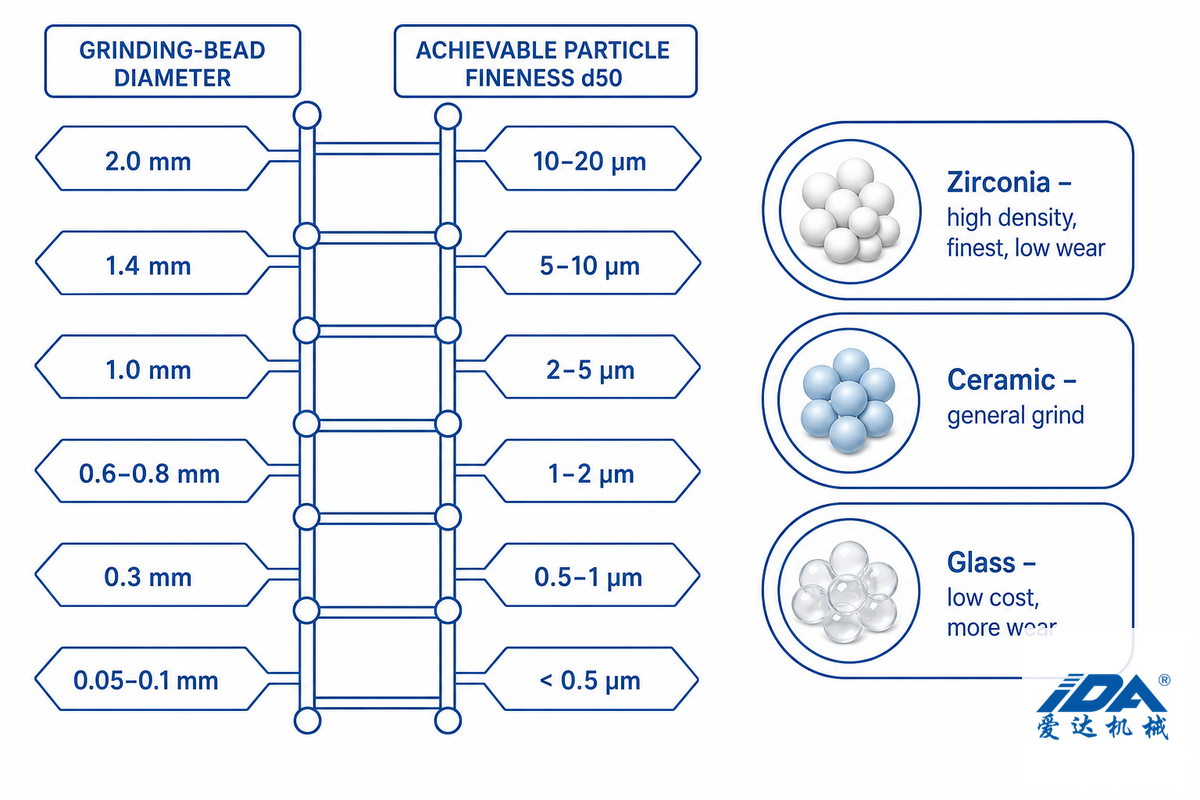
Choosing the correct grinding media is the most important factor for the overall performance of the basket-mill; and that selection often rests upon the most common misperception associated with the machine. People assume that when targeting the finest possible grind size, one should select the smallest available beads. In fact, the optimal bead size is dictated by the particle size to be used in the feed – not by the desired outcome.
“Use the smallest bead possible determined by the feed size, not the desired final size. General rule: feed particle size should be 90% < 10× bead size.”
Grinding-media selection guidance, Coatings Trends & Technologies (via Paint & Coatings Industry)
Mechanically, the trade-off works like this: a bead must be large enough to fracture the largest particles in the feed, yet small enough that the sheer number of beads creates enough contacts for fine grinding down to the final size. Too little beads of too small a size don’t possess sufficient impact energy to chip an agglomerate, and will wear down too fast anyway. But feed size is only one half of the coin – The impact energy the bead exerts on the particles.
The bead’s mass multiplied by the rotor velocity determines how small the bead is able to reach, which is why high-density zirconia grinding balls achieve finer fine particles and a tighter particle size reduction than glass of the same diameter, and why comminution studies treat the lowest achievable size as a function of media energy, not the feed screen size. This relationship between feed size and desired fineness under which the highest impact is gained, we call the basket mill Media-to-Fineness Map:
| Bead Ø | Handles feed up to (90% <) | Practical d50 floor | Best use |
|---|---|---|---|
| 2.0 mm | ~200 µm | 10–20 µm | Coarse premix, fast deagglomeration |
| 1.4 mm | ~140 µm | 5–10 µm | General paint/coating start stage |
| 1.0 mm | ~100 µm | 2–5 µm | Standard pigment dispersion |
| 0.6–0.8 mm | ~70 µm | 1–2 µm | Finish stage, ink/fine color |
| 0.3 mm | ~30 µm | 0.5–1 µm | High-transparency / nano-adjacent |
| 0.05–0.1 mm | ~10 µm | <0.5 µm | Nano pigment, pharma (needs fine screens + bearing protection) |
| Zirconia bead | High density | Finest, lowest wear | Default for fine/sub-micron, low contamination |
| Ceramic / alumina | Medium density | Good general grind | Cost-balanced paint/ink work |
| Glass | Low density | Coarser, more wear | Low-cost, low-demand color |
bead-size / feed relationship: From the coatings media-selection guide lines. Fineness bands cross-checked with data from media-mill. Use floors as estimates.
Verify with your material.
📐 Worked Example — staging media to halve grind time
One coatings-industry milling trial mentioned in PCI found 315 minutes were needed with 1.0–1.4 mm beads to reach 80% < 2 µm; switching to 0.6–0.8 mm beads after the first 90 minutes cut that to 150 minutes for the same feed, roughly a 52% reduction.
Your exact times may differ depending on pigment and mill, but the staged milling principle still holds, that’s coarse initially to remove the bulk of your feeds quickly, then fine to complete the process.
Two additional in-field regulations: keep media near the 30–50% level and powder near the 10–20% mark. overfilling restricts bead motion, which means inefficient grinding, heat, and an uneven, non-uniform particle size. A common mistake on the plant floor is loading a fresh basket to the brim for extra grinding, which only adds longer cycles, more downtime, and lower product quality — and finally, cheaper or harder media aren’t invariably lower wear. Wear implies pollution and gradual grinding across the lifespan of media and so contamination produced (in terms of weight per batch) ought to be measured, instead of price per kg of media. One practical decision rule: if a dispersion still reads grainy on the Hegman gauge, the fix is usually a longer finish stage or a denser zirconia bead, not a jump to micro-media that cannot fracture the remaining coarse particles, which is the mistake that traps most new operators.
Basket Mill vs Bead Mill vs Sand Mill vs Three Roll Mill
Basket mill vs bead mill, which is better?
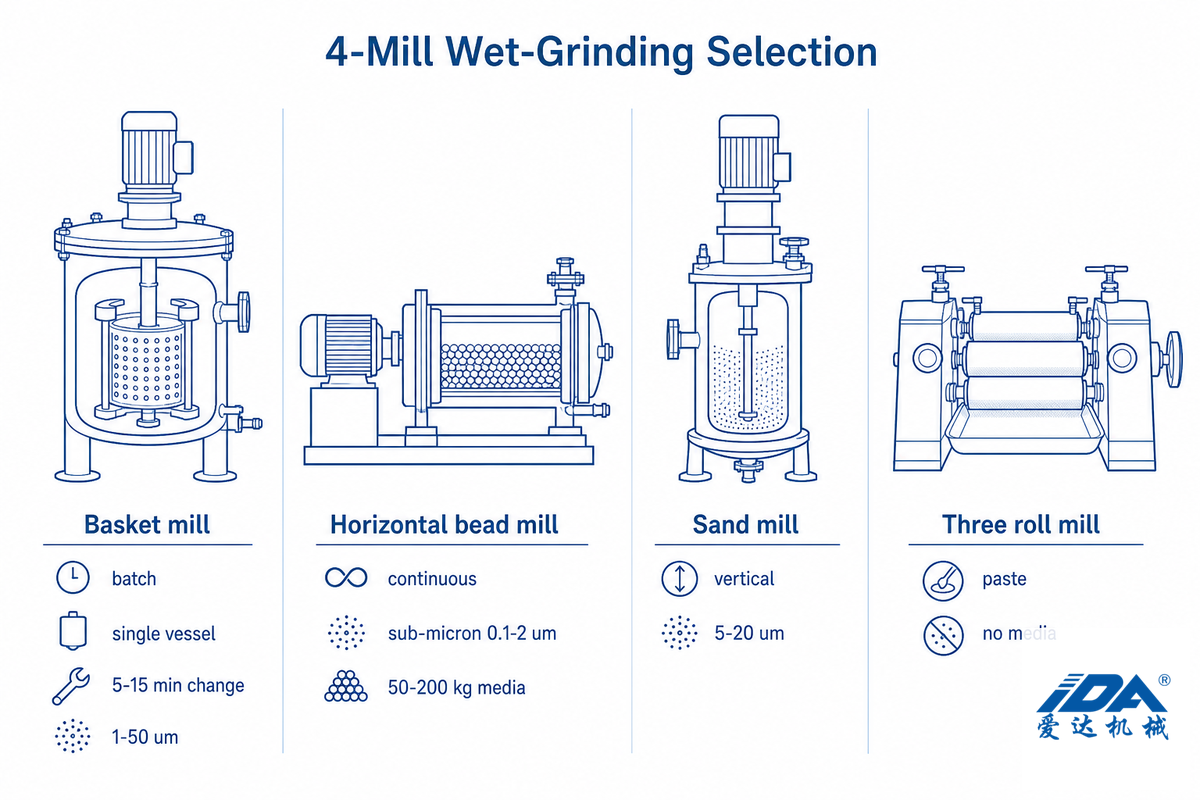
The basket mill and the horizontal bead mill haven’t beaten each other – one wins in one aspect, another in another: the former is a batch, single- vessel mill. It’s ideal in conditions where you’re frequently switching colours or are doing small runs. The latter is a continuous mill.
It’s ideal for large-scale production in which you’re producing sub-micron particles. People who think the basket mill’s just a “small bead mill” make a mistake; changing colour isn’t so inexpensive that it’s possible to simply swap between models of different size – it comes down to run length, not fineness. A dry ball mill – the standard choice for hard solids before- isn’t really even part of this group; since cycle times were too slow and fineness was low, people used this until wet media grinding technology and modern milling technology made machines such as the basket mill possible. Across the common types of milling, these wet methods have displaced older milling methods and dry milling for fine color work, and a modern milling system usually pairs the basket mill with an upstream disperser.
| Spec category | Basket mill | Horizontal bead mill | Sand mill (vertical) | Three roll mill |
|---|---|---|---|---|
| Operation | Batch, one vessel | Continuous, recirculated | Continuous/pass, vertical | Pass, open rolls |
| Fineness (d50) | 1–50 µm (to ~0.5 µm) | 0.1–2 µm (D90 < 100 nm) | 5–20 µm | Fine paste, no media |
| Color/product change | 5–15 min ✔ | 30–60 min | 15–20 min | 15–20 min |
| Media charge | 3–8 kg ✔ | 50–200 kg | Moderate | None |
| Power at equal capacity | Baseline (~30–50% lower) | Higher | Moderate | Low–moderate |
| Material yield | ~100% ✔ | 85–95% | 90–95% | 85–90% |
| Media separation | In-vessel screens | External separator | Top screen | N/A |
| Main failure mode | Stratification at low flow | Hydraulic packing at screen | Seal wear | Roll wear / gap drift |
| Best run size | Small–medium, multi-SKU | Large, single product | Medium | Small, very high viscosity |
| Viscosity ceiling | ~500–50,000 cP | ~50–5,000 cP | High | Very high (paste) |
Comparative values were compiled from manufacturer specification ranges and coatings-industry literature. bead-mill external separation is accounted for by the most recent patents. This fineness information also mixes measurement standards: Hagman fineness for grind (ASTM D1210), D50/D90 via laser diffraction for ISO 13320, and microns per vendor for the rest, so use the table below as a directional guide, not for precise lab-to-lab comparability. Confirm with your own material and suppliers.
One contributing design factor: mill beads increasingly use external, tangential media separators designed to keep the media in the mill during recirculation – an arrangement that’s the subject of an agitator-bead-mill patent (JP 2026511832 A), filed in 2026. A basket mill need not rely on this hardware, since screens ensure the media remain in the basket during processing-hence the speed of basket-cleanout.
Lab, Pilot, and Production Basket Mills

Basket mills share one architecture across scales, from a 0.75 L lab basket mill to production vessels above 5,000 L. Well-tuned, a basket mill is a highly efficient unit with reliable performance from bench to plant. Because the basket geometry and bead field stay proportional, a milling process proven on a lab unit translates to a pilot plant and then to production without re-optimizing from scratch, provided bead size, tip speed, and screen gap are held constant. Modern modular basket mills add automation and ease of operation that raise efficiency and make this scale-up faster still.
| Scale | Typical batch | Purpose |
|---|---|---|
| Lab / bench | ~0.75–5 L | Formulation, media trials, color matching |
| Pilot | 20–200 L | Scale-up validation, small production |
| Production | 500–5,000+ L | Full batches, multi-SKU lines |
By far the cheapest way to de-risk a grinding equipment purchase is to test your actual material before you finalize specifications. IDA Equipment runs a material-testing program at its Jiangyin, China lab: ship your raw material and target specs, and the team mills it across configurations, measures the particle size distribution, and returns a report recommending the model, media, and operating parameters. Buying on catalog numbers alone is the most expensive mistake in grinding equipment, because the final system design, and the product quality it delivers, is set by hardness, abrasiveness, and solids loading as much as by particle size. At production scale, the real sizing constraint is specific energy, the kWh per ton needed to reach your target fineness, more than raw vessel volume: lab energy data showing roughly 21.8 kWh/t at 11.6 µm, rising toward 1,225 kWh/t near 1 µm scales more reliably than a lab batch time.
When to Choose a Basket Mill: The 4-Signal Fit Test
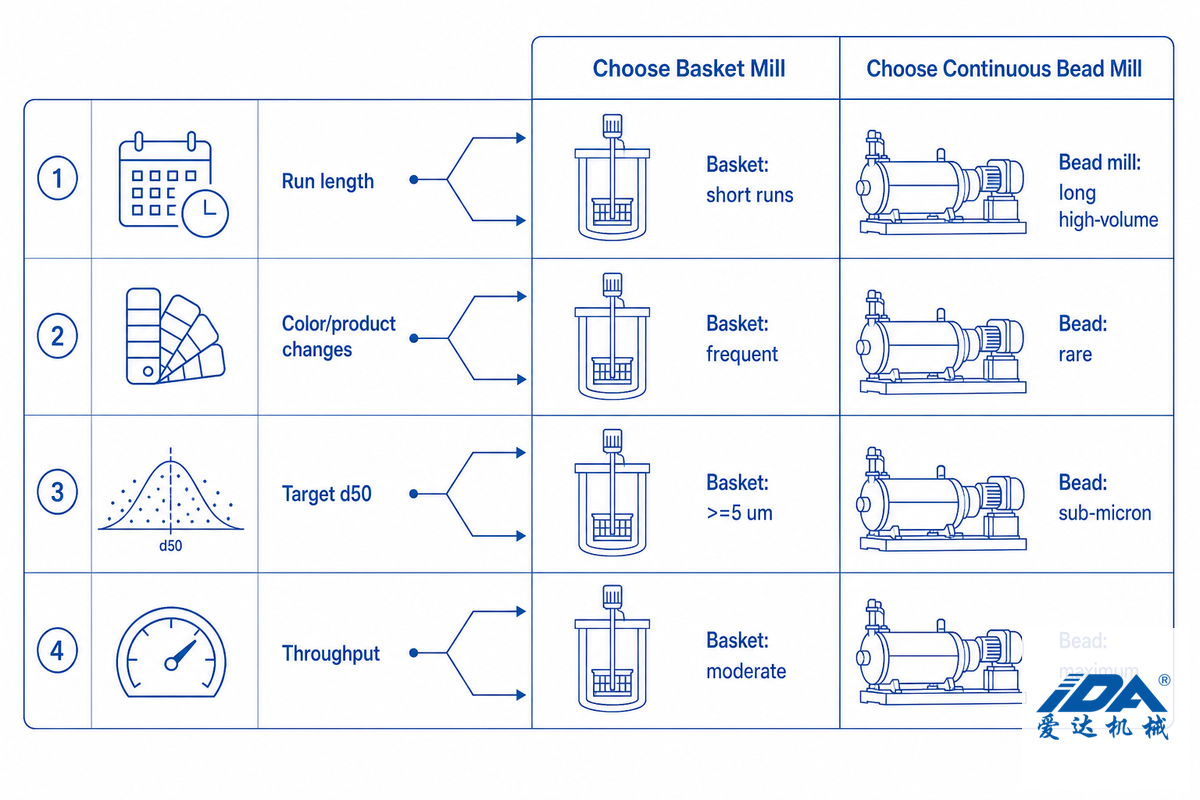
Choose a basket mill when your operation favors short runs, frequent color changes, a target d50 at or above roughly 5 µm, and flexible volume; choose a continuous bead mill when you need steady, high-volume, sub-micron output. Run the 4-Signal Basket-Mill Fit Test below: if most of your answers to these four questions point the same way, your choice is clear.
| Signal | Choose a basket mill if… | Choose a continuous bead mill if… |
|---|---|---|
| 1. Run length | Short / small batches | Long, high-volume runs |
| 2. Color/product changes | Frequent, multi-SKU | Rare, single product |
| 3. Target d50 | ≥ ~5 µm (down to ~0.5 µm with fine media) | Consistent sub-micron / nano |
| 4. Throughput need | Moderate, flexible | Maximum, steady-state |
✔ Basket mill advantages
- 5–15 min changeover; lift-and-rinse cleanout
- ~100% yield, no external pump or hoses to drain
- Small media charge, manufacturers cite ~3–8 kg vs 50–200 kg for a horizontal mill
- One vessel = lower capital and floor space
⚠ Basket mill limitations
- Coarser practical floor than a closed bead mill
- Batch, not continuous, caps top-end throughput
- Stratifies above a few hundred cP without bottom suction
- High-solids or shear-thickening slurries can resist circulation
- Per-batch fineness consistency needs operator control
Changeover is the economic lever: the basket’s easy cleaning and easy to change design is what cuts a multi-product plant’s idle time. Reported field switches to basket mills cut a coatings changeover from four hours to one, trimmed batch time by about 30%, and lowered energy use by roughly 20% on multi-product lines, gains that show up on multi-SKU lines, not single-product runs. Plan downstream too: once pigment is milled to about 1 µm, separating and filtering the fine slurry, not the grinding, becomes the rate-limiting step. On the buying side, a basket mill price is usually lower than a comparable continuous bead mill line, and the shorter production time per color change keeps a multi-product plant moving; for solvent-based coatings, ATEX explosion-proof versions and jacketed cooling systems are options worth specifying. If your four signals point to a basket mill, you can see the IDA basket mill range or request a free material test before you commit.
Where Basket Mill Technology Is Heading

With wet media milling gaining traction across the battery and renewable energy storage industry, specifying a mill that meets the demands of lithium-cathode chemistries (NMC, LFP, LCO) is now the priority. These materials are sensitive to extraneous iron, chromium, nickel, and copper down to parts-per-million amounts, so contamination control becomes the deciding spec.
Wet media milling is also more economical than jet or impact milling below about 1 micron, and 2025 electrochemistry research points to in-situ slurry milling that disperses and deagglomerates cathode particles in one stage. This means when shopping for a basket mill, buyers will need to inquire about media wear rates and contaminants generated as a critical first step – ahead of simply specifying production capacity.
Two other shifts matter. Waterborne and high-solids coating reformulation – prompted by solvent regulation – alters dispersion behavior and encourages machinery that changes over quickly between batches. And media continues to shrink: agitator mills now run beads as fine as 30–300 µm with centrifugal separation, pushing toward the nanoscale roof that basket mills approach with their finest charges, where high-performance media and tighter screens matter most. For perspective only, market trackers believe the more narrow bead-mill range heading into the early 2030s is running at an approximately 5-6% per year growth rate – directional context, not a closing sales rationale.
If you are designing a 2026 line, the measureable concern of the day is specific: call out your verification process early. Present ASTM D1210-05(2022) for Hegman fineness of grind and ISO 13320:2020 for laser-diffraction particle sizing in your acceptance spec so “fine enough” includes a number — the discipline that lets modern technology deliver higher efficiency without guesswork.
Frequently Asked Questions
Q: What is the difference between a basket mill and a bead mill?
View Answer
A basket mill is a batch machine that holds beads in a perforated basket inside one tank, so it changes color in 5–15 minutes and reaches about 1–50 µm. A bead mill is a continuous machine with beads sealed in a closed chamber and an external separator, so it reaches sub-micron (0.1–2 µm) at high volume but needs 30–60 minutes and 50–200 kg of media to change over. Pick the basket mill for short, varied runs; the bead mill for long, single-product, sub-micron runs.
Q: What particle size can a basket mill achieve?
View Answer
A basket mill typically reaches a median particle size of 1–50 µm, and down to about 0.5 µm with fine (0.05–0.3 mm) media, staged milling, and the right screens. Its achievable floor depends on bead size, the feed particle size, and how long you recirculate — not on the rotor alone. For consistent sub-micron output at volume, a continuous bead mill is the better choice.
Q: What grinding media do basket mills use?
View Answer
Basket mills use 0.3–2.0 mm beads for most paint and ink work, and micro-beads down to about 0.05 mm for fine and nano grinding. Zirconia is the default for the finest, lowest-contamination work because of its high density and low wear; ceramic and alumina balance cost and grind quality; glass is a low-cost option for undemanding color. Set bead size by the feed particle size (90% of feed smaller than 10× the bead), not the target.
Q: Can a basket mill be used for nano grinding?
View Answer
Yes, to a point — with micro-media below 0.1 mm, fine retaining screens, and bearing protection, a basket mill can approach the sub-micron range, but a continuous bead mill is more reliable for true nano (D90 below 100 nm) at production volume.
Q: How do you clean a basket mill between batches?
View Answer
You lift the basket out of the tank and rinse it. Because the media, basket, and product all sit in one open vessel with no external pump, hoses, or pressurized seals to drain, a basket mill changes color in 5–15 minutes — versus the 30–60 minutes a closed bead mill needs to flush its recirculation loop. That fast lift-and-rinse cleanout is the basket mill’s main economic advantage on multi-product lines.
Q: Is a basket mill better than a horizontal bead mill for production?
View Answer
It depends on what “production” means for you. If you run many colors or products in small-to-medium batches, a basket mill usually wins on total output because its 5–15 minute changeover and ~100% yield beat a bead mill’s 30–60 minute changeover and 85–95% yield across a shift. But if you run one product at high volume to a sub-micron target, a continuous horizontal bead mill delivers more kilograms per hour at a finer, more consistent particle size. Many plants run both: a bead mill for flagship single-product lines and basket mills for everything else. Deciding factors are run length, changeover frequency, and target fineness — run the 4-Signal Fit Test above before specifying.
About This Guide
IDA Equipment manufactures wet grinding solutions and dispersing machinery – basket mills, sand mills, three roll mills, and dispersers – in its Jiangyin, China facility, and operates a material-testing laboratory where customer formulas are measured and milled before sale. The particle size, media, and changeover figures presented in this guide are sourced from published coatings-industry and research-based sources and our own gear; performance on your material will depend on hardness, solids loading, and end fineness, hence the advised test cut prior to purchasing.
References & Sources
- ISO 13320:2020, Particle size analysis: Laser diffraction methodsInternational Organization for Standardization
- Specific energy of stirred-media milling (kWh/t vs product size)PubMed Central, U.S. National Library of Medicine
- Particle size reduction and media milling reviewUniversity of North Carolina (Carolina Digital Repository)
- Nanoparticle aggregate morphology during wet milling (Powder Technology)University of Minnesota, Hogan Lab
- Effect of grinding media diameter on grinding time (Materials, 2024)MDPI
- In-situ slurry milling of single-crystal NMC cathodes (2025)Journal of The Electrochemical Society (IOP)
- Immersion Milling, construction and operationPaint & Coatings Industry magazine
- Choosing the best media mill (media size vs grind time)Paint & Coatings Industry magazine
- US 8,733,677 B1, Bearing-isolation in a basket media millU.S. Patent (via Google Patents)
- US 2009/0212141 A1, Milling apparatus with facing attrition pegsU.S. Patent (via Google Patents)
Related Articles
- Horizontal sand mill series, continuous wet grinding to sub-micron
- Three roll mill, high-viscosity paste grinding
- High-speed disperser, premix and wetting-out before milling
- Paint production line, dispersion, grinding and filling
- Ink production line, pigment grinding for gravure and flexo inks
- Battery production line, electrode slurry dispersion