Get in Touch with IDA

The Ultimate Guide to Horizontal Sand Mill

Contents
show
The horizontal sand mill has established itself as the precision standard for wet grinding and particle dispersion across high-demand industrial environments. These machines operate continuously at performance levels which no other competing technology can achieve in coatings and paints and pharmaceuticals and cosmetics and ceramics. The foundation for maximizing equipment value through horizontal sand mill operation requires knowledge of its mechanical design and grinding methods and media selection process and maintenance needs. The guide provides complete technical information which experienced professionals and first-time technology users can use to understand all relevant aspects of their work.
Introduction to Horizontal Sand Mills

Definition and Overview
A sand mill serves two primary purposes because it operates as equipment for wet grinding and material dispersion into ultra-fine particle sizes. The process works by introducing small grinding beads — typically made from zirconia, steel, or glass — into a rotating agitator system. The agitator conducts high-speed spinning which enables beads to create powerful shear forces through their collisions with raw material particles that result in size reduction and uniform particle distribution throughout the mixture.
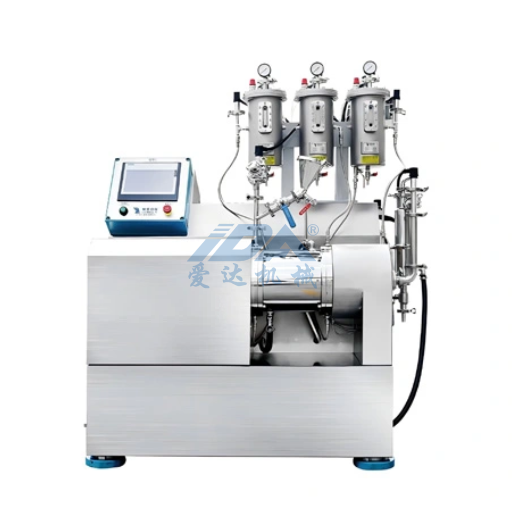
The modern version of this basic technology appears in the horizontal sand mill which designers built to improve both system reliability and production capacity. The horizontal design of the system enables better grinding media movement throughout the entire chamber which results in consistent particle size distribution and allows the system to function continuously at high production levels. The design functions across various industries which include paints and coatings, pharmaceuticals, cosmetics, ceramics, and adhesives because these fields depend on accurate particle distribution and precise control of product texture for their product quality control.
Primary Industries of Application
- ▸Paints & Coatings — Precise pigment dispersion and particle size reduction for consistent color development and stability.
- ▸Pharmaceuticals — Sub-micron particle production for improved bioavailability and drug delivery system performance.
- ▸Cosmetics — Nano-scale refinement of pigments, fillers, and active compounds for texture, skin absorption, and finish quality.
- ▸Ceramics & Adhesives — High-viscosity material processing requiring consistent dispersion without product contamination.
- ▸Renewable Energy — Emerging role in producing advanced nanomaterials for solar panel coatings and wind turbine component manufacturing.
History and Evolution
Horizontal sand mills emerged as a significant advancement in milling technology during the mid-20th century, developed in direct response to the limitations of traditional ball mills and vertical sand mills. Earlier designs produced irregular grinding results and consumed excessive power — inadequacies that became increasingly unacceptable as industrial formulation complexity grew. The horizontal configuration addressed both problems by improving energy distribution and particle size control simultaneously.
The development of material science together with the advancement of fluid dynamics brought about ongoing design enhancements. The initial rotor models evolved into high-speed centrifugal systems which used advanced zirconia beads to achieve better operational durability and precise grinding results. The installation of advanced cooling systems enabled operators to manage heat production during their most demanding work periods which protected sensitive materials from thermal damage that previous systems failed to shield.
The modern horizontal sand mill represents a new stage of development which combines automated process control systems with AI-based monitoring and sensor technology to maintain product quality while decreasing operational downtime. The design enables machines to operate both as pharmaceutical nanoparticle production systems and industrial thick coating manufacturing processes which has made horizontal sand mills essential for present-day industrial operations.
Working Principle of Horizontal Sand Mills

Mechanical Structure and Key Components
Grinding Chamber
The primary vessel where raw materials are introduced and subjected to high shear forces. Chamber geometry directly influences flow dynamics and residence time — both of which affect final particle size distribution and throughput capacity.
Agitator Disc
Constructed from high-performance alloys or ceramics, agitator discs drive precise particle distribution and size reduction throughout the grinding process. Disc geometry and rotational speed are primary variables for controlling shear intensity and energy transfer to the media.
Separation System
Three separation approaches are used across different mill designs: centrifugal separation, dynamic gap separation, and screen-based separation. Each method isolates finely ground materials from particles requiring further processing, enabling continuous operation without manual intervention.
Feeding Mechanism
The system regulates material input into the grinding chamber because it needs to prevent system overload. The operation needs to maintain continuous material flow for production to keep going. The calibration of feed rate measurement directly affects both grinding performance and the steadiness of production results.
Grinding Media: Beads and Material Selection
The grinding media is among the most consequential variables in sand mill performance. Beads produced from zirconia, silica, and ceramic composite materials deliver the impact energy required for effective milling — but the selection of media size, composition, and density determines how energy transfers to suspended particles during grinding, and therefore what grinding efficiency and final product characteristics the system will achieve.
Smaller bead sizes — typically between 0.5 mm and 1.5 mm — possess higher surface area-to-volume ratios which deliver improved particle dispersion through increased shear force contact. For long-term industrial applications requiring durability under intensive operating conditions, high-density yttria-stabilized zirconia beads provide the most reliable protection against equipment wear. The combination of optimized bead media with a well-configured agitator system achieves faster grinding results, lower energy consumption, and minimal product contamination — meeting the precision demands of both pharmaceutical and renewable energy manufacturing sectors.
Dispersion and Grinding Process
The grinding process begins with the introduction of raw material combined with bead media into the milling chamber. High-speed agitation drives the beads to collide forcefully with particles, causing progressive size reduction and complete distribution throughout the carrying medium. Modern AI-driven monitoring systems have substantially improved the reliability and repeatability of dispersion results — enabling manufacturers to achieve the nano-particle sizes required for advanced drug delivery systems, electronic components, and next-generation renewable energy materials with consistent output quality across production runs.
Types of Horizontal Sand Mills

Horizontal Bead Mill vs. Traditional Sand Mill
| Factor | Horizontal Bead Mill | Traditional Sand Mill |
|---|---|---|
| Particle Uniformity | Highly uniform — dynamic separation system eliminates variance | Variable — basic design produces less consistent results |
| Energy Consumption | Lower — optimized rotor and chamber design | Higher — less efficient energy transfer to grinding media |
| Contamination Risk | Minimal — advanced separation and sealed design | Higher — basic operational structure offers less protection |
| Viscous Material Handling | Capable — processes sticky materials without equipment damage | Limited — viscous materials cause operational complications |
| Scale-Up Capability | Advanced — formulas scale directly to large production runs | Constrained — design limits scalability for complex formulations |
| Maintenance Requirements | Lower — advanced components reduce interruption frequency | Higher — basic construction requires more frequent service |
Laboratory Sand Mills
Laboratory sand mills function as miniature grinding systems which execute three functions. The system provides three main functions which include creating efficient grinding results and maintaining exact temperature conditions while processing different material types with specific particle size requirements. Their advanced dispersion mechanisms produce highly reproducible results which scientists use to create small-scale formulations and determine industrial production parameters.
The pharmaceutical industry and paint manufacturing and coating production and nanomaterial research all require laboratory sand mills. The machines enable rapid, efficient grinding and dispersion of pigments, additives, and other components to establish optimal product consistency before committing to full-scale production runs. The laboratory mills become effective tools for developing multiple formulations because their simplified cleaning procedures result in lower inter-batch downtime.
Horizontal Media Mill Comparison
Particle Size Reduction
Horizontal media mills achieve superior size reduction through uniform energy distribution across the full milling chamber. The design serves pharmaceutical companies and nanomaterial producers that require consistent sub-micron level dispersions at production scale.
Energy Efficiency
New-generation models use automated control systems to dynamically manage energy input, delivering maximum grinding performance at minimum consumption. This capability sets horizontal mills apart from older vertical and stirred mill designs that lack adaptive energy management.
Design and Maintenance
The system uses modular chamber construction together with built-in cooling systems to prevent heat damage during intensive operational periods. The system provides accessible loading areas together with operational functions and cleaning options which allow maintenance work to proceed without interrupting production in continuous manufacturing facilities.
Customization and Versatility
Modern horizontal media mills support multiple interchangeable media options that can be matched precisely to the material characteristics of specific formulations — enabling a single mill platform to serve across diverse product lines and changing production requirements.
Applications of Horizontal Sand Mills

Benefits of Using Horizontal Sand Mills

Documented Performance Gains
- ▸Industries implementing modern milling technologies report a 25% increase in product consistency alongside measurable reductions in product defects.
- ▸Production process optimization through advanced dispersion technology decreases raw material waste by up to 20% through real-time process monitoring.
- ▸Businesses adopting advanced milling solutions achieve 30–40% reductions in production cycle times, enabling faster product availability to market.
Grinding Efficiency
The grinding efficiency of the system operates at maximum capacity because its high-energy shear forces use optimized milling chambers to generate particle sizes that remain constant while using less energy and completing work tasks at faster speeds which results in increased production capabilities that maintain product quality.
Product Quality
The final product achieves better durability and improved functionality and enhanced aesthetic performance because milled material distributes evenly throughout the product. The manufacturers can produce their desired product characteristics through precise control of particle size which they will maintain across all production batches.
Cost and Time Savings
The three factors of reduced material waste and shorter cycle times and lower maintenance frequency bring direct benefits that enhance operational economics for businesses. Companies that adopt advanced milling technologies experience significant improvements in both their financial results and their customer satisfaction scores.
Frequently Asked Questions
Reference Sources
- ▸Scientific and Methodological Support of Sand Management During Operation of Horizontal Wells Examines mathematical modeling and physical methods for sand management within horizontal operational systems.
- ▸Performance Comparison of Vertical and Horizontal Oriented Stirred Mills Provides a systematic comparison of efficiency and performance characteristics across horizontal and vertical milling configurations.
- ▸A Review of Research Status and Development Prospects for Gravel Packing Sand Control in Horizontal Wells Reviews advancements and emerging directions in sand control technologies for horizontal processing systems.