Get in Touch with IDA

Putting gum in water produces two opposite physical outcomes based on polymer chemistry. Commercial chewing gum contains a hydrophobic synthetic plastic and elastomer gum base with zero aqueous solubility (0 g/100 g in water). Cold water at 4–10 °C cools its formulated elastomer, resin, wax matrix and makes the chewed mass firmer, though blends that remain flexible at those temperatures don’t turn brittle. Conversely, water-soluble hydrocolloid gums include xanthan gum, guar gum, gum arabic, and cellulose gum. These hydrophilic polymers bind water molecules to increase the viscosity of an aqueous batch. At ~1.0% w/w and 25 °C on a Brookfield rotational viscometer (20–60 rpm in water), guar gum reaches 2,000–7,500 mPa·s. By contrast, gum arabic produces much lower viscosity (5–15 mPa·s at ~1% w/w), and xanthan reaches 1,200–1,600 mPa·s at 60 rpm in ~1% KCl. Dumping fine gum powder directly into water creates rubbery “fish-eye” lumps. Particles can be separated using a 1:3 glycerin slurry, a 1:5 gum-to-sugar dry blend, or high-shear mixing at 15–25 m/s. The method table lists hydration cycles of 5–10 minutes for pre-slurry and inline induction, and 10–15 minutes for dry premixing and sawtooth vortex feeding.
Key Engineering Takeaways for Formulators & Process Engineers
- In polymer chemistry, two distinct polymer classes govern water behavior. Chewing gum bases use hydrophobic polyisobutylene and polyvinyl acetate plastics that repel water. Hydrocolloid gums are hydrophilic polysaccharide chains that hydrate and swell in an aqueous phase.
- Across standard grades, viscosity at ~1.0% w/w (25 °C) depends on the test medium, viscometer spindle, and shear rate. The xanthan range of 1,200–1,600 mPa·s refers to FCC testing in ~1% KCl at 60 rpm. It doesn’t provide a like-for-like comparison with guar gum (2,000–7,500 mPa·s) or sodium CMC (500–3,000 mPa·s) in water. Gum arabic dissolves up to 30%–50% w/w while staying below 100–300 mPa·s at 30% w/w.
- During powder wetting, the 3-Stage Wetting-to-Shear Hydration Window requires separating dry grains before surface solvation forms a hydrogel skin. Food Processing notes that unhydrated fish-eyes retained on downstream filters can lead operators using conventional agitators to add ~10%–20% extra gum.
- For large-scale industrial production, matching the equipment viscosity also depends on the apparent viscosity at the operating shear rate, yield stress, impeller geometry, shaft speed and torque. In yield-stress gum solutions, an axial agitator can leave stagnant regions where the applied stress can’t sustain bulk flow. Engineers therefore match rotor-stator, sawtooth or vacuum planetary mixers to actual circulation demands.
Why Does Chewing Gum Harden in Water While Hydrocolloid Gums Hydrate and Thicken?

Chewing gum gets firmer in cold water because cooling reduces molecular mobility of the water-insoluble elastomer, resin, and wax matrix of gum base. Neat polyvinyl acetate (PVAc) has a glass transition near 28–30 °C. Even so, the stiffness of a commercial gum base in 4–10 °C water reflects the combined viscoelastic blend rather than pure PVAc alone. Hydrocolloid gums instead carry abundant hydrophilic hydroxyl (, OH) groups, and anionic gums also carry carboxylate (, COO−) groups while guar is non-ionic. The polar groups form hydrogen bonds with water molecules and thus uncoil and align in a linear fashion to bring about viscosity.
The Hydrophobic Elastomer and Synthetic Plastic Physics of Chewed Gum in Cold Water
Does chewing gum contain plastic? Yes, as documented in the Science in School chewing gum chemistry study, commercial chewing gum splits into two distinct phases. Roughly 60%–75% of a fresh stick consists of water-soluble sweeteners, polyols, and flavorings distributed through the gum interior and any outer coating. Under this two-phase breakdown, the remaining ~25%–40% is the insoluble gum base. This base blends food-grade synthetic plastics and rubbers: polyisobutylene elastomer, polyvinyl acetate (PVAc) thermoplastic resin, rosin esters, and microcrystalline wax.
Water soluble sugars and polyols are components of gum that, when in contact with water, dissolve and leave the gum base. Gum base is made up of an elastomer, resins, and waxes (or similar components). At human mouth temperature (37 °C), warmth and lipid softeners keep the elastomer, resin, wax matrix pliable. For reference, neat PVAc has a glass transition near 28–30 °C and neat polyisobutylene near −74 °C (199 K). In 4–10 °C water, cooling reduces molecular mobility and makes the formulated gum base firmer. Blends that remain flexible at these temperatures do not necessarily become brittle or snap cleanly off fabric.
How Hydrophilic Polysaccharide Chains Uncoil and Entangle
Industrial hydrocolloids hydrate in water as polar groups form hydrogen bonds with water molecules. This causes polymer chains to uncoil and entangle. According to Saha and Bhattacharya (2010) in PMC3551143 , neutral galactomannans like guar gum and locust bean gum depend on numerous hydroxyl (, OH) groups. A similar case is with anionic hydrocolloids like xanthan gum and sodium CMC where the polymeric chains carry negatively charged carboxylate (, COO−) groups. When a hydrocolloid gum dissolves or disperses in an aqueous solvent, water molecules start to penetrate the amorphous regions of the polymer network.
Above a critical overlap concentration (C* ≈ 4/[η], where [η] is intrinsic viscosity), the uncoiled polysaccharide chains collide and entangle. As a result, liquid movement is obstructed and an increase in apparent viscosity is observed. Xanthan gum is a polysaccharide produced by the bacterium Xanthomonas campestris in an extracellular biofilm. It’s composed of a cellulosic β-1,4-linked glucose backbone with charged trisaccharide side chains that together form a pentasaccharide repeating unit. At commonly 0.5% to 1.0% (w/w) in water, those extended rods create a weak gel network with a yield stress in the range of 2 to 15 Pa.
| Property / Parameter | Chewing Gum Base (Synthetic Elastomer / Plastic Resin) | Hydrocolloid Gums (Xanthan, Guar, Arabic, CMC) |
|---|---|---|
| Primary Polymer Backbone | Synthetic plastics and rubbers: polyisobutylene, polyvinyl acetate (PVAc), rosin esters, microcrystalline wax | High-molecular-weight polysaccharides (200,000 to 5,000,000 Da) with abundant –OH groups; xanthan, gum arabic, and sodium CMC also carry ionizable carboxyl (–COO−) groups, while guar is non-ionic |
| Affinity for Water Molecules | Strictly hydrophobic (non-polar hydrocarbon chains repel water) | Strongly hydrophilic (rapid hydrogen-bonding solvation in water) |
| Typical Working Concentration at 25 °C | Insoluble elastomer base (0 g/100 g water; only sugars/polyols in the interior and coating dissolve) | ~0.1% to ~1.5% w/w (viscosity-limited xanthan/guar systems) up to 30%–50% w/w (gum arabic solutions) |
| Effect of Cold Water (4–10 °C) | Cooling reduces molecular mobility across the elastomer–resin–wax matrix, making the chewed mass firmer | Xanthan, guar, gum arabic, and suitable CMC grades hydrate in cold water |
| Effect of Hot Water (80–95 °C) | Softens into a tacky, stretchy mass; polymer base remains insoluble | Lowers fluid viscosity and dissolves thermally activated locust bean gum, agar, and kappa-carrageenan |
Water-Soluble Gums Compared: Solubility, Temperature Limits, and Viscosity of Xanthan, Guar, Gum Arabic, and CMC

Not all water-soluble gums build the same thickness in water, and apparent viscosity depends on polymer grade, concentration, temperature, viscometer spindle, and rpm. At ~1.0% w/w and 25 °C in water (Brookfield LV at 20–60 rpm), guar gum reaches 2,000–7,500 mPa·s and sodium CMC spans roughly 500–3,000 mPa·s across molecular-weight grades. The xanthan range of 1,200–1,600 mPa·s reported here refers to testing in ~1% KCl at 60 rpm. It doesn’t provide a like-for-like comparison with the guar and CMC values in water. Gum arabic dissolves up to 30%–50% w/w in cold water and stays at 5–15 mPa·s at ~1% w/w (below 100–300 mPa·s at 30% w/w). Locust bean gum requires heating to 80–95 °C for full hydration.
Cold-Water vs. Hot-Water Hydration Profiles Across Popular Gums
For thickening or emulsion stabilization, xanthan gum, guar gum, gum arabic, and sodium CMC are soluble in water at ambient temperature (15–25 °C). Locust bean gum instead requires heating to 80–95 °C for full hydration. As verified in Mudgil et al. (PMC2212352), native 1% w/v guar gum in water commonly develops 2,000 to 3,000 mPa·s in standard food grades. High-molecular-weight industrial grades reach 6,000 to 7,500 mPa·s (PMC3551143). When a recipe needs a soluble fiber ingredient without high viscosity, enzymatic cleavage produces partially hydrolyzed guar gum (PHGG). That modification drops a typical 5% w/w aqueous solution to ~10 mPa·s.
Under US FDA 21 CFR Part 172 and the Food Chemicals Codex (FCC 7th Edition), xanthan gum (21 CFR 172.695) follows a standard benchmark test. It is measured at 1.0% w/w in a 1% potassium chloride (KCl) solution at 25 °C on a Brookfield viscometer at 60 rpm. Because xanthan, guar, and sodium CMC solutions are strongly shear-thinning, every certificate of analysis must state the temperature, spindle, and shear rate or rpm. Consider an illustrative 0.5% w/w guar gum dispersion measured at 25 °C. Depending on grade molecular weight, it can read ~500 mPa·s at 10 s−1, ~300 mPa·s at 30 s−1, and ~150 mPa·s at 100 s−1.
What Is Gum Arabic and How Does It Behave in Water Compared to Xanthan Gum?
Gum arabic (acacia gum, E414) is regulated under US FDA 21 CFR 172.780. It is a dried gummy exudate harvested from the stems and branches of Acacia senegal and Acacia seyal trees. Unlike linear thickeners, gum arabic is a highly branched, globular arabinogalactan-protein complex. According to Saha and Bhattacharya (PMC3551143), this compact globular structure lets gum arabic dissolve in cold water (20–25 °C) up to 30%–50% w/w. Even at commonly 30% w/w in water, it stays below 100–300 mPa·s. It shows shear-thinning flow below 10 s−1 and a near-Newtonian plateau above 100 s−1.
In contrast, xanthan gum, guar gum, and sodium CMC uncoil into extended chains that build high viscosity at ~0.5%–1.0% w/w. Above around ~1.5% w/w, they form heavy, non-pourable gels. Across temperature changes, gum arabic, xanthan gum, guar gum, and sodium CMC all hydrate fully in cold water at 15–25 °C without heating. Locust bean gum instead requires 80–95 °C heating to dissolve. While guar gum and sodium CMC lose apparent viscosity reversibly as temperature rises, xanthan gum maintains a stable viscosity profile across ambient and warm temperatures.
| Hydrocolloid Gum Type & Category | Cold Water (20–25 °C) Behavior | Required Heating Temp | Typical Viscosity at 25 °C (mPa·s, Brookfield LV) | Rheology, Shear & Stability Profile |
|---|---|---|---|---|
| Xanthan Gum (E415 — Microbial Polysaccharide) | Fully hydrates; typical working ceiling ~1.5% w/w | None (ambient 15–25 °C) | 1,200–1,600 mPa·s (at commonly 1.0% w/w, 60 rpm in 1% KCl) | Yield stress (2–15 Pa); strong shear-thinning; stable pH 2–12 |
| Guar Gum (E412 — Seed Galactomannan) | Fully hydrates; 200-mesh can reach ~85%–90% viscosity in 3–5 min | None (ambient 20–25 °C) | 2,000–3,000 mPa·s (standard) to 6,000–7,500 mPa·s (high-MW, 20–60 rpm) | Non-ionic; shear-thinning across 10–100 s−1; optimal pH 5–8 |
| Partially Hydrolyzed Guar Gum (PHGG — Fiber) | Dissolves rapidly into clear, low-viscosity aqueous solution | None (ambient 20–25 °C) | ~10 mPa·s even at commonly 5% w/w in water (PMC2212352) | Enzymatically cleaved chains; used for soluble fiber fortification |
| Gum Arabic / Acacia (E414 — Tree Exudate) | Dissolves up to 30%–50% w/w true colloidal solution | None (ambient 20–25 °C) | Below 100–300 mPa·s at commonly 30% w/w in water (PMC3551143) | Globular complex; shear-thinning <10 s−1, Newtonian >100 s−1 |
| Sodium CMC / Cellulose Gum (E466 — Derivative) | Fully soluble (DS 0.7–1.5); forms clear aqueous solution | None (ambient 20–25 °C) | Commonly 500–3,000 mPa·s at ~1.0% w/w (20–60 rpm, grade MW) | Anionic linear polymer; sensitive to divalent cations and pH <4.0 |
| Locust Bean Gum / LBG (E410 — Carob Seed) | Partially swells (~20%–30% hydration in cold water) | 80–95 °C for 10–15 min | 3,000–3,500 mPa·s at commonly 1.0% w/w after heating and cooling | Non-ionic galactomannan; forms thermally reversible gels with xanthan (50:50) |
| Gum Tragacanth (E413 — Astragalus Sap) | Tragacanth swells in cold water (unlike agar and kappa-carrageenan below, which require 75–90 °C heat) | None for tragacanth (75–90 °C for agar and carrageenan) | Up to 4,000 mPa·s at ~1.0% w/w tragacanth (PMC3551143); firm gel on cooling for agar/carrageenan | Tragacanth is acid-stable down to pH 2.5; kappa-carrageenan gels with potassium (K+) and calcium (Ca2+) ions |
| Kappa-Carrageenan (E407 — Red Seaweed) | Swells in cold water; requires heat to dissolve fully | 75–90 °C | Forms firm thermo-reversible hydrogel upon cooling (around ~0.5%–1.5% w/w) | Anionic sulfated galactan; cross-links strongly with K+ and Ca2+ ions |
| Agar-Agar (E406 — Red Algae Hydrocolloid) | Insoluble in cold water; disperses as suspension | 85–95 °C | Forms rigid brittle gel on cooling to 32–40 °C (around ~0.5%–1.5% w/w) | High thermal hysteresis between 85–95 °C melting and 32–40 °C setting |
Why Gum Forms Lumps (“Fish Eyes”) When Added to Water: The 3-Stage Wetting-to-Shear Hydration Window
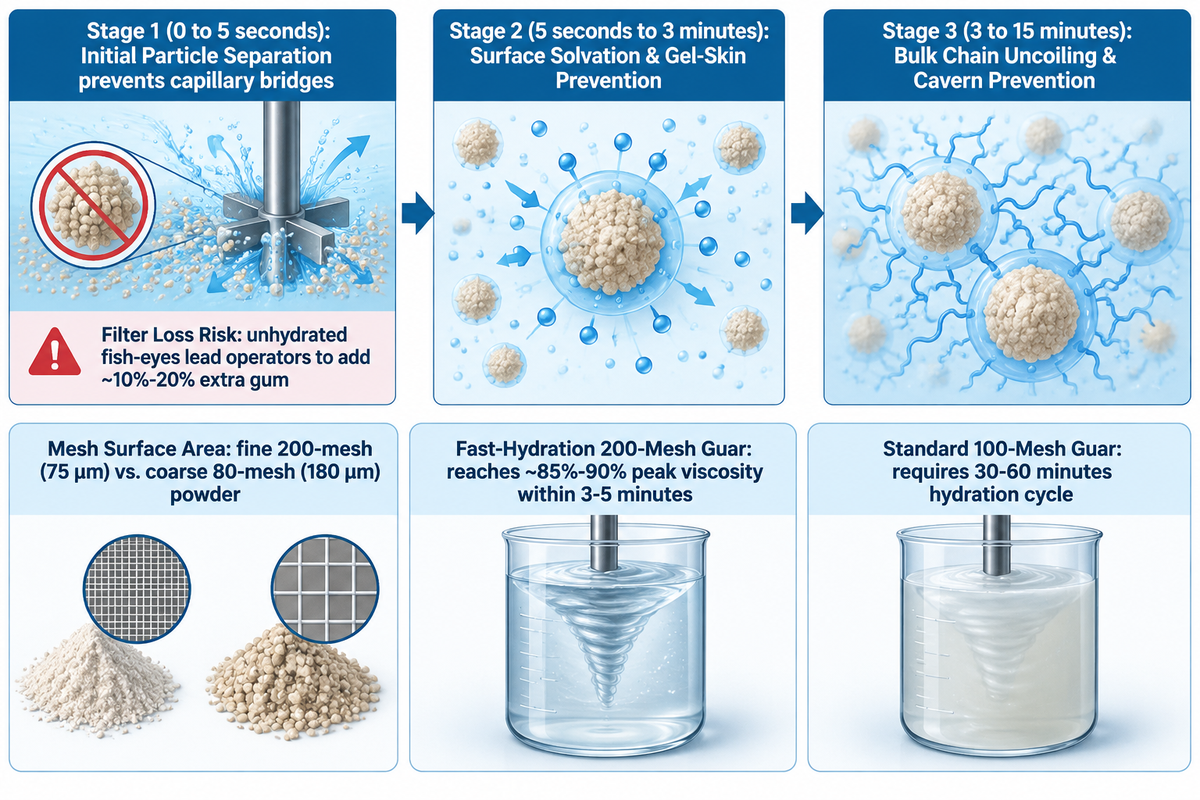
Hydrocolloid gum forms lumps when added rapidly to water because outer particles wet within seconds and fuse into a tough hydrogel skin. Once this gelatinous envelope seals the clump, water can only penetrate the dry interior by the slow process of molecular diffusion. Food Processing reports unhydrated fish-eyes retained by downstream filters can lead formulators using conventional agitators to add ~10%-20% extra gum. Actual filtration loss depends on batch conditions and wetting efficiency.
The 3-Stage Wetting-to-Shear Hydration Window
Why do popular gums form lumps when added to a liquid batch? In industrial wet processing, we represent the dissolving process through the 3-Stage Wetting-to-Shear Hydration Window (noting that the three processes of wetting, dispersion and viscosity build overlap across powder grades):
- During Stage 1: Initial Particle Separation (typically the first 0 to 5 seconds), dry powdered gum particles must be separated before or as they enter the liquid. Powder that hits a stagnant liquid surface forms capillary bridges and locks neighboring grains together.
- During Stage 2: Surface Solvation & Gel-Skin Prevention (typically 5 seconds to 3 minutes), water wets each separated grain and causes its outer polymer layer to swell. As noted in the Ingredion hydrocolloid dispersion technical guide, colliding swollen grains weld together when shear is too low.
- Stage 3: Bulk Chain Uncoiling & Cavern Prevention (typically 3 to 15 minutes) is when all the particles are fully dispersed and the polymer chains uncoil sharply into a viscous solution. As documented in the Silverson xanthan gum hydration report, a high-viscosity pseudoplastic solution with yield stress can stall bulk flow away from a simple paddle.
Why Fine 200-Mesh Powder Lumps Faster Than Coarse 80-Mesh Grades
The fine 200-mesh (75 μm) powder has more than double the specific surface area of the coarse 80-mesh (180 μm) powder. As a result, the 200-mesh powder quickly forms a skin and a gel around itself due to the rapid surface hydration. According to Altrafine’s guar gum hydration benchmark data and guar gum rheology references, coarse-mesh guar gums commonly develop viscosity more slowly than fine powders once dispersed.
Altrafine reports that fast-hydration 200-mesh guar gum reaches ~85%–90% of its peak viscosity within 3-5 minutes in cold water. Standard 100-mesh grades can require 30–60 minutes, depending on gum grade, concentration, temperature, and formulation. However, if an operator dumps a 25 kg bag of 200-mesh powder into a low-shear agitator, it forms an impermeable hydrogel crust almost immediately. Coarse 80-mesh or agglomerated granules allow water to wick through larger inter-particle pores before the pore walls swell shut.
4 Proven Methods to Dissolve Xanthan Gum and Guar Gum in Water Without Clumping
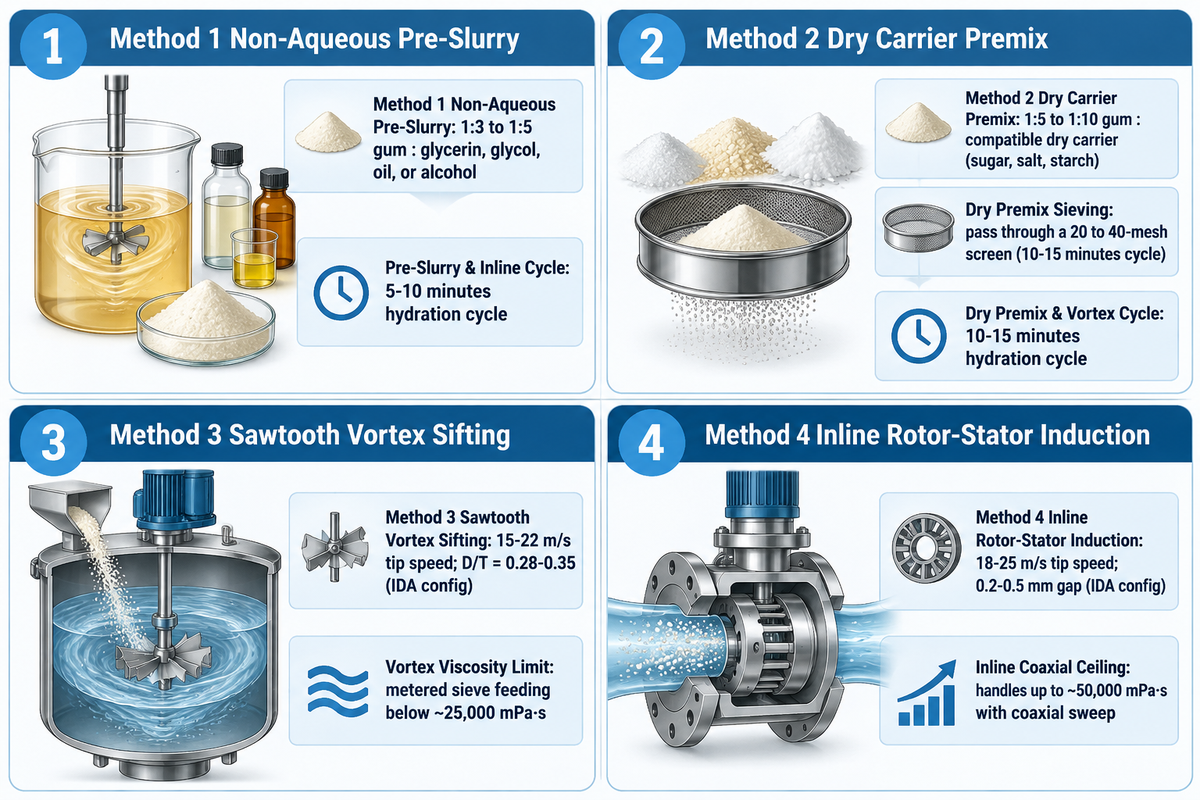
In order to prevent the surface of dry particles from swelling, shear the particles apart using one of the methods described in our 4-Route Hydrocolloid Dispersion Selector. In our 4-Route Hydrocolloid Dispersion Selector , Route 1 pre-slurries 1 part gum in 3–5 parts non-aqueous liquid (5–10 minutes). Route 2 dry-blends 1 part gum with 5-10 parts of a compatible dry carrier (10-15 minutes). Route 3 sifts powder into a 15-22 m/s vortex (10-15 minutes) and Route 4 uses an in-line 18-25 m/s rotor-stator eductor (5-10 minutes).
Method 1: Non-Aqueous Liquid Pre-Slurry (Glycerin, Propylene Glycol, Oil, or Alcohol)
Stirring powdered gum into vegetable oil, food-grade glycerin, propylene glycol, or alcohol at a 1:3 to 1:5 gum-to-carrier weight ratio physically separates the grains. To dissolve xanthan gum in water or dissolve guar gum without clumping, separate the dry particles before their surfaces swell. Dispersing the slurry in the water phase using an agitator, allows the isolated particles to absorb the surrounding water, without clumping. Once the slurry pours into the agitated water phase, water wets each isolated particle without clumping; Table 3 lists a 5–10 minute hydration cycle for pre-slurry dispersion.
Method 2: Dry Carrier Powder Blending (Sugar, Salt, Maltodextrin, or Starch Spacers)
When your formulation can’t tolerate oil or glycerin, dry-blend the gum with a compatible particulate carrier at a 1:5 to 1:10 gum-to-carrier weight ratio (Ingredion). Soluble carriers include granulated sugar, maltodextrin, or sodium chloride, while native tapioca flour can serve as a non-soluble starch spacer in recipes that accept starch solids. Refer to Mt. Royal’s sauce and dressing stabilizer guide and formulator troubleshooting discussions for more information on sieving the dry premix through a 20 to 40-mesh screen to break up lumps. This is done prior to wetting the mix.
How Do You Dissolve Xanthan Gum in Water Without Glycerin or Oil?
To dissolve xanthan gum in water without glycerin, oil, or dry sugar carriers, apply mechanical shear for a uniform dispersion. Use Method 3 (Controlled-Rate Vortex Sifting) or Method 4 (Inline High-Shear Powder Induction). In IDA Equipment batch setups, a hydraulic sawtooth high-speed disperser runs at a peripheral tip speed of 15–22 m/s (D/T = 0.28–0.35) to pull a clean surface vortex. Sift the dry xanthan powder at a controlled rate onto the upper wall of the spinning vortex under vigorous agitation. Never dump powder onto the flat outer liquid surface or shaft.
How Can You Mix Guar Gum with Water Without Forming Clumps?
You can mix guar gum with water without forming clumps by pre-slurrying 1 part guar gum with 3–5 parts oil or glycerin. Dry-blending is also an option. Alternatively, you can dry-blend 1 part guar gum with 5-10 parts dry carrier powder, or induct the powder through an inline high-shear mixer (Method 4). For industrial batches, choose between sawtooth vortex feeding and inline induction based on feed rate, viscosity development, and cycle time. Batch volume alone doesn’t dictate this choice. An inline rotor-stator workhead with a tip speed of 18-25 m/s and a gap of 0.2-0.5 mm is partnered with a vacuum-based Venturi hopper to create a suction to draw dry guar powder into the high-shear zone. This is used along with a Food Processing plant in conjunction with a system that uses a principle known as Flodyn. Table 3 lists a 5–10 minute hydration cycle for inline induction while avoiding bead-mill attrition or prolonged cavitation on shear-sensitive guar and high-MW CMC chains. This is given in Table 3.
| Dispersion Method | Carrier / Shear Parameter | Typical Application Scale | Typical Hydration Cycle | Primary Constraint / Best Fit |
|---|---|---|---|---|
| 1. Non-Aqueous Pre-Slurry | 1:3 to 1:5 gum : glycerin, glycol, oil, or alcohol | Lab jar to pilot/batch vessels | 5–10 minutes | Ideal for cosmetic serums and dressings whose recipes already include glycerin or oil |
| 2. Dry Carrier Premix | 1:5 to 1:10 gum : compatible dry carrier (sugar, salt, starch) | Lab to batch food/beverage tanks | 10–15 minutes | Works in low-shear tanks; carrier selection must match formulation sugar and solids limits |
| 3. Sawtooth Vortex Sifting | Carrier-free; 15–22 m/s tip speed; D/T = 0.28–0.35 (IDA config) | Medium-viscosity batch vessels | 10–15 minutes | Requires metered sieve feeding while batch viscosity remains below ~25,000 mPa·s |
| 4. Inline Rotor-Stator Induction | Carrier-free; 18–25 m/s tip speed; 0.2–0.5 mm gap (IDA config) | Recirculation loops & high-rate lines | 5–10 minutes | Handles up to ~50,000 mPa·s with coaxial sweep; reduces filter bag gum waste |
Gum-to-Water Ratio and Viscosity Chart: Typical 0.1% Beverage Stabilization to 1.5% Heavy Gels

A small shift in the gum-to-water ratio changes apparent viscosity exponentially once the polymer exceeds its critical overlap concentration. At ~0.1%–0.2% w/w in water, xanthan gum builds 30–180 mPa·s and guar gum builds 20–120 mPa·s for beverage suspension. At ~0.5% w/w, viscosity rises to 250–1,500 mPa·s for dressings and serums. At ~1.5%–2.0% w/w, the table lists 2,500–4,500 mPa·s for xanthan and 10,000–25,000+ mPa·s for guar. Select mixing equipment from the actual viscosity and circulation requirements rather than concentration alone.
Concentration-to-Viscosity Dosing Table & Co-Thickening Gum Blends
When formulators use guar gum and xanthan gum together in low-salt water at neutral pH, their polymer chains cross-link reversibly. Smooth galactomannan regions of guar gum interact with the ordered helical regions of xanthan gum. As reported in PMC3551143 (Sworn 2000), the co-thickening interaction reaches its peak at an approximately 80:20 guar-to-xanthan weight ratio at 25 °C, more than doubling the apparent viscosity. In the same manner, locust bean gum and xanthan gum form thermally reversible elastic gels near a 50:50 to 40:60 ratio after heating to 80-95 °C. Salt levels and galactomannan substitution affect these ratios.
| Concentration (% w/w of final mixture) | Gum Mass (g per kg of final mixture) | Xanthan Gum Viscosity (mPa·s) | Guar Gum Viscosity (mPa·s) | Typical Industrial Application |
|---|---|---|---|---|
| Around ~0.10% w/w | 1.0 g/kg (1.0 kg / 1,000 kg) | 30–80 mPa·s | 20–50 mPa·s | Fruit beverages and light pulp mouthfeel stabilization |
| Around ~0.15%–0.20% w/w | 1.5–2.0 g/kg (1.5–2.0 kg / 1,000 kg) | 80–180 mPa·s | 50–120 mPa·s | Agrochemical suspension concentrates (post-milling addition) |
| Around ~0.30% w/w | 3.0 g/kg (3.0 kg / 1,000 kg) | 250–450 mPa·s | 300–600 mPa·s | Pourable salad dressings, syrups, and agrochemical SC |
| Around ~0.50% w/w | 5.0 g/kg (5.0 kg / 1,000 kg) | 500–800 mPa·s | 600–1,500 mPa·s | Culinary sauces, cosmetic lotions, and liquid detergent modifiers |
| Around ~0.80% w/w | 8.0 g/kg (8.0 kg / 1,000 kg) | 900–1,200 mPa·s | 1,500–2,200 mPa·s | Personal care serums and water-based latex coating thickeners |
| Around ~1.00% w/w | 10.0 g/kg (10.0 kg / 1,000 kg) | 1,200–1,600 mPa·s (in 1% KCl, 60 rpm) | 2,000–7,500 mPa·s | Standard FCC / USP viscometry benchmark and cosmetic hydrogels |
| Around ~1.50% w/w | 15.0 g/kg (15.0 kg / 1,000 kg) | 2,500–4,500 mPa·s | 10,000–25,000+ mPa·s | Concentrated pre-hydrated mother liquors, heavy sauces, and printing pastes |
| Around ~5.0% w/w (PHGG) | 50.0 g/kg (50.0 kg / 1,000 kg) | Non-pourable viscoelastic paste | ~10 mPa·s (enzymatically cleaved PHGG) | Low-viscosity soluble dietary fiber beverages (PMC2212352) |
| Around ~30% w/w (Gum Arabic) | 300.0 g/kg (300.0 kg / 1,000 kg) | Exceeds aqueous dispersion limit | Below 100–300 mPa·s (Gum Arabic E414) | Beverage flavor oil emulsions and spray-dried encapsulation (PMC3551143) |
Worked Engineering Calculation: 1,000 kg Batch at Commonly 0.50% w/w Xanthan Gum in 25 °C Water
Suppose a process engineer models a 1,000 kg aqueous batch (approximately 1,000 L total volume) at commonly 0.50% w/w xanthan gum in 25 °C water:
- Mass Balance: Xanthan gum mass = 1,000 kg × 0.005 = 5.0 kg; Reverse-osmosis water mass = 1,000 kg − 5.0 kg = 995.0 kg.
- For impeller and tank geometry in a tank of diameter T = 1.00 m, select a sawtooth blade of diameter D = 0.30 m. This gives D/T = 0.30, which is in the 0.28-0.35 IDA design window.
- For shaft speed and tip speed run the shaft at N = 1,200 rpm (20 s^−1^). This produces a peripheral tip speed of v = π × 0.30 m × 20 s −1 = 18.85 m/s, inside the 15–22 m/s dispersion zone.
- For the feed rate and hydration cycle, sift the 5.0 kg of xanthan gum into the vortex wall over 75–90 seconds (3.3–4.0 kg/min). Maintain agitation for 10–15 minutes to reach ~600–800 mPa·s (measured at 20–60 rpm and 25 °C).
Water Quality, pH, Salt Electrolytes, and Over-Shearing: Avoiding Viscosity Loss

Xanthan gum is able to maintain viscosity in saline formulations. Xanthan gum can maintain viscosity in saline formulations, while calcium and magnesium ions or high salt levels added before hydration can decrease sodium CMC solubility and viscosity. Hydrating standard xanthan and sodium CMC grades in low-hardness water before adding salts helps reduce electrolyte interference during initial coil expansion. As mentioned in Patent WO2012030651A1, a specialized surface-treated xanthan hydrates under shear in less than 8 minutes in a 6 wt% salt solution while providing high low-shear viscosity.
The Order-of-Addition Rule for Salt Electrolytes, Hardness Ions, and Acids
Like sodium CMC, xanthan gum carries negatively charged groups (-COO-) along its chains. In the case of sodium CMC, makeup water containing >~1% w/w NaCl or divalent cations (Ca2+, Mg2+) triggers charge screening. As a result, the final viscosity of sodium CMC is lower than expected. Xanthan gum exhibits greater electrolyte tolerance, because, as mentioned, salt can stabilize its ordered conformation. Surface-treated xanthan described in WO2012030651A1 hydrates directly in 6 wt% salt brines in <8 minutes.
Add salts and acids compatible with the selected gum grade after hydration. Hydrated xanthan gum remains stable across pH 2–12 and tolerates up to commonly 10%–15% w/w NaCl with minor viscosity shift. Sodium CMC on the other hand, precipitates below pH 4.0 and loses viscosity in the presence of divalent brines.
Reversible Shear-Thinning vs. Permanent Polymer Chain Scission & Microbial Spoilage
Engineers must distinguish the three separate types of viscosity drops in aqueous gum systems:
- In reversible shear-thinning , under impeller or pump shear (10 to 1,000 s −1 ), xanthan and guar chains align with flow lines. Apparent viscosity can drop by roughly 70%–90% across shear rates, then recover when shear stops.
- Irreversible Chain Scission: Passing hydrated guar gum, high-MW CMC, or xanthan gum through a bead mill or prolonged cavitation can cleave glycosidic bonds. Depending on energy input, exposure time, and polymer grade, this causes permanent viscosity loss.
- During unpreserved storage, microbial enzymes can cleave polymer chains in gum solutions and reduce viscosity, compromising shelf stability. Untreated batches can result in shelf stable. Mannanases attack the galactomannan backbone of guar gum, while xanthan degradation requires enzymes targeting its distinct structure.
Is It Okay to Dilute a Thick Gum Solution with Water After Hydration?
Yes. A well-known industry practice is the concentrated mother-liquor method. This is the dilution of a thick, completely hydrated xanthan gum, guar gum, or sodium CMC solution with water. Hydrated xanthan and guar solutions are physical polymer entanglements and not irreversible covalent gels. Blending extra water into a pre-hydrated stock solution, commonly at 1%-2% w/w, under moderate agitation smoothly lowers apparent viscosity to the desired specification.
Industrial Mixing Equipment for Hydrating Gum in Water: High-Speed Dispersers vs. Rotor-Stator & Planetary Mixers

Matching your mixer architecture to the batch’s apparent viscosity at the operating shear rate, yield stress, impeller geometry, and torque prevents both fish-eye clumping and stagnant caverns. Axial agitators can mix liquids above 2,000 mPa·s when impeller size, speed, and torque sustain bulk circulation. As nominal IDA reference envelopes (varying with shear rate and vessel geometry), hydraulic sawtooth high-speed dispersers (15–22 m/s tip speed) commonly process ~500 to 25,000 mPa·s batches. Coaxial rotor-stator homogenizers (18–25 m/s) reach ~50,000 mPa·s with an anchor sweep. Vacuum double planetary mixers (−0.090 to −0.098 MPa) knead ~50,000 to 1,000,000 mPa·s pastes.
Comparing Dispersers, Rotor-Stator Homogenizers, and Vacuum Planetary Mixers
Choose a sawtooth disperser when bulk tank turnover in medium-viscosity batches is the primary bottleneck, or a rotor-stator workhead when sub-millimeter agglomerate disintegration is the primary bottleneck. As detailed in our disperser vs. homogenizer comparison, a hydraulic sawtooth disperser generates radial discharge and localized tooth-edge shear. It handles batches with apparent viscosities up to ~25,000 mPa·s. For pseudoplastic gels between ~10,000 and 50,000 mPa·s, an IDA butterfly disperser mixer or coaxial system is used. It pairs a low-speed anchor scraper with a high-shear rotor-stator homogenizer (Food Processing).
Once hydrocolloid pastes exceed ~50,000 mPa·s, as with CMC battery anode binders commonly at 1.0%-1.5% w/w or thick dental pastes, open high-speed blades cavitate and trap air bubbles. Cavitation of high speed blades and air trapping occur at this viscosity. At this viscosity, an IDA double planetary mixer (or vacuum planetary mixer) combines dual twisted planetary blades operating at 15-60 rpm with high-speed dispersion discs operating at 15-20 m/s. Operating under -0.090 to -0.098 MPa vacuum, it disperses and deaerates batches up to 1,000,000 mPa·s in one vessel.
| Mixer Equipment Architecture (IDA Config) | Typical Viscosity Envelope (mPa·s) | Tip Speed / Shear Geometry | Vacuum Deaeration | Primary Hydrocolloid Duty |
|---|---|---|---|---|
| Axial / Hydrofoil Propeller Agitator | Commonly 50 to 2,000 mPa·s | 3–8 m/s; bulk circulation (low shear ~10–100 s−1) | Atmospheric | Gum arabic solutions, pre-slurried commonly 0.1%–0.2% w/w beverage gums |
| Hydraulic Sawtooth High-Speed Disperser | Commonly 500 to 25,000 mPa·s | 15–22 m/s; D/T = 0.28–0.35 radial sawtooth disc | Optional (−0.085 MPa) | Water-based coatings, pigment slurries, commonly 0.3%–1.0% w/w xanthan/CMC batches |
| Batch / Inline Rotor-Stator Homogenizer | Commonly 100 to 50,000 mPa·s (with coaxial anchor sweep) | 18–25 m/s; 0.2–0.5 mm rotor-stator gap | Optional (−0.090 MPa) | Carrier-free powder induction, cosmetic emulsions, sauces, agrochemical SC |
| Vacuum Double Planetary Mixer | Commonly 50,000 to 1,000,000 mPa·s | Planetary twist blades (15–60 rpm) + high-speed discs (15–20 m/s) | Standard (−0.090 to −0.098 MPa) | Lithium-ion battery CMC anode slurries, heavy hydrogels, silicone/adhesive pastes |
Industrial Applications in Cosmetic Formulation, Water-Based Coatings, Battery Slurries, and Agrochemicals

Coherent Market Insights estimates the xanthan gum market at USD 803.0 million in 2026, growing at a typical 4.6% CAGR to USD 1,100.1 million by 2033. Globally, aqueous hydrocolloid dispersion governs product stability. From commonly 0.2%–0.8% w/w cosmetic hydrogels to 1.0%–1.5% w/w lithium-ion battery CMC binders, each sector requires a specific addition sequence and deaeration protocol.
1. Cosmetic Formulation, Personal Care Serums, and Liquid Detergents
A ~0.2%-0.8% w/w xanthan gum loading is typical in a personal care serum or product (Mt. Royal). Overdosing above ~0.5%–0.8% w/w in sauces or gels creates a slimy texture, while poor wetting leaves lumpy micro-gels. Pre-wetting the gum at a 1:3 ratio in glycerin prevents defects in transparent serums. In liquid detergent lines, dispersion of gum in water before high foaming surfactants (such as SLES) in the liquid detergent mixing machine reduces air entrainment.
2. Water-Based Architectural Coatings and Agrochemical Suspension Concentrates (SC)
In how paint is manufactured for water-based latex coatings, HEC, sodium CMC, or xanthan gum is commonly dosed at 0.2% to 0.6% w/w. These thickeners prevent titanium dioxide (TiO2) settling and control roller spatter. Agrochemical suspension concentrates (SC) commonly use 0.15% to 0.30% w/w xanthan gum to prolong shelf life and prevent sedimentation. Never feed xanthan gum through a horizontal bead mill; instead, blend a commonly 1%–2% w/w pre-hydrated mother liquor into the batch after wet milling.
3. Lithium-Ion Battery Anode Slurries (Sodium CMC + SBR in Water)
Water-based lithium-ion battery anode slurries usually use 1.0% to 1.5% w/w high-MW sodium CMC in de-ionized water. CMC helps the suspension of conductive carbon black and graphite before the addition of SBR latex. Trace amounts of un-hydrated CMC cause pinhole defects on the copper foil. Battery plants hydrate CMC glue and knead the anode paste inside a vacuum double planetary mixer operating at -0.095 MPa vacuum.
Equipment Cost Drivers, Lead Times, Manufacturer Evaluation, and RFQ Checklist for Gum Dispersion Systems

Determining a suitable industrial mixer for the hydration of gum in water begins with defining your desired hydrocolloid grade and mesh size. You also specify target viscosity at 25 °C (with Brookfield spindle and rpm) and working batch volume. There are no publicly available industry benchmarks or IDA Equipment catalogs to reference standard catalog prices and/or delivery times for a mixer of this nature. Each order is engineered to order based on customers’ requirements, including pressure ratings, materials of construction and automation. Therefore, it isn’t uncommon to seek a quote for equipment based on a project specification.
What Drives Industrial Gum Mixer Pricing and Manufacturing Lead Times?
Industrial high-speed dispersers, inline powder-liquid mixers, and vacuum planetary mixers are custom-quoted against four engineering cost and lead-time drivers (request a quote with your batch parameters):
- With regard to machine complexity, a single hydraulic, sawtooth, disperser has a simpler machine drive and design than a coaxial, or dual-shaft, vacuum, double planetary mixer.
- For working volume and power (kW), scaling from small pilot mixers to larger production mixers increases shaft size and torque, hydraulic lift capacity, and Variable Frequency Drives (VFDs).
- For vacuum rating and thermal jacketing, vacuum vessels (−0.085 to −0.098 MPa) and heating/cooling jackets (80–95 °C) add fabrication and pressure-testing steps.
- For wetted metallurgy and hazardous-area certification, upgrading from SS304 to sanitary SS316L or ATEX/IECEx motors extends component procurement periods.
How Do Industrial Gum Mixer Manufacturers Compare Across Machine Architectures?
When evaluating suppliers for hydrocolloid dispersion and wet mixing equipment, process engineers assess vendors based on the viscosity regime and the induction hardware that each company produces:
- In the rotor-stator segment, Silverson Machines (Silverson) manufactures High-Shear Batch and Inline Rotor-Stator mixers as well as Powder-liquid Induction Systems for food, beverage and personal care gums.
- In the inline powder induction segment, Flodyn manufactures high-velocity inline powder dispersers and wet mills. These units are capable of performing single-pass powder wetting and high-solids dispersions (typically up to 70% solids by weight).
- Across full-range batch and paste systems, Jiangyin IDA Equipment Co., Ltd. (IDA Equipment) manufactures hydraulic sawtooth high-speed dispersers (15–22 m/s, commonly 500–25,000 mPa·s). IDA also builds coaxial butterfly disperser mixers and rotor-stator homogenizers (18–25 m/s, up to ~50,000 mPa·s), plus vacuum double planetary mixers (−0.090 to −0.098 MPa, 50,000 to 1,000,000 mPa·s). Send your process parameters via the IDA Equipment inquiry page using the checklist below.
Copyable Engineering RFQ Checklist for Industrial Hydrocolloid Dispersion Systems
- Item 1 – Hydrocolloid Identity & Mesh Specification: Specify the gum type (xanthan, guar, gum arabic, sodium CMC, LBG, carrageenan) and particle size (80 mesh, 200 mesh, or agglomerated).
- Item 2 – Target Concentration & Peak Viscosity: Specify the gum dosage (% w/w) and the peak apparent viscosity in mPa·s (cP) at 25 °C with viscometer spindle and rpm.
- Item 3 – Batch Size & Vessel Heating/Cooling: Give the working batch size (L or kg) and specify ambient operation versus jacketed heating (e.g., 80-95 °C for LBG hydration). Indicate your target hydration time (e.g. 5-15 minutes).
- Item 4 – Feeding & Carrier Allowance: State whether pre-slurrying (glycerin/oil) or dry carrier blending is permitted, or if carrier-free inline Venturi powder induction is required.
- Item 5 – Vacuum Deaeration & Sanitary/Material Grade: State the required vacuum level (−0.085 to −0.098 MPa for air-free gels), wetted stainless steel (304 vs. 316L), and CIP/explosion-proof ratings.
Frequently Asked Questions About Dissolving and Hydrating Gum in Water
1. Does gum dissolve in water, or is it waterproof?
Chewing gum hardens in 4-10 °C water because the polyvinyl acetate (PVAc) resin and elastomer-wax matrix in chewing gum become hard and stiff. Chewing gum remains un-dissolved because its gum base is made up of hydrophobic synthetic elastomers and PVAc resin and has no solubility in water (0 g/100 g). On the other hand, culinary and industrial hydrocolloids, such as xanthan gum, guar gum, gum arabic, and cellulose gum, which are hydrophilic polysaccharides, hydrate and dissolve in water.
2. Why does gum harden when you drink cold water?
The formulated chewing gum base stiffens in 4-10 °C water due to diminished molecular mobility. That thermal response reflects its combined elastomers, resins, waxes, and plasticizers (neat PVAc resin has a glass transition near 28–30 °C). While 37 °C mouth warmth and lipid softeners keep the chewed matrix pliable, cold water makes the composite mass firmer without dissolving the hydrophobic base.
3. Why do gums form lumps when added rapidly to water?
Hydrocolloid powders form lumps (fish eyes) when rapidly added to water since the outer layers of the grains quickly take up water and become an impermeable, tight hydrogel layer, thus encapsulating the inner dry core of the grains. Separation of the grains can be achieved using a 1:3 glycerin slurry, 1:5-1:10 dry carrier premix, or high-speed (15-25 m/s) mixers.
4. Does xanthan gum dissolve in cold water or hot water?
Both xanthan gum and guar gum hydrate fully in cold water at ambient temperatures (15–25 °C) without requiring heat. In our worked xanthan gum batch calculation, rheology is measured at 20–60 rpm and 25 °C. Warm water (45–60 °C) lowers liquid viscosity and speeds up diffusion after particles are separated. However, dumping dry xanthan or guar powder into hot water without high shear worsens fish-eye clumping. On the other hand, locust bean gum (LBG) requires heating to 80-95 °C to completely dissolve.
5. Can you substitute guar gum for xanthan gum in water-based formulations, and how do their properties differ?
You can substitute guar gum for xanthan gum in neutral pH (pH 5–8) cold-water thickeners. Standard 1% w/w guar gum reaches 2,000–3,000 mPa·s (up to 6,000–7,500 mPa·s in high-MW grades), whereas 1% w/w xanthan gum reaches commonly 1,200–1,600 mPa·s in 1% KCl. Non-ionic guar gum lacks xanthan’s high low-shear yield stress (2–15 Pa for particle suspension) and hydrolyzes at low pH (<3.5). Xanthan gum instead remains stable across pH 2–12. Blending guar and xanthan at an 80:20 weight ratio at 25 °C creates a strong co-thickening viscosity peak.
6. Why did my aqueous gum solution lose viscosity after adding salt or acid?
Xanthan gum can maintain viscosity in saline formulations, whereas calcium and magnesium ions, high salt levels, or low pH (<4.0) reduce sodium CMC solubility and viscosity. Hydrating standard sodium CMC and xanthan grades in low-hardness water before adding electrolytes helps reduce charge-screening interference. By contrast, surface-treated xanthan described in WO2012030651A1 hydrates under shear in less than 8 minutes in a 6 wt% salt solution.
7. When should a plant upgrade from a high-speed disperser to a vacuum planetary mixer for gums?
Select industrial mixing equipment from actual apparent viscosity at the operating shear rate, yield stress, impeller geometry, and circulation demands rather than fixed viscosity cutoffs or batch volume alone. Upgrade to an IDA vacuum double planetary mixer (−0.090 to −0.098 MPa) when high paste viscosity (~50,000-1,000,000 mPa·s reference pastes) stalls open impellers. Vacuum planetary mixing removes trapped air bubbles from thick battery CMC anode slurries and cosmetic hydrogels.
References & Sources
- Saha, D., & Bhattacharya, S. (2010). Hydrocolloids as thickening and gelling agents in food: a critical review. Journal of Food Science and Technology, 47(6), 587-597. National Center for Biotechnology Information (PMC3551143). https://pmc.ncbi.nlm.nih.gov/articles/PMC3551143/
- Mudgil, D., Barak, S., & Khatkar, B. S. (2014). Guar gum: processing, properties and food applications – A review & PHGG Viscosity Data (PMC2212352). National Library of Medicine. https://pmc.ncbi.nlm.nih.gov/articles/PMC2212352/
- U.S. Food and Drug Administration (FDA). 21 CFR Part 172 — Food Additive Regulations; Incorporation by Reference of the Food Chemicals Codex (FCC) 7th Edition. Federal Register. https://www.federalregister.gov/documents/2013/11/29/2013-28439/food-additive-regulations-incorporation-by-reference-of-the-food-chemicals-codex-7th-edition
- WIPO Patent WO2012030651A1 (2012). High viscosity Xanthan gum with fast hydration. Google Patents. https://patents.google.com/patent/WO2012030651A1/en
- Food Processing (2012). 5 Advantages of Using High Shear Mixers for Processing Gums and Thickeners. https://www.foodprocessing.com/manufacturing-equipment/mixing-blending/article/55367898/5-advantages-of-using-high-shear-mixers-for-processing-gums-thickeners
- Ingredion Incorporated (2012). How to Disperse Gums (Hydrocolloids) in Water. https://www.ingredion.com/na/en-us/solving-a-challenge/resource-library/how-to-disperse-gums
- Silverson Machines (2013). Application Report: Hydration of Xanthan Gum. https://www.silverson.com/us/resource-library/application-reports/hydration-of-xanthan-gum
- Science in School. Chewing gum: chemistry and polymer elasticity. https://www.scienceinschool.org/article/2008/chewinggum/
- Coherent Market Insights. Xanthan Gum Market Size and Share Analysis – Growth Trends and Forecasts (2026 – 2033). https://www.coherentmarketinsights.com/market-insight/xanthan-gum-market-929