Fraud Blocker

Get in Touch with IDA
Contact Form 再用
Battery Production Line

Battery Production Line Manufacturer & Equipment Supplier

From slurry mixing to electrode preparation — battery assembly line systems and production equipment designed for pouch, prismatic, and cylindrical formats. Built for EV batteries, energy storage, and industrial applications.

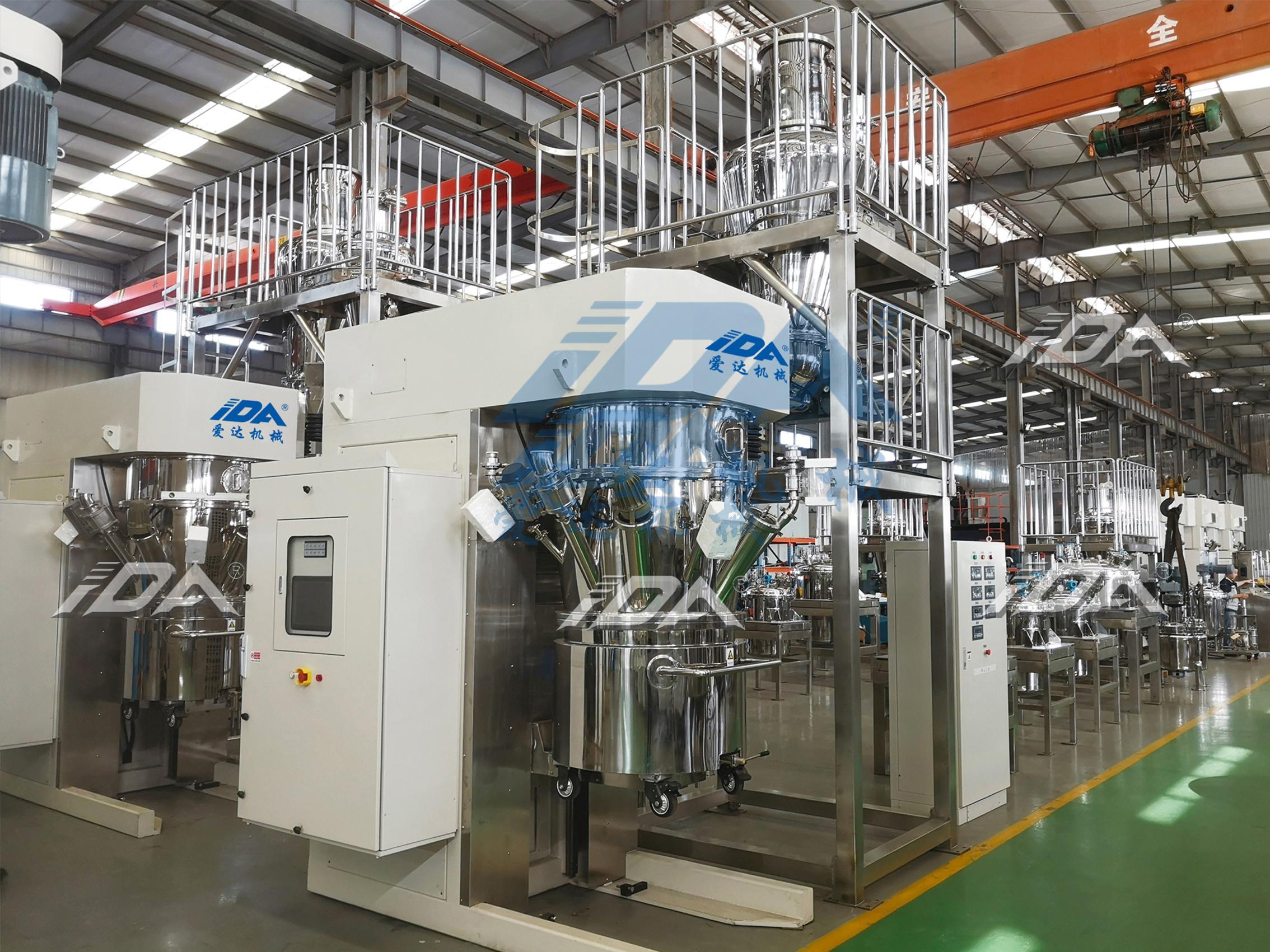
Battery production line equipment - complete assembly line system for pouch, prismatic and cylindrical battery manufacturing
Multiple Utility Model Patents
German Grinding Technology
200+ Installations Worldwide
On-Site Commissioning & Training
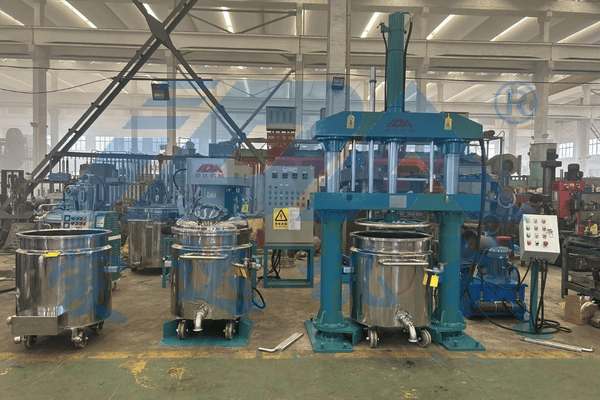
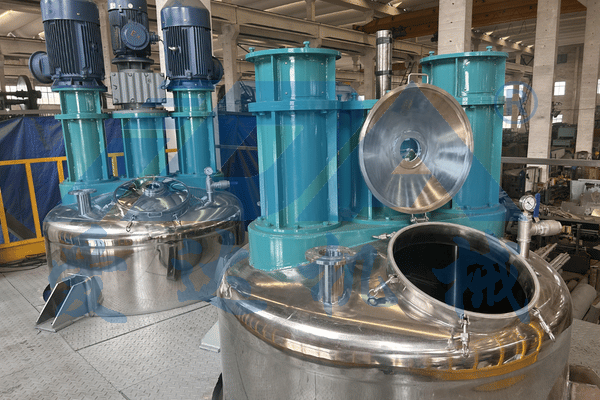
Battery production line equipment — front-end electrode preparation systems for lithium battery manufacturing
Production Line Equipment

Battery Production Equipment — From Lab Scale to Full Production

Our equipment covers the entire front-end electrode preparation process.
Each system is designed for battery manufacturing environments with enclosed dust-free operation, automated recipe management, and real-time data monitoring. Here’s what we build.
Core Mixing

Dual Planetary Vacuum Mixer

The workhorse of lithium battery slurry mixing. Handles viscosities up to 500,000 cps (custom models to 5 million cps). Revolution + rotation action eliminates dead zones. Vacuum capability for degassing. Available from 5L lab units to 1000L+ production scale.
Dispersion

High-Speed Disperser

Breaks agglomerates and ensures uniform particle distribution in electrode slurries. Variable speed up to 1500 rpm. Used as the micro-dispersion control unit paired with planetary mixers. Critical for NMC and LFP formulations where particle size directly affects cell performance.
Advanced Mixing

Three-Axis Powerful Disperser

Combines low-speed stirring, high-speed dispersion, and wall-scraping in one unit. Ideal for high-viscosity, high-solid-content battery pastes. The three independent drive shafts give precise control over shear rate and mixing intensity.
Multi-Function

Concentric Twin-Shaft Mixer

Inner and outer shafts rotate independently — one for bulk flow, one for shear dispersion. Particularly effective for anode slurries where carbon black agglomeration is a persistent problem. Enclosed design suits dry-room installation.
Turnkey Line

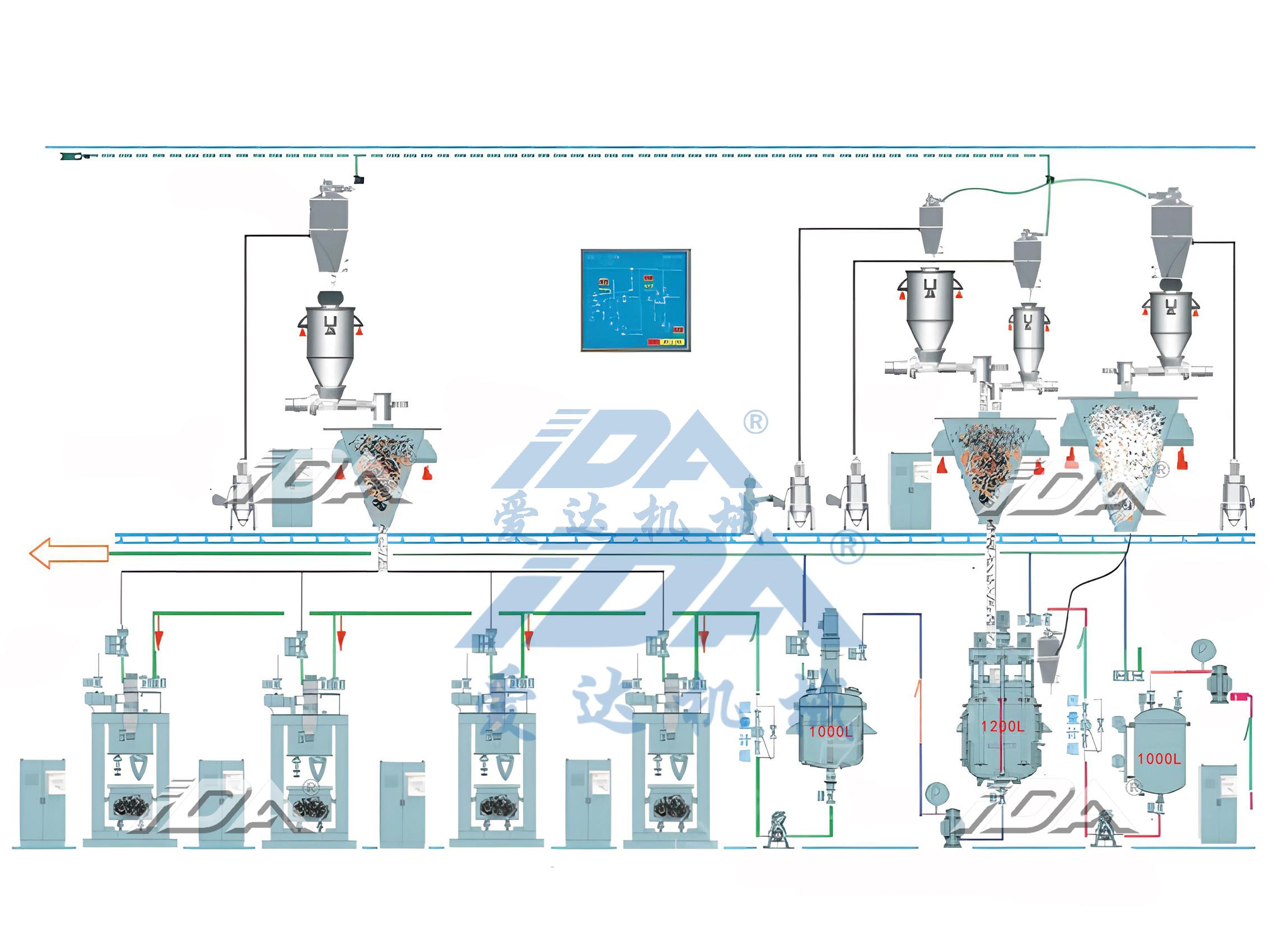
Battery Slurry Complete Production Line

Full integrated system: powder metering and feeding, solvent dosing, dual planetary vacuum mixing, high-speed dispersion, three-stage iron removal (down to 0.03 ppm Fe), slurry transfer, storage tanks, and automated pipeline cleaning. One-click recipe management.
R&D / Pilot

Laboratory & Pilot Line Systems

Scaled-down versions of our production equipment for battery research labs and pilot lines. Available from 200 mL to 60L capacity. Same control software as production units — recipes transfer directly from lab to production scale without parameter re-validation.
Precision Grinding

Nano Sand Mill Series

Turbine, disc, and rod-pin horizontal sand mills for ultra-fine grinding of electrode materials. Achieves nano-level particle size reduction for enhanced electrochemical performance. Closed-loop recirculation for continuous operation.
Specialty

Butterfly & Basket Mixers

Supplementary mixing equipment for specific battery material formulations. The butterfly mixer handles medium-viscosity applications; the basket mill combines grinding and dispersing in a single vessel — reduces processing steps for certain cathode pastes.
Automation

Intelligent Control & Dosing Systems

Automated powder weighing (±0.5% accuracy), solvent metering, PLC-controlled mixing sequences, real-time viscosity and temperature monitoring, MES integration, and tiered access control for formula confidentiality. Reduces manual setup time by roughly 80%.
Need help choosing the right configuration?
Tell us your target chemistry, cell format, and throughput — we’ll put together a system recommendation.
Get a Custom Quote
Specifications

Battery Slurry Mixing System — Capacity & Technical Data

Below are representative specs for our dual planetary mixer series — the central component of any battery production line we build. These are the models most commonly deployed in lithium battery slurry preparation. All specs are from actual production units currently in operation. Custom configurations available.

Dual Planetary Mixer Series

7 models · Lab to mass production · All vacuum-capable
Model Working Vol. (L) Total Vol. (L) Low-Speed (rpm) High-Speed (rpm) Power (kW) Typical Use
IDA-PM-5 5 8 0–60 0–1500 1.5 Lab R&D
IDA-PM-30 30 45 0–55 0–1200 5.5 Pilot line
IDA-PM-60 60 90 0–50 0–1200 11 Pilot / small production
IDA-PM-150 150 220 0–45 0–1000 22 Small-scale production
IDA-PM-300 300 450 0–40 0–900 37 Mid-scale production
IDA-PM-500 500 750 0–35 0–800 55 High-volume production
IDA-PM-1000 1000 1500 0–30 0–700 90 Mass production
All Models Feature
Vacuum capability (-0.098 MPa), jacket heating/cooling, SUS304/316L contact surfaces, mechanical seal design, independent wall/bottom scraper, and variable frequency drives. The PM-300 and above can be configured with automatic CIP (clean-in-place) systems for faster changeover between cathode and anode batches.
Applicable Materials
LFP (Lithium Iron Phosphate) NMC/NCA (Ternary Lithium) LTO Sodium-Ion Cathode/Anode Slurries Solid-State Battery Electrode Pastes Solar Cell Slurries Lead-Acid Battery Pastes Other High-Viscosity Battery Materials
B2B Supply

Wholesale Battery Production Line Equipment & OEM Partnership

Battery production line — complete slurry mixing and electrode preparation system for wholesale and OEM supply

OEM & ODM

We build mixing systems to your engineering specs. Private labeling available for equipment integrators and turnkey line builders. Our engineering team handles mechanical design, electrical layout, and control software customization.

MOQ & Pricing

No hard minimum on standard models — we’ll quote a single unit. Volume pricing kicks in at 3+ units. Complete production line projects are quoted on a per-configuration basis after reviewing your process requirements and site layout.

Global Logistics

We handle FOB, CIF, and DDP shipping. Equipment ships from our facility, crated for ocean freight. We’ve cleared customs in 30+ countries.
Ready to discuss your project?
Whether you need a single mixer or a full battery production line, we’ll scope it out and get you a quote within 48 hours.
Request a Quote
Real-World Challenges

Common Battery Manufacturing Problems — And Our Solutions

We’ve been doing this long enough to see the same issues come up across different plants, different chemistries, different continents. Here are the ones that keep coming back — and what we’ve done about them.
Problem

Slurry Inconsistency Kills Coating Quality

You’re running a coating line and the viscosity keeps drifting. Every third batch needs rework. The active material isn’t dispersing evenly, and you can see the agglomerates under a microscope. Your reject rate is climbing, and the coating machine operator is frustrated.
Our Approach

Dual Planetary + High-Shear Dispersion

The combination of planetary mixing for bulk homogenization and high-speed dispersion for particle deagglomeration is where we see the biggest impact. One LFP producer in Texas went from a 12% reject rate to under 3% after switching to our system — and batch cycle time dropped from 4.5 hours to 2.8. The enclosed vacuum design also eliminates the air bubbles that cause pinholes in the coating layer.
Problem

Can’t Switch Between LFP and NMC Without a Full Teardown

Your plant runs LFP during the week and NMC on weekends (or the reverse). But every chemistry change means hours of cleaning, recalibration, and — if you’re not careful — cross-contamination that ruins an entire batch of NMC cells because of trace iron from the LFP run.
Our Approach

Automated CIP + Recipe Management

Our production lines include automated clean-in-place systems and formula management software. Select the target chemistry, and the system runs the appropriate cleaning cycle, then pre-loads the new mixing parameters. A pouch cell startup in Poland is running both NMC 811 and LFP on the same IDA mixing line — no hardware swaps, just a recipe change in the control panel. Their first-pass yield on NMC hit 94%.
Problem

Iron Contamination in the Slurry

Even trace iron content above 0.1 ppm in your cathode slurry can cause micro-short circuits in the finished cell. You’re seeing occasional field failures and your QC team can’t consistently trace the contamination source. The welded seams in your old mixer? Prime suspects.
Our Approach

Three-Stage Iron Removal + All-Stainless Contact

Every production line we ship includes a three-stage magnetic iron removal system — permanent magnets plus electromagnetic filtration — that brings Fe content down to 0.03 ppm or less. All slurry-contact surfaces are SUS316L polished to Ra 0.4 μm. An energy storage manufacturer near Pune runs our system at 8 tons/day with iron levels consistently below the 0.05 ppm threshold their cell assembly line requires.
Problem

Scaling from Lab to Production Means Re-Developing Everything

Your R&D team spent months perfecting a formulation at lab scale. But when you try to replicate it at 300L, the results don’t match — the mixing dynamics change, the particle distribution shifts, and you’re basically starting from scratch. Sound familiar?
Our Approach

Unified Lab-to-Production Platform

Our lab mixers (5L–60L) and production units (150L–1000L) share the same control software architecture and proportionally scaled geometry. A sodium-ion research lab in Ontario is using this exact setup — 5L for experiments, 60L for pilot batches, same recipe parameters, transferable without re-validation. Their PI published a paper citing the system’s scalability six months after installation.
Problem

Manual Batching Eats Up Production Time

Your operators are hand-weighing powders, eyeballing solvent additions, and manually tracking which batch is which. Each setup takes 30-45 minutes, and every batch is slightly different because human consistency has limits. At 6 batches per day, that’s 3-4.5 hours of pure setup time — not counting the errors.
Our Approach

Fully Automated Dosing & Mixing Sequences

Our integrated production lines automate the entire weighing, dosing, and mixing sequence. Operators select the formula on the touchscreen; the system handles powder metering (±0.5% accuracy), solvent injection, mixing speed ramps, and endpoint detection. One client in India cut their per-batch setup from 45 minutes to under 10. Plus, every batch is logged — weights, temperatures, speeds, timestamps — for full traceability.
Project Stories

Battery Production Line Projects We’ve Delivered

These are real projects, though we’ve kept some client details vague at their request. The numbers are accurate.
Gulf Coast LFP battery production line — dual planetary vacuum mixer system installed in Texas
<3%
Reject Rate
2.8h
Batch Cycle
Gulf Coast LFP Scale-Up

From 12% Reject Rate to Under 3% — Texas Cathode Producer

Dual planetary vacuum stirring + high-speed dispersion
A mid-size LFP cathode producer in Texas had been struggling with a single 100L mixer on their pilot line. Worked fine at small volumes, but past 500 kg/day, slurry consistency collapsed. Particle agglomeration was the main culprit — their coating machine kept flagging viscosity deviations.
We deployed a dual planetary vacuum stirring system with our high-speed dispersion unit. The plant layout was tight — we had to redesign the powder metering feed system three times before it fit. Took an extra six weeks of engineering. But once running, batch cycle dropped from 4.5 hours to 2.8, reject rate fell from 12% to under 3%. They’ve since ordered a second identical line for a new facility in Louisiana.
“We burned through two other vendors before finding IDA. Should’ve started here.”
— Plant Operations Director
European EV startup pouch cell battery production line — NMC 811 and LFP dual-chemistry mixing system in Poland
94%
First-Pass Yield
11d
Commissioning
European EV Startup — Pouch Cell Line

Dual-Chemistry Mixing for NMC 811 and LFP — Poland

Automated CIP + nitrogen-blanketed transfer system
A startup in Poland building a pouch cell assembly line for EV battery packs needed front-end slurry equipment that could handle NMC 811 and LFP without a full changeover. The NMC 811 — that chemistry is moisture-sensitive, so the mixing enclosure had to maintain below 1% relative humidity. We added redundant seals and a nitrogen blanket on the transfer piping.
Commissioning took 11 days. Hit a snag on day three — PLC communication between our dosing system and their MES kept dropping packets. Turned out to be a grounding issue on their side, but we stayed extra days to help sort it out. Eight months in, they’re hitting 94% first-pass yield on NMC cells.
“IDA’s mixing system handles both our chemistries without us having to swap anything out. That alone saved us six figures on duplicate equipment.”
— CTO
Indian energy storage battery production line — full slurry preparation system for prismatic LFP cells near Pune
140
MWh / Year
8t
Slurry / Day
Indian Energy Storage Expansion

Tripling Production Capacity — 50 MWh to 140 MWh/Year

Full slurry line with three-stage iron removal & dual coating heads
An energy storage company near Pune making prismatic LFP cells needed to triple capacity. We designed a full slurry preparation line: automated powder weighing, dual planetary vacuum mixing, high-speed dispersion, three-stage iron removal, and slurry transfer feeding two parallel coating heads. Total throughput: 8 tons of slurry per day.
Honest moment — the freight logistics were a nightmare. One mixing vessel got stuck at Mumbai customs for nearly three weeks over a classification dispute. We sent our logistics coordinator in person to sort it out. Once on site, installation took 18 days, trial runs started on day 22. Six months in, they’re at 140 MWh/year with headroom to spare.
“We went from a bottleneck at mixing to a bottleneck at formation. That’s the kind of problem we wanted.”
— VP Manufacturing
Working on a similar project?
We’re happy to walk through our experience with your specific chemistry and format.
Discuss Your Project
Cell Formats

Pouch, Prismatic & Cylindrical

The front-end electrode prep — slurry mixing, coating, calendaring — stays mostly the same regardless of cell format. Where things split is at the assembly stage.

Pouch Cell

Flexible Format, Popular for EV & Consumer
Stacking or Z-fold assembly. Aluminum laminate pouch sealing. Lightest form factor per kWh. Favored by Hyundai-Kia, SK Innovation. Requires careful vacuum sealing and edge trimming. Good for prototyping because tooling cost is lower.

Prismatic Cell

Preferred for EV & Grid Storage
Wound or stacked electrode assembly in aluminum/steel can. Dominant in China’s EV market (BYD Blade Battery is prismatic LFP). Easier to package into modules. Weld integrity on can sealing is critical. The format most energy storage projects default to.

Cylindrical Cell

High-Speed, Proven at Scale
18650, 21700, and the newer 4680 tabless design. Tesla’s original format. High winding speeds enable high-volume automation. Strong structural rigidity. The 4680 format is driving renewed investment in cylindrical cell lines because it reduces per-cell assembly costs.
Battery Chemistries

Lithium-Ion, Sodium-Ion & Solid-State Battery Production Support

LFP NMC 811 NCA
Production Proven

LFP & NMC — The Workhorses

LFP runs at high solid content (70-75%) and is relatively tolerant of moisture. NMC — especially 811 and higher-nickel variants — needs moisture control below 1% RH and more precise temperature management during mixing. Both require thorough dispersion to avoid agglomerates that would cause coating defects. Our dual planetary mixers handle both, with automated recipe switching.
Sodium-Ion Solid-State
Emerging — R&D Active

Sodium-Ion & Solid-State — The Next Wave

Sodium-ion electrode formulations are similar enough to lithium that existing mixing equipment often works with minor parameter adjustments. Solid-state battery pastes are a different animal — much higher viscosity, lower solvent content, and often require specialized disperser configurations. We’ve supplied R&D mixing setups to three solid-state battery research labs in the past two years. The formulations keep changing, so flexibility is more important than raw throughput at this stage.
Interactive Engineering Tools

Battery Production Line Tools

Select the right mixer, estimate line costs, or calculate slurry throughput — all based on real IDA Equipment specifications.

Your Requirements

Working volume per batch in liters

Recommended Configuration

Select your requirements
and click “Find My Mixer”

Project Parameters

Your planned yearly production output

Estimated Investment

Enter your project parameters
and click “Estimate Costs”

Mixing Parameters

Working volume, not total vessel volume
Typical range: 45-75% depending on chemistry
Including loading, mixing, dispersion, and discharge

Production Capacity

Enter your mixing parameters
and click “Calculate Throughput”

Frequently Asked Questions

About Battery Production Lines
The full chain from powder to finished pack includes: slurry mixing (that’s us — dual planetary mixers, dispersers, iron removal, transfer systems), electrode coating, calendaring, slitting, cell assembly (winding or stacking depending on format), electrolyte filling, formation and grading, and finally module/pack assembly with welding machines, BMS integration, and end-of-line testing.
A lab or pilot line for R&D: $200K to $2 million. Small-scale production line (50-100 MWh/year): $3M to $15M. Mid-scale (500 MWh to 1 GWh): $20M to $80M. Full gigafactory-scale: we’re talking hundreds of millions to billions. Depending on throughput and automation level. We’ll give you a detailed breakdown once we know your target capacity and chemistry.
Yes — with caveats. The hardware is the same: dual planetary mixer plus disperser. NMC 811 and higher-nickel formulations need tighter moisture control (below 1% RH), so you’ll want enclosed mixing with nitrogen blanket and potentially dry-room installation. LFP is more forgiving. The mixing parameters differ — speed, time, sequence — but our automated recipe management handles that. One of our clients in Poland runs both chemistries on a single IDA system with no hardware changes. Just select the recipe and go. The automated CIP system handles decontamination between changeovers.
Standard models — a 300L planetary mixer, for instance — ship in 8-14 weeks. Customize the controls, add a CIP system, or spec out a full integrated production line, and you’re looking at 16-24 weeks. Installation and commissioning add 2-4 weeks depending on site readiness. For a complete cell production line involving multiple vendors and process stages, plan 6-12 months from initial engineering to first production run. We’ve done faster — our India project went from signed contract to trial runs in about five months — but that was with a very prepared site.
That depends on your end market more than anything. EV OEMs are split — some prefer prismatic (BYD, CATL), others use pouch (Hyundai, some GM platforms), and Tesla pushed the cylindrical 4680 format. Energy storage mostly defaults to prismatic LFP. Consumer electronics leans pouch. But here’s the thing — the electrode slurry prep stage is the same regardless of format. Chemistry-specific, not format-specific. So if you start with our mixing system and later decide to add a different cell assembly line, the front end doesn’t change. We’ve had clients start with pouch pilot lines and later add cylindrical production using the same slurry prep equipment.
Yes. We dispatch engineers for on-site installation, commissioning, and operator training. We’ve done it in over 30 countries — the most recent international installs were in Poland, India, the US, and Thailand. After installation, we provide remote support through our service platform, periodic calibration visits, and spare parts within 3-5 business days for standard wear items. For urgent issues, we can typically get a technician on site within 48-72 hours depending on location. We also maintain partnerships with regional service providers in key markets for faster response.