Póngase en contacto con IDA


Los materiales de los rodillos del molino de tres rodillos son los rodillos de metal endurecido o cerámica avanzada que se muelen y dispersan dentro de la máquina, y se dividen en dos familias (metal endurecido y cerámica avanzada) que alteran su riesgo de contaminación, su programa de desgaste y su total. costo de propiedad por cantidades que la mayoría de las hojas de especificaciones nunca muestran. Esta guía omite definiciones y se centra en números reales: dureza, comportamiento térmico, comparación de precios en el mundo real y las variables que impulsan su costo, para que pueda decidir si la cerámica es adecuada para su aplicación específica.
Especificaciones rápidas
| Aleación endurecida/hierro fundido | Costo de adquisición más bajo; Elección estándar para tintas, pinturas, revestimientos generales |
| Acero inoxidable | Terreno intermedio resistente a la corrosión; común en ejecuciones de electrónica general y adyacente a alimentos |
| Cerámica de circonio/alúmina | Mohs 8-8.5, Vickers ~1200-1400 HV; Contaminación por metales casi nula |
| Cerámica de carburo de silicio (SiC) | Raro entre las cerámicas por su alta conductividad térmica; Se utiliza cuando la acumulación de calor es una preocupación |
¿qué materiales para rodillos utiliza realmente una fresa de tres rodillos?
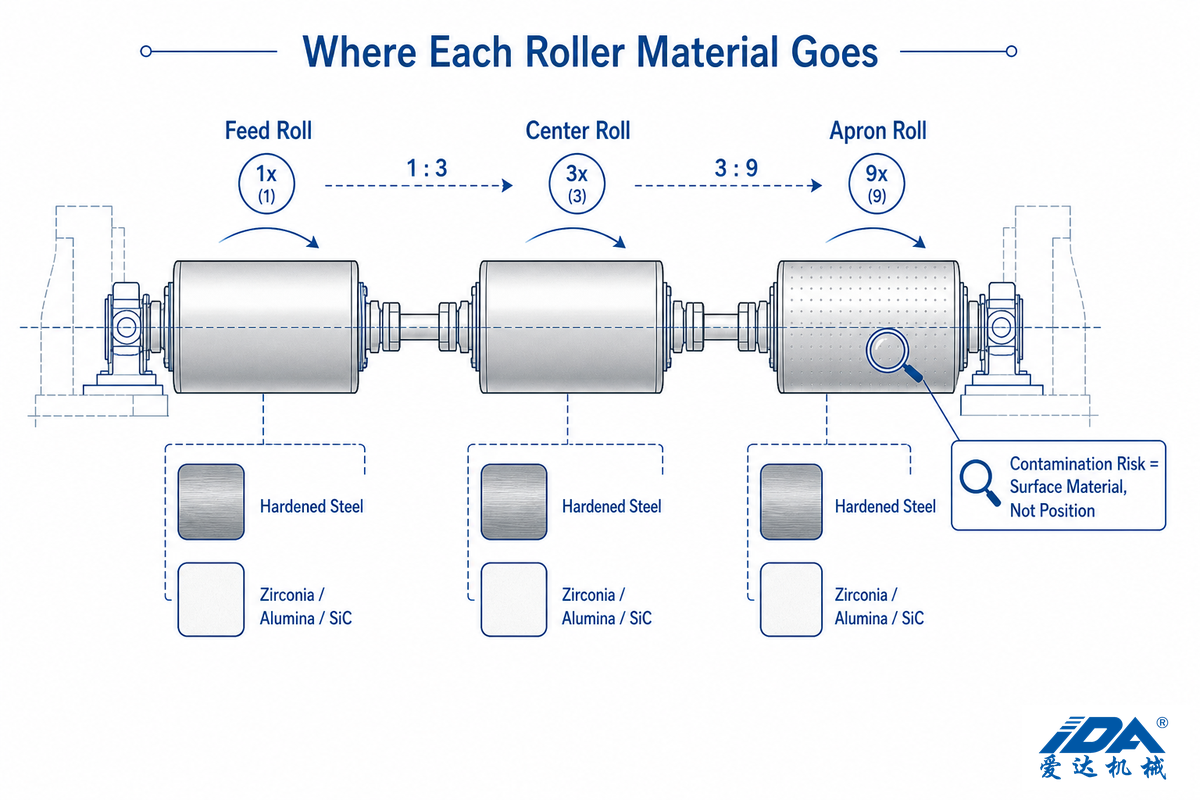
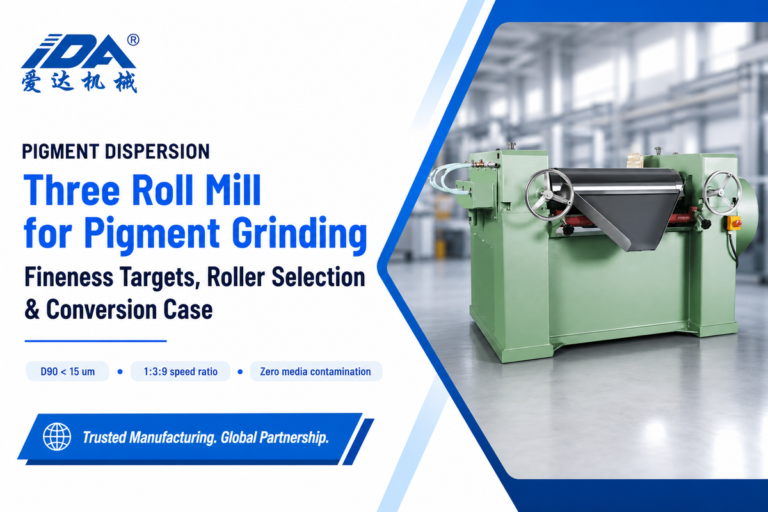
A molino de tres rodillos utiliza rodillos hechos de una de dos familias de materiales: aleación endurecida o acero fundido (la opción tradicional y de menor costo), o cerámica avanzada 'circonia, alúmina o carburo de silicio 'para una contaminación por metales casi nula. El propio molino (también llamado molino de tres rodillos, molino de triple rodillo o simplemente molino de 3 rodillos) hace funcionar tres rodillos montados horizontalmente a diferentes velocidades, ya sea un molino de tres rodillos para moler pigmentos o una línea que dispersa pastas electrónicas.
Un rodillo, a menudo llamado rodillo de alimentación, primer rodillo o rodillo frontal, gira lentamente para aceptar sus materiales; A medida que sus materiales se aprietan entre el primer rodillo y el rodillo central (rollo central o segundo rodillo), el espacio de contracción y las fuerzas de corte se rompen y dispersan. Estos materiales dispersos luego se transfieren entre el rodillo medio y el último, que también recibe el nombre de rodillo de plataforma o tercer rodillo, según el fabricante. Aquí, el espacio cada vez más estrecho es aún más estrecho y las velocidades de rotación son aún mayores, generando una dispersión fina o una película delgada lista para el procesamiento posterior. Su material experimentará cizallamiento a medida que se fuerza entre rodillos, por lo que necesitará una superficie de rodillo que transfiera efectivamente ese cizallamiento para una dispersión uniforme, pero hay más en esta elección que riesgo de contaminación. Ese alto cizallamiento es lo que descompone los aglomerados y aprieta la distribución del tamaño de las partículas a medida que los rodillos giran, refinando materiales viscosos, ya sea una pasta de alta viscosidad o una tinta más delgada hasta un tamaño de partícula uniforme. Debido a que los tres rodillos (los tres rodillos horizontales también descritos por sus nombres de rodillo delantero, rodillo central y rodillo de plataforma) comparten la misma geometría básica y espaciado entre rodillos adyacentes, las mejores prácticas para cualquier molino de rodillos comienzan con hacer coincidir el material con esa realidad mecánica.
- Los rollos de metal endurecido o hierro fundido son una entrada de muy bajo costo para aplicaciones a granel en pinturas, recubrimientos y algunas tintas de gran volumen donde se puede tolerar una ligera contaminación.
- Los rollos de acero inoxidable pueden ser un buen compromiso si trabaja con materiales que pueden entrar en contacto con una pequeña cantidad de humedad o ciertos productos químicos, pero que no necesitan estar absolutamente libres de trazas de metales.
- Los rollos cerámicos avanzados (como los hechos de circonio, alúmina o carburo de silicio) brindan una resistencia extrema a la abrasión, eliminan la posibilidad de contaminación por metales en sus productos y pueden tener beneficios únicos en aplicaciones especializadas que involucran medios agresivos.
En un Presentación internacional de patentes de 2010 (WO2010055099A1) Para una máquina de molienda de tres rodillos, el documento describe explícitamente el uso de estas máquinas para “moler pastas cerámicas” y procesos convencionales de dispersión de tinta con rodillos tradicionales. Esto confirma que el uso de cerámica avanzada como material de rodillo no es una opción de nicho; Es parte de la misma tecnología subyacente de molino de tres rodillos, utilizada desde hace décadas. Tenga en cuenta que tanto para los rodillos cerámicos como para los metálicos, el acabado de la superficie del rodillo es fundamental. La desigualdad o el rayado del rodillo pueden provocar rayas en el producto terminado, especialmente en aplicaciones como serigrafía o en tintas de película gruesa centradas en la electrónica, incluso si al material a granel subyacente le quedan años de desgaste.
📐 Nota de ingeniería
El producto terminado se desprende del último rodillo mediante una cuchilla médica, también conocida como cuchilla de despegue. Cuando maneja un molino de rodillos cerámicos avanzado, la punta de su cuchillo de despegue debe estar hecha de un material con un perfil de dureza que sea al menos tan grande como el rodillo de su delantal. Un cuchillo más blando puede dañar incluso los rodillos cerámicos duros más rápido que un rodillo de metal endurecido, y lo hará mientras agrega contaminación no deseada de metales traza.
¿su industria realmente necesita rodillos cerámicos de contaminación cero?
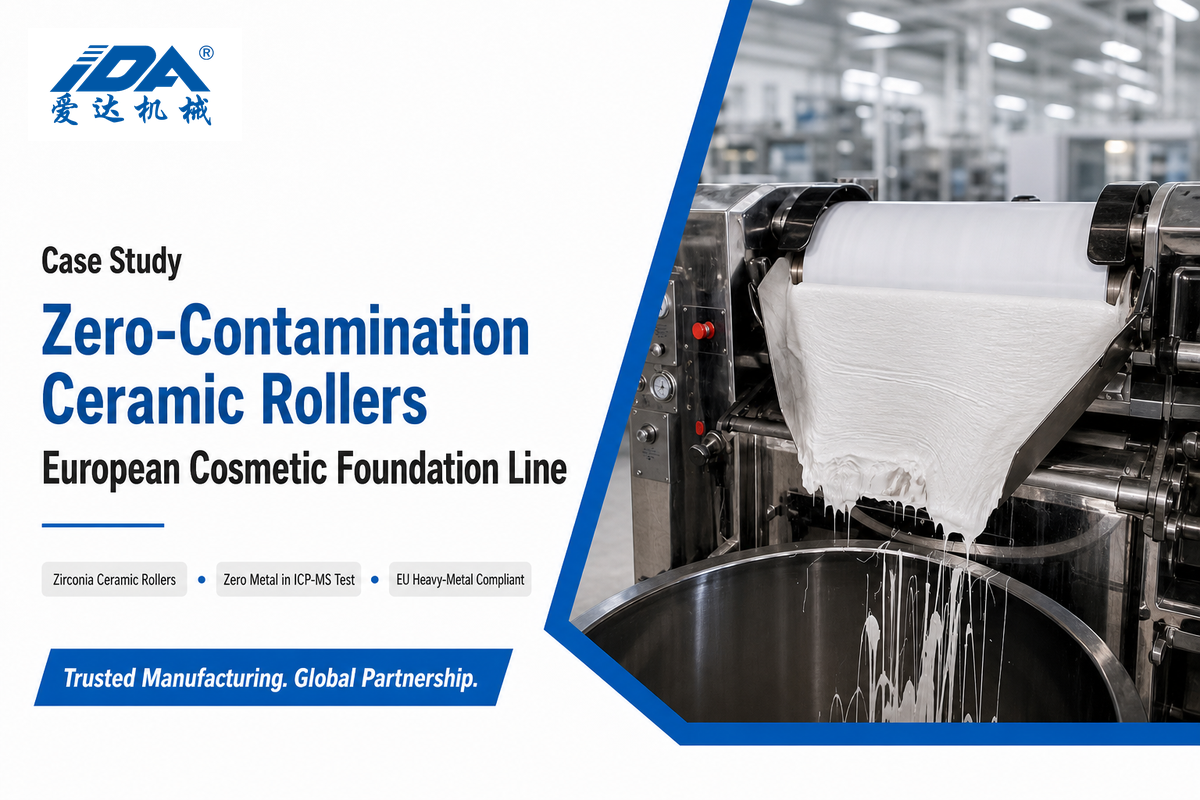
No todas las tiradas exigen una prima para la cerámica. Su industria necesita rodillos cerámicos de contaminación cero sólo si una partícula de metal perdida realmente dañaría su producto o violaría una especificación que suelen hacer los fabricantes de cosméticos, productos farmacéuticos, electrónicos y de baterías; Los productores generales de tinta, pintura y revestimientos no suelen hacerlo. La pregunta no es “¿qué material es mejor?” 'es cuánta contaminación puede tolerar su producto. Antes incluso de considerar el precio, utilizamos este sistema de clasificación de cuatro etapas:
La puntuación de riesgo de contaminación (0-3)
| Puntuación | Producto típico | Rodillo recomendado |
|---|---|---|
| 0 « Nicio preocurare | Tintas industriales, recubrimientos generales, imprimaciones | Aleación endurecida/hierro fundido |
| 1 « Suave | Pinturas de consumo, adhesivos generales | Acero inoxidable |
| 2 « Moderat | Cosméticos, pigmentos de colores críticos, pastas electrónicas en general | Cerámica de circonio o alúmina |
| 3 « Estricto | Pármaco, suspensión de batería, pasta electrónica de alta pureza | Cerámica de circonio/alúmina, especificaciones de contacto sin metales verificadas |
Ejemplo trabajado: una base cosmética de crema base/BB obtiene una puntuación de 2 «básicamente, cualquier pastilla de hierro de un rodillo metálico puede manchar el lote o causar una queja del cliente objetivo del lote, por lo que la cerámica es la opción económicamente predeterminada, incluso si el conjunto de rodillos cuesta más en frente. Sin embargo, una imprimación exterior de uso general obtiene una puntuación de 0 'nadie's monitoreando ese lote en busca de contaminación por partes por millón de metales, por lo que un rodillo de aleación endurecido es el valor predeterminado rentable. El perfil de contaminación casi nulo de la cerámica proviene específicamente de su inercia química, una propiedad documented in government materials-science literature on ceramic processing, which is exactly why score-2 and score-3 products default to it regardless of price.
That’s exactly the logic behind IDA’s own Roller Material Selector – and below, we break down exactly how the tool calculates and weights these inputs.
Dureza, vida útil y resistencia al calor, los números detrás de la elección
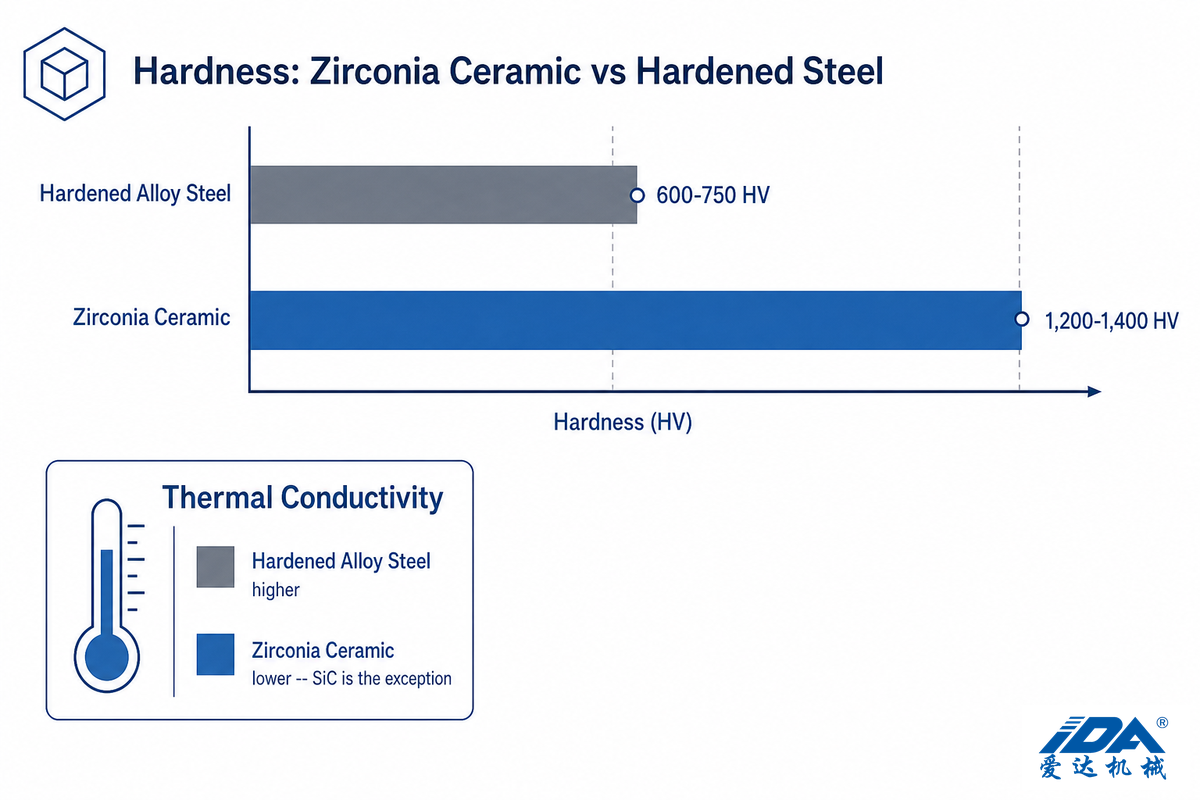
Hardness is the real predictor of wear life, and typically is the number sales people don’t bring up. Zirconia ceramic rollers consistently rate as Mohs 8-8.5 and have a Vickers hardness (HV) in the range of 1,200-1,400, while the hardened alloy roller steel ranges from about 55-62 HRC, which corresponds to 600-750 HV. That’s almost double the hardness, and wear hardness is the predominant factor affecting wear during abrasive rolling contact.
| Material | Dureza | Thermal Conductivity | Riesgo de contaminación |
|---|---|---|---|
| Hardened alloy steel | ~600–750 HV (55–62 HRC) | Moderate–high (~15–50 W/m·K) | Present |
| Zirconia (ZrO₂) | 1,200–1,400 HV | Low (~2–3 W/m·K) | Near-zero |
| Alumina (Al₂O₃) | ~1,200–1,500 HV | Moderate (~20–30 W/m·K) | Near-zero |
| Silicon carbide (SiC) | ~2,400–2,800 HV | High (~120–270 W/m·K) | Near-zero |
Zoomed out past the raw numbers, here’s the full steel-versus-ceramic picture in one table – the 9-Category Steel vs Ceramic Matrix we walk buyers through before they see a quote:
| Categoría | Hardened Alloy Steel | Advanced Ceramic |
|---|---|---|
| Dureza | ~600–750 HV (55–62 HRC) | 1,200–2,800 HV depending on grade |
| Thermal conductivity | Moderate–high (~15–50 W/m·K) | Low for zirconia/alumina, high for SiC |
| Riesgo de contaminación | Present (metal pickup possible) | Near-zero |
| Typical acquisition cost | Baseline (e.g., $4,900 in our documented quote) | Roughly 80% higher (e.g., $8,700 in the same quote) |
| Shock/brittleness resistance | High – bends or dents before it cracks | Lower – can chip under sudden impact |
| Best-fit industries | General inks, paints, coatings | Cosmetics, pharma, electronics, battery slurry |
| Cooling requirement | Standard water-cooling jacket | Higher-margin cooling flow recommended |
| Retrofit compatibility | N/A (typical incumbent material) | Usually drop-in on same frame and journals |
| Typical wear mechanism | Gradual abrasive scoring | Slow wear, occasional shock chipping |
“The hardness number gets all the attention in a sales conversation, but the question we actually ask a buyer first is what happens if a stray metal particle ends up in their finished batch. That answer decides the material family before cost ever enters the discussion.”
— IDA engineering team
⚠¦ A Counterintuitive Wrinkle
One would think that “better” would mean superior in every respect, but this isn’t true. NIST thermal property data on zirconia and alumina ceramics demonstrate both materials are significantly poorer heat conductors than steel, with zirconia acting almost as a thermal insulator. The implication for a mill utilizing ceramic rollers is that the ceramic may create hotter spot temperatures in the nip compared to a steel roller under the same material conditions-the opposite of what a purchaser seeking a “premium” component would want.
The only exception to the general rule of ceramic poor conductivity is silicon carbide (SiC). Its thermal conductivity is unusually high compared to other ceramics, so SiC can be used in high-throughput, heat-sensitive runs where zirconia’s insulative properties are undesirable.
Across process industries where pigment dispersion is key-from printing inks and electronic thick film inks to heat-sensitive materials in pharmaceutical pastes-ultimate processed material quality depends on a roller surface which maintains its finish over countless passes, medium and high load, over high viscosity compounds. Ceramics’hardness superiority comes with a disadvantage that has to be faced: peer-reviewed materials science research on advanced ceramics also confirms that hard ceramic bodies are less resistant to shock from mechanical or rapid temperature fluctuations than are traditional metal rollers. A tool falling on the roller or rapid change in temperature could fracture the roll instead of steel, for example – the same compressive-failure mechanism that EN ISO 17162:2025’s compressive strength testing standard for fine ceramics exists to quantify.
Studies confirm zirconia and alumina have poor resistance to thermal shock and cycling; This in turn is the reason that more importance must be placed on controlling cooling water temperature with ceramic.
¿puedo adaptar rodillos de acero a cerámica en un molino de tres rodillos existente?
Generally yes, within limitations. Roll journals, bearing housings, and the drive train are usually designed to accommodate a range of roll diameters and weights rather than one specific material, so a ceramic roll set built to the same dimensions as your existing steel rolls will normally fit an existing mill frame. Two things are worth verifying before ordering, though.
First, confirm your apron knife and doctor blade hardness suit a ceramic apron roll – a blade that’s too hard can score ceramic faster than steel. Second, check whether your cooling water circuit has enough flow capacity, since ceramic’s lower thermal conductivity shifts more heat load onto active cooling. Most three-roll mill manufacturers, including IDA, can confirm frame compatibility from your mill’s model number.
El costo real de los rodillos de cerámica versus acero (modelo de costo por hora)
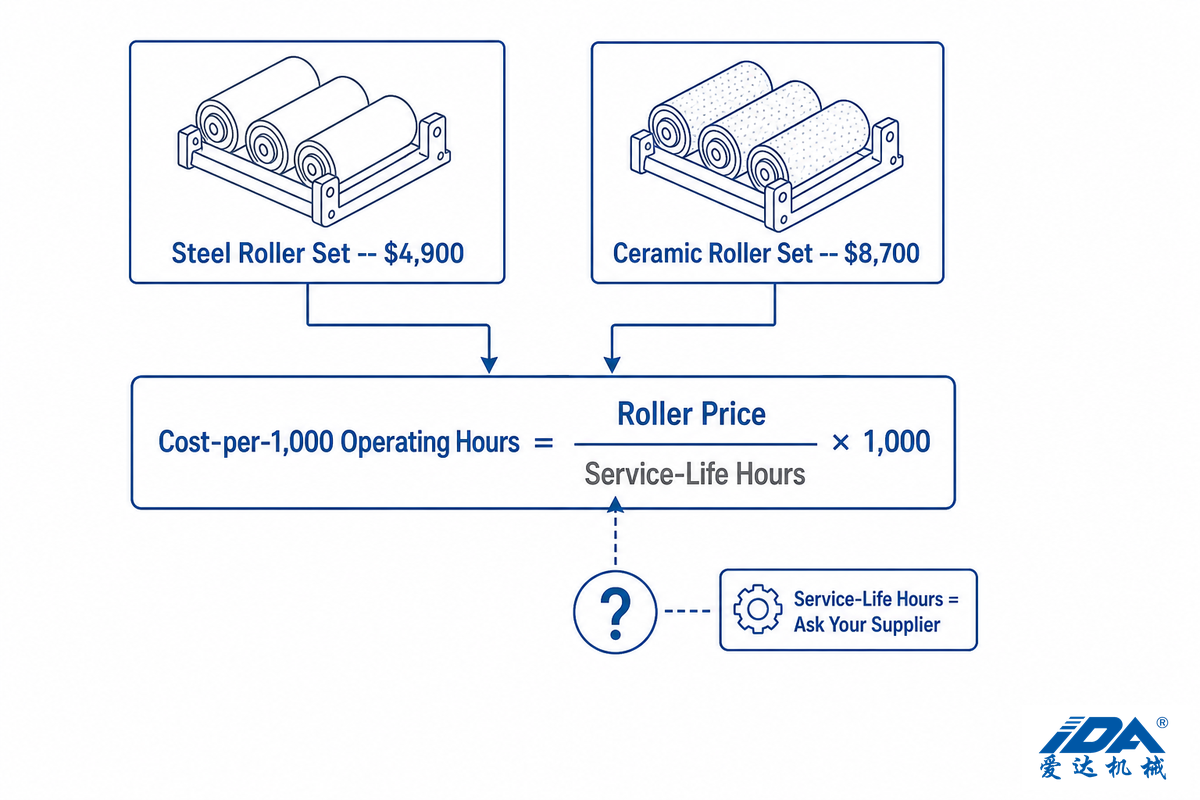
On the surface, ceramic rollers will always appear more expensive, and by purchase price, they are. One example provided for a set of two stainless-steel, 300-millimeter, 150-millimeter three-roll mill rolls was for a quote of $4,900. The corresponding quote for zirconia ceramic rollers of identical dimensions was $8,700 – a factor of roughly 1.8 times greater, at least according to this one data point. That single figure is a specific data point, not an industry average; whatever three roll mill price you’re quoted will vary according to roll diameter, face length and precision.
Cost-per-1,000 Operating Hours Formula
(1,000 / Price per roller set in $ ) × Expected service-life hours = Cost per 1,000 hours
Using the price example of $4,900 for steel and $8,700 for ceramic, a steel roller set will have a lower cost-per-hour if it lasts less than about 1.8 times the number of hours the ceramic set will last before needing regrinding or replacement. At that break-even point, ceramic costs-per-hour actually become lower despite the higher sticker price; above that break-even point, steel is the economical choice. The single biggest factor in calculating this – one that virtually none of your suppliers will provide upfront – is your own expected service-life-hours figure for both steel and ceramic, taking into account your product and process. This factor is key to utilizing the Roller Material Selector tool below effectively, or to manually crunching the numbers on your own.
However, two key cost drivers work to push ceramic into the more economical position than the price tag alone would suggest: downtime and regrind frequency. Experts consistently advise that thermal-shock-sensitive materials require controlled handling to avoid premature wear, and that each roll swap costs a full shift’s worth of downtime (and thus, production), which most cost comparisons based on price per roll neglect to factor in.
Cómo decide realmente una herramienta de selección de material de rodillo
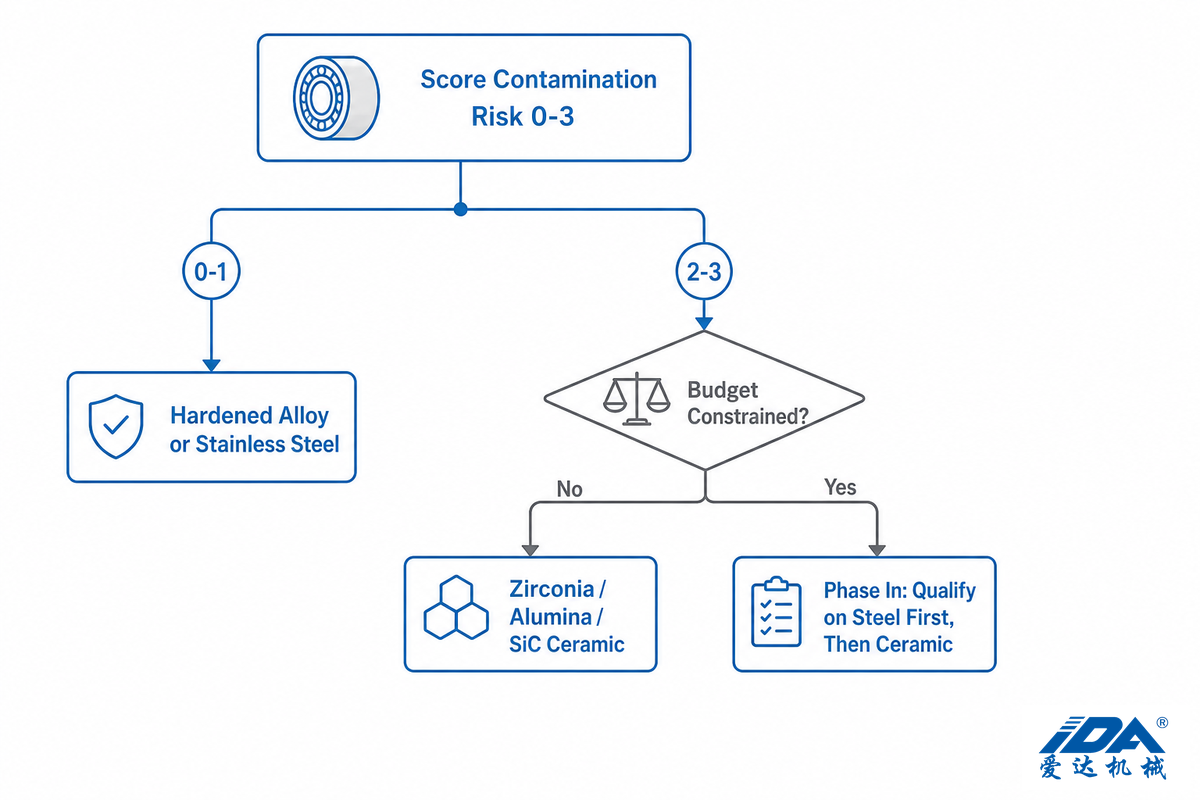
A roller material selector tool decides by weighing three inputs in order: contamination sensitivity first, then duty-cycle abrasiveness, then budget. If you’ve used IDA’s Roller Material Selector tool and wondered how it reached its recommendation, that’s roughly the calculation running behind it – and you can walk the same steps manually without opening the tool at all.
Key Factors to Consider
- Determine your product’s Contamination Risk (from 0-3) using the table below.
- If score is 0-1: default to hardened alloy or stainless steel – ceramic’s purity advantage buys you nothing your process actually needs.
- If score is 2-3: default to ceramic, with a focus on throughput to decide if zirconia/alumina or silicon carbide is required for thermal loads (see notes on thermal conductivity above).
- If score is 2-3, but budget is truly tight: phased qualification – qualify with steel, observe the real contamination, and then re-qualify with ceramic – is a practical approach many smaller organizations take.
There’s no universally better choice here-the wrong conclusion is to automatically assume ceramic wins because it’s harder. The same materials principle shows up in ceramic-versus-steel bearing selection: ceramic components aren’t always better than steel: they win specifically where speed, low friction, or corrosion resistance matter, and lose on raw impact toughness and cost. The same logic applies to three roll mill rollers: match the material to the failure mode you’re actually trying to avoid, not to a blanket assumption that the harder, more expensive material is automatically the safer choice.
Diferencias de mantenimiento y lubricación entre rodillos cerámicos y de acero
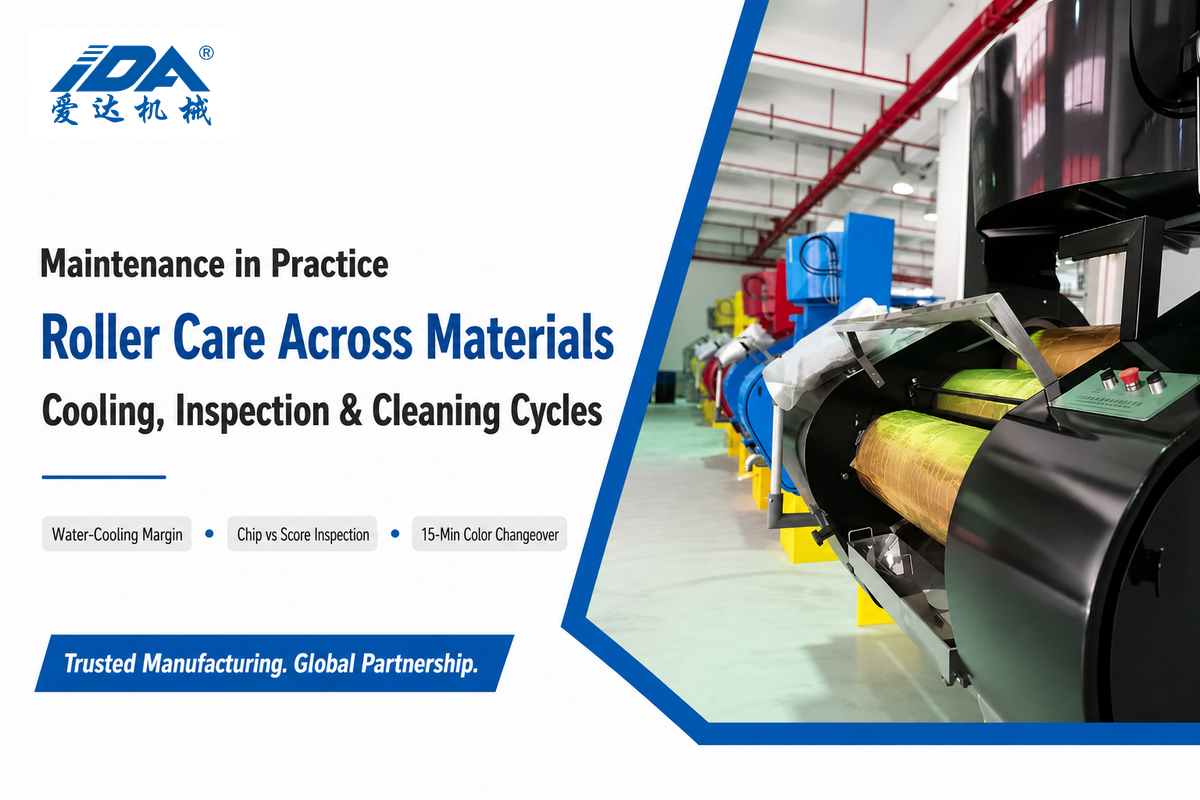
Beyond material, day-to-day care differs little. Two points of vigilance after a material switch, though – both trace back to the same NIST-documented thermal conductivity gap between ceramic and steel discussed above.
- Monitor water-cooling flow on ceramic – since ceramic’s heat conduction is lower, the water cooling jacket has to pick up a bigger part of the load that would otherwise be carried out by the roll body in steel.
- Check for chip and crack development on the roller ends following any hard stop or temperature fluctuation – shock-induced damage on ceramic shows up as chips, whereas steel damage is generally visible as gradually progressing scores.
- Re-torque rollers and check gaps to your standard maintenance intervals – this remains a function of your bearings, not the rollers.
⚠¦ Error común
Assuming thicker or harder rollers always mean greater safety is false. Excessive thickness and hardness in industrial roller coatings can induce additional stress and cracking, shifting failure from wear to fracture, especially if substrate adhesion is not ideal.
Perspectivas de la industria: hacia dónde se dirige la tecnología de materiales de rodillos
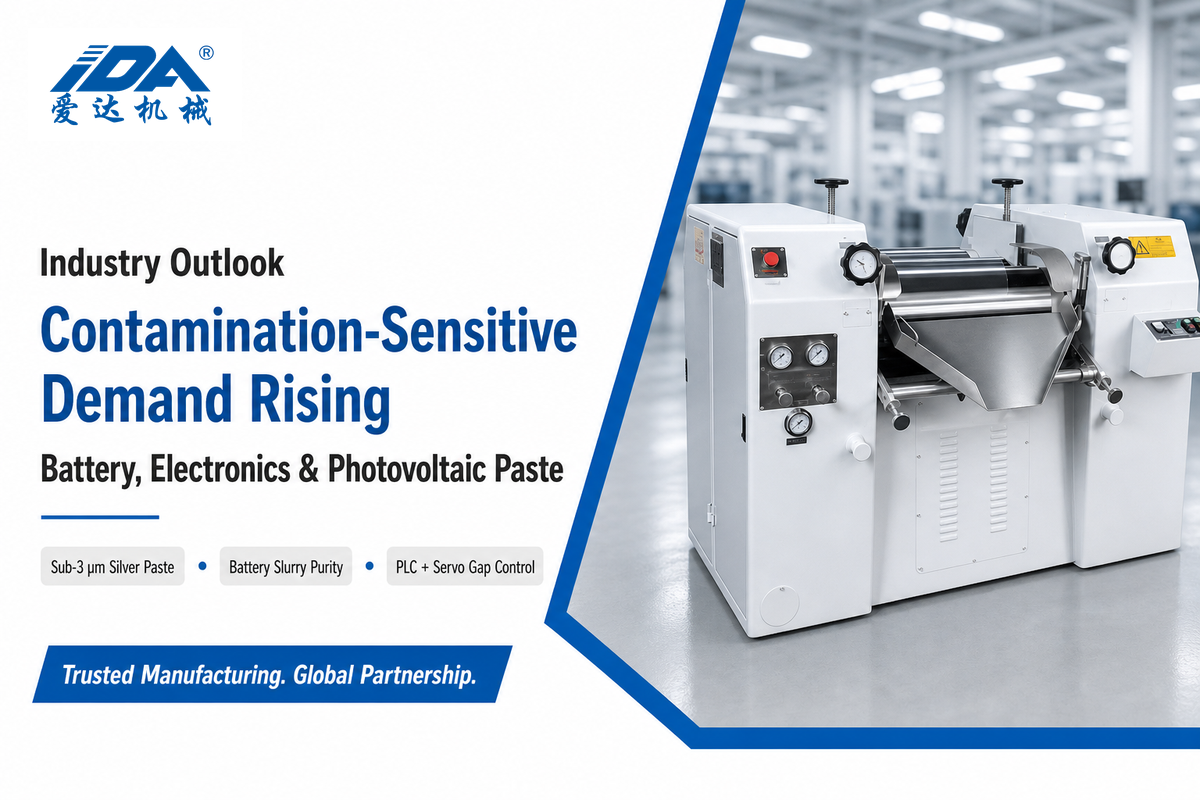
What’s driving increased ceramic roller use isn’t a generic swing away from steel, but rather a concentration of growth in segments where metal contamination is a non-negotiable fact of life: battery slurries, high-purity electronic pastes, and pharmaceutical formulations are all intrinsically contamination-intolerant – often due to regulatory requirements or strict product specifications rather than inherent preference – and are growing more quickly than general industrial coatings. (For market-sizing context, market-research reports peg the overall grinding media market at around $8.35 billion in 2026, trending towards $13.6 billion by 2035 – this is an order of magnitude, not a precisely forecast market size, and indicates growth, but not exponential acceleration). The pressure behind that growth isn’t abstract: in battery slurry processing specifically, contamination risk is a real problem because a single stray metal particle can trigger an internal short circuit years into a finished cell’s service life, which is why OEM and regulatory specs have, since around 2024, increasingly written metal-contamination limits directly into the purchase order rather than leaving roller material to supplier discretion – a very different buying conversation than a general industrial production line has ever had to have. Equipment design is tracking the same direction: dispersion-mill patent filings covering ceramic paste grinding go back over a decade, and that engineering base is exactly what today’s contamination-driven demand is building on rather than starting fresh. So for a buyer, the simple message is this: if your process doesn’t fall into a clearly contamination-intolerant category, the “industry trend” won’t necessarily shift your steel-versus-ceramic decision; the trend is segment-specific, not ubiquitous.
Preguntas frecuentes
P: ¿Cuánto más cuestan los rodillos cerámicos que los de acero?
Ver respuesta
The purchase price for ceramic typically runs significantly higher than steel; in one cited equipment quotation, a pair of matched 150mm diameter zirconia ceramic rollers priced out at approximately $8,700 versus $4,900 for stainless steel, a nearly 1.8X premium. This isn’t a market average – the actual costs vary with roller diameter, face length and finish accuracy among suppliers – but it is a realistic basis for budgeting.
Whether this premium is justified hinges entirely on the number of operating hours the rollers can expect to provide – as opposed to the initial cost difference alone. Consult the Cost-per-1,000 Operating Hours section below for how to crunch this with your specific supplier costs.
P: ¿Cuánto duran normalmente tres rodillos de laminación antes del reemplazo?
Ver respuesta
A major variable is the abrasiveness of the material processed, along with its formulation. Zirconia and alumina ceramics typically exhibit hardness in the range of 1,200 to 1,400 on the Vickers scale, while the hardened alloy steel commonly used for rollers has a Vickers hardness of 600 to 750.
This explains why ceramic usually outperforms steel in high-wear applications, but the actual number of hours before regrind depends on the product’s properties and duty cycle. Discuss expectations with your roller supplier, but you should not rely on generic multipliers to estimate performance.
P: ¿Mi industria necesita rodillos cerámicos de contaminación cero o es suficiente acero inoxidable?
Ver respuesta
The most pragmatic approach to deciding whether to use ceramic is to apply the Contamination Risk Score framework described above, rather than simply going by industry label: General industrial inks, primers, and coatings generally score a 0 to 1 and are well served by steel rolls. Color-critical pigments, most cosmetic applications, and general-purpose electronic pastes score a 2, where ceramic may be the practical default even if steel could technically work.
High-purity electronic pastes, battery slurries, and pharmaceutical formulations score a 3, for which ceramic rolls that guarantee a zero-metal-contact product are the standard requirement.
P: ¿Cuál es la diferencia entre rodillos de circonio, alúmina y carburo de silicio?
Ver respuesta
They’re all near zero contamination potential, though the differences kick in when considering heat and hardness. Zirconia and alumina are pretty much in the same ballpark (1200-1500 HV) and both have low thermal conductivity – meaning either can heat up a localized zone at the nip more quickly than a metal roller would. Silicon carbide is slightly harder still and has relatively good thermal conductivity for a ceramic – making it the go-to material for high-volume or heat-sensitive operations where a zirconia roller would just insulate the nip.
P: ¿Puedo adaptar rodillos de acero a cerámica en un molino de tres rodillos existente?
Ver respuesta
Usually, as long as the frame and bearing housings were sized for the same roll diameter and weight class, which is the norm across most manufacturers’ model lines. Confirm apron-knife hardness compatibility and cooling-water flow margin before ordering, as detailed in the retrofit discussion above.
P: ¿Cómo calcula la herramienta Selector de material de rodillos su recomendación?
Ver respuesta
It operates with the same Contamination Risk Score and budget calculations from the logic outlined in the above decision-making tool – it will factor in the contamination risk, and the second level will take into account throughput and budget – instead of some black box or proprietary algorithm.
Referencias y fuentes
- Cryogenic Properties of Inorganic Insulation Materials — National Institute of Standards and Technology (NIST)
- Mechanical and Thermal Properties of Ceramics — National Institute of Standards and Technology (NIST)
- Ceramic Machining — U.S. Government Publishing Office
- Compression Strength of Advanced Ceramics: An Overview — Journal of the American Ceramic Society
- EN ISO 17162:2025 — Compressive Strength Testing of Fine Ceramics — International Organization for Standardization
- Molino de tres rodillos — International Patent WO2010055099A1
- Roll Mill — Patent CN101091930B
Por qué escribimos esto
As a manufacturer that builds three roll mills with either ceramic or steel roller configurations, the “which one” question comes across our desk on almost every quote request. We built this guide because almost everything written about ceramic rollers versus steel rollers just provides a pros/cons and definitions; we wanted to give real numbers (hard, thermal and cost) from the tool we use ourselves (our Roller Material Selector). Updated July 2026
Artículos relacionados
- Ceramic vs Steel Rollers for Three Roll Mills — our companion guide covering material definitions, properties, and industry use cases in more depth
- Guía de fresado de tres rodillos: principio de funcionamiento, selección y uso — start here for the full selection framework
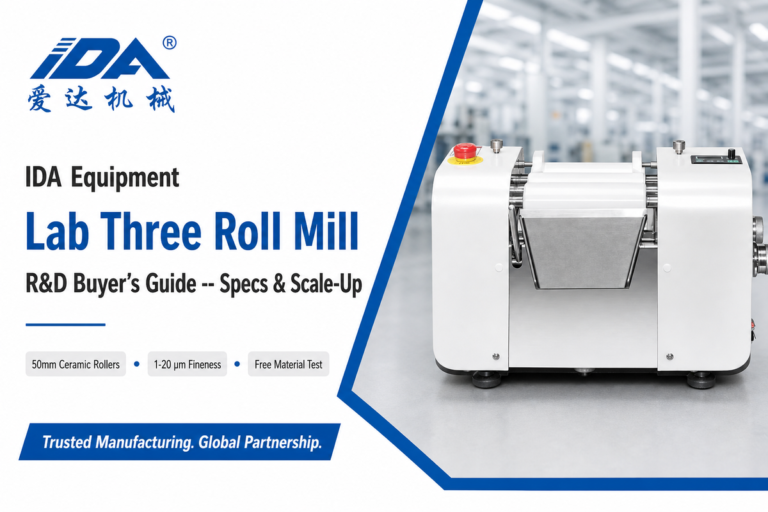
- Lab Three Roll Mill Buyer’s Guide — bench-scale considerations for R&D and universities
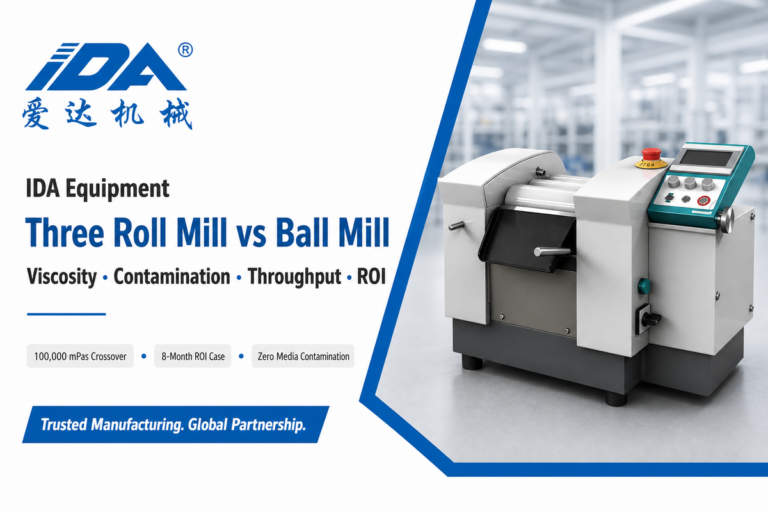
- Three Roll Mill vs Bead Mill: Which Is Best — for comparing equipment types, not just roller materials